
When a vessel suffers hull damage below the waterline, the immediate concern is often the prospect of costly and time-consuming dry-docking. However, modern maritime technology offers a powerful alternative. This guide explains the process of class-approved underwater welding, a critical service that ensures swift, permanent ship repairs, allowing your vessel to maintain its schedule and operational readiness without leaving the water.
What is Underwater Welding Repair? The Solution to Avoid Dry-Docking
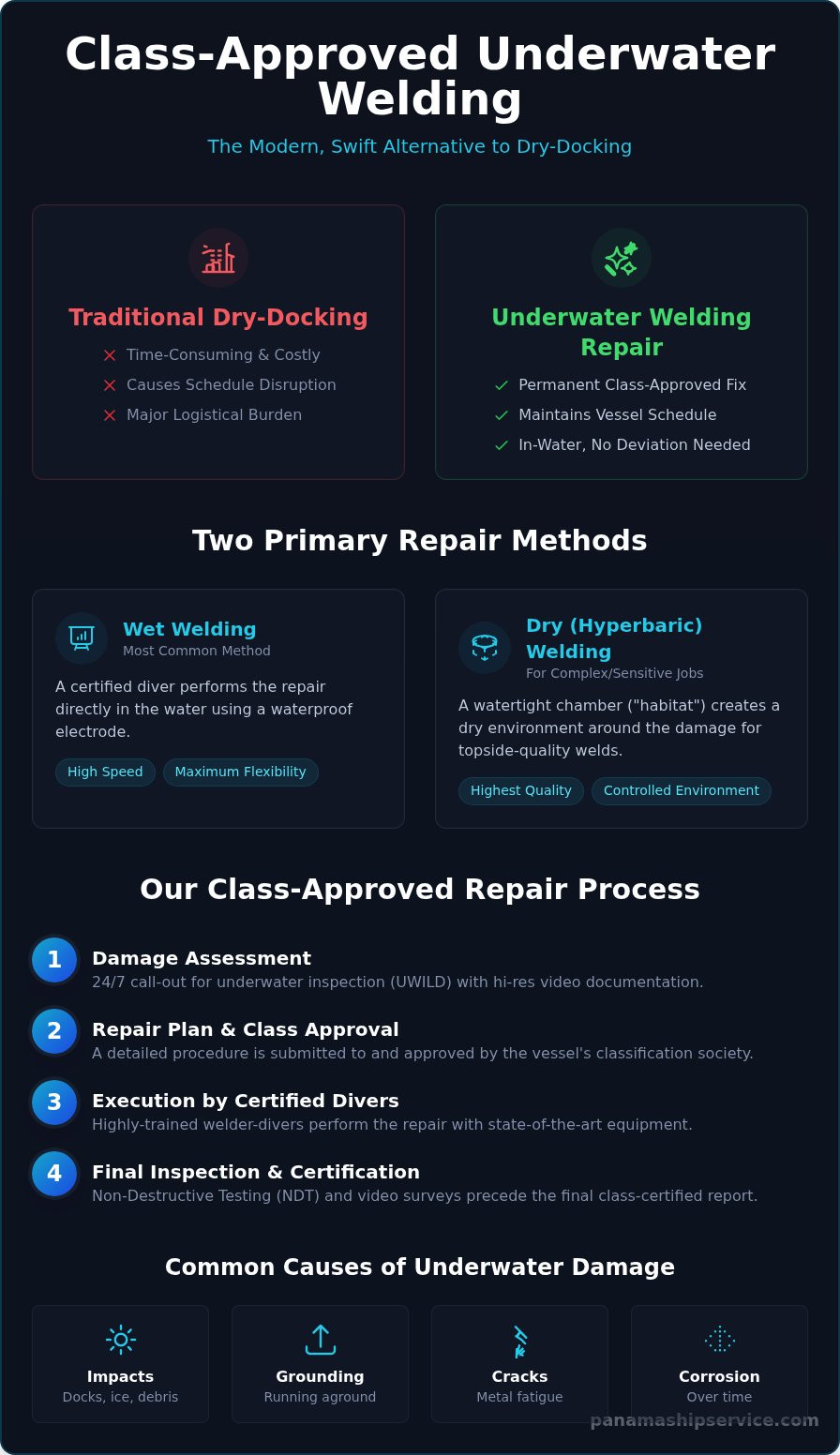
Underwater welding is a specialized technique used to repair damage to a ship’s hull, propellers, rudders, and other submerged structures. It is a critical service designed to fix issues like cracks, fractures, holes, or other forms of structural damage that compromise a vessel’s integrity. The primary advantage is its ability to circumvent the immense logistical and financial burden of an unscheduled dry-dock. These in-water repairs are not temporary fixes; they are performed to the stringent standards set by major classification societies, ensuring the vessel remains safe, compliant, and seaworthy.
Common Causes of Underwater Hull Damage
A vessel’s hull is constantly exposed to harsh conditions, and damage can occur from various sources. The most frequent causes include impacts with docks during mooring, collisions with floating or submerged objects like ice or debris, and grounding incidents. Over time, factors such as metal fatigue and corrosion can also lead to the development of cracks, particularly in high-stress areas. Furthermore, critical appendages like rudders, skegs, and stabilizers are vulnerable to damage that can severely impact maneuverability and safety.
Wet Welding vs. Dry Welding (Hyperbaric): The Two Main Methods
Two primary methods are employed for underwater repairs, each suited for different scenarios. The most common is wet welding, where a certified diver-welder performs the repair directly in the water using a waterproof electrode. This method is valued for its speed and flexibility, making it ideal for a wide range of repairs. For more complex or sensitive jobs, dry welding, also known as hyperbaric welding, is used. This process involves securing a watertight chamber or “habitat” around the damaged area and pumping it dry. This creates a controlled, dry environment that allows for higher-quality welds comparable to those done topside. The choice between wet and dry welding ultimately depends on the extent of the damage, its location on the hull, and the specific requirements of the vessel’s classification society.
This principle of creating a watertight barrier against external pressure is also fundamental in civil engineering. To see how a similar concept is applied to protect building foundations from groundwater, you can explore Cuvelage.
The Underwater Repair Process: From Inspection to Certification
Our structured repair process is designed to guarantee safety, quality, and full compliance with class requirements. From the initial call to the final certification, we provide clear, constant communication, ensuring all stakeholders are informed and confident in the procedure.
Step 1: Emergency Call-Out and Damage Assessment
Maritime incidents don’t adhere to business hours, which is why our team is available 24/7 for immediate response to any emergency. Upon engagement, our certified divers are dispatched to conduct a thorough underwater inspection in lieu of dry-docking (UWILD). Using high-resolution video and still photography, we meticulously document the full extent of the damage, providing a clear and accurate assessment for the ship owner and classification society.
Step 2: Repair Plan and Classification Society Approval
Based on the inspection findings, our technical team develops a comprehensive, detailed repair procedure. This plan outlines the chosen welding method, materials, and safety protocols necessary to restore the vessel’s integrity. Critically, this plan is formally submitted to your vessel’s classification society for review and approval. This step is essential to ensure the final repair is recognized as permanent and fully certified, maintaining the vessel’s class status.
Step 3: Execution by Certified Welder-Divers
With an approved plan in place, our highly trained and certified welder-divers execute the repair. Adhering strictly to the procedure, they utilize state-of-the-art underwater welding equipment to ensure precision, strength, and durability. The entire in-water operation is overseen by an experienced supervisor who manages safety and quality control throughout the process, ensuring every aspect of the job meets the highest industry standards.
Step 4: Final Inspection, NDT, and Reporting
Upon completion of the welding, the work is not yet finished. Non-destructive testing (NDT) techniques, such as magnetic particle inspection (MPI), are performed to verify the integrity and quality of the new weld. A final video survey is conducted to visually confirm the completed repair. At the conclusion of the project, you receive a comprehensive report containing all documentation, inspection footage, NDT results, and the final certification from the classification society for your vessel’s records. If your vessel has sustained hull damage and requires immediate attention, do not hesitate to contact our 24/7 emergency team now.
Why Panama Ship Service is Your Trusted Partner at the Canal
At Panama Ship Service, we combine world-class technical expertise with unparalleled local knowledge of the Panama Canal’s unique operational environment. Our singular focus is to get your vessel repaired correctly and back on its transit schedule with absolute minimal delay.
Strategic Location for Rapid Response
Our base of operations at the Panama Canal provides a significant strategic advantage. We eliminate costly deviation time and expenses by meeting your vessel where it is. Our teams are equipped to be rapidly dispatched to either the Atlantic or Pacific side, seamlessly coordinating repairs with your vessel’s transit schedule to prevent costly delays and port calls.
Class-Approved Procedures You Can Trust
We maintain strong working relationships with all major IACS classification societies, including DNV, ABS, Lloyd’s Register, and Bureau Veritas. Our repair procedures are meticulously designed and executed to meet the highest industry standards, ensuring that every repair we perform is fully compliant and helps your vessel maintain its class certification without issue.
A Single Point of Contact for All Your Needs
Panama Ship Service is a true one-stop-shop for all maritime needs at the Canal. We offer the ability to combine essential underwater repairs with other services like hull cleaning, propeller polishing, marine surveys, ship supplies, or MARPOL-compliant disposal. This integrated approach simplifies logistics, reduces administrative burden, and provides a single, reliable point of contact for the vessel operator.
This dedication to certified processes and high-quality design extends beyond the maritime world. While the applications are different, the principles of precision and quality management are universal. For a look at how these standards translate to architectural environments, you can visit Purespace Interior Design Studio, an ISO-certified leader in its field.
Frequently Asked Questions
- Is underwater welding a permanent repair?
Yes. When performed by certified welder-divers according to a class-approved procedure, underwater welding is recognized as a permanent repair by all major classification societies, equivalent to a repair done in a dry dock.
- What types of damage can be repaired with underwater welding?
A wide variety of damages can be addressed, including cracks in the hull plating, punctures, damaged bilge keels, rudder or propeller issues, and the replacement of anodes or other hull appendages.
- How long does a typical underwater welding repair take?
The duration depends on the size and complexity of the damage. However, most repairs are completed within 12 to 48 hours, which is significantly faster than the days or weeks required for dry-docking.
- Is underwater welding safe for the vessel and the environment?
Absolutely. We follow strict safety protocols to protect the vessel, our divers, and the marine environment. All procedures are designed to prevent any pollution and ensure the structural integrity of the ship is maintained throughout the repair.
- Which classification societies do you work with for repair approval?
We work with all members of the International Association of Classification Societies (IACS), including but not limited to DNV, American Bureau of Shipping (ABS), Lloyd’s Register (LR), Bureau Veritas (BV), and ClassNK.
Don’t let underwater damage disrupt your schedule and budget. With a team of certified experts ready to respond 24/7 at the Panama Canal, we provide the permanent, class-approved repairs you need to keep your vessel moving safely and efficiently. We are experts so you don’t have to be. Request a Quote for Underwater Repair today and let our team provide the rapid solution you need.