
In the competitive shipping industry, rising fuel costs, failure to meet charter party speed claims, and mounting regulatory pressure from EEXI and CII directly impact your operational expenditure and profitability. Every percentage point of efficiency is critical. While these challenges can seem relentless, one of the most effective solutions for vessel performance lies just below the waterline. Understanding the significant benefits of propeller polishing is no longer a matter of marginal gains; it is a strategic necessity for any cost-conscious operator seeking a competitive edge.
This article provides an expert, straightforward guide to how this essential maintenance task delivers measurable results. We will detail how a professionally polished propeller directly reduces fuel consumption, increases vessel speed, and improves your environmental compliance rating. Discover how this cost-effective service protects your critical propulsion assets from expensive damage, prevents unscheduled downtime, and ultimately enhances the performance and profitability of your fleet. We provide the solutions so you can focus on your destination.
Key Takeaways
- Lower your vessel’s fuel consumption and operational costs by ensuring a smooth propeller surface, which directly reduces engine strain and improves efficiency.
- The financial and operational benefits of propeller polishing are a direct countermeasure to marine biofouling, tackling the root cause of decreased performance.
- Restore optimal vessel speed and propulsive power by eliminating marine growth, which is critical for achieving maximum thrust and maintaining schedules.
- View regular polishing as proactive asset protection that mitigates corrosion and helps identify propeller damage early, preventing costly dry-dock repairs.
The Foundation: Understanding Propeller Polishing and Biofouling
In the high-stakes world of maritime operations, vessel efficiency is paramount. Underwater propeller polishing is not merely a cleaning task; it is a critical maintenance procedure designed to restore propeller surfaces to optimal condition, directly impacting fuel consumption and performance. The core problem this service solves is marine biofouling-the inevitable accumulation of marine life on submerged surfaces.
As surface roughness increases, so does hydrodynamic drag, forcing the main engine to work harder and consume more fuel to maintain the same speed. The industry measures this roughness using the Rupert Scale, a standardized comparison tool. Achieving a smooth, clean propeller surface is one of the most cost-effective ways to enhance vessel efficiency, and understanding this foundation is key to unlocking the full benefits of propeller polishing.
What is Biofouling and Why Does it Matter?
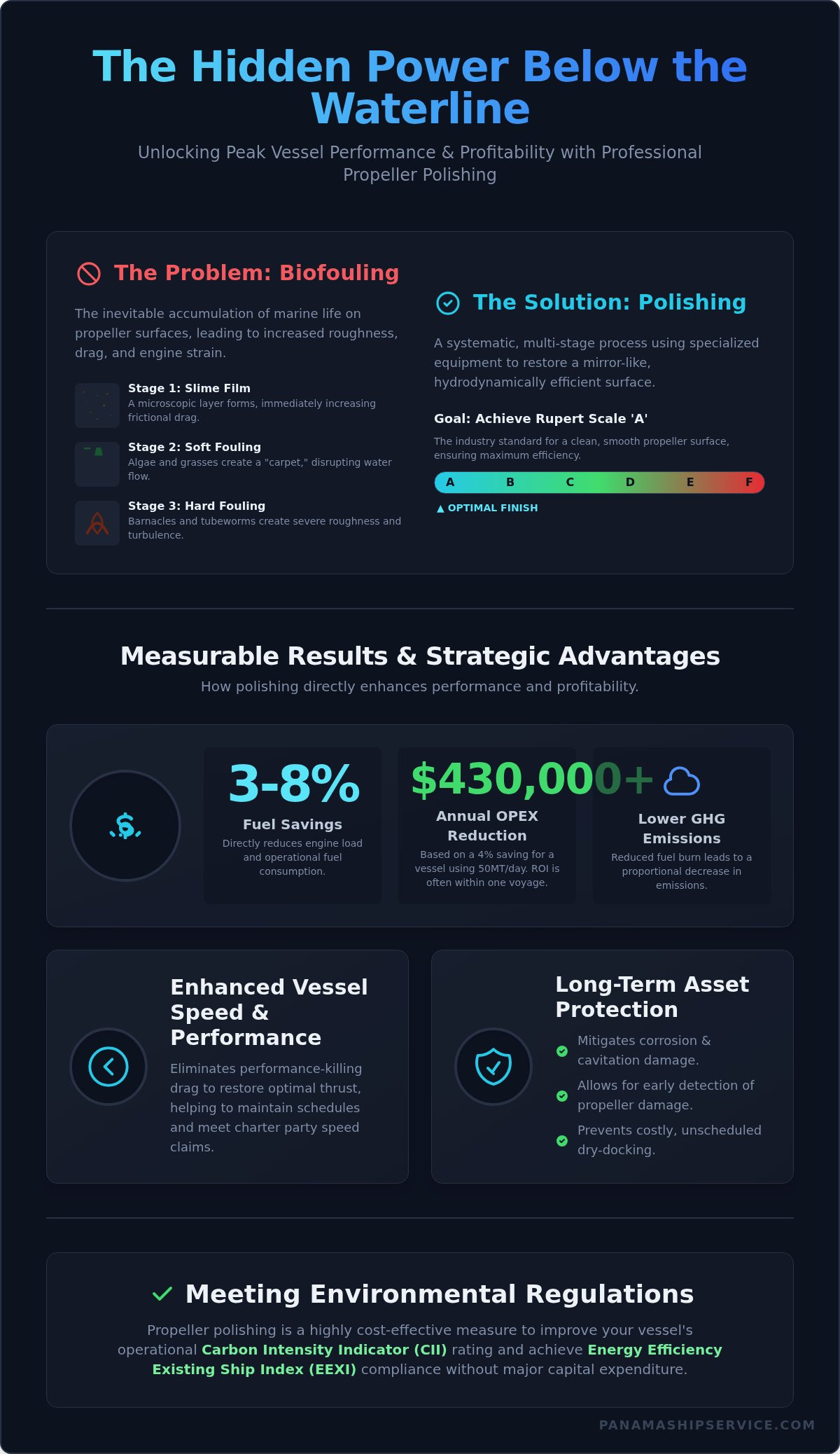
Biofouling is a multi-stage process that degrades propeller performance. It begins with a microscopic slime film, the first stage in what is biofouling, which alone is enough to increase frictional drag. This initial layer quickly gives way to more complex organisms:
- Soft Fouling: Algae and other marine grasses create a “carpet” effect, disrupting the smooth flow of water over the blades.
- Hard Fouling: Barnacles, tubeworms, and mussels attach, creating significant surface roughness. This hard growth generates turbulence, severely disrupting thrust and placing immense strain on the engine.
Even a thin layer of biofouling can lead to a significant increase in fuel costs and a reduction in speed, making its removal a top priority for any cost-conscious operator.
The Polishing Process: A Technical Overview
Effective propeller polishing is a technical operation performed by certified commercial diving teams who are experts in underwater maintenance. Our qualified divers utilize specialized hydraulic polishing equipment designed for precision and efficiency. The process is systematic and multi-staged to ensure a superior finish without damaging the propeller itself. It involves using progressively finer abrasive pads to remove all traces of fouling and restore the surface. The goal is to achieve a mirror-like finish, corresponding to a Rupert Scale ‘A’ or ‘B’ rating. Reaching this industry standard is essential to realizing the maximum benefits of propeller polishing and ensuring your vessel operates at peak performance.
Benefit 1: Significant Fuel Savings and Emission Reduction
For any ship owner or charterer, the most critical of all the benefits of propeller polishing is the direct and substantial impact on fuel consumption. A propeller’s efficiency is entirely dependent on its surface condition. Over time, the accumulation of marine biofouling and surface roughness from cavitation creates significant hydrodynamic drag. This forces the main engine to work harder-and consume more fuel-to maintain the desired speed and RPM.
By restoring the propeller blades to a smooth, hydrodynamically efficient state (Rupert Scale A or B), the required engine torque is immediately reduced. Comprehensive industry analysis of propeller efficiency and operational data confirm that regular, professional polishing can lower fuel consumption by 3-8%. This reduction not only cuts operational costs but also leads to a proportional decrease in greenhouse gas (GHG) emissions.
The Financial Impact on Your OPEX
Translating percentage points into dollars reveals the true value of this essential maintenance. Consider a vessel consuming 50 metric tons (MT) of fuel per day at a cost of $600/MT. A conservative 4% fuel saving results in a daily cost reduction of $1,200. Annually, this amounts to over $430,000 in direct savings on bunker costs alone. This service provides an exceptionally rapid return on investment (ROI), often paying for itself within a single voyage, while also minimizing your exposure to volatile Bunker Adjustment Factor (BAF) surcharges.
Meeting Environmental Regulations: EEXI and CII Compliance
In today’s stringent regulatory environment, fuel efficiency is synonymous with compliance. Reduced fuel consumption directly improves a vessel’s operational Carbon Intensity Indicator (CII) rating, a critical metric for charterers and regulators. Furthermore, propeller polishing is recognized as one of the most cost-effective technical measures for achieving Energy Efficiency Existing Ship Index (EEXI) compliance without requiring major capital expenditure or vessel downtime for retrofitting. It is a proactive, powerful tool for ensuring sustainable shipping operations. Keep your vessel compliant. Discuss your needs with our experts.
Benefit 2: Enhanced Vessel Speed and Performance
A vessel’s performance is directly tied to the condition of its propeller. A clean, smooth propeller operates at optimal hydrodynamic efficiency, allowing it to generate maximum thrust with minimum effort. When marine fouling-such as barnacles, algae, and tubeworms-accumulates on the blades, it disrupts the smooth flow of water, creating drag and reducing propulsive power. Removing this biofouling through professional polishing restores the propeller’s design integrity, immediately translating to improved vessel speed and responsiveness.
This performance boost is not just a matter of operational preference; it is a commercial necessity. Many charter party agreements contain stringent clauses regarding a vessel’s speed and performance capabilities. Failure to meet these contractual obligations can lead to significant financial penalties and disputes. Regular propeller polishing ensures your vessel can achieve and maintain its required service speed, safeguarding your commercial interests and reputation.
Maintaining Schedule Integrity
In the time-sensitive shipping industry, delays are costly. Performance loss due to a fouled propeller can cause schedule disruptions, jeopardizing deadlines and leading to cascading logistical problems. One of the most critical benefits of propeller polishing is the restoration of reliable vessel speed. This allows operators to maintain tight schedules, enhance commercial reliability, and improve profitability-all while maintaining speed without placing an additional load on the main engine.
Reduced Load on Propulsion Machinery
A fouled propeller forces the entire propulsion system to work harder. The increased resistance overloads the main engine, which must burn more fuel to maintain the required RPM. This excessive strain is a well-documented issue; in fact, an International Maritime Organization study highlights how propeller roughness directly correlates to increased engine load. This stress is transferred throughout the system, negatively impacting the operational health of critical components such as:
- Main engine components
- Shaft line bearings and seals
- The gearbox and transmission system
By reducing this strain, propeller polishing acts as a crucial preventative maintenance measure, contributing to the longevity and reliability of your vessel’s machinery and reducing vibrations throughout the hull.
Benefit 3: Long-Term Asset Protection and Reduced Dry-Docking Costs
Viewing propeller polishing as a simple cleaning service is a critical operational mistake. It is a strategic, proactive maintenance procedure that safeguards one of your vessel’s most vital and expensive components. The minor, predictable cost of regular in-water polishing is insignificant when compared to the six-figure expense and operational downtime associated with major propeller repairs or a full replacement. Protecting this asset is fundamental to long-term cost control.
Regular polishing is your first line of defense against the degradation that directly impacts your bottom line. By maintaining a hydrodynamically smooth surface, you not only improve efficiency but also extend the propeller’s service life, maximizing the return on your initial investment.
Preventing Cavitation and Corrosion Damage
A rough propeller surface is a primary cause of cavitation-the formation and violent collapse of vapor bubbles against the blades. This process acts like a microscopic hammer, creating irreversible cavitation pitting that permanently degrades performance. Polishing to a Rupert Scale A or B standard smooths the micro-fractures and surface imperfections where these destructive bubbles form. This same process removes corrosive elements and eliminates the footholds where galvanic corrosion can begin, protecting the integrity of the blade material itself.
The Value of In-Water Surveys During Polishing
One of the most overlooked benefits of propeller polishing is the expert inspection that occurs simultaneously. Our qualified divers are trained to provide a valuable condition report without the time and expense of a dry-dock. This in-water survey provides critical intelligence on potential issues, including:
- Hairline cracks or stress fractures on blades
- Bent blade tips or impact damage
- Damage to the rope guard or propeller seals
- Signs of excessive or uneven wear
Identifying these problems early allows for scheduled, cost-effective repairs, preventing catastrophic failures at sea that lead to emergency dry-docking and significant revenue loss. This transforms a routine maintenance task into a powerful risk management tool. Contact our expert team to learn how our services protect your assets and your schedule.
Why Choose Panama Ship Service for Propeller Polishing at the Canal
When your vessel is positioned at the crossroads of global trade, every moment counts. Maximizing the benefits of propeller polishing requires not just an expert service, but strategic timing. At the Panama Canal, you have a unique opportunity to perform essential maintenance without losing a single second of sailing time. Panama Ship Service is your trusted partner, turning your vessel’s waiting period into a productive, performance-boosting operation.
We leverage our strategic location to deliver unmatched efficiency:
- Zero Downtime Service: Our certified diving teams perform comprehensive propeller polishing while your vessel awaits or undergoes its Canal transit.
- Highest Quality Standards: We operate in strict adherence to international safety and quality protocols, ensuring every job is completed to exacting specifications.
- Integrated Solutions: As your single, trusted partner at the Canal, we streamline all your underwater service needs, from inspections to repairs and polishing.
Expertise in a High-Stakes Environment
With over 20 years of dedicated experience in the Panama Canal Zone, our team possesses an unparalleled understanding of this demanding environment. We navigate local regulations and Panama Canal Authority (ACP) requirements with precision, ensuring every operation is fully compliant and seamless. For your peace of mind and records, we provide detailed photographic and video reports documenting the entire polishing process from start to finish.
Seamless, Efficient, and Cost-Effective Service
Our one-stop-shop approach saves you valuable time and eliminates administrative burdens. Utilizing state-of-the-art hydraulic polishing equipment, we deliver a fast, effective service that restores your propeller’s efficiency. Our competitive pricing structure ensures you receive maximum value, amplifying the financial benefits of propeller polishing and improving your vessel’s bottom line.
Don’t let a rough, inefficient propeller drain your profits and increase fuel consumption. Choose the proven experts at the Panama Canal. Get a fast quote today.
Capitalize on Efficiency: Your Partner for Propeller Polishing
In the high-stakes world of maritime operations, efficiency is not just an advantage-it is a necessity. As we’ve detailed, a smooth, professionally polished propeller is a direct investment in your vessel’s operational excellence. This crucial maintenance combats the costly effects of biofouling, leading to significant fuel savings, reduced emissions, and enhanced speed. Ultimately, the tangible benefits of propeller polishing extend beyond immediate performance gains, safeguarding your asset and minimizing the need for expensive dry-docking.
When transiting the Panama Canal, you cannot afford delays or subpar service. Panama Ship Service is your trusted partner, offering over 20 years of specialized experience in this critical waterway. Our certified and insured commercial diving teams provide Class-approved underwater services, ensuring every job is completed to the highest standards of safety and quality. We are the experts, so you don’t have to be.
Ready to unlock your vessel’s full potential? Maximize your vessel’s efficiency. Request a quote for propeller polishing in Panama. Put your vessel in our expert hands and sail forward with confidence.
Frequently Asked Questions
How often should a commercial vessel’s propeller be polished?
The optimal frequency for propeller polishing is every 6 to 12 months, contingent on the vessel’s operational routes, trading patterns, and idle periods. To realize the full benefits of propeller polishing, vessels operating in areas with high marine biofouling may require more frequent service. Maintaining a proactive polishing schedule is a cost-effective strategy to ensure sustained fuel efficiency, prevent performance degradation, and protect your asset from accelerated wear and cavitation damage.
What is the difference between propeller polishing and full underwater hull cleaning?
Propeller polishing is a highly specialized task focused solely on restoring the propeller’s surfaces to a hydrodynamically smooth finish, typically a Rupert Scale Grade A. In contrast, full underwater hull cleaning is a broader service that removes all marine biofouling from the entire submerged surface of the vessel. While both reduce drag, polishing provides a concentrated improvement in propulsive efficiency, making it one of the most impactful maintenance actions for reducing fuel consumption.
Can propeller polishing damage the propeller’s surface if done incorrectly?
Yes, improper polishing can cause irreversible damage. Using overly abrasive equipment or incorrect techniques can create micro-roughness, alter the blade’s precise geometry, and accelerate corrosion, ultimately reducing efficiency and service life. This is why the task must be performed by qualified and experienced divers. Our certified teams use specialized, non-destructive tools and adhere to strict procedures to guarantee a perfect finish without compromising the propeller’s structural integrity.
How long does a typical underwater propeller polishing service take at the Panama Canal?
Efficiency is critical during a Panama Canal transit. A standard underwater propeller polishing service for most commercial vessels can be completed by our expert dive teams in approximately 3 to 5 hours. This service is strategically performed while the vessel is at anchor awaiting its transit slot, ensuring there are no operational delays. Our rapid and professional service allows you to improve vessel performance without disrupting your tight schedule.
What is the Rupert Scale and why is it important for propeller maintenance?
The Rupert Scale is the globally recognized industry standard for measuring and comparing propeller surface roughness. The scale ranges from Grade A, representing a new or perfectly smooth surface, to Grade F, which indicates a heavily fouled and corroded surface. This objective measurement is critical for quality control. Our objective is always to restore the propeller to a Grade A or B finish, as this directly correlates with maximum hydrodynamic efficiency and optimal fuel savings.
How does regular propeller polishing contribute to a better Carbon Intensity Indicator (CII) rating?
A vessel’s CII rating is a direct measure of its carbon efficiency. Marine growth on a propeller increases drag, which forces the main engine to consume more fuel and emit more CO2 to maintain speed. By regularly polishing the propeller to a smooth finish, we significantly improve propulsive efficiency. This immediate reduction in fuel consumption and carbon emissions is a direct, measurable action that helps improve your vessel’s annual CII rating and supports compliance with environmental regulations.
Is it possible to perform propeller polishing in all weather conditions?
Safety and quality are our primary directives, so propeller polishing cannot be performed in all conditions. Factors such as strong underwater currents, poor visibility, or significant sea swell can present unacceptable risks to our divers and compromise the quality of the polish. Our operations team continuously monitors conditions at the Panama Canal anchorages and will only proceed when it is safe to do so, ensuring both the safety of our personnel and a guaranteed high-quality result.