
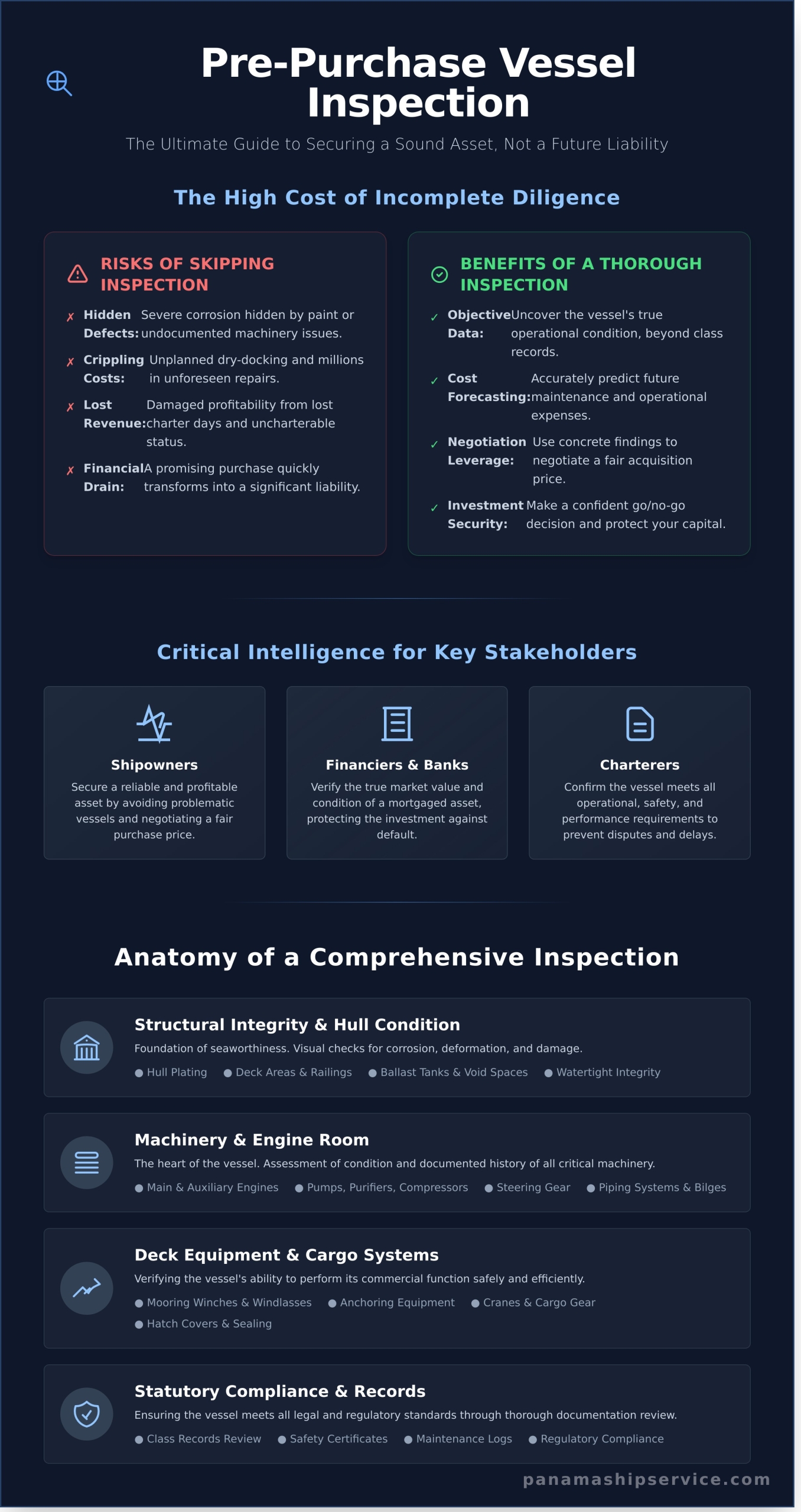
Acquiring a new vessel is a significant capital investment, but it carries immense risk. Hidden defects, undocumented machinery issues, and inaccurate class records can transform a promising purchase into a financial drain, leading to crippling, unexpected repair costs. A meticulously executed pre-purchase vessel inspection is your most critical safeguard, providing the objective data required to validate a seller’s claims, identify potential liabilities, and gain crucial leverage for price negotiations.
This ultimate checklist is engineered for ship owners and charterers who demand certainty. We provide a systematic framework to move beyond speculation and secure a clear, objective assessment of a vessel’s true operational condition. Inside, you will find a comprehensive guide covering everything from hull integrity and main engine performance to statutory compliance and a thorough review of class records.
Use this expert guide to accurately forecast future costs, mitigate your financial exposure, and make your final go/no-go investment decision with absolute confidence. Secure a sound asset, not a future liability.
Key Takeaways
- A thorough inspection goes beyond class records to uncover a vessel’s true condition, protecting you from significant post-purchase liabilities.
- Use our detailed checklist to ensure your pre-purchase vessel inspection covers all critical areas from hull integrity to machinery performance.
- Learn to translate the final inspection report from a list of defects into a powerful tool for forecasting costs and negotiating acquisition terms.
- The quality of your surveyor directly impacts the quality of your investment; identify the key qualifications that separate a standard survey from an expert assessment.
Why a Pre-Purchase Inspection is Your Most Critical Investment
In the high-stakes world of vessel acquisition, relying solely on class records is a significant business risk. While these documents confirm regulatory compliance, they do not reveal the vessel’s complete operational story or its true condition. A comprehensive pre-purchase vessel inspection is the only way to look beyond the paperwork and uncover the physical and operational realities of your potential asset. This diligence is not an expense; it is a critical investment in financial security and operational success.
The objective is to identify hidden defects, establish a baseline for future maintenance, and provide concrete data for price negotiation. An expert assessment mitigates risk for owners, financiers, and charterers alike, ensuring the vessel is a profitable asset, not a costly liability.
The High Cost of Skipping a Thorough Inspection
The difference between a vessel being ‘in class’ and being in ‘good condition’ can translate to millions of dollars in unforeseen costs. We have seen buyers discover severe hull corrosion cleverly hidden by fresh paint or face main engine failures just weeks after purchase-issues that a proper inspection would have flagged. These discoveries lead directly to unplanned dry-docking, lost charter days, and damaged profitability. Furthermore, hidden structural or machinery defects can significantly increase insurance premiums or even render a vessel uncharterable for premium routes, crippling its earning potential from day one.
Who Benefits from a Pre-Purchase Survey?
A detailed inspection report from a qualified Marine surveyor delivers critical intelligence that protects multiple stakeholders. The value of a thorough pre-purchase vessel inspection cannot be overstated for:
- Shipowners: By identifying potential defects before purchase, owners can negotiate a fair price or avoid acquiring a problematic asset altogether. It secures a reliable vessel ready for profitable service.
- Financiers & Banks: For financial institutions, the inspection verifies the true market value and condition of a mortgaged asset, protecting their investment against default and ensuring the collateral is sound.
- Charterers: A pre-charter inspection confirms that the vessel meets all operational, safety, and performance requirements specified in the charter party, preventing costly disputes and operational delays.
The Anatomy of a Comprehensive Inspection: A Detailed Checklist
A successful pre-purchase vessel inspection provides a complete 360-degree view of the asset’s physical and operational state. It is more than a simple walkthrough; it is a systematic evaluation where each area reveals crucial information about maintenance history, potential liabilities, and future operational costs. Use this detailed checklist as a guide to understand what our qualified surveyors are looking for, ensuring no critical component is overlooked.
Structural Integrity and Hull Condition
The foundation of any vessel is its hull. Our surveyors conduct a meticulous visual inspection of hull plating for any signs of corrosion, deformation, dents, or damage that could compromise seaworthiness. This assessment extends to:
- Deck Areas: Including railings, stairways, and access points for structural soundness and safety compliance.
- Ballast Tanks and Void Spaces: Checking for coating breakdown, corrosion, and structural anomalies.
- Watertight Integrity: Testing hatches, watertight doors, and manholes to confirm their seals and closing mechanisms are fully functional.
Machinery and Engine Room Assessment
The engine room is the heart of the vessel. Our inspection focuses on both the condition and the documented history of all critical machinery. We scrutinize the main and auxiliary engines through visual checks and operational tests where possible, cross-referencing findings with running hours and maintenance logs. The evaluation includes a detailed review of pumps, purifiers, compressors, steering gear, and the condition of bilge and engine room piping systems for any leaks or substandard repairs.
While marine diesel engines operate on a different scale, the principles of expert maintenance and diagnostics are universal. For asset managers who also oversee land-based diesel fleets, specialized repair centers like Diego’s Shop serve as a valuable example of the type of warrantied service required to protect critical machinery investments.
Deck Equipment and Cargo Systems
A vessel’s ability to perform its commercial function depends on its deck and cargo equipment. Our inspection includes operational tests of mooring winches, windlasses, and anchoring equipment to verify performance. We assess the condition of cranes and other cargo handling gear, along with the integrity of cargo holds, hatch covers, and their sealing arrangements. For specialized vessels like tankers, this extends to a thorough inspection of cargo pumps, piping, and heating coils.
Navigation, Safety, and Accommodation
Operational readiness and crew welfare are paramount. This phase of the inspection verifies that all bridge equipment-including radar, ECDIS, autopilot, and communication systems-is fully functional. We conduct a comprehensive review of all life-saving appliances (LSA) and fire-fighting equipment (FFE) to ensure they meet strict regulatory standards, such as those detailed in the U.S. Coast Guard Inspection Guidelines. The inspection also covers the condition of crew accommodation, galley, and sanitary facilities, concluding with a verification of all statutory certificates and safety documents to confirm the vessel is fully compliant.
The Inspection Process: From Scheduling to Final Report
A successful pre-purchase vessel inspection is not a single event but a structured, multi-phase process. Understanding this workflow from start to finish is critical for managing expectations, coordinating logistics efficiently, and ensuring no detail is overlooked. Proper planning prevents costly delays and guarantees a thorough evaluation of your potential asset. This systematic approach transforms a complex task into a manageable and transparent procedure, providing the clarity needed to make a sound investment.
Phase 1: Documentation Review and Planning
The groundwork for an effective inspection is laid before our surveyors even see the vessel. This critical planning phase involves a meticulous review of all essential documents, including the General Arrangement (GA) plan, classification society records, and any previous survey reports. We analyze the vessel’s operational and maintenance history to identify potential areas of concern. Finally, we coordinate directly with sellers, vessel command, and port authorities to secure timely access and develop a tailored inspection plan specific to the vessel’s type and intended service.
Phase 2: The On-Board Physical Inspection
This is where our expertise is put into action. The on-board physical inspection is a systematic process designed to provide a complete picture of the vessel’s condition. This hands-on assessment is the core of a comprehensive pre-purchase survey and typically includes:
- A thorough visual inspection of all accessible areas, from the hull and main deck to cargo holds and accommodation spaces.
- Operational testing of key machinery and equipment, including main engines, generators, and navigation systems, where permissible.
- Extensive photographic documentation to provide clear evidence of the vessel’s condition and any noted defects.
- Direct interviews with the Chief Engineer and Master to gain crucial insights into the vessel’s performance and operational history.
Phase 3: Reporting and Analysis
The final, and most crucial, phase is translating on-site findings into a clear, actionable intelligence report. Our experts consolidate all data, notes, and photographic evidence into a structured document that is easy to understand. Defects are categorized by severity-major, minor, or observational-to help you prioritize and assess risk accurately. The report concludes with a professional summary of the vessel’s overall condition, empowering you to make a confident, informed investment decision. Let our experts manage your next inspection in Panama.
Decoding the Inspection Report: Turning Data into Decisions
A comprehensive report from a pre-purchase vessel inspection is more than a list of defects; it is a strategic asset. The true value lies in translating its technical data into a clear financial and operational roadmap. This critical document empowers you to move beyond the vessel’s asking price and understand its true cost, enabling you to protect your investment and optimize future performance.
Key Sections of a Quality Report
A professional report is structured for efficiency, allowing you to access the information you need without delay. It provides a multi-layered view of the vessel’s condition, from a high-level overview to granular detail. A quality report will always include:
- Executive Summary: A concise overview of the vessel’s condition and critical findings for rapid, high-level decision-making.
- Detailed Findings: An itemized breakdown of all identified deficiencies, supported by photographic evidence and technical specifications.
- Recommendations: Clear, actionable suggestions for rectifying issues, often categorized by urgency (e.g., immediate, before next dry-dock).
- Documentation Review: An analysis of statutory certificates, class records, and maintenance history to identify compliance gaps or recurring problems.
Estimating CAPEX and Future Costs
The inspection findings are the foundation for your financial planning. Use the report to translate defects into a preliminary budget for Capital Expenditures (CAPEX) and ongoing operational costs. This process involves identifying items that require immediate repair before the vessel can operate versus those that can be scheduled for future maintenance. Factor in potential dry-docking costs, the price of spare parts, and the significant financial impact of off-hire time required for rectifications.
Using the Report for Negotiation
Armed with a detailed report, you gain significant negotiation leverage. The key is to present a professional, data-driven case to the seller. Focus on significant, objective findings backed by photographic evidence-not minor cosmetic issues. Quantify the estimated cost of necessary repairs to justify a price adjustment or request that the seller rectifies critical issues prior to sale. Understanding which deficiencies are operational deal-breakers versus negotiable points is crucial for a successful outcome.
A well-executed pre-purchase vessel inspection culminates in a report that gives you control. It transforms uncertainty into a clear action plan, providing the data needed for sharp negotiations and smart financial forecasting. For expert analysis and reporting you can trust, contact Panama Ship Service. We deliver the clarity you need to make the right decision.
Choosing Your Inspection Partner at the Panama Canal
The success of your asset acquisition hinges on the quality of your pre-purchase vessel inspection. Not all surveyors offer the same level of diligence, expertise, or integrity. A superficial report can hide critical defects, leading to costly post-purchase repairs and operational downtime. The right partner provides an unbiased, technically detailed, and timely assessment that empowers you to negotiate effectively or walk away from a bad investment. Choosing that partner is as crucial as the inspection itself.
Essential Qualities of a Top-Tier Surveyor
Your surveyor is your technical representative, and their qualifications must be beyond reproach. Look for a partner who demonstrates proven expertise and absolute impartiality. Key indicators of a qualified professional include:
- Vessel-Specific Experience: Proven track record inspecting the exact type of vessel you are considering, whether it’s a tanker, bulk carrier, or container ship.
- True Independence: Complete separation from brokers, sellers, or any party with a vested interest in the transaction’s outcome. Their loyalty must be exclusively to you, the buyer.
- Strong Technical Background: Credentials as an ex-Chief Engineer, Naval Architect, or Technical Superintendent ensure a deep understanding of machinery, hull integrity, and operational systems.
- Regulatory Knowledge: In-depth familiarity with class requirements (IACS) and statutory regulations (SOLAS, MARPOL) is non-negotiable for a comprehensive assessment.
Why Conduct Inspections in Panama?
Strategic location is a major operational and financial advantage. Conducting a pre-purchase vessel inspection while a ship is scheduled to transit a major global chokepoint like the Panama Canal is the most efficient solution. This approach minimizes costly deviation from trading routes and eliminates unnecessary downtime. Panama offers a hub of qualified surveyors and technical support services, ensuring you can mobilize an expert team within the vessel’s transit window. Panama Ship Service is your trusted survey partner at the Canal.
Before commissioning any surveyor, demand clarity and verify their expertise. A professional organization will welcome detailed questions. Ask the following to ensure you are partnering with a reliable expert:
- What is your direct experience with this specific vessel class and age?
- How do you guarantee an unbiased and independent report?
- Can you provide a sanitized sample report for review?
- What is your availability to board during our vessel’s scheduled transit?
Selecting a qualified, independent surveyor in a strategic location like the Panama Canal is the final, critical step in protecting your investment and avoiding a bad buy.
Your Trusted Partner for a Confident Vessel Acquisition
Navigating the complexities of a vessel acquisition demands diligence and expert insight. As this guide has shown, the inspection is not a cost but a critical investment, and a detailed report is the key to turning data into a decisive action. A thorough pre-purchase vessel inspection is your most powerful tool for mitigating risk and verifying the true condition and value of your potential maritime asset.
When your transaction hinges on an inspection at the Panama Canal, you need a partner with unmatched local expertise and a reputation for integrity. For over 20 years, Panama Ship Service has been that trusted partner. Our team of qualified, independent marine surveyors delivers comprehensive reporting designed for clear, data-driven decisions, giving you the clarity needed to proceed with confidence.
Secure your investment before you commit. Request a quote for your pre-purchase vessel inspection in Panama and let our expertise protect your interests. Make your next acquisition your best one.
Frequently Asked Questions
How much does a pre-purchase vessel inspection typically cost?
The cost of a pre-purchase vessel inspection is determined by several factors, including the vessel’s type, size, age, and location. The specific scope of the inspection required also influences the final price. We provide a detailed, transparent quote outlining all costs before any work begins. Our goal is to offer a competitive, cost-conscious solution that provides the comprehensive data you need to make a sound investment decision, minimizing your financial risk and avoiding unexpected expenses post-purchase.
How long does a standard pre-purchase inspection take?
A typical inspection is completed within one to two days, depending on the vessel’s size, complexity, and accessibility. Our qualified surveyors work efficiently to minimize any potential disruption to the vessel’s schedule. We understand that timing is critical in asset acquisition. Our process is designed for a rapid response and timely delivery of the final report, ensuring you have the critical information needed to proceed with your transaction without unnecessary delays or holding costs.
Can the buyer or their representative attend the inspection?
Yes, we strongly encourage the buyer or their designated technical representative to be present during the inspection. Attending provides an invaluable opportunity to observe the vessel’s condition firsthand, ask direct questions to our expert surveyor, and gain immediate clarification on any findings. This direct involvement ensures complete transparency and helps you develop a deeper understanding of the vessel’s operational state, maintenance history, and overall value beyond the written report.
What is the difference between a class survey and a pre-purchase inspection?
A class survey verifies that a vessel complies with the rules of its classification society for insurance and regulatory purposes. In contrast, a comprehensive pre-purchase vessel inspection is conducted on behalf of a potential buyer. Its purpose is to perform a detailed assessment of the vessel’s condition, identify potential defects and liabilities, and evaluate its operational readiness and maintenance standards. This protects your investment by revealing the vessel’s true condition before purchase.
Does the inspection include an underwater hull survey (UWILD)?
A standard pre-purchase inspection focuses on the accessible areas of the vessel. An Underwater Inspection in Lieu of Dry-docking (UWILD) is a specialized service that can be seamlessly integrated into the inspection scope at your request. We highly recommend a UWILD for a complete assessment, as it provides critical insight into the condition of the hull, propellers, and rudders below the waterline. This ensures no hidden structural or mechanical issues are overlooked.
What key documents should I provide to the surveyor before the inspection?
To ensure an efficient and thorough inspection, please provide the vessel’s General Arrangement plan, capacity plan, recent class status reports, and a list of any known deficiencies. Access to recent survey reports, maintenance records for main and auxiliary machinery, and trading certificates is also essential. Supplying these documents in advance allows our surveyor to prepare effectively, saving valuable time on-site and focusing on the most critical aspects of the vessel’s condition.