
Transiting the Panama Canal is a high-stakes operation where timing is everything. The risk of crippling fines from Port State Control or costly vessel delays due to a MARPOL violation is a constant pressure for ship operators. This is precisely why securing efficient and reliable certified sludge disposal services isn’t just a routine task-it’s a critical component of a successful transit. Yet, finding a truly dependable vendor and navigating the specifics of local regulations in one of the world’s busiest maritime crossroads can be a difficult and frustrating process, leaving many uncertain about compliance.
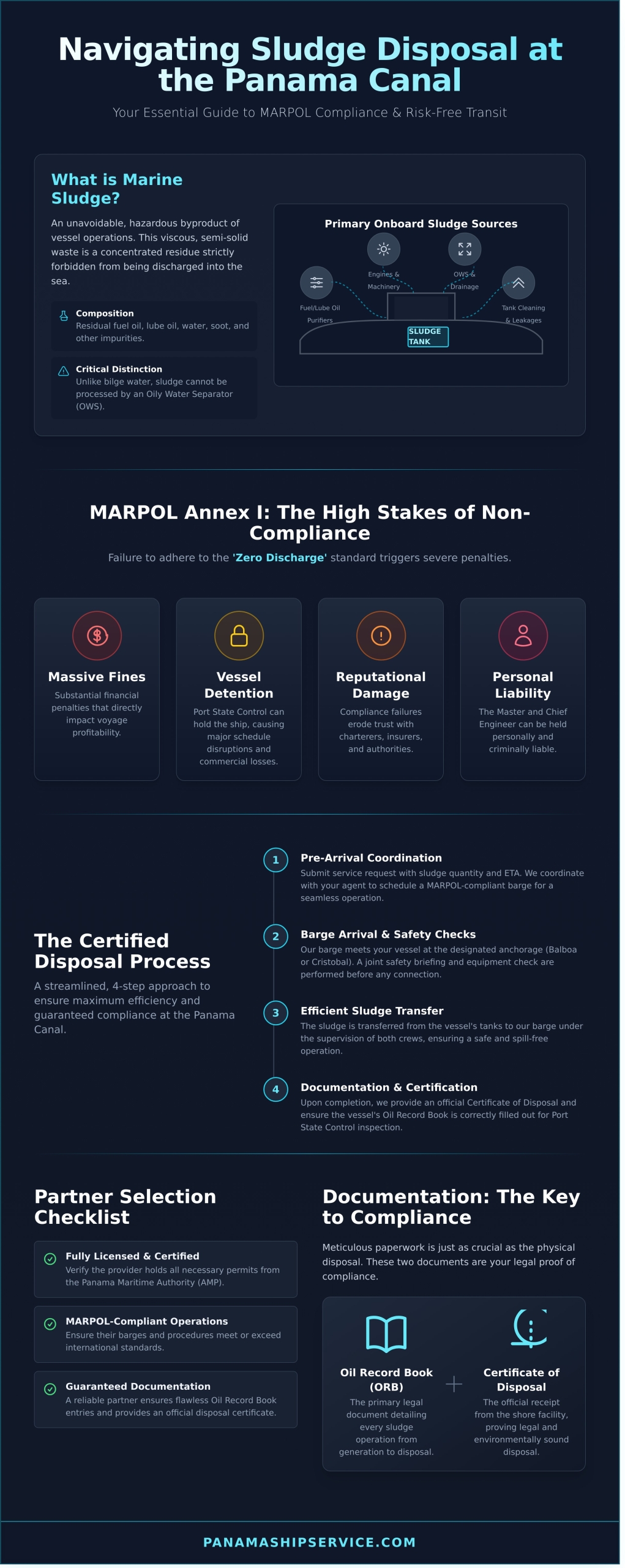
This guide provides the solution. We are experts so you don’t have to be. We will walk you through every critical aspect of sludge disposal at the Panama Canal, from understanding the precise MARPOL requirements to ensuring your Oil Record Book entries and disposal certificates are flawless. You will learn the step-by-step process for a seamless operation and, most importantly, how to identify and select a qualified partner who can guarantee compliance and efficiency. Consider this your operational playbook for eliminating the risk of costly errors.
Key Takeaways
- Understand the strict MARPOL Annex I regulations governing marine sludge to avoid costly fines and operational delays at the Panama Canal.
- Master the step-by-step sludge disposal process, learning how pre-arrival coordination is critical for an efficient and timely service.
- Utilize a comprehensive checklist to select fully licensed and certified sludge disposal services, ensuring your vessel remains compliant.
- Discover why meticulous documentation in the Oil Record Book is just as crucial as the physical disposal for passing inspections.
Understanding Marine Sludge: Sources, Risks, and Regulations
In vessel operations, marine sludge is an unavoidable and hazardous byproduct. It is a viscous, semi-solid waste composed of residual fuel oil, lubricating oil, water, soot, and other impurities generated within the engine room. Unlike bilge water, sludge is a concentrated residue that cannot be processed by an oily water separator and is strictly forbidden from being discharged into the sea. Improper management poses significant environmental risks and severe operational consequences, making professional handling through certified sludge disposal services a non-negotiable aspect of maritime compliance.
While often grouped together, it’s crucial to differentiate between engine room sludge, which accumulates from various leakages and drains, and purifier sludge, the dense residue separated from fuel and lube oils. Both fall under the same stringent disposal regulations.
Common Sources of Sludge Onboard a Vessel
The continuous operation of a vessel’s machinery generates oily waste from multiple points. Understanding these sources is key to effective management and capacity planning for your sludge tanks. Primary sources include:
- Fuel and Lubricating Oil Purifiers: These are the most significant contributors, separating impurities and water from oil to protect engine components.
- Oily Water Separators (OWS): The concentrated oily residue separated from bilge water is transferred to sludge tanks.
- Engine Room Drainage: Leakages and drainage from main engines, auxiliary engines, and other machinery contribute to sludge accumulation.
- Tank Cleaning and System Leakages: Residues from cleaning fuel tanks and minor leaks in the fuel oil system are collected.
The Role of MARPOL Annex I in Sludge Management
The management of marine sludge is governed by the International Maritime Organization (IMO). These strict regulations are outlined in Annex I of the MARPOL 73/78 international convention, which establishes a ‘zero discharge’ standard for sludge in nearly all sea areas. Ships are mandated to have dedicated, sealed sludge tanks of adequate capacity to store all sludge generated between port calls. This sludge must be retained onboard until it can be legally transferred to a licensed shore reception facility. Every operation-from generation to transfer and final disposal-must be meticulously recorded in the Oil Record Book (ORB), which serves as the primary legal document during inspections.
Consequences of Non-Compliance
Failure to adhere to MARPOL regulations is a critical misstep with severe repercussions. Port State Control (PSC) authorities conduct rigorous inspections, and any discrepancies in the Oil Record Book or evidence of illegal discharge can trigger immediate and costly penalties. Engaging unverified providers is a major risk; only certified sludge disposal services provide the necessary documentation to prove compliance. The consequences of non-compliance include:
- Massive Fines: Financial penalties can be substantial, impacting a voyage’s profitability.
- Vessel Detention: The ship can be held in port until the issue is resolved, causing major commercial losses and schedule disruptions.
- Reputational Damage: A compliance failure damages the shipping company’s reputation with charterers, insurers, and authorities.
- Personal Liability: The vessel’s Master and Chief Engineer can be held personally liable, facing fines or even criminal charges.
The Certified Sludge Disposal Process at the Panama Canal: A Step-by-Step Guide
In the time-sensitive environment of the Panama Canal, every operation must be executed with precision. Disposing of sludge is not just a maintenance task; it’s a critical compliance requirement. The strict regulations outlined in the Panama Canal Sanitary Requirements prohibit any discharge of oily waste, making professional, certified sludge disposal services non-negotiable. A structured, expert-led process ensures your vessel remains compliant while minimizing operational delays. Our streamlined approach is designed for maximum efficiency from start to finish.
Step 1: Pre-Arrival Coordination and Scheduling
Efficiency begins long before your vessel arrives. Proactive coordination is the key to a seamless operation that aligns with your tight transit schedule. The process starts when your team submits a service request detailing the estimated sludge quantity and vessel ETA for either Balboa or Cristobal. We immediately coordinate with your ship’s agent to confirm a precise schedule, ensuring our MARPOL-compliant barge is ready upon your arrival, eliminating costly waiting times and keeping your transit on track.
Step 2: The On-Site Pumping Operation
Once your vessel is anchored or berthed, our certified disposal barge comes alongside. Safety is our top priority. Before any transfer begins, our qualified crew conducts a pre-transfer safety meeting with the vessel’s Chief Engineer to review procedures, inspect hoses and connections, and establish clear communication protocols. The sludge is then pumped from the ship’s tanks to our barge under continuous monitoring by our experienced personnel. This meticulous oversight prevents spills and ensures the entire operation is conducted safely and efficiently.
Step 3: Measurement, Documentation, and Certification
Compliance hinges on accurate and transparent documentation. Upon completion of the pumping, our team conducts a joint measurement with the vessel’s crew to verify the exact quantity of sludge removed. All details are recorded on a Bunker Delivery Note (BDN) or an equivalent service receipt, which is signed by both parties. Most importantly, we issue an official Certificate of Disposal. This crucial document serves as definitive proof of legal disposal, allowing for correct and defensible entries in the vessel’s Oil Record Book and satisfying all port authority and MARPOL requirements.
How to Choose a Certified Sludge Disposal Partner in Panama
Selecting the right partner for certified sludge disposal services in Panama is a critical operational decision that directly impacts your vessel’s compliance, schedule, and budget. A reliable provider does more than remove waste; they act as a trusted agent to safeguard your transit and prevent costly delays. To ensure you choose a competent and efficient partner, use this checklist to evaluate potential vendors.
Verifying Credentials and Compliance
Compliance is non-negotiable. Your first step must be to verify that a potential provider operates with full legal and environmental authority. Ask for copies of their current licenses from the Panama Maritime Authority (AMP) and confirm their strict adherence to all Panama Canal Authority (ACP) regulations. Their disposal methods must be environmentally sound and align with global standards set by bodies like the International Maritime Organization (IMO). Finally, ensure their staff holds relevant safety training, such as HAZWOPER certification, to handle all materials safely.
Assessing Operational Capability and Efficiency
A provider’s operational capacity determines their ability to service your vessel without causing delays. Inquire about the size and condition of their fleet of disposal barges and pumping equipment. Time is money at the Canal, so evaluate their 24/7 availability and guaranteed emergency response times. An experienced partner will have a proven track record servicing your specific vessel type, whether it’s a tanker, container ship, or bulk carrier. This expertise ensures a smooth, predictable, and timely operation. See how our certified fleet ensures efficient service.
Evaluating Service and Cost Transparency
Beyond technical capability, a true partner offers transparent pricing and streamlined service. Always request a clear, itemized quotation with no hidden fees to avoid budget overruns. A single point of contact is essential for simplifying communication and ensuring accountability throughout the service. To maximize efficiency, prioritize partners who offer a full suite of MARPOL services, allowing you to consolidate sludge, bilge, and garbage disposal with one trusted provider. Finally, ask for recent client testimonials or references to verify their reputation for reliability within the local maritime community.
Documentation Deep Dive: The Oil Record Book and Certificate of Disposal
In the maritime industry, physical compliance is only half the battle. Flawless documentation is non-negotiable, especially during a Port State Control (PSC) inspection. The Oil Record Book and the Certificate of Disposal are the two pillars of your MARPOL compliance record for sludge. Getting them right is not just a recommendation; it is an absolute requirement that protects your operations from costly delays and penalties.
Making Correct Entries in the Oil Record Book
The Oil Record Book (ORB) Part I is the official log of all machinery space oil and sludge operations. Every disposal must be recorded meticulously. A single mistake can trigger a full-scale PSC investigation. A correct entry for sludge disposal to a shore facility under Code C.12.4 must include:
- Date: The exact date of the operation.
- Port: The name of the port where the disposal occurred.
- Quantity Discharged: The volume of sludge (in m³) discharged to the reception facility.
- Name/Identity of Facility: The official name of the certified shore reception facility.
- Signature: The signature of the officer in charge, countersigned by the Chief Engineer.
Common errors, such as mismatched quantities between the ORB and the Certificate of Disposal or a missing signature, are immediate red flags for inspectors. Precision is paramount, and there is no room for error.
The Certificate of Disposal: Your Proof of Compliance
The Certificate of Disposal is your official receipt and legal proof that sludge was transferred to an authorized facility in accordance with MARPOL regulations. This document is your primary defense during an audit or inspection, confirming the transaction was legitimate. Issued by the reception facility, it confirms key details like the vessel’s name, IMO number, the port of disposal, and the precise type and quantity of waste received. Remember, only a licensed provider can issue a valid certificate, which is why using certified sludge disposal services is critical for guaranteed compliance.
As per MARPOL Annex I, this certificate must be retained on board for a minimum of three years. Partnering with an expert provider like Panama Ship Service ensures that every entry is accurate and every certificate is correctly issued. We handle the details so you can focus on your voyage. Ensure your documentation is flawless by visiting panamashipservice.com.
Secure Your Vessel’s Compliance with Expert Sludge Disposal
Navigating MARPOL regulations at the Panama Canal requires a deep understanding of the risks, processes, and documentation involved. Choosing the right provider for certified sludge disposal services is not just a logistical decision; it’s a strategic one that protects your vessel from costly delays and non-compliance penalties. A reliable partner ensures every step, from collection to the final Certificate of Disposal, is handled with precision and expertise.
For over 20 years, Panama Ship Service has been the trusted solutions provider for vessel operators in these waters. As a partner fully licensed by the Panama Maritime Authority (AMP), we deliver efficient, cost-conscious services backed by a 24/7 rapid response team dedicated to minimizing your vessel’s downtime. We are the experts so you don’t have to be.
Request a quote for certified MARPOL sludge disposal at the Panama Canal.
Put your vessel’s compliance in our hands and ensure a smooth, efficient transit.
Frequently Asked Questions
What is the difference between sludge, slops, and bilge water disposal?
Sludge (MARPOL Annex I) refers to concentrated oily residues from fuel purifiers and engine room machinery. Slops are mixtures of oil and water, typically from cargo tank cleaning, while bilge water is the contaminated water that collects in a ship’s lower spaces. Each waste stream has a different composition and requires specific, compliant handling and disposal methods. Our expert teams are qualified to manage all MARPOL waste categories according to strict international standards.
How much advance notice is required to schedule a sludge disposal service in Panama?
To ensure timely coordination and avoid vessel delays, we recommend providing a minimum of 48 hours’ advance notice. This allows our operations team to secure the necessary permits and allocate the appropriate collection barge and personnel for your service. For urgent or short-notice requirements, please contact our 24/7 support team directly. We are structured to provide a rapid and efficient response to meet the demanding schedules of Canal traffic.
Can sludge disposal be performed at both the Atlantic (Cristobal) and Pacific (Balboa) sides of the Canal?
Yes. Our operational network is strategically positioned to provide certified sludge disposal services at both key anchorages. We maintain fully equipped collection barges and qualified crews at the Atlantic side (Cristobal) and the Pacific side (Balboa). This comprehensive coverage ensures your vessel receives timely and compliant MARPOL disposal regardless of its location or transit direction, reinforcing our role as your trusted partner for all Panama Canal operations.
What information do I need to provide to get an accurate quote for sludge removal?
To receive a fast and accurate quote, please provide the following details: the vessel’s name and IMO number, the estimated quantity of sludge for disposal (in cubic meters or metric tons), the vessel’s location (Cristobal or Balboa anchorage), and your requested service date. Including any specific details, such as unusually high viscosity, also helps us ensure the correct equipment is dispatched for a seamless and cost-conscious operation.
What happens if the actual quantity of sludge is different from the estimated amount?
Our final invoice is always based on the actual quantity of sludge collected, ensuring you only pay for the service you receive. The final volume is determined using calibrated flow meters during the transfer or by a joint sounding of the collection barge tanks before and after the operation. For complete transparency, this measured quantity is officially recorded on the collection receipt and the MARPOL certificate provided to the vessel’s master.
Are your disposal facilities and processes audited by environmental authorities?
Absolutely. Compliance is the foundation of our services. Our disposal facilities, equipment, and operational processes are fully licensed and regularly audited by the Panama Maritime Authority (AMP) and other relevant environmental bodies. We operate in strict adherence to MARPOL 73/78 regulations, providing you with the assurance that all waste is managed responsibly, legally, and with the complete, certified documentation required to prove compliance for your vessel’s records.