
In the high-stakes maritime industry, a single oversight can lead to catastrophic financial loss and significant operational delays. Hiring an unqualified marine surveyor isn’t just a poor decision; it’s a critical risk to your vessel’s integrity, insurance validity, and bottom line. A vague report, a missed structural flaw, or a survey rejected by insurers can turn a routine procedure into a costly and frustrating ordeal. This is why a systematic approach is non-negotiable. To protect your assets and ensure operational continuity, you need a definitive checklist for hiring marine surveyor services that leaves no room for error.
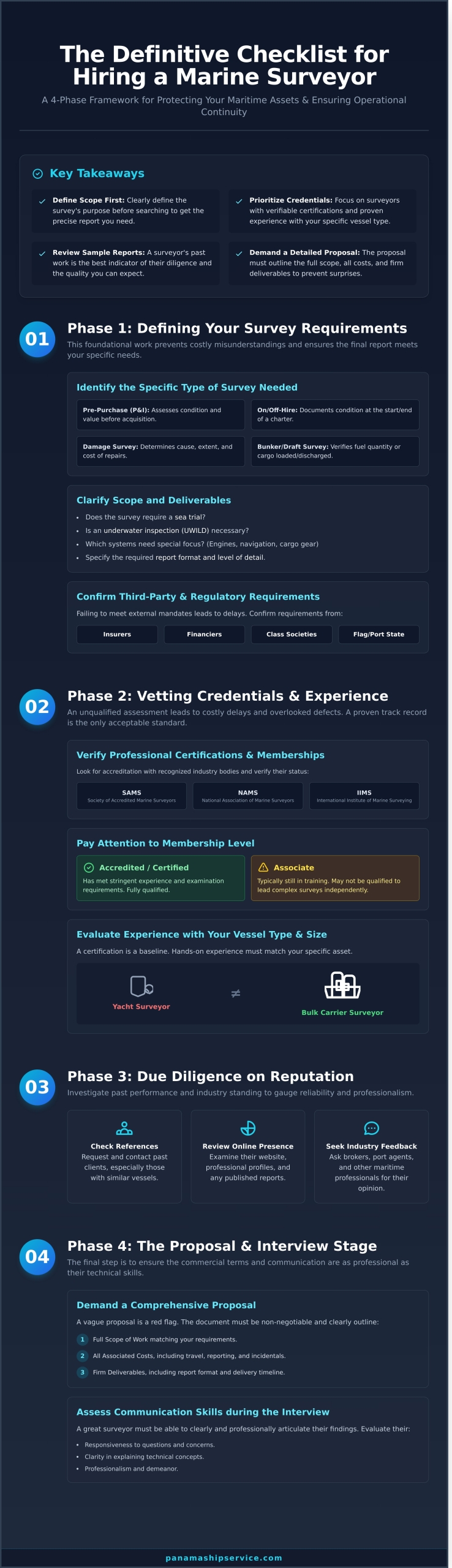
This guide provides that expert-driven framework. We will walk you through the essential criteria for vetting candidates, from verifying credentials and specialized experience to understanding the key components of an actionable, comprehensive survey report. Put our expertise to work and learn how to select a trusted professional who will safeguard your investment, satisfy all third-party requirements, and ensure a smooth, efficient process from start to finish. We are experts so you don’t have to be.
Key Takeaways
- Clearly define the scope and purpose of your survey before you search to ensure you receive the precise report your maritime asset requires.
- Prioritize surveyors with verifiable credentials from recognized organizations and a proven track record with vessels of your specific type and class.
- A surveyor’s sample report is the most reliable indicator of their diligence; our checklist for hiring a marine surveyor details exactly what to look for.
- A comprehensive proposal is non-negotiable and must outline the full scope of work, all associated costs, and firm deliverables to prevent unexpected expenses.
Phase 1: Defining Your Survey Requirements Before You Search
In the high-stakes maritime industry, precision is paramount. The most critical step in your checklist for hiring marine surveyor is not the search itself, but the foundational work you do beforehand. Defining the ‘why’ behind the survey is essential. A clearly defined scope of work prevents costly misunderstandings, ensures the final report meets your specific needs, and aligns all stakeholders from the outset. This initial planning is not a delay; it is a strategic investment that saves significant time and money by eliminating ambiguity and ensuring the surveyor you hire is qualified for the exact task at hand.
Identify the Specific Type of Survey Needed
The purpose of your inspection directly dictates the type of survey required. Each survey has a distinct objective and methodology, so clarity is non-negotiable. While a general understanding of what is a marine surveyor and their role is a good starting point, you must specify the exact service you need to get an accurate and useful report. The most common types include:
- Pre-Purchase Condition & Valuation (P&I) Survey: A comprehensive inspection to assess a vessel’s condition and market value prior to acquisition.
- On-Hire / Off-Hire Survey: Documents the vessel’s condition and bunker levels at the start and end of a charter party agreement to protect your interests.
- Damage Survey: An expert assessment to determine the extent, cause, and cost of repairs following an incident, crucial for insurance claims.
- Bunker or Draft Survey: Verifies the quantity of fuel on board or cargo loaded/discharged, preventing commercial disputes.
Clarify the Required Scope and Deliverables
Simply naming the survey type is not enough. A professional surveyor needs a detailed scope to deliver a report that meets your operational and commercial requirements. Before engaging a surveyor, define the exact parameters of the inspection. Does the survey need to include a sea trial? Is an underwater inspection (UWILD) necessary? Specify which systems-such as main engines, navigation equipment, or cargo gear-require particular focus. Finally, clarify the required format and level of detail for the final report to ensure it is fit for purpose.
Confirm Third-Party and Regulatory Requirements
Your survey needs are often dictated by external parties. Failing to meet their requirements can lead to significant operational delays and financial penalties. Before finalizing your checklist for hiring marine surveyor, confirm all third-party and regulatory mandates. What are the specific survey requirements from your insurance provider or financier? Does the inspection need to be approved by a specific Class Society like Lloyd’s Register or DNV? Consider any Flag State or Port State Control regulations that may apply to the vessel and its intended voyage.
Phase 2: Vetting Surveyor Credentials and Experience
In the high-stakes maritime industry, not all surveyors are created equal. An unqualified assessment can lead to costly delays, overlooked defects, and significant financial risk. The second phase of your checklist for hiring marine surveyor involves a rigorous, non-negotiable evaluation of their professional background. This critical step ensures you engage a qualified expert capable of protecting your high-value asset, not just a person with a clipboard.
Your objective is to verify that a surveyor’s credentials and experience align precisely with the demands of your vessel and its operational environment. A proven track record is the only acceptable standard.
Verify Professional Certifications and Memberships
Reputable surveyors demonstrate their commitment to professional standards and ethics through accreditation with recognized industry bodies. You must verify these affiliations directly. Look for memberships with leading organizations such as:
- The Society of Accredited Marine Surveyors (SAMS)
- The National Association of Marine Surveyors (NAMS)
- The International Institute of Marine Surveying (IIMS)
Request the surveyor’s membership number and confirm their status on the organization’s website. Pay close attention to their designation; an Accredited or Certified member has met stringent experience and examination requirements, whereas an Associate member is typically still in training and may not be qualified to lead a complex survey independently.
Evaluate Experience with Your Vessel Type and Size
A certification is a baseline, not the full picture. The surveyor’s hands-on experience must match your specific operational needs. A surveyor who primarily inspects small yachts is not qualified to assess a commercial bulk carrier. Ask direct questions about their experience with vessels of a similar type (e.g., tankers, container ships, offshore support vessels) and their familiarity with the specific propulsion and auxiliary machinery onboard. For operations in specialized environments, experience with local conditions, such as navigating regulations and logistics in the Panama Canal, is a significant advantage that saves both time and money.
Confirm Adequate Professional Indemnity (PI) Insurance
Never engage a surveyor without first verifying their Professional Indemnity (PI) insurance, also known as Errors and Omissions (E&O) coverage. This is your financial protection against negligence or mistakes in the survey report. Request a copy of their current insurance certificate and confirm that the coverage amount is sufficient to cover the value of your vessel and potential losses. Failure to confirm adequate insurance exposes your operation to unacceptable risk.
Phase 3: Due Diligence on Reputation and Past Performance
Verifying a surveyor’s credentials is the first step; validating their real-world performance is the most critical. A surveyor’s reputation is built on the quality, accuracy, and reliability of their work. This phase of your checklist for hiring marine surveyor moves beyond qualifications on paper to the tangible evidence of their expertise. Professional organizations like the National Association of Marine Surveyors (NAMS) provide a directory of certified members, but your due diligence must go further to ensure their work product meets your specific operational standards.
Request and Scrutinize Sample Survey Reports
The single best indicator of a surveyor’s competence is their final report. Request a recent, anonymized sample for a vessel similar to yours and assess it with a critical eye. A comprehensive report is not merely a list of findings; it is a clear, objective, and actionable document that protects your assets. Look for:
- Clarity and Structure: Is the report logically organized, easy to navigate, and free of jargon? Key findings should be summarized and simple to locate.
- Detailed, Objective Findings: The report must present evidence-based facts, not subjective opinions. Each noted deficiency should be supported by detailed descriptions and measurements.
- High-Quality Visual Evidence: High-resolution photographs and diagrams are non-negotiable. They must be clearly labeled and directly referenced within the text to illustrate the exact location and nature of any issues.
Ask for and Contact Professional References
A confident, experienced surveyor will readily provide references from previous clients. Specify that you require contacts who commissioned surveys for vessels or needs similar to your own. When you contact these references, be direct and efficient. Inquire about the surveyor’s professionalism, timeliness in delivering the report, and overall communication. Crucially, ask if the final survey report was accepted without issue by their insurance underwriter, financial institution, or flag state registry. This confirms the report meets stringent industry standards.
Assess Their Communication and Professionalism
Your initial interactions are a reliable predictor of the surveyor’s on-the-job conduct. A true professional is responsive, clear, and thorough in all communications, whether by phone or email. They should answer your technical questions with confidence and provide detailed explanations. Delays, vague answers, or a lack of clarity during this vetting process are significant red flags. Remember, this is a key part of your checklist for hiring marine surveyor because poor communication can lead to costly misunderstandings and project delays down the line.
Phase 4: The Proposal and Interview Stage
You have vetted credentials and confirmed experience. This final phase is where you transition from qualification to selection, comparing detailed proposals from your shortlisted candidates. A comprehensive proposal is a non-negotiable deliverable; it serves as the primary tool for an objective comparison and protects your interests. This is the most critical step in your checklist for hiring marine surveyor, ensuring the expert you choose aligns with your operational and financial requirements.
A vague proposal is a significant red flag. Insist on a document that clearly outlines all costs, the specific scope of the survey, and the expected deliverables to avoid costly misunderstandings later.
Ask Key Questions About Their Process and Timeline
Your operational timeline is critical. Before committing, you must have clear answers to fundamental logistical questions. An expert surveyor will provide direct, confident responses. Ask specifically:
- What is your immediate availability to conduct the survey?
- What is the estimated turnaround time for the final, comprehensive report?
- What specific technology do you utilize (e.g., thermal imaging, ultrasonic thickness gauging, moisture meters) to ensure a thorough inspection?
Compare Quotes: Look Beyond the Bottom Line
While cost is a factor, the lowest bid is often not the most cost-effective. A suspiciously low quote may indicate a lack of experience, a limited scope, or the potential for hidden fees. A professional quote should clearly itemize all anticipated charges, including the surveyor’s rate (hourly or flat fee), travel time, and any administrative or equipment expenses. Verify exactly what is included and what might constitute an extra charge, such as follow-up consultations or specialized testing.
Finalize the Survey Agreement or Contract
A formal survey agreement or contract is essential to protect both you and the surveyor. This legally binding document moves beyond the initial quote to codify the entire engagement. It must explicitly state the scope of work, the standards the survey will be conducted under (e.g., SAMS, NAMS), any limitations, and the agreed-upon payment terms. Do not proceed without a signed agreement in place. For mission-critical inspections, partner with a trusted expert. Trust Panama Ship Service for certified surveys at the Canal.
Your Final Checkpoint: Choosing the Right Marine Surveyor
Selecting the right marine surveyor is a critical, multi-stage process that directly impacts the safety and value of your vessel. The key takeaways are to clearly define your survey requirements before you begin your search and to meticulously vet a candidate’s credentials, experience, and reputation. Using a comprehensive checklist for hiring marine surveyor transforms this crucial task from a challenge into a systematic process, ensuring no detail is overlooked.
When operating in a high-stakes environment like the Panama Canal, you need more than a surveyor-you need a trusted, expert partner. Panama Ship Service brings over 20 years of specialized experience to every inspection. Our fully certified and insured surveyors deliver the solutions you need, backed by our capacity as a one-stop-shop for surveys, repairs, and MARPOL services. We are experts so you don’t have to be. Need a reliable, certified marine surveyor in Panama? Contact our expert team today.
Put your vessel in capable hands and protect your investment with confidence.
Frequently Asked Questions
How much does a commercial marine survey typically cost?
The cost of a commercial marine survey is not fixed; it depends on the vessel’s size, type, age, and location. The scope of the work-whether it’s a pre-purchase, insurance, or damage survey-is also a primary factor. A detailed quote should be requested from any prospective surveyor to understand the full cost, including travel and other expenses. This ensures transparency and helps you manage your budget effectively for this critical service.
What is the difference between a marine surveyor and a class surveyor?
A marine surveyor and a class surveyor serve different functions. An independent marine surveyor is hired by a client-such as a buyer, owner, or underwriter-to assess a vessel’s condition, compliance, and value for a specific transaction. A class surveyor works for a Classification Society (e.g., ABS, DNV, Lloyd’s Register) and verifies that the vessel meets the technical standards required to remain ‘in class,’ which is essential for insurance and international operation.
Can a surveyor represent both the buyer and the seller in a transaction?
No. A professional marine surveyor cannot ethically represent both the buyer and the seller in the same transaction. This creates an undeniable conflict of interest. The surveyor’s primary duty is to provide an objective, unbiased report exclusively for their client. To maintain professional integrity and ensure a fair assessment, the surveyor must work for one party only. This protects the interests of all involved and upholds the credibility of the survey process.
What are the most respected professional organizations for marine surveyors?
Globally, several organizations are recognized for their high standards and rigorous accreditation processes. The International Institute of Marine Surveying (IIMS) is a prominent international body. In the United States, the Society of Accredited Marine Surveyors (SAMS) and the National Association of Marine Surveyors (NAMS) are the most respected. Verifying a surveyor’s affiliation with one of these organizations is a reliable indicator of their qualifications and commitment to professional ethics.
What should I do if I find an error or disagree with the survey report?
If you identify a potential error or disagree with a finding, first contact the surveyor directly to discuss your concerns. Provide specific details and any supporting evidence you may have. A reputable professional will be willing to review the point of contention and provide clarification or make a correction if warranted. If the issue remains unresolved, your next step would be to seek a second opinion from another qualified surveyor or contact the surveyor’s professional organization.
How long does a typical pre-purchase survey take on a commercial vessel?
The duration of a pre-purchase survey on a commercial vessel varies significantly with its size, type, and complexity. A smaller vessel may take one full day, while a large cargo ship or tanker could require several days for a thorough inspection, including sea trials. The time required is a critical factor to consider in your checklist for hiring marine surveyor, as it directly impacts vessel downtime and operational scheduling. Always confirm the estimated timeframe with the surveyor beforehand.