
For any ship owner or charterer, a mechanical failure during a Panama Canal transit is a worst-case scenario. The immediate concerns are overwhelming: crippling fines from the Panama Canal Authority (ACP), a lost transit slot that disrupts the entire schedule, and the urgent need for qualified local assistance. The uncertainty can be as costly as the incident itself. Understanding exactly what happens if a ship breaks down in the Panama Canal is not just a matter of procedure-it is a critical component of risk management and operational readiness.
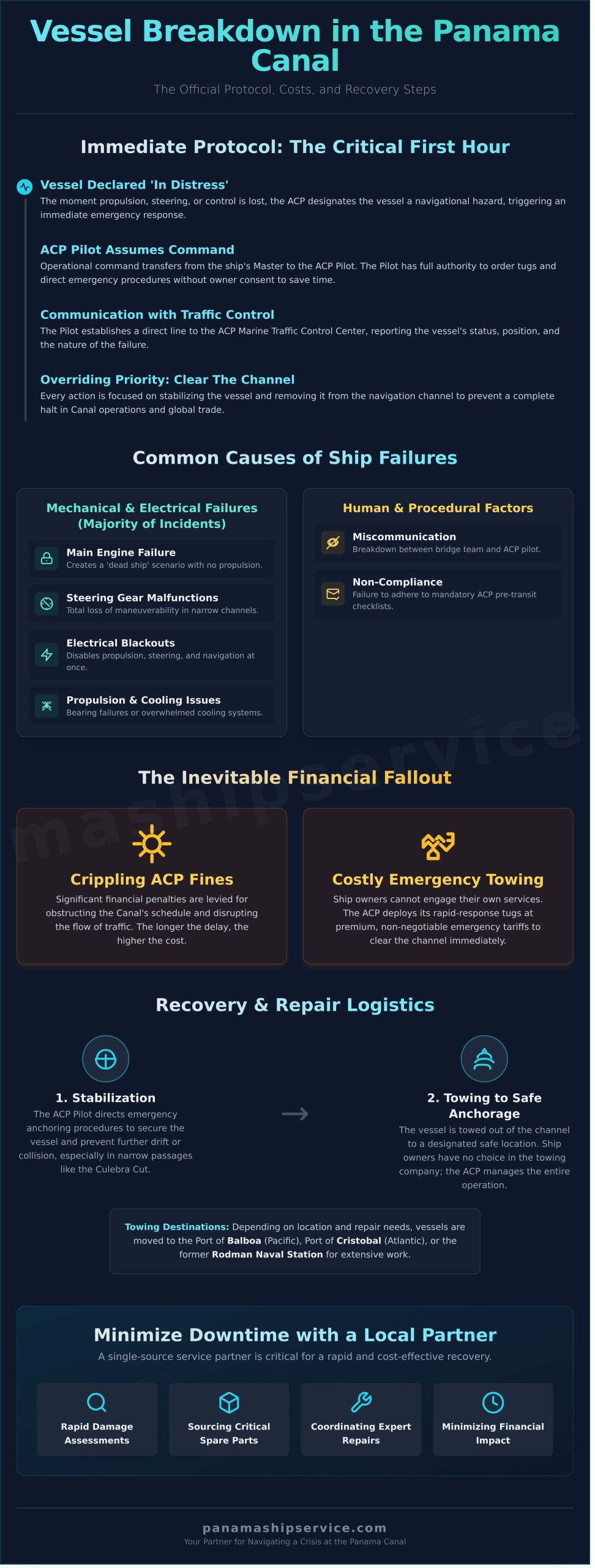
This comprehensive guide eliminates that uncertainty. We provide a clear, step-by-step breakdown of the official ACP protocol for vessel failures, from initial incident reporting to emergency towing. You will gain a transparent understanding of the potential costs involved and the logistics for securing rapid, expert mechanical repairs to get your vessel back on schedule with minimal financial impact. Consider this your essential briefing for navigating a crisis at one of the world’s most critical maritime chokepoints.
Key Takeaways
- Understand the immediate protocol when a vessel is declared ‘in distress,’ including how the Panama Canal Authority (ACP) Pilot assumes command to mitigate the situation.
- Learn to anticipate the significant financial impact of a breakdown, from ACP fines for schedule obstruction to costly emergency tugboat tariffs.
- Discover the essential logistical steps for emergency repairs and learn exactly what happens if a ship breaks down in Panama Canal from a response and recovery perspective.
- Recognize why a single-source service partner is critical for coordinating rapid damage assessments, sourcing spare parts, and minimizing costly downtime.
Immediate Protocol: The First 60 Minutes of a Canal Breakdown
When a vessel experiences a critical failure during transit, the question of what happens if a ship breaks down in panama canal is answered by a swift and decisive protocol. The Panama Canal Authority (ACP) immediately designates the vessel as ‘in distress’ if it loses propulsion, steering, or poses any navigational hazard. This is not a moment for deliberation; it is a time for immediate action. The intricate and time-sensitive operations of the Panama Canal demand a structured response to prevent a system-wide shutdown, and control is instantly centralized with the ACP.
From the moment of failure, operational command effectively transfers from the ship’s master to the ACP Pilot on the bridge. The pilot’s first action is to establish a clear communication line with the ACP Marine Traffic Control Center, reporting the vessel’s status, position, and the nature of the emergency. The immediate and overriding priority is safety and the continuity of Canal operations. Every decision made in this critical first hour is geared towards a single goal: clearing the navigation channel to prevent a blockage that could halt the flow of global trade and cost other vessels thousands in delays.
The Role of the ACP Pilot During Mechanical Failure
The ACP Pilot is vested with significant authority. They can order immediate tugboat assistance without waiting for owner or charterer consent, a critical power that saves valuable time. In narrow passages like the Culebra Cut, the pilot will direct emergency anchoring procedures to stabilize the vessel. If the failure occurs within the locks, the pilot coordinates directly with the operators of the ‘mules’ (locomotives) and lock personnel to secure the ship and manage the situation safely.
Towing and Salvage: Where Your Ship Goes Next
Once stabilized, your vessel will be removed from the channel. Standard procedure involves towing the ship to a designated safe anchorage or pier. Depending on your location, this will be either the Port of Balboa on the Pacific side or the Port of Cristobal on the Atlantic. For vessels requiring extensive or specialized repairs, the former U.S. Naval Station Rodman is often utilized. During this active emergency, ship owners cannot engage their own towing company; the ACP directs the entire operation using its pre-approved, rapid-response assets.
Common Causes of Ship Failures in the Panama Canal
A vessel breakdown in the Panama Canal is a high-stakes event, triggering costly delays and complex logistical challenges. Understanding the root causes is the first step toward prevention. While every situation is unique, most failures can be traced back to a handful of critical vulnerabilities in machinery and operations.
Mechanical vs. Electrical Failures
The majority of incidents stem from the vessel’s core systems. In these confined waters, even a momentary lapse in power or control can have severe consequences. Key failure points include:
- Main Engine Failure: The ultimate risk, creating a ‘dead ship’ scenario where the vessel is completely without propulsion and adrift in a narrow channel.
- Steering Gear Malfunctions: Loss of maneuverability is catastrophic. This is why the Panama Canal Authority (ACP) mandates steering gear tests 48 hours before transit.
- Electrical Blackouts: Modern vessels with Integrated Power Plants (IPP) are efficient but vulnerable. A total blackout can disable propulsion, steering, and all navigational systems simultaneously.
- Propulsion Issues: Problems like bearing failures or propeller damage, often from accidental contact with lock walls, can immobilize a ship instantly.
The tropical environment adds another layer of stress. The warm waters of Gatun Lake can overwhelm engine cooling systems, leading to heat exchanger failures-a critical issue highlighted by the incident involving the USS Zumwalt. Older vessels are also particularly susceptible, as the frequent ‘stop-start’ nature of lock transits can strain aging machinery.
Human Error and Pilotage Issues
Even perfectly maintained equipment is subject to human factors. Miscommunication between a vessel’s bridge team and the expert ACP pilot is a significant risk, especially when navigating the tight margins of the New Panamax locks. The answer to what happens if a ship breaks down in panama canal often involves a breakdown in communication first.
To mitigate this, the ACP enforces a rigorous set of pre-transit checklists. Failure to comply with the Panama Canal Authority’s official regulations regarding equipment readiness is a leading cause of preventable incidents. These protocols are not suggestions; they are mandatory requirements for a safe and efficient transit.
The Financial Fallout: Fines, Fees, and Demurrage
When a vessel fails during transit, the operational scramble is immediately followed by a cascade of severe financial penalties. Understanding what happens if a ship breaks down in panama canal requires a clear view of the direct and indirect costs, which can quickly escalate into hundreds of thousands of dollars. The Panama Canal Authority (ACP) operates on a strict, time-sensitive schedule, and any disruption incurs significant charges designed to penalize delays and recover operational costs.
Beyond direct fines, costs multiply rapidly. The ACP will dispatch tugboats for emergency assistance, billing the vessel at a premium ‘forced’ tariff rate that is substantially higher than standard, pre-arranged assistance. Perhaps the most significant financial blow is the loss of a pre-booked transit slot. This not only means forfeiting the expensive booking fee but also relegates the vessel to the back of the queue, potentially facing weeks of delay and the high cost of securing a new slot. This delay triggers a chain reaction of demurrage claims from charterers and potential cargo claims for time-sensitive shipments, spreading the financial damage throughout the supply chain.
Breaking Down the ACP Fine Structure
The primary penalty is a direct fine from the ACP for obstructing Canal operations. The calculation is influenced by the vessel’s size (PC/UMS), the location of the incident (a breakdown in the Culebra Cut is far more disruptive than one at anchorage), and the total duration of the delay. In addition to fines, the ACP issues administrative fees for ‘vessel deficiency’ reports. As detailed by major marine insurers, the financial fallout and disruption charges are clearly defined in the official tariff. Mitigating these penalties requires an immediate, expert response and meticulous documentation.
Secondary Costs: The Hidden Expenses
The official penalties are just the beginning of the financial challenge. Ship owners must budget for a range of secondary expenses that accumulate while the vessel is immobilized. An efficient local partner is critical to controlling these costs. Key hidden expenses include:
- Port and Anchorage Fees: Daily charges at the Port of Balboa or Cristobal while awaiting parts, technicians, and final clearance can become substantial.
- Emergency Surveys: Classification societies must conduct emergency surveys and issue approvals post-repair, adding another layer of mandatory cost and time.
- Crew and Provisioning: Extended downtime often necessitates unplanned crew changes, repatriation flights, and additional provisioning, further inflating operational expenses.
Emergency Repair Logistics: Getting Back to Sea
When a vessel suffers a mechanical failure, the immediate question is no longer just what happens if a ship breaks down in Panama Canal, but how quickly it can be made seaworthy. A swift, coordinated response is critical to minimize downtime and control costs. The process involves a highly synchronized chain of events, from initial assessment to final certification, managed by an expert team on the ground.
The repair sequence is methodical and time-sensitive. A successful operation hinges on executing these key steps with precision:
- Step 1: Immediate Damage Assessment: A certified marine surveyor boards the vessel to conduct a thorough inspection, identifying the root cause and scope of the failure. This initial report is crucial for planning the entire repair operation.
- Step 2: Sourcing Marine Spare Parts: We leverage the Panama Free Trade Zone to rapidly procure necessary parts, from engine components to hydraulic fittings, minimizing international shipping delays.
- Step 3: Mobilizing Technical Teams: Specialized mechanical and steel fabrication teams are dispatched to the vessel’s location-whether at anchorage or alongside a berth-to begin work immediately.
- Step 4: Underwater Inspections (UWILD): If contact with locks or grounding is suspected, an Underwater Inspection in Lieu of Dry-docking (UWILD) is performed to check for hidden hull, rudder, or propeller damage.
- Step 5: ACP Re-inspection and Certification: Once repairs are complete and certified by Class, the Panama Canal Authority (ACP) conducts a final inspection to ensure the vessel is safe to resume its transit.
Critical Repair Services at the Canal
Our teams provide comprehensive, on-the-spot solutions to address any issue. This includes complete engine overhauls, cooling system fixes, and underwater hull cleaning or propeller polishing required after contact with lock walls. We also manage all MARPOL compliance for waste and sludge disposal during these unexpected port stays, ensuring your vessel remains environmentally compliant throughout the repair process.
Sourcing Spare Parts and Specialized Labor
The logistics of a breakdown demand local expertise. While flying in a ‘super-tech’ from the manufacturer is an option, our qualified local teams often provide a more rapid and cost-conscious solution. We are experts in navigating Panama’s customs for the urgent clearance of marine spares and ensure all repairs meet strict Class Approval standards, guaranteeing your vessel is ready for international transit. Navigating this complex process requires a trusted partner on the ground like Panama Ship Service.
Navigating the Crisis with Panama Ship Service
When a vessel suffers a mechanical failure in the world’s most critical maritime shortcut, the situation demands more than just a repair crew. Understanding what happens if a ship breaks down in the Panama Canal is one thing; having a trusted, on-the-ground partner to manage the entire crisis is another. In an emergency, coordinating with multiple vendors for repairs, surveys, and logistics creates delays and inflates costs. This is why a ‘One-Stop-Shop’ solution is not a luxury-it is a necessity.
For over 20 years, Panama Ship Service has been that solution. Our extensive expertise in mechanical and underwater repairs means we have the technical skills to resolve the immediate problem. More importantly, our deep local knowledge allows us to manage resources efficiently, sourcing qualified technicians and necessary parts to minimize expenses. We provide constant, daily communication, giving owners and charterers the clarity and confidence they need during a high-stress event.
Our Emergency Response Capabilities
Our rapid response protocol is designed to address every facet of a Canal breakdown, ensuring a swift return to operational status. We are your single point of contact for:
- 24/7 Technical Support: Immediate availability for emergency mechanical, steel, and A/C repairs performed by our qualified teams.
- Comprehensive Marine Surveys: We conduct the necessary underwater inspections and damage surveys required to expedite clearance from the Panama Canal Authority (ACP).
- Logistical Coordination: Our team liaises directly with port authorities, pilots, and local supply chains to streamline every action, from crew changes to parts delivery.
We Are Experts So You Don’t Have to Be
The aftermath of a breakdown involves more than just fixing the ship. When you consider what happens if a ship breaks down in the Panama Canal, navigating the complex local bureaucracy is often the most frustrating hurdle. We manage these difficult administrative aspects for you. Our proven track record is built on reducing vessel downtime by handling all regulatory requirements efficiently, allowing your crew to focus on the vessel while we focus on resuming your transit. Put your transit in our hands.
Contact Panama Ship Service for Emergency Support
Navigate Canal Breakdowns with an Expert Partner
A mechanical failure in the Panama Canal is more than an inconvenience; it’s a high-stakes event triggering immediate protocols, severe financial penalties, and complex logistical hurdles. The answer to what happens if a ship breaks down in panama canal involves a race against time where every decision impacts costs and delays. A swift, coordinated response is not just an advantage-it is essential for mitigating the financial fallout and resuming your voyage.
This is where an experienced partner becomes your most valuable asset. For over 20 years, Panama Ship Service has been the trusted one-stop-shop for ship owners and charterers navigating these challenges. We provide rapid, Class-approved surveys, efficient repairs, and MARPOL compliant disposal services to resolve issues quickly and professionally. Our expert team is ready to manage every technical and operational need, minimizing downtime and protecting your investment.
Don’t leave your transit to chance. Put your transit in our hands-Contact our 24/7 Emergency Repair Team and sail with the confidence that an expert is ready to act.
Frequently Asked Questions
How much does it cost if a ship breaks down in the Panama Canal?
The cost of a breakdown is substantial and highly variable. Direct expenses include Panama Canal Authority (ACP) fines for disrupting traffic, mandatory tugboat and towing fees, and the cost of emergency repairs. Indirect costs are often higher, encompassing off-hire losses, potential cargo claims, and schedule disruptions that impact future voyages. A proactive approach with a local partner is the most effective way to control these escalating expenses and ensure a cost-conscious solution.
Does the Panama Canal Authority pay for towing if my ship breaks down?
No, the Panama Canal Authority (ACP) does not cover towing costs. The vessel’s owner or operator is fully liable for all expenses resulting from a breakdown. The ACP will arrange for the necessary tugs to clear the navigation channel swiftly, and these significant costs will be billed directly to the vessel. Managing these situations requires immediate financial arrangements and expert coordination to avoid further administrative penalties and delays, which is a core part of our service.
Can I perform my own repairs while anchored in the Canal?
Performing your own repairs is highly restricted. For minor issues that do not compromise safety or navigation, the ACP may grant permission for the crew to perform repairs while at a designated anchorage. However, for any significant mechanical or structural failure, the vessel will be moved to an approved repair facility. The ACP’s primary objective is to maintain the safety and efficiency of Canal traffic, and all repair activities are subject to their strict oversight.
What are the most common reasons for a ship to be denied transit?
The most common reasons for transit denial are technical deficiencies identified during an ACP inspection. These frequently include main engine or steering gear malfunctions, non-compliant pilot ladders, inadequate mooring equipment, or visibility obstructions from the bridge. Vessels may also be denied for outstanding financial debts to the ACP. A pre-transit inspection by a qualified local agent can identify and resolve these potential issues before they cause costly delays at the Canal.
Where is the nearest repair yard if a ship breaks down on the Pacific side?
If a vessel requires significant repairs on the Pacific side, the nearest and most comprehensive facilities are located in the Port of Balboa. The primary option is the Astilleros Braswell International shipyard, which is equipped to handle a wide range of dry-docking and afloat repairs for various vessel types. Coordinating with a local service provider ensures rapid access to these yards and qualified technical teams, minimizing downtime and expediting the repair process efficiently.
What happens to the cargo if a ship is delayed for weeks in Panama?
When a vessel is delayed for weeks, the cargo’s fate depends on its nature and charter party agreements. For perishable goods, lengthy delays can result in total loss and significant insurance claims. For other cargo, the owner may face breach of contract penalties from charterers. In extreme cases, a complex and expensive transshipment operation-transferring cargo to another vessel-may be required to fulfill contractual obligations and mitigate further financial losses.
How long does it take to get a ‘vessel deficiency’ cleared by the ACP?
The time required to clear a ‘vessel deficiency’ varies based on its complexity. A minor issue might be resolved in hours, while a major engine failure could take weeks, pending parts and technician availability. The crucial step is getting the repair approved by an ACP inspector. Understanding what happens if a ship breaks down in Panama Canal involves efficient project management to expedite repairs and present a comprehensive solution to the ACP for their final clearance.
Do I need a local agent to handle a breakdown situation?
Yes, appointing a local agent is critical for efficiently managing a breakdown. An experienced agent acts as your single point of contact, coordinating directly with the ACP, arranging for qualified repair teams, sourcing spare parts, and handling all required administrative and financial procedures. Their local expertise and established relationships are indispensable for navigating this complex process, minimizing delays, and controlling costs in a high-pressure situation. We are experts so you don’t have to be.