
In the high-stakes environment of a Panama Canal transit, timing is everything. A single unexpected delay doesn’t just disrupt your schedule; it costs thousands of dollars per hour and puts your entire operation at risk. These costly setbacks are often the direct result of preventable errors during maintenance and repair. For ship owners, charterers, and chief engineers, knowing the common ship repair mistakes to avoid is not just best practice—it is essential for financial and operational success.
The principle of using specialized suppliers is universal across heavy industries. For example, in the commercial trucking sector, fleet managers rely on experts like Tim Halpin Equipment Corp for reliable, purpose-built equipment to avoid similar costly failures.
This guide provides the expert solutions you need. We will expose the critical technical and operational pitfalls that lead to incomplete work, costly re-dos, and serious regulatory non-compliance with ACP or MARPOL standards. You will learn how to implement efficient, class-approved repair strategies that guarantee your vessel remains mission-ready. Put these insights into practice to ensure successful maintenance, eliminate transit delays, and protect your bottom line.
Key Takeaways
- Shift your strategy from reactive fixes to proactive “operational maintenance” to prevent costly failures that jeopardize your Panama Canal transit slot.
- Recognize the critical mechanical oversights in engine and rudder systems that frequently lead to steering failures and emergency downtime.
- Learn why logistical miscalculations and delaying hull inspections are some of the most common ship repair mistakes to avoid in the unique operational environment of Panama.
- Understand how using fragmented vendors for repairs and supplies can derail your transit schedule, and why a single, expert partner provides a cost-conscious solution.
The High Cost of Error: Why Ship Repair Mistakes Are Critical in 2026
In the high-stakes environment of global shipping, the margin for error is rapidly shrinking. For vessels transiting the Panama Canal in 2026, the industry-wide shift from reactive repairs to proactive “operational maintenance” is no longer a best practice—it is a core requirement for profitability. The unique operational challenges of the Canal, from high traffic density to the aggressive biofouling in its tropical waters, amplify the consequences of any misstep. Understanding the most common ship repair mistakes to avoid is the first line of defense for any cost-conscious ship owner or charterer.
The Economic Ripple Effect of Repair Downtime
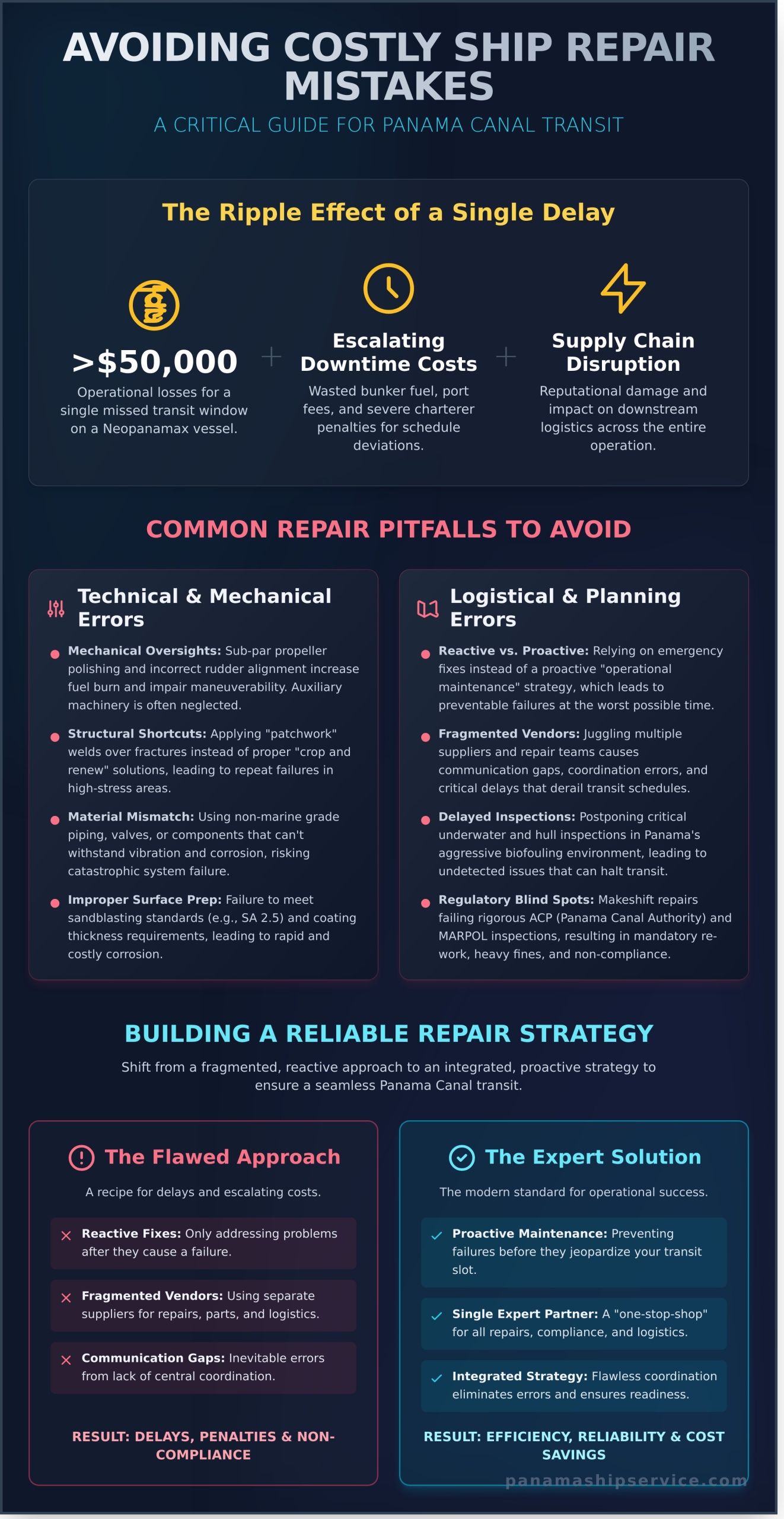
A failed repair triggers a cascade of financial penalties that extend far beyond the technician’s invoice. The direct costs of re-work are often dwarfed by crippling indirect losses, including wasted bunker fuel, escalating port fees during unplanned anchorage, and severe charterer penalties for schedule deviations. A 24-hour delay in Panama can disrupt an entire supply chain, causing reputational damage and impacting downstream logistics. In 2026, a single missed transit window at the Panama Canal can result in operational losses exceeding $50,000 for a standard Neopanamax vessel.
Regulatory Pressure: ACP and MARPOL Standards
Compounding the financial risks are the ever-tightening regulatory standards from the Panama Canal Authority (ACP) and MARPOL. Makeshift or “good enough” repairs that cut corners on materials or procedures are increasingly likely to fail rigorous ACP safety and seaworthiness inspections, leading to mandatory and costly re-work. Furthermore, MARPOL’s stringent rules on emissions and underwater hull condition mean that all aspects of proper ship husbandry and maintenance are under intense scrutiny. A non-compliant vessel faces heavy fines, turning a minor repair oversight into a major compliance failure.
These converging pressures demand a flawless repair strategy. The most effective defense against the common ship repair mistakes to avoid is adopting a “one-stop-shop” philosophy. Entrusting all repair, compliance, and logistical needs to a single, expert partner at the Canal eliminates the coordination errors and communication gaps that so often lead to catastrophic downtime. This integrated approach is the modern solution for ensuring an efficient, compliant, and timely transit.
Technical Pitfalls: Common Mechanical and Structural Repair Errors
Technical integrity is the non-negotiable standard for every component on a deep-sea commercial vessel. It means that every repair must restore equipment and structures to their original design specifications, ensuring they can withstand the harsh maritime environment. Deviating from these standards introduces unacceptable risks, leading to costly secondary failures, operational downtime, and potential safety hazards. Overlooking these details is one of the most frequent and expensive common ship repair mistakes to avoid.
Mechanical and Propulsion System Oversight
Errors in the engine room often have an immediate impact on a vessel’s performance and profitability. Sub-par propeller polishing or incorrect rudder alignment, for instance, directly increases fuel consumption and can impair maneuverability. These interventions must be validated by class-approved surveys to ensure compliance. Proper rudder function, for example, is essential for meeting the strict operational standards outlined in official notices like the Panama Canal vessel requirements. Another critical oversight is focusing exclusively on the main engine while neglecting auxiliary machinery. A failure in a generator or ballast pump can be just as debilitating as a main propulsion issue.
Structural Integrity and Steel Fabrication
When it comes to hull repairs, shortcuts compromise the very foundation of the vessel’s safety. During emergency steel repairs, a frequent error is applying a “patchwork” weld over a fracture without addressing the underlying local stress points that caused the failure. While fast, this approach is a temporary fix that invites repeat cracking. For high-stress areas like the sheer strake or main deck, a full-section replacement—or “crop and renew”—is the only correct, class-approved solution. The repair is only complete once the steel is properly protected; ensuring sandblasting meets SA 2.5 standards and that coatings are applied to specific maritime micron-thickness standards is critical for preventing rapid corrosion.
Finally, one of the most dangerous common ship repair mistakes to avoid is the use of non-marine grade materials. Substituting standard industrial piping, valves, or A/C components in a specialized marine system is a recipe for disaster. These parts are not designed to withstand the constant vibration, corrosive saltwater environment, and specific pressure ratings, leading to premature and often catastrophic failure.
This highlights the critical importance of a reliable supply chain for certified components. While focused on different sectors, the expertise of industrial suppliers like Mobel Suministros in managing materials for complex projects serves as a valuable model for the maritime industry.
Underwater and Environmental Repair Mistakes
When a vessel is waterborne, every repair carries heightened risk and cost. At a critical chokepoint like the Panama Canal, underwater issues can cause catastrophic delays and regulatory penalties. Understanding the most common ship repair mistakes to avoid in this environment is essential for maintaining operational efficiency and compliance.
A frequent error is delaying hull inspections, especially after navigating tropical waters where aggressive biofouling can drastically reduce speed and fuel efficiency. What might seem like a minor issue can quickly become a transit-denying problem. This reactive approach, instead of proactive maintenance, is a costly gamble.
Hull Cleaning and Propeller Maintenance
Opting for a full dry-docking when a timely in-water hull cleaning could suffice is a major miscalculation for vessels needing to meet emergency canal transit schedules. The mistake is compounded when unqualified teams use improper brush types, stripping expensive anti-fouling coatings and causing long-term damage. For canal transit, propeller polishing is not optional; it is a critical task to meet mandatory speed-over-ground (SOG) requirements. Relying on a simple “visual check” instead of a Class-approved Underwater Inspection in Lieu of Dry-docking (UWILD) survey is another pitfall. A UWILD provides a comprehensive, certifiable assessment of hull integrity, whereas a visual check can easily miss critical damage hidden by poor visibility or marine growth.
Underwater Welding and Seal Repairs
Wet welding is a highly specialized discipline that requires certified welders and Class-approved procedures to ensure a permanent, structurally sound repair. Attempting this work with an unqualified team is one of the most dangerous common ship repair mistakes to avoid. Similarly, improper stern tube seal repairs often result in catastrophic failures, leading to oil leaks, steep MARPOL fines, and environmental damage. Finally, a simple administrative oversight—failing to coordinate with local authorities for underwater work permits in the Balboa or Cristobal anchorages—can halt all operations, wasting valuable time and resources while your vessel sits idle.
Logistical and Planning Errors During Canal Transit
The Panama Canal is a critical chokepoint where timing is everything and delays are measured in thousands of dollars per hour. Misjudging the narrow “Panama Window” for repairs and services is one of the most costly and common ship repair mistakes to avoid. For fleet managers, a lack of constant, daily reporting from on-site partners creates an information vacuum that can jeopardize the entire voyage. Every logistical detail, from fumigation certificates to parts delivery, must be meticulously planned to align with your vessel’s transit slot.
The Danger of Fragmented Service Providers
Coordinating multiple, independent vendors for repairs, surveys, and supplies is a recipe for miscommunication and delays. Imagine your repair team finishes an urgent job, but the third-party surveyor is unavailable for another six hours, causing your vessel to miss its slot. Consolidating services under a single, trusted partner eliminates these risks. A single point of contact for Mechanical Ship Repairs Panama, surveys, and MARPOL disposal ensures seamless execution and clear accountability, saving both time and money.
Foresight in Marine Surveys and Inspections
Proactive planning for all required inspections is not optional; it is essential for a smooth transit. Failing to prepare is a critical error that leads to costly detentions by the Panama Canal Authority (ACP).
- Pre-Transit Surveys: Condition and pre-purchase surveys must be completed before the vessel reaches the locks. Attempting to perform these inspections during the transit process is a logistical nightmare that guarantees delays.
- Accurate Cargo Surveys: Seemingly minor mistakes in bunker and draft surveys frequently escalate into significant cargo claims and commercial disputes long after the vessel has departed.
- Regulatory Compliance: Ensure all certificates are current and valid. Failing to present an updated Deratting Certificate (Ship Sanitation Control Exemption Certificate) or MARPOL documentation can result in immediate detention and costly fines.
Ultimately, avoiding these logistical and planning errors requires an expert partner on the ground. A proactive approach to coordination and compliance is the only way to protect your schedule and your bottom line during this critical passage.
Conclusion: Building a Reliable Repair Strategy in Panama
The most effective way to navigate the complexities of maritime operations is to shift from a reactive mindset of “fixing problems” to a proactive strategy of “managing vessel health.” This fundamental change is the ultimate solution for fleet managers looking to eliminate costly delays and unexpected expenses. By planning ahead, you can sidestep the most common ship repair mistakes to avoid and ensure your vessel is an asset, not a liability, during its critical Panama Canal transit.
For over 20 years, Panama Ship Service has been the trusted partner for owners and charterers at this global chokepoint. Our experience is built on a simple premise: preventing problems is more efficient and cost-effective than solving them. As a comprehensive “one-stop-shop,” we consolidate all necessary technical services, from afloat repairs to MARPOL disposals, minimizing transit delays and eliminating the logistical headaches of coordinating multiple vendors.
The Panama Ship Service Advantage
Our philosophy is straightforward: We are experts so you don’t have to be. With rapid response teams stationed in both Balboa and Cristobal ports, we are positioned to act decisively. We provide constant daily communication to keep owners and charterers fully informed, transforming uncertainty into confidence. This proactive partnership is essential to steering clear of preventable issues and ensuring a smooth passage.
Next Steps for Fleet Managers
A successful Canal transit begins long before your vessel arrives. To ensure operational readiness and avoid preventable issues, your team should focus on two key actions:
- Conduct a thorough pre-arrival technical audit to identify potential maintenance needs.
- Schedule necessary inspections and repairs well in advance of your transit date to secure resources and avoid last-minute emergencies.
Don’t leave your vessel’s performance to chance. Take the first step toward a seamless and efficient transit. Request a comprehensive ship repair quote in Panama today and put your transit in the hands of proven experts.
Building a Reliable Repair Strategy in Panama
In the high-stakes environment of maritime operations, the difference between profit and loss often comes down to efficiency. As we’ve detailed, technical errors, poor logistical planning, and environmental missteps can lead to significant delays and budget overruns. Ultimately, proactive planning and partnering with seasoned experts are the most effective ways to navigate the common ship repair mistakes to avoid, especially during a critical Panama Canal transit.
Don’t leave your vessel’s operational readiness to chance. As your trusted partner at the Panama Canal, Panama Ship Service puts over 20+ years of maritime expertise at your disposal. Our rapid response teams are available 24/7 for emergency repairs, and we provide comprehensive, MARPOL-compliant technical and disposal services to ensure your transit is seamless. We are the experts so you don’t have to be.
Secure your vessel’s efficiency and minimize costly downtime. Get an Expert Ship Repair Quote for Your Panama Transit today and put your transit in our hands.
Frequently Asked Questions
What are the most common mechanical failures that delay Panama Canal transits?
The most frequent mechanical issues causing costly delays at the Panama Canal include main engine malfunctions, steering gear failures, and problems with mooring equipment like winches and lines. Since Canal transit requires precise maneuverability, any failure in these critical systems can halt a vessel’s passage. Proactive inspections and maintenance are essential to ensure all machinery is in optimal condition before arrival, preventing avoidable downtime and ensuring a smooth, efficient transit.
How does underwater hull cleaning impact fuel efficiency for large commercial vessels?
Underwater hull cleaning directly enhances fuel efficiency by removing biofouling—marine growth like algae and barnacles—that creates significant hydrodynamic drag. A fouled hull can increase fuel consumption by up to 40% as the engines must work harder to maintain speed. Regular, professional hull cleaning restores a smooth surface, reducing resistance through the water. This results in immediate, measurable fuel savings, lower operational costs, and reduced vessel emissions.
Can ship repairs be performed while a vessel is at anchor in the Panama Canal?
Yes, many essential ship repairs can be executed efficiently while a vessel is at the designated Balboa or Cristobal anchorages. This includes underwater services like hull cleaning and propeller polishing, UWILD surveys, and a wide range of mechanical and electrical repairs. Performing work at anchor is a time- and cost-effective solution that minimizes port-stay duration and avoids disrupting the vessel’s tight transit schedule, ensuring operational continuity.
What is a UWILD survey and why is it required for class approval?
A UWILD (Underwater Inspection in Lieu of Dry-docking) is a comprehensive survey of a vessel’s hull, propeller, rudder, and sea chests performed by certified divers. Classification Societies (e.g., ABS, DNV, Lloyd’s Register) require these inspections to verify the vessel’s structural and operational integrity without the high cost and downtime of dry-docking. Successful completion of a UWILD is critical for maintaining class certification, which is essential for insurance and legal operation.
How do I ensure my vessel is MARPOL compliant during a Panama port stay?
To ensure MARPOL compliance, you must engage a certified and licensed service provider for the disposal of all ship-generated waste, including sludge, bilge water, and garbage, as stipulated in MARPOL Annexes I, IV, and V. Proper documentation and record-keeping are mandatory. Using an authorized agent guarantees that all disposal procedures meet the strict requirements of the Panama Maritime Authority (AMP), preventing heavy fines and potential operational delays.
What is the risk of using non-certified divers for underwater inspections?
Using non-certified divers poses significant risks, including inaccurate or incomplete inspection reports that can be rejected by Classification Societies, leading to mandatory re-inspections and costly delays. Unqualified teams may also lack the proper equipment or training, potentially causing damage to hull coatings or critical components. Relying on uncertified personnel is one of the most serious common ship repair mistakes to avoid, as it compromises safety, compliance, and your vessel’s operational schedule.
How long do typical emergency mechanical repairs take in Balboa port?
The duration of emergency repairs depends on the issue’s complexity and the availability of spare parts. However, a well-coordinated, rapid-response team can often complete common mechanical repairs—such as pump overhauls, valve replacements, or minor steel work—within 12 to 48 hours. Our expert teams are equipped to provide efficient, timely solutions around the clock to minimize vessel downtime and ensure you meet your scheduled Canal transit slot.
Why is a “one-stop-shop” service provider better for Canal transits?
A “one-stop-shop” provider streamlines all operational needs—from repairs and surveys to MARPOL disposal and provisions—through a single point of contact. This integrated approach eliminates the complexity of coordinating multiple vendors, reducing administrative burden and the risk of miscommunication. It ensures all services are executed seamlessly and efficiently, providing a cost-effective solution that saves valuable time and guarantees a smoother, more predictable Panama Canal transit.