
In the high-stakes maritime industry, timing is everything, and nowhere is this more critical than at the Panama Canal. For ship owners and charterers, the threat of a transit delay due to mechanical failure following a major service is a constant source of anxiety. Misjudging your vessel’s readiness doesn’t just result in lost time; it leads to compounding port expenses and the logistical complexity of coordinating last-minute class-approved surveys. To mitigate these risks and safeguard your schedule, implementing a comprehensive post-repair sea trial checklist is a vital step in ensuring your vessel is truly sea-ready.
At Panama Ship Service, we are experts so you don’t have to be. We understand that your priority is a rapid, reliable return to service without the burden of regulatory uncertainty. This article provides an authoritative framework designed to validate all repair work and ensure full compliance for your next transit. By following our expert-led sea trial protocol, you will secure the necessary documentation to satisfy inspectors, prevent costly downtime, and guarantee an uninterrupted passage through the Canal. Put your transit in our hands and move forward with the confidence of a fully operational fleet.
Key Takeaways
- Understand why a structured performance test is essential to prevent the logistical and financial nightmare of a mechanical failure during Panama Canal transit.
- Learn to monitor critical engine room metrics and auxiliary system stability under real-world operational stress to ensure total mechanical reliability.
- Discover how to verify structural integrity and underwater hull conditions, ensuring new welds and anti-fouling applications meet strict pressure standards.
- Master the calibration requirements for navigation and AIS systems to ensure your vessel remains fully visible and compliant for Canal pilots.
- Utilize our expert-led post-repair sea trial checklist to streamline your vessel’s validation process and guarantee a cost-effective, timely transit.
Why a Post-Repair Sea Trial is Critical for Panama Canal Transit
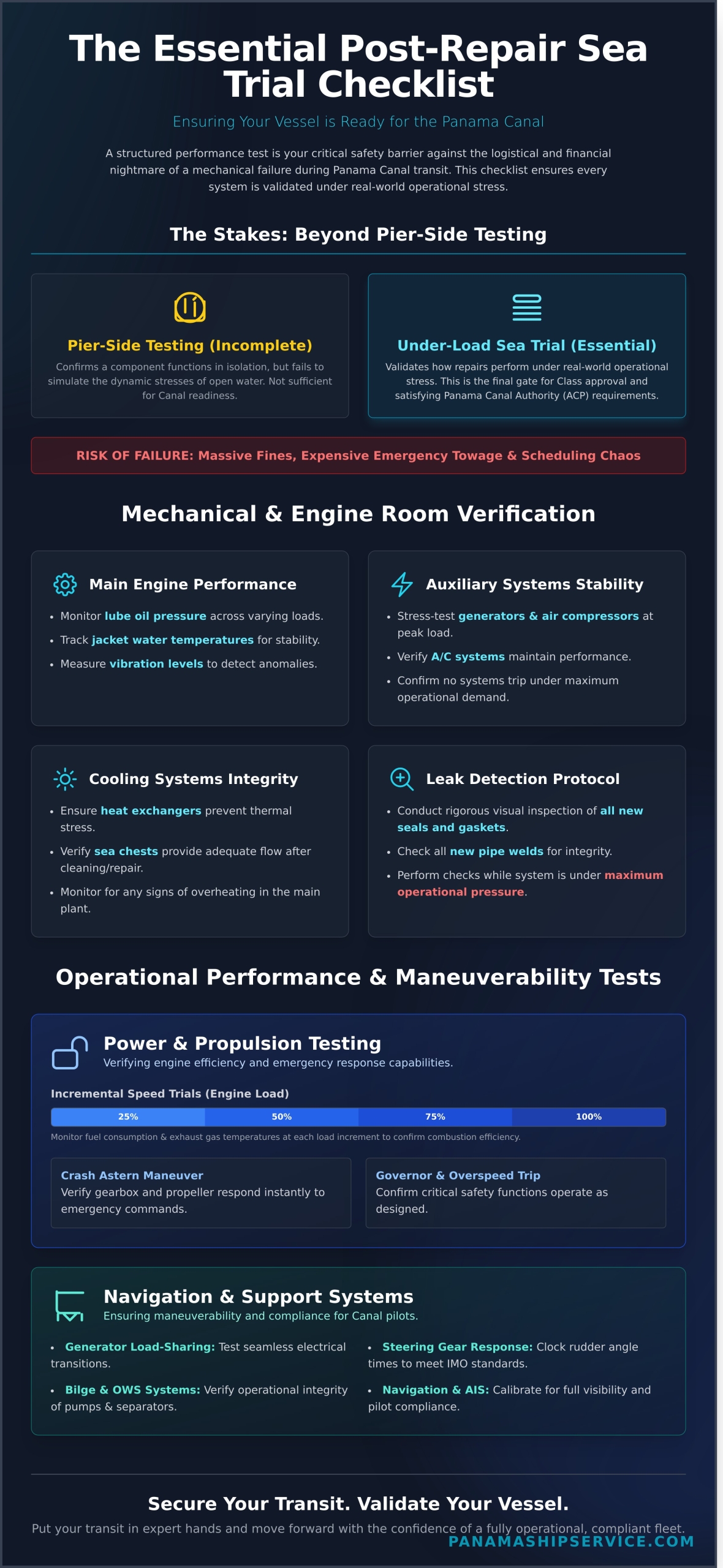
A sea trial is a structured performance test designed to verify that mechanical, structural, or underwater repairs meet strict operational standards. For vessels preparing for a Panama Canal transit, this is not a mere formality; it is a critical safety barrier. The high stakes of the Canal mean that a mechanical failure during transit is a logistical and financial nightmare. A disabled vessel in the locks leads to massive fines, expensive emergency towage, and scheduling disruptions that can cost ship owners hundreds of thousands of dollars.
It is vital to distinguish between “pier-side” testing and “under-load” sea trials. While pier-side tests confirm that a component functions in isolation, only a sea trial validates how repairs perform under the dynamic stresses of open water. This process serves as the final gate for Class approval and insurance validation. Utilizing a comprehensive post-repair sea trial checklist ensures that every system-from propulsion to steering-is ready to handle the unique demands of the Isthmus.
The Difference Between Pre-Purchase and Post-Repair Trials
While pre-purchase trials assess the overall condition of a vessel, post-repair trials focus specifically on “delta” performance. This involves comparing new operational results against pre-repair baselines to ensure the repair has restored or improved the vessel’s capabilities. We focus intensely on specific repair zones, such as mechanical overhauls, steel structural integrity, or underwater hull surfaces. Verification of specialized components like rudders, propellers, and sea chests is mandatory to ensure the vessel remains responsive in the tight confines of the Canal.
Regulatory Requirements and ACP Readiness
The Panama Canal Authority (ACP) has zero tolerance for vessels with compromised maneuverability. As your trusted partner at the Panama Canal, we understand that “timing is everything.” Your post-repair sea trial checklist must produce the specific documentation required by pilots and port authorities to prove the vessel is fit for transit. We are experts so you don’t have to be, ensuring your ship meets all local protocols and regulatory requirements before the pilot steps on board. This proactive approach minimizes vessel expenses and prevents the “difficult and frustrating” delays associated with failed inspections.
Mechanical and Engine Room Verification Checklist
The engine room is the heart of any maritime operation. Following major overhauls or routine maintenance, a comprehensive post-repair sea trial checklist is the only way to ensure your vessel is ready for the rigors of open ocean transit or a demanding Panama Canal crossing. Precision in the engine room prevents costly delays and ensures crew safety.
During the trial, technical teams must focus on four critical areas of mechanical integrity:
- Main Engine Performance: Monitor lube oil pressure, jacket water temperatures, and vibration levels across varying load increments.
- Auxiliary Systems: Stress-test generators, air compressors, and A/C systems to ensure they handle peak operational loads without tripping.
- Cooling Systems: Verify that heat exchangers and sea chests provide adequate flow after cleaning or repair, preventing thermal stress on the main plant.
- Leak Detection: Conduct a rigorous visual inspection of all seals, gaskets, and new pipe welds while the system is under maximum operational pressure.
Power and Propulsion Testing
Testing begins with incremental speed trials. We monitor fuel consumption and exhaust gas temperatures (EGT) at 25%, 50%, 75%, and 100% load to confirm the engine’s combustion efficiency. Critical safety validations include governor response and overspeed trip testing. To ensure the vessel can handle emergency scenarios, we perform “crash astern” maneuvers, verifying that the gearbox and controllable-pitch propeller respond instantly to bridge commands without mechanical hesitation.
Auxiliary and Support System Checks
Modern vessels rely on complex electrical and hydraulic support. We perform load-sharing tests on multiple generators to ensure seamless transitions and electrical stability during high-demand maneuvers. Steering gear response times are clocked to ensure rudder angle accuracy meets IMO standards. Furthermore, we verify the operational integrity of bilge pumps and MARPOL-compliant oily water separators.
By adhering to these rigorous internal protocols and cross-referencing results with the Common Marine Inspection Document (eCMID), operators can validate that their vessel meets the highest international safety benchmarks. This systematic approach ensures that your post-repair sea trial checklist provides the documented proof of reliability required by charterers and port authorities alike. We are the experts in technical verification so you can focus on your transit with total confidence.
Structural and Underwater Integrity Post-Repair
The structural integrity of a vessel is its first line of defense. During the sea trial, the hull is subjected to hydrodynamic pressures and vibration levels that cannot be replicated in a dry dock or at the pier. A comprehensive post-repair sea trial checklist must prioritize the verification of all steel fabrication and underwater maintenance to ensure the vessel is fit for service and to prevent costly operational delays.
- Steel Fabrication Integrity: Inspect new welds and plates for signs of stress, weeping, or seepage. High-speed maneuvers and heavy seas test the flexibility and strength of recent structural repairs under pressure.
- Underwater Hull Condition: Confirm the effectiveness of anti-fouling applications. A smooth hull is essential for minimizing drag and maximizing transit efficiency.
- Propeller Efficiency: Measure the “delta” in fuel efficiency. Professional polishing and repair should result in a measurable increase in speed relative to fuel consumption and RPM.
- Rudder and Zinc Anodes: Ensure all cathodic protection components and steering gear are secure. Loose anodes or misaligned rudders can lead to severe corrosion and steering failure.
Verifying Underwater Hull Services
Efficiency in the shipping industry is driven by data. Compare speed-to-fuel ratios against pre-repair benchmarks to validate the quality of underwater cleaning services. If unusual vibrations occur at specific RPM ranges, it likely indicates a propeller imbalance or residual fouling. If anomalies are detected, we recommend immediate visual verification via an underwater drone or diver post-trial. This proactive approach ensures your vessel operates at peak performance, helping to minimize expenses and save time.
Steel and Tank Repair Validation
Validation must extend to the internal structures. Conduct a thorough internal inspection of repaired tanks to check for “sweating” or structural movement during heavy sea states. It is also critical to verify the integrity of sea chest gratings and intake valves following underwater maintenance. Ensure that all sandblasting and painting areas remain intact after exposure to high-velocity water flow. Including these steps in your post-repair sea trial checklist ensures that all technical services meet the high standards required for a safe and efficient transit.
Operational Performance and Navigation Systems Testing
Once mechanical works are finalized, the focus must shift to the vessel’s integrated systems. Technical repairs are only successful if the ship’s “brain” and its ability to execute commands remain uncompromised. A comprehensive post-repair sea trial checklist must prioritize the synchronization of navigation and communication hardware, as even minor electrical or A/C repairs can inadvertently de-calibrate sensitive electronics.
During this phase, prioritize the following system verifications:
- ENC and GPS Calibration: Re-verify coordinates and chart overlays. Post-repair electrical surges can cause offset errors that lead to dangerous positioning discrepancies.
- Radar and AIS Integrity: Ensure your vessel is fully visible to Canal pilots and Vessel Traffic Services (VTS). Faulty AIS data is a frequent cause of transit delays and regulatory fines.
- Bridge-to-Engine Room Communication: Test all telegraph speed increments and emergency backup systems. There must be zero latency between the bridge command and engine room execution.
- Draft and Trim Assessment: Significant steel replacement or cargo gear repairs can alter the vessel’s center of gravity. Confirm the ship sits according to its stability plan before entering restricted waters.
Maneuverability and Steering Trials
Testing the steering gear is a critical component of any post-repair sea trial checklist. We recommend executing full “S-turns” at varying speeds to monitor rudder response times and vessel stability. For ships transiting the Panama Canal, lateral thruster performance is paramount for precise lock entry. Furthermore, verify that the emergency steering system meets all SOLAS and ACP standards to ensure you are never a liability in the channel.
Safety and Emergency Equipment Verification
Operational safety extends beyond navigation. If repairs involved mechanical overhauls, test all fire pumps and fire-fighting systems under full load to ensure pressure integrity. For vessels that underwent structural work near the boat deck, perform a functional test of lifeboat davits and release mechanisms. Finally, conduct a rigorous walkthrough of all “hot work” areas; dormant sparks can smolder for hours, and a final inspection ensures the vessel remains fire-safe after technicians disembark.
At Panama Ship Service, we provide the expertise needed to navigate these technical requirements efficiently. Put your transit in our hands by visiting panamashipservice.com.
Expert Oversight: How Panama Ship Service Validates Vessel Readiness
In the high-stakes environment of the maritime industry, timing is everything. Misjudging your repair schedule or trial requirements can lead to mounting costs and lost transit slots. Panama Ship Service offers a “one-stop-shop” advantage, coordinating mechanical repairs, technical surveys, and sea trials simultaneously to maximize operational efficiency. With over 20 years of experience navigating the specific technical and regulatory challenges of the Panama Canal, we act as your trusted partner on the ground.
Our “experts so you don’t have to be” philosophy is specifically designed to reduce owner anxiety and streamline complex workflows. We manage the technical nuances and provide constant daily communication, ensuring you are informed of every milestone. By utilizing a rigorous post-repair sea trial checklist, our team validates that every repair meets international standards and local requirements before your vessel resumes its voyage.
Consolidated Technical Services in Panama
We streamline vessel maintenance by integrating diverse technical requirements into a single service window. Our rapid response teams in Balboa and Cristobal are equipped to handle emergency repairs and essential compliance tasks with precision. Our integrated services include:
- Emergency mechanical and electrical repairs to minimize vessel downtime.
- Certified MARPOL disposal and class-approved underwater hull surveys.
- Provision of all necessary documentation and certificates for a seamless Canal transit.
Get Your Vessel Back to Sea
A professional, documented sea trial is more than a safety formality; it is a critical investment in your vessel’s long-term ROI. It provides the data-backed assurance that your ship can handle the rigors of open-sea operations without unexpected failure. By entrusting your post-repair sea trial checklist to our qualified technicians, you eliminate guesswork and ensure a safe, timely departure from Panamanian waters.
Put your transit in the hands of seasoned professionals who prioritize your schedule and your bottom line. Contact Panama Ship Service for a comprehensive ship repair quote today.
Ensure a Seamless Panama Canal Transit
Navigating the complexities of the Panama Canal requires absolute certainty in your vessel’s operational status. A rigorous post-repair sea trial checklist is your primary defense against unexpected mechanical failures, structural issues, or navigation system errors that can lead to costly delays. By systematically verifying engine room performance and underwater integrity, you protect your schedule and your bottom line. Expert oversight is not just a recommendation; it is a critical component of maritime safety and efficiency.
Panama Ship Service is your trusted partner at the Panama Canal, offering a one-stop-shop for all technical and operational requirements. With over 20 years of specialized expertise and 24/7 emergency repair availability, we provide the rapid response and reliable solutions needed in this high-stakes environment. We are experts so you don’t have to be. Put your transit in our hands and ensure your vessel is fully validated for its next voyage.
Ready to verify your vessel’s readiness? Request a Professional Ship Repair & Sea Trial Quote today. We are here to ensure your ship remains compliant, efficient, and ready for the challenges of 2026 and beyond.
Frequently Asked Questions
What is the typical duration of a post-repair sea trial for a commercial vessel?
The duration varies based on the scope of work. For standard mechanical repairs, a trial typically lasts between 4 to 8 hours. However, major engine overhauls or propulsion system replacements may require 12 to 24 hours of continuous operation to reach thermal stability. Utilizing a detailed post-repair sea trial checklist ensures that every hour spent on the water is used efficiently to verify operational integrity.
Does the Panama Canal Authority require a sea trial after all mechanical repairs?
The Panama Canal Authority (ACP) does not mandate a trial for every minor fix, but it strictly requires proof of maneuverability for critical systems. Any repair affecting propulsion, steering, or electrical power must be verified before the vessel is cleared for transit. Panama Ship Service helps owners coordinate these trials to prevent costly delays or the mandatory use of expensive tug assistance during the canal passage.
How many engineers should be present during a post-repair sea trial?
A minimum of three to five qualified engineers should be present to ensure comprehensive monitoring. This team usually includes the vessel’s Chief Engineer, the Second Engineer, and specialized OEM technicians. Multiple experts are necessary to simultaneously track bridge commands and engine room responses, ensuring every technical parameter on your post-repair sea trial checklist is validated under real-world load conditions.
What happens if a ship fails its post-repair sea trial near the Canal?
If a vessel fails its trial, it must return to a designated anchorage or repair berth to rectify the issue. This often results in the loss of a scheduled transit slot and increased port expenses. As your trusted partner at the Panama Canal, we provide rapid-response technical teams to address failures immediately, minimizing your downtime and getting the vessel back into service as quickly as possible.
Can underwater hull cleaning be verified during a sea trial without divers?
Yes, hull cleaning effectiveness can be verified through speed-power trials. By comparing current RPM and fuel consumption data against the vessel’s original performance baselines, engineers can accurately measure the reduction in hull friction. While diver inspections provide visual confirmation, the sea trial provides the pragmatic data ship owners need to confirm that the vessel has regained its fuel efficiency and speed capabilities.
What are the most common mechanical failures discovered during sea trials?
The most frequent failures include hydraulic leaks, sensor calibration errors, and overheating in newly installed bearings. We also commonly identify vibration issues caused by minor misalignments in the shafting or propulsion systems. Detecting these “infant mortality” failures during a controlled trial is essential to prevent catastrophic breakdowns during a voyage, ensuring the safety of both the crew and the cargo.
How does a sea trial impact the vessel’s MARPOL compliance status?
Sea trials are used to verify that environmental protection equipment, such as Oily Water Separators (OWS) and exhaust gas cleaning systems, function correctly under full load. This testing is vital for maintaining MARPOL compliance. A successful trial demonstrates that the vessel can operate without risk of illegal discharges, protecting the owner from the severe legal and financial penalties associated with environmental non-compliance.
Is a sea trial necessary after minor steel fabrication or welding work?
For minor above-waterline fabrication or internal welding, a sea trial is generally not required; static pressure tests or non-destructive testing (NDT) are usually sufficient. However, if the welding involved structural repairs below the waterline or affected the vessel’s watertight integrity, a trial is highly recommended. This ensures the repairs can withstand the dynamic stresses and hull flexing encountered during standard sea-going operations.