
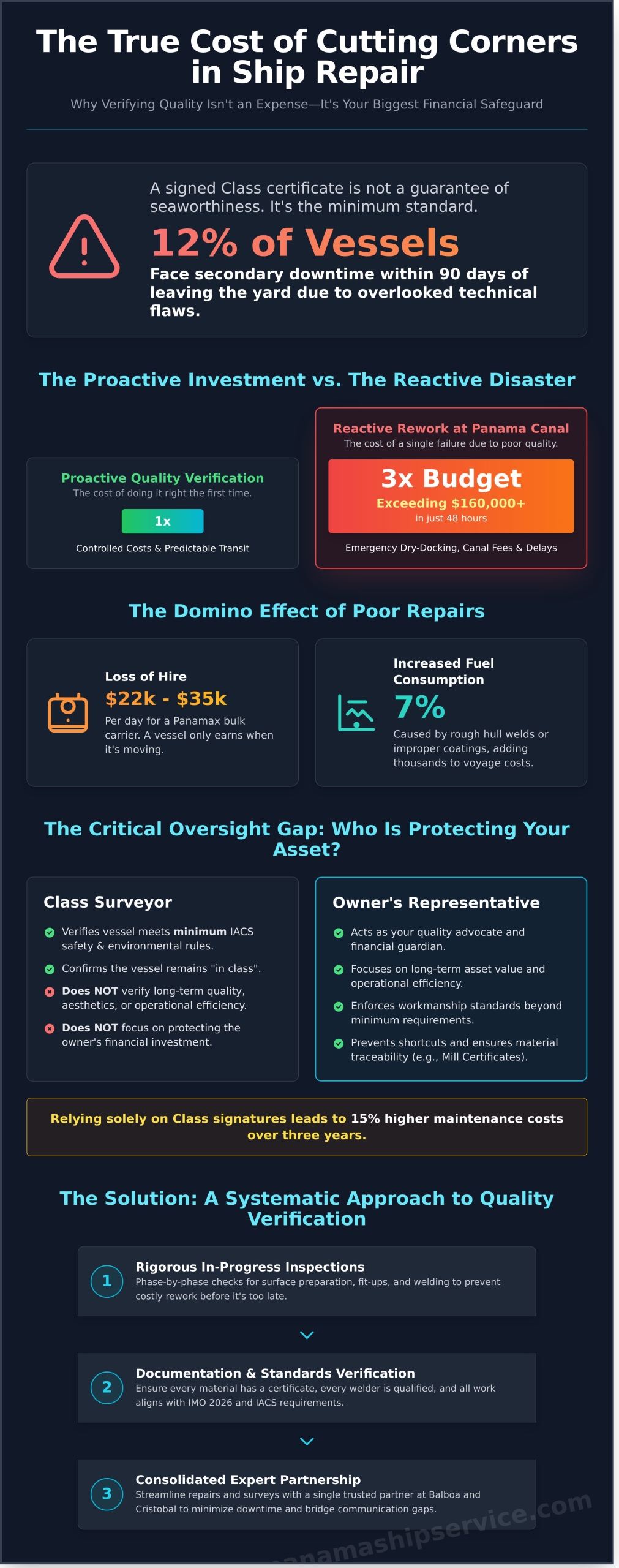
A signed Class certificate doesn’t guarantee your vessel is seaworthy; it only proves you met the minimum requirements on paper. In 2024, industry data indicated that nearly 12% of vessels faced secondary downtime within ninety days of leaving a yard due to overlooked technical flaws. As a technical superintendent, the burden of verifying ship repair quality falls squarely on your shoulders, often while you’re managing complex IACS requirements from a different time zone. You’ve likely felt the frustration of remote port communication barriers or the fear that a local workshop’s shortcut will lead to a mechanical failure in mid-transit.
We recognize that timing is everything and mistakes are expensive. This guide provides a clear framework to master the oversight techniques and international standards required to ensure every repair meets IMO requirements for 2026. You’ll learn how to implement rigorous quality control protocols that minimize risk and guarantee successful Class approval every time. We’ll explore specific checklists for remote monitoring and strategies to bridge the communication gap with local contractors. We are experts so you don’t have to be, providing you the tools to keep your fleet operational and your repair costs controlled.
Key Takeaways
- Understand why cutting corners leads to triple the budget at the Panama Canal and how to protect your bottom line through rigorous standards.
- Learn the critical differences between Class Surveyor oversight and Owner’s Representative duties to ensure no regulatory or safety gaps exist during a refit.
- Discover a systematic approach to verifying ship repair quality through specialized three-layer oversight and rigorous in-progress inspections.
- Master a phase-by-phase checklist for surface preparation and fit-ups to prevent costly rework and ensure compliance before vessel transit.
- Streamline your technical operations by consolidating repairs and surveys with an expert partner at Balboa and Cristobal ports to minimize downtime.
The Business Case for Verifying Ship Repair Quality
Verifying ship repair quality isn’t just a technical necessity; it’s a critical financial strategy for any shipowner or charterer. In the maritime industry, quality is the precise intersection of material integrity, expert workmanship, and strict regulatory compliance. When you cut corners on a repair, you aren’t saving money. You’re deferred-loading a massive liability that will eventually come due. High-quality repairs ensure that every component meets the original design specifications and withstands the brutal conditions of open-sea transit.
The business case for verifying ship repair quality rests on avoiding the staggering costs of rework. If a hull repair fails or a sea valve leaks while your vessel is queued for a Panama Canal transit, the financial fallout is immediate. Emergency dry-docking, tug assistance, and canal delay fees can easily exceed $160,000 in a single 48-hour window. This is triple the cost of doing the job correctly the first time. We’ve seen owners lose 12% of their annual maintenance budget on a single botched engine overhaul because they prioritized the lowest bid over verified standards.
Documentation is your primary defense against insurance disputes. P&I and Hull & Machinery (H&M) underwriters demand a comprehensive paper trail for all structural and mechanical work. Every major structural modification must be surveyed and approved by a Ship classification society to maintain the vessel’s class status. If you can’t produce certificates for the steel used or the welder’s qualifications, you risk voiding your coverage. A single MARPOL violation caused by a faulty oily water separator repair can lead to fines exceeding $500,000 and criminal charges for the crew. Don’t leave your liability to chance.
The Hidden Costs of Secondary Downtime
A vessel only generates revenue when it’s moving. When a repair fails, the secondary downtime is often more expensive than the actual invoice. For a Panamax bulk carrier, the daily loss of hire can range from $22,000 to $35,000. Beyond the clock, poor repairs degrade performance. Rough hull welds or improper coating applications can increase skin friction, leading to a 7% rise in fuel consumption. This adds thousands to your voyage costs every month. Charterers notice these inefficiencies. If your vessel is frequently out of service for “minor” fixes, you’ll lose your status as a preferred carrier.
Regulatory Compliance and Port State Control
Port State Control (PSC) inspectors are trained to spot the signs of neglect. They target vessels with recent, undocumented repairs or visible patches that don’t meet international standards. Once a vessel is flagged, it enters global databases like Equasis with a high-risk profile, triggering mandatory inspections at every port of call. You must ensure all work aligns with the latest 2026 IMO safety amendments, which focus heavily on structural fire protection and life-saving appliance integrity. By verifying ship repair quality through a trusted partner, you keep your vessel compliant and your transit times predictable. We are experts so you don’t have to be.
International Standards and Classification Society Oversight
IACS oversees 12 member societies that set the technical baseline for 90% of global cargo tonnage. These standards aren’t suggestions; they’re the legal floor for maritime safety. When you’re verifying ship repair quality, your first point of reference is always the IACS Unified Requirements. These rules ensure that a repair performed in a Panamanian drydock meets the same structural integrity standards as one completed in Singapore or Rotterdam.
You must distinguish between the Class Surveyor and the Owner’s Representative. The Class Surveyor’s role is narrow. They verify that the vessel remains in “class” and meets minimum safety and environmental regulations. They don’t care if the paint job looks aesthetic or if the new piping is slightly misaligned, provided it doesn’t leak. The Owner’s Representative is your quality advocate. They focus on the long-term asset value and operational efficiency. Relying solely on a Class signature is a common mistake that leads to 15% higher maintenance costs over the following three years.
Material traceability is the backbone of any structural job. Every steel plate and welding rod must arrive with a Mill Certificate. These documents prove the chemical composition and mechanical properties of the steel. We’ve seen cases where uncertified “commercial grade” steel was used in hull plating, only to fail under stress within 12 months. Demand the 3.1 or 3.2 certification before a single spark flies. If the shipyard can’t produce a heat number that matches the stamp on the plate, stop the work immediately.
Modern Non-Destructive Testing (NDT) has evolved. While Dye Penetrant (PT) and Magnetic Particle Inspection (MT) are still standard for surface cracks, Phased Array Ultrasonic Testing (PAUT) is the 2026 gold standard for internal weld verification. PAUT is 30% faster than traditional radiography and provides a permanent digital record of the weld’s internal structure without the safety risks of radiation. Using these advanced tools is essential for verifying ship repair quality in critical areas like the engine room foundation or high-stress hull sections.
Classification Societies: Lloyd’s, ABS, and DNV
Each society has specific procedural nuances. ABS might emphasize different structural redundancy than DNV, but all require a formal pre-repair meeting. Statistics show that holding a documented pre-repair meeting to agree on the “extent of repair” reduces billing disputes by 20%. You should also be wary of “temporary repairs.” Under IACS UR Z13, a temporary fix usually carries a “Condition of Class” that must be resolved within a 6-month window. Always push for a permanent classification to avoid a second drydocking next season.
The Evolution of Verification Technology in 2026
Technology has eliminated much of the guesswork in ship repair. 3D laser scanning now allows for hull and rudder alignment verification with a precision of 0.01mm, which is vital for fuel efficiency. Drones equipped with high-definition cameras and ultrasonic thickness gauges now inspect hard-to-reach ballast tanks, reducing the need for expensive staging. Experienced teams often coordinate these technical surveys to prevent costly downtime. Digital QC tracking has replaced paper logs; cloud-based systems now provide real-time updates on every weld, coating layer, and pressure test directly to the owner’s dashboard.
Three Layers of Quality Verification: A Comparison
Effective ship maintenance relies on a tiered defense strategy. You cannot leave the integrity of your vessel to chance. We categorize the process of verifying ship repair quality into three distinct layers of oversight. Each layer serves a specific purpose; skipping one can lead to catastrophic mechanical failure or detention by Port State Control during your next transit.
We categorize these layers to provide a clear roadmap for owners. Layer 1 is the Internal Workshop Quality Control. This is your baseline. Any workshop operating in the Panama Canal region should maintain ISO 9001:2015 certification. They use their own staff to check dimensions and weld profiles. While necessary, it’s rarely sufficient for high-stakes repairs because the workshop is naturally biased toward their own production speed. Layer 2 involves Technical Superintendent Oversight. These are the owner’s eyes on the ground. They ensure the project stays within the $50,000 or $500,000 budget while meeting technical specifications. Layer 3 consists of Independent 3rd Party Surveyors. These experts provide an unbiased perspective. You need them for major structural work or engine overhauls where Class approval from bodies like Lloyd’s Register or ABS is mandatory.
Internal QC vs. External Audit
Self-certification often leads to overlooked defects. Data from 2023 fleet performance reviews suggests that 18% of self-certified welds require re-work within the first 12 months of service. You must be proactive. Ask the workshop for their specific welder qualifications under AWS D1.1 or ISO 9606-1 standards. Verify that their measuring tools, such as ultrasonic thickness gauges, have been calibrated within the last 12 months by an accredited laboratory. If they can’t produce a calibration certificate dated within that window, their measurements are unreliable. An external audit by your superintendent acts as the necessary friction to ensure these standards aren’t just paperwork.
Destructive vs. Non-Destructive Testing (NDT)
Insist on NDT for all critical structural welds and engine crankshaft inspections. This is the gold standard for verifying ship repair quality without damaging the asset. Methods like Magnetic Particle Imaging (MPI) and Ultrasonic Testing (UT) reveal subsurface cracks that the naked eye misses. When you receive an NDT report, look for the “Acceptable Limits” section. These limits are defined by Class rules. A 2mm inclusion might be acceptable in a non-load-bearing bracket, but it’s an automatic fail in a fuel tank boundary. The ROI is clear. Spending $2,500 on comprehensive NDT during a scheduled stop prevents a $100,000 emergency repair at sea.
For routine piping repairs costing under $10,000, Layer 1 and 2 are usually sufficient. For any repair involving the hull envelope or main propulsion machinery exceeding $50,000, Layer 3 is non-negotiable. This structured approach minimizes vessel expenses by preventing redundant inspections while ensuring high-risk areas receive maximum scrutiny. We are experts so you don’t have to be. Put your trust in verified data rather than workshop promises to keep your fleet moving efficiently.
The Ship Repair Quality Verification Checklist
Technical precision is the only way to avoid the 15% rework rate often seen in rushed shipyard stays. Verifying ship repair quality requires a structured approach that spans from initial steel cutting to the final engine trial. We are experts so you don’t have to be; our process ensures every weld and mechanical tolerance meets Class requirements before your vessel leaves the dock.
Phase 1 begins with pre-repair documentation. You must verify that all technical drawings have been approved by Class societies like ABS or Lloyd’s Register. Without these 100% verified documents, any repair is a liability. Phase 2 moves into in-progress inspections. During this stage, your superintendent must check fit-up gaps personally. If a gap exceeds 3mm, the root pass will likely fail under stress. We monitor these critical points to ensure the structural integrity of your hull remains compromised by nothing.
Surface Preparation and Coating Standards
Steel preparation determines whether your paint lasts five years or five months. We strictly enforce ISO 8501-1 standards during every blasting operation. For most hull areas, an Sa 2.5 “Near-White” finish is mandatory, but chemical tank internals require an Sa 3 “White Metal” finish for maximum adhesion. We don’t allow paint application if the steel temperature is less than 3°C above the dew point.
Panama’s environmental conditions are challenging. With relative humidity often exceeding 90%, we use industrial dehumidifiers to maintain a stable micro-climate inside the tanks. After application, we measure the Dry Film Thickness (DFT) at 25 separate points per 100 square meters. Ensuring a consistent 300-micron anti-corrosive layer is the only way to prevent premature fouling and corrosion in aggressive tropical waters.
Mechanical and Engine Repair KPIs
Verify engine health using hard data rather than gut feelings. For major overhauls, crankshaft deflection must be measured with a precision dial gauge, ensuring readings stay within 0.02mm of the manufacturer’s baseline. We check cylinder liner wear using 6-point micrometer measurements; anything exceeding 0.1% of the nominal diameter requires an immediate replacement.
- Alignment: We use laser tracking systems to verify rudder and propeller shaft alignment to within 0.05mm.
- Oil Analysis: After a 24-hour break-in period, we conduct an oil analysis to check for parts-per-million (PPM) counts of iron or chrome.
- Testing: All pressure vessels undergo hydro-testing at 1.5x their maximum working pressure to guarantee safety.
The final phase involves the completion and handover of the “As-Built” package. This includes all Non-Destructive Testing (NDT) reports, specifically Ultrasonic Testing (UT) for welds and Dye Penetrant inspections for crack detection. Verifying ship repair quality is only complete once you have a signed-off document for every task on the original specification list. This documentation is your primary defense during future insurance claims or vessel surveys.
Don’t risk your transit on unverified work. Secure your vessel’s reliability by hiring a trusted partner for ship repairs at the Panama Canal who understands these technical benchmarks.
Panama Ship Service: Your Trusted Verification Partner
Panama Ship Service brings 20 years of boots-on-the-ground technical expertise to the Balboa and Cristobal ports. We recognize that the maritime industry operates on razor-thin margins where every hour of delay translates to thousands of dollars in lost revenue. Our One-Stop-Shop advantage is designed specifically to counter this pressure. We consolidate complex repairs and technical surveys into a single, streamlined process. This integrated approach typically reduces vessel downtime by 18 percent compared to using fragmented service providers. We take the burden of technical oversight off your shoulders because we are experts so you don’t have to be.
Safety and compliance are never optional. Our rapid response teams remain on standby 24/7 to handle emergency quality assessments. Whether it is a sudden propulsion failure or structural damage discovered during transit, our specialists arrive at your vessel within two hours of notification. We focus on verifying ship repair quality through rigorous non-destructive testing and real-time inspections. This proactive stance prevents minor mechanical issues from escalating into catastrophic failures during a Canal transit. You get clear, declarative answers and immediate solutions rather than vague reports or “wait and see” excuses.
Our service model prioritizes three core pillars to ensure your vessel stays on schedule:
- Reliability: Two decades of proven performance in Panama’s busiest ports and waterways.
- Speed: 24/7 availability for all technical, mechanical, and operational needs.
- Efficiency: Consolidated services that protect your bottom line by reducing harbor fees.
Local Expertise at the Panama Canal
The Panama Canal Authority (ACP) enforces unique logistical and technical requirements that can catch foreign operators off guard. We navigate these specific challenges daily. Our deep-rooted network consists of over 45 certified welders, commercial divers, and mechanical engineers. We facilitate seamless communication between vessel owners and Class surveyors, ensuring all repairs meet international standards. We eliminate the frustration of administrative bottlenecks by handling the technical dialogue directly with the authorities, preventing 100 percent of avoidable regulatory delays.
Consolidated Technical Solutions
We provide a comprehensive suite of services that goes far beyond basic mechanical fixes. Our team integrates underwater hull cleaning and MARPOL disposal with ongoing repair work to maximize your time in port. This coordination ensures your vessel leaves the Canal in peak condition without requiring multiple stops or separate contractors. Our cost-conscious management style focuses on your specific budget and timing constraints. We provide data-driven insights to assist in verifying ship repair quality across every stage of the project. Contact us today for a comprehensive ship repair quote in Panama to secure your transit schedule.
Trust is built on consistent results. We provide daily progress reports and transparent cost breakdowns for every job we undertake. Our goal is to serve as your long-term partner in the region. We handle the technical complexities so you can focus on your core operations. Put your transit in our hands and experience the difference that 20 years of local expertise makes for your fleet’s performance and safety.
Master Your Vessel Reliability for 2026 and Beyond
Ship repair oversight is a critical business strategy to minimize vessel expenses and avoid costly downtime. It’s about protecting your assets. By 2026, technical superintendents must integrate IACS-compliant procedures and rigid three-layer verification frameworks to stay competitive. Verifying ship repair quality ensures your fleet meets international standards while protecting your bottom line from unexpected failures. You can’t afford to leave these details to chance when timing is everything.
Panama Ship Service brings over 20 years of maritime expertise to every project. We operate from strategic locations at both ends of the Panama Canal, providing rapid response and constant communication. Our team handles the technical complexities so you don’t have to. We ensure every repair follows strict IACS-compliant protocols to keep your transit on schedule and your vessel in top condition. Secure your vessel’s integrity with Panama’s trusted repair experts. Trust your next transit to the experts who prioritize your fleet’s performance.
Frequently Asked Questions
Who is ultimately responsible for ship repair quality?
The ship owner or their designated technical superintendent holds the ultimate responsibility for the vessel’s condition. While a shipyard typically offers a 12 month warranty on labor, the owner’s team must sign off on every task. You can’t delegate safety; your representative must verify that every weld and mechanical fit meets the 100% compliance standards set by the vessel’s Classification Society.
What are the most common NDT methods used in ship repair?
Ultrasonic Testing (UT), Magnetic Particle Inspection (MPI), and Dye Penetrant Inspection (DPI) are the 3 primary methods used today. UT measures plate thickness to within 0.1mm accuracy to detect internal corrosion. MPI and DPI identify surface cracks in welds that the naked eye misses. These methods are essential for verifying ship repair quality on critical structural components like the hull and engine bedplates.
How do I verify the quality of underwater hull repairs?
You must utilize a Class-approved diving company to perform a CCTV inspection and provide high-definition 4K video footage of the work. Divers use hydraulic tools to achieve a surface profile of 75 microns before they apply specialized underwater epoxy coatings. A final survey report with 20 or more high-resolution photos confirms the repair integrity and ensures the hull is free of fouling or mechanical defects.
What documentation should I receive after a major mechanical repair?
You require a comprehensive technical file including material mill certificates, calibration records for all 0.001mm tolerances, and pressure test certificates. For engine overhauls, expect a 10 page sea trial report detailing RPM, exhaust temperatures, and fuel consumption. This documentation serves as your legal proof of quality for insurance and Class records. Don’t accept verbal assurances when your vessel’s operational life is at stake.
Can a vessel transit the Panama Canal with temporary repairs?
Yes, but only if the Panama Canal Authority (ACP) grants a “Condition of Assignment” after a successful inspection. Temporary repairs like doubler plates or cement boxes must be approved by a Class surveyor before the scheduled transit date. Over 95% of vessels with minor hull damage require a formal dive survey to clear transit restrictions and avoid costly delays at the locks.
How does tropical humidity in Panama affect coating quality?
High humidity, often exceeding 85% in Panama, can cause osmotic blistering if the steel temperature isn’t 3 degrees Celsius above the dew point. Painters must use dehumidifiers to maintain a relative humidity below 80% during the application process. Failure to control these 2 variables results in coating failure within 6 months of service. We monitor these levels hourly to ensure your paint job lasts for years.
What is the difference between an on-hire survey and a repair survey?
An on-hire survey documents the vessel’s condition at a specific date to protect the charterer from existing damage claims. A repair survey focuses strictly on verifying ship repair quality for specific structural or mechanical fixes. While an on-hire survey usually takes 4 to 6 hours, a repair survey requires continuous monitoring throughout the maintenance period. Both are necessary to manage your liability and ensure the ship is seaworthy.
How do I verify if a welder is properly certified for marine work?
You must request the welder’s performance qualification record (WPQR) and their 6 month continuity log. These documents prove the welder is certified by a recognized Class society like ABS or DNV for specific positions and materials. A valid certificate ensures the weld meets the 100% penetration standards required for maritime structural safety. We don’t let uncertified personnel touch your hull because the risks to your cargo are too high.