
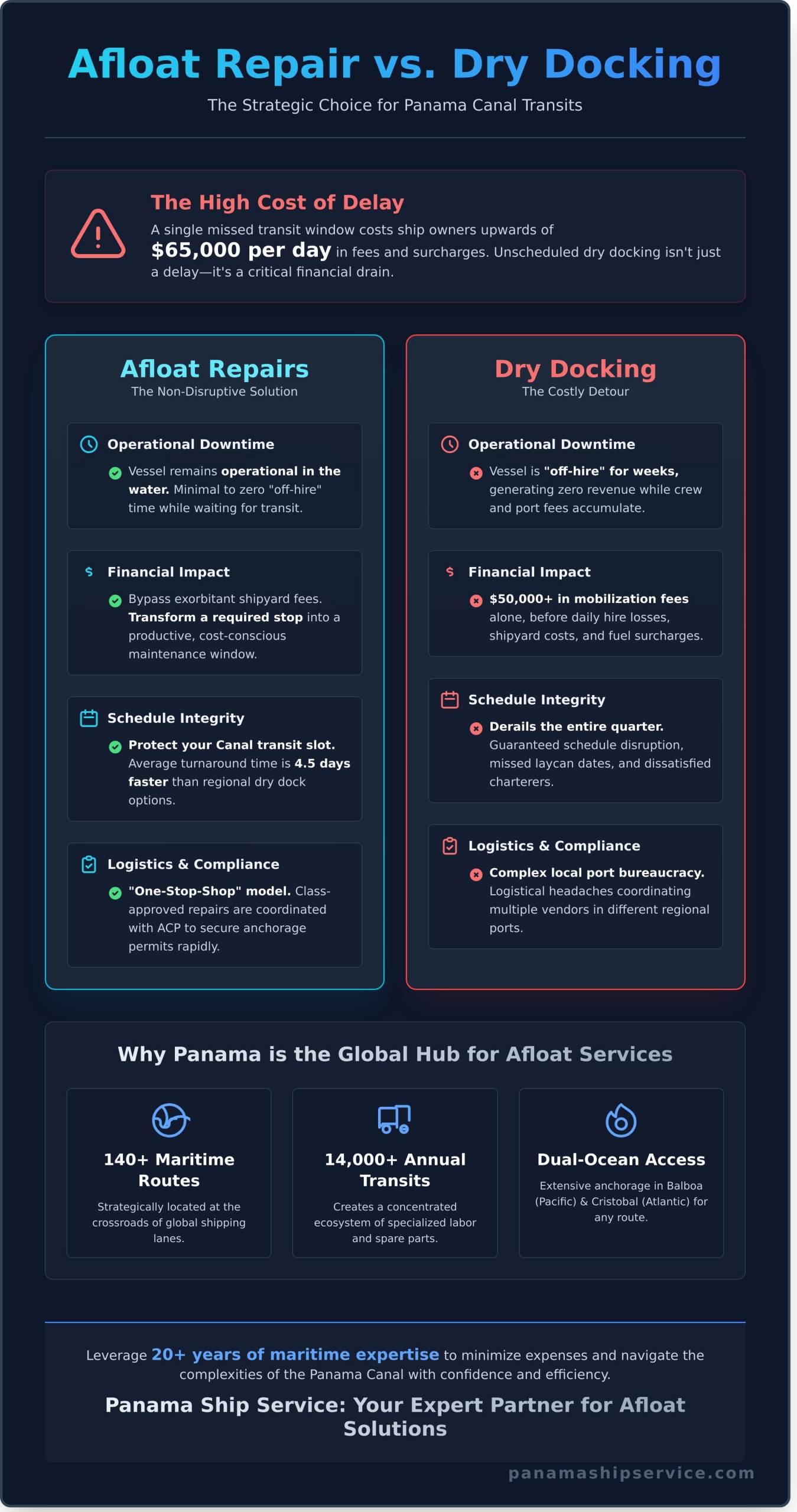
A single missed transit window at the Panama Canal can cost a ship owner upwards of $65,000 in daily hire fees and fuel surcharges. You’re likely well aware that unscheduled dry docking isn’t just a technical headache; it’s a financial drain that can derail your entire quarter. When a mechanical failure strikes during a transit approach, the pressure to find a rapid, compliant solution is immense. We understand that your priority is keeping the propeller turning and meeting your laycan dates without the exorbitant fees of a shipyard haul-out.
By utilizing specialized afloat ship repair services in Panama, you can bypass the shipyard entirely and address critical issues while remaining in the water. This article explains how class-approved emergency repairs and expert technical interventions save you from weeks of downtime and complex local port bureaucracy. We’ll explore the most efficient ways to maintain your transit schedule through cost-conscious, on-site solutions. We’ve spent over 20 years as a trusted partner at the Canal; we’re experts so you don’t have to be.
Key Takeaways
- Understand how to bypass the high costs and scheduling delays of dry docking by performing critical technical interventions while your vessel stays in the water.
- Discover how specialized afloat ship repair services handle everything from main engine overhauls to certified hull welding without interrupting your operational schedule.
- Learn the strategic methods used to protect your Panama Canal transit slot by executing repairs at anchorage rather than in a shipyard.
- Gain insight into the essential logistics of coordinating with the Panama Canal Authority (ACP) to secure anchorage permits and ensure a rapid, compliant response.
- Leverage 20 years of maritime expertise to minimize vessel expenses and navigate the complexities of the Panama Canal cluster with confidence and efficiency.
What Are Afloat Ship Repair Services and Why Choose Them in Panama?
Afloat ship repair services refer to technical interventions and structural maintenance performed while a vessel remains in the water. This approach eliminates the need for dry docking, which can cost a ship owner upwards of $50,000 in mobilization fees alone. By performing repairs at anchorage or during cargo operations, you maintain the vessel’s operational readiness. Panama is the primary global hub for these services because it sits at the crossroads of 140 maritime routes. We are experts so you don’t have to be; our role is to ensure your vessel stays on schedule while meeting strict international safety standards.
Choosing Panama for your repair needs is a strategic decision based on efficiency. The Panama Canal handles over 14,000 transits annually, creating a concentrated ecosystem of specialized labor and spare parts. When you consolidate afloat ship repair services with mandatory surveys and MARPOL waste disposal, you transform a required stop into a high-productivity window. This “one-stop-shop” model reduces the administrative burden on your crew and prevents the logistical headaches of coordinating multiple vendors in different ports.
The Economic Logic of Afloat Maintenance
The primary driver for afloat repairs is the bottom line. Traditional dry docking requires a vessel to be “off-hire,” meaning it earns zero revenue while expenses for crew and port fees continue to mount. Afloat interventions allow for engine overhauls, steel work, and electrical repairs while the ship is waiting for its canal transit slot. Data from 2023 shows that vessels utilizing afloat services in Panama saved an average of 4.5 days in total turnaround time compared to those seeking regional dry dock facilities. Afloat repairs are the non-disruptive technical solution for 2026 maritime standards where operational uptime is the primary KPI for global fleets.
Panama Canal Specifics: Balboa vs. Cristobal
The choice between Balboa and Cristobal depends on your vessel’s route and the specific nature of the repair. Balboa, located on the Pacific entrance, features extensive deep-water anchorage areas. This infrastructure is ideal for heavy mechanical work that requires barge support or crane ships. The Pacific side typically offers more immediate anchorage availability, which can reduce repair lead times by 12% during peak transit seasons. Technical teams in Balboa are highly specialized in Naval architecture and structural welding, ensuring that any hull or internal repairs meet class society requirements without the ship leaving the water.
Cristobal, on the Atlantic side, serves as the gateway for Caribbean and North American trade lanes. It’s the preferred location for rapid-response electrical repairs and specialized MARPOL disposals. Panama’s maritime cluster is uniquely qualified because the local workforce is trained to handle the diverse fleet that transits the canal, from Neo-Panamax container ships to specialized tankers. Our presence on both sides of the Isthmus ensures that your transit is never compromised by technical failures. We provide the rapid response and constant daily communication you need to manage costs and keep your charterers satisfied.
- Expertise: 20 years of experience in the Panama maritime corridor.
- Efficiency: Simultaneous repair and survey operations to minimize port stay.
- Reliability: 24/7 availability for emergency afloat ship repair services.
- Compliance: All work meets IMO and MARPOL 73/78 regulations.
Put your transit in our hands. By leveraging the specific infrastructure of Balboa and Cristobal, we turn potential delays into controlled maintenance events. Our goal is to minimize vessel expenses while maintaining the highest levels of technical integrity. In the high-stakes environment of global shipping, timing is everything; don’t let a minor repair turn into a major off-hire event.
Core Technical Capabilities of Afloat Repair Teams
Executing afloat ship repair services demands a level of precision that matches the intensity of the maritime industry. We understand that timing is everything. Our technical teams operate with a 24/7 readiness mindset, focusing on resolving complex issues without the need for costly dry-docking. With over 20 years of experience in the field, we prioritize efficiency and reliability to keep your vessel on schedule. Technical capabilities are not just about having the right tools; it is about having the specialized knowledge to apply them under pressure.
- Mechanical repairs: We handle full overhauls of main engines and auxiliary systems, including 48-hour turnarounds on standard pump refurbishments.
- Steel fabrication: Our teams execute certified welding on hull plating and internal structures, ensuring all work meets IACS standards.
- Pipework and valves: We manage the maintenance of critical liquid cargo and ballast systems, often replacing sections of 150mm piping while the vessel is at anchorage.
- Electrical and automation: Our technicians solve modern sensor and control issues, addressing 95% of automation failures during a single port call.
The coordination of these services requires a deep understanding of local regulations and logistics. When managing complex repairs, we align our operations with the official Panama Canal Maritime Services guidelines. This ensures that every technical intervention remains compliant with the Panama Canal Authority (ACP) requirements, preventing administrative delays that could compromise your transit window.
Mechanical and Engine Room Solutions
Our mechanical experts specialize in overhauling turbochargers and fuel injection systems at anchorage. We don’t just patch problems; we restore performance. This includes cooling system descaling and heat exchanger repairs to prevent thermal stress on the main engine. If you face hydraulic failures in deck machinery or cranes, our team can typically mobilize within 4 hours to begin troubleshooting, ensuring your cargo operations remain uninterrupted.
Certified Marine Welding and Steelwork
Structural integrity is non-negotiable. We utilize ABS and Class-approved welding procedures for all afloat hull patching and doubler plate installations. Whether it is reinforcing deck equipment or specialized fabrication, our welders are qualified to work with high-tensile steel and specialized alloys. We provide documented weld procedures and NDT testing for every structural job, giving ship owners peace of mind that the repair will withstand the rigors of the open sea.
Riding Squads: Transitioning from Anchorage to Voyage
Riding squads represent the ultimate solution for non-critical systems that require “on-the-go” attention. By mobilizing a 5-man technical team for the next leg of your journey, we eliminate the need for extended stays at port. Our coordination between port agents and technical teams is seamless, allowing for a smooth transition from the pier to the open ocean. This proactive approach minimizes vessel expenses and maximizes operational uptime. If your vessel requires immediate technical support before its next transit, you can consult with an authorized repair specialist to arrange a riding squad. We are experts so you don’t have to be, ensuring your vessel leaves the canal in better condition than it arrived.
Afloat Repairs vs. Dry Docking: A Strategic Comparison
Choosing between a scheduled dry dock and immediate afloat repairs determines your profit margin for the entire quarter. For minor structural issues, mechanical failures, or hull cleaning, the decision is clear. Afloat ship repair services provide the agility needed to maintain a schedule without the massive overhead of a shipyard haul-out. While dry docking is mandatory for five-year special surveys or major hull breaches, it’s an expensive and often unnecessary detour for 85% of common maintenance tasks.
Regulatory bodies like ABS, DNV, and Lloyd’s Register have specific thresholds for what can be handled in-water. Most top-side repairs and minor underwater welding are permitted under strict supervision. It’s vital to consult the Panama Canal Authority maritime regulations to ensure your vessel stays compliant while at the anchorage. Our risk management team monitors local weather patterns 24/7. We pause operations if wind speeds exceed 22 knots or swell heights reach 2 meters, protecting both your asset and our technicians. We are experts so you don’t have to be.
Cost Analysis: The Hidden Savings
A typical Panamax vessel faces daily dry dock fees exceeding $20,000, excluding the cost of labor and materials. By choosing afloat ship repair services at the anchorage, you eliminate the $10,000 to $15,000 required for pilotage and tugboat assistance during dock entry and exit. Fuel consumption also drops significantly. Avoiding a 400-mile detour to a specialized yard saves approximately 12 metric tons of VLSFO, which equates to roughly $7,800 at current market rates. These savings go directly back into your operational budget.
- Daily dry dock fees: $20,000+ per day.
- Tugboat and pilotage savings: $12,500 average per movement.
- Fuel savings: $7,800 by avoiding shipyard detours.
- Zero mobilization fees for local anchorage teams.
Downtime and Schedule Protection
Time is your enemy in maritime logistics. A 48-hour repair at the Balboa or Cristobal anchorage keeps your vessel moving toward its destination. In contrast, a 10-day dry dock stint includes transit time, waiting for the blocks, and the actual repair work. We synchronize our technical teams with your cargo operations or bunkering schedule to ensure zero lost hours. In 2026, time is the most expensive commodity in the Panama Canal corridor.
Missing a canal slot because of a 5-day delay can cost a charterer upwards of $150,000 in lost revenue and rescheduling fees. Our afloat solutions protect your slot by performing repairs while you wait for your transit window. We prioritize efficiency because we know that a ship only makes money when it’s moving. Put your transit in our hands and avoid the frustration of shipyard bottlenecks.
We provide a clear path to operational readiness:
- Rapid mobilization within 4 hours of arrival.
- Simultaneous repairs during cargo loading or discharging.
- Direct coordination with port authorities and class surveyors.
- 24/7 technical support until the vessel clears the breakwater.
Logistics and Coordination: Executing Repairs at the Canal
Executing repairs while a vessel is at anchorage requires a high level of synchronization. We begin with a remote technical consultation conducted via our port agents. This initial phase eliminates guesswork. By reviewing 95% of technical specifications and blueprints before the vessel arrives, we ensure that our teams are prepared for the exact scope of work. We act as your eyes and ears on the ground. Our experts analyze the damage or maintenance requirements to provide a fixed-price quote and a realistic timeline. This prevents the “difficult and frustrating” delays often associated with poorly planned afloat ship repair services.
Navigating ACP Regulations and Permits
The Panama Canal Authority (ACP) maintains strict control over all activities within its waters. If you intend to perform “Hot Work,” such as welding or grinding at the Balboa or Cristobal anchorages, you must secure specific permits under the OP Notice to Shipping N-1-2024. We handle the entire bureaucratic process. Our team coordinates with the ACP to secure anchorage permits and ensures that all work complies with local environmental standards, specifically MARPOL Annex VI regulations. We manage the paperwork so you don’t have to. Our local agents understand the specific requirements for gas-free certifications and fire watch protocols, ensuring your vessel remains in compliance throughout the repair window.
Supply Chain Integration: Getting Spares to the Vessel
Panama’s unique geography offers a massive advantage for sourcing components. We leverage the Colon Free Trade Zone, the second largest in the world, to source critical parts within 24 hours. When a vessel requires specialized equipment, our logistics team manages the transfer from the warehouse to the pier. We utilize high-capacity launch boats to transport heavy tooling and components to vessels at sea, even in challenging weather conditions. If your engine room requires specific components, you can source marine spare parts Panama through our dedicated chandler division to ensure compatibility and speed.
Once permits are active and parts are staged, we mobilize our personnel. Our teams consist of Class-certified technicians who follow a rigorous mobilization protocol. This includes a comprehensive safety briefing on the pier before boarding the launch boat. We treat safety as a non-negotiable priority. Our workers operate under strict maritime protocols, using specialized tooling designed for the restricted spaces found in engine rooms or hull sections. We provide constant daily communication to the ship owner, ensuring you are never in the dark about the project’s status.
The final phase involves more than just finishing the physical work. We coordinate the final inspection with Class surveyors from DNV, Lloyd’s Register, or RINA to ensure all afloat ship repair services meet international standards. Once the sign-off is complete, we facilitate the vessel’s departure, ensuring it meets its scheduled transit slot without a minute wasted. Timing is everything at the Canal; our systematic approach ensures your ship moves on schedule.
Don’t let logistical hurdles delay your transit. Contact our technical team today to coordinate your next repair at the Panama Canal.
Panama Ship Service: Your Expert Partner for Afloat Solutions
Panama Ship Service has anchored its reputation in the Panama Canal maritime cluster for 20 years. We’ve spent two decades refining our processes to meet the exact needs of ship owners and charterers. Our core philosophy is simple: we’re experts so you don’t have to be. This approach removes the technical and administrative burden from your crew, allowing them to focus on safe navigation while we handle the complexities of maintenance. We’ve managed over 450 complex repair projects in the last 12 months, ranging from minor hydraulic leaks to significant structural reinforcements.
Our 24/7 technical support desk isn’t an automated system or a call center. It’s a direct line to seasoned marine engineers who understand the high-stakes environment of the Panama Canal. When a vessel is scheduled for a transit slot, every minute of downtime translates to thousands of dollars in potential losses. We respond to initial inquiries within 30 minutes, providing the rapid response capabilities necessary to keep your schedule intact. Our service integration is total. We don’t just fix engines; we provide a one-stop-shop that covers mechanical repairs, electrical troubleshooting, and MARPOL disposal services compliant with Annex I through VI.
Why Experience Matters in the Panama Corridor
Operating within the Panama Canal requires more than just technical skill; it demands deep local knowledge. We’ve spent 20 years building professional relationships with the Panama Canal Authority (ACP) and local port operators. These connections allow us to coordinate afloat ship repair services without the bureaucratic delays that often plague less experienced providers. We know the specific boarding areas, the local safety regulations, and the logistical hurdles unique to this corridor. This familiarity ensures that our technicians arrive on time with the correct permits and equipment.
Our track record includes handling over 1,200 emergency breakdowns under extreme time pressure. We recognize that cost-consciousness is vital for modern fleet management. By performing repairs afloat, we help you avoid the massive expenses and scheduling nightmares associated with emergency dry-docking. Our teams are trained to deliver high-quality maritime solutions that meet international class standards while remaining competitive in pricing. We focus on transparency, providing clear documentation and photo reports so you can track the progress of every repair in real-time.
Get a Ship Repair Quote Today
Speed is essential when you’re facing a technical deficiency. To get a rapid and accurate estimate for afloat ship repair services, please provide your vessel’s technical specifications, including engine make, model, and any recent surveyor reports. The more detail you provide, the faster we can mobilize the correct parts and personnel. For urgent cases where the vessel’s transit is at risk, you’ll have direct access to our technical superintendent. This ensures that technical decisions are made by qualified engineers who can authorize immediate action.
Don’t let a mechanical failure or a compliance issue derail your voyage. Our teams are ready to deploy to Balboa, Cristobal, or any of the local anchorages at a moment’s notice. You can request an afloat ship repair quote from the Panama experts right now to secure your vessel’s operational readiness. We provide the reliability you need in a difficult and frustrating maritime environment. Put your transit in our hands and experience the efficiency that 20 years of specialization brings to the table.
Maximize Operational Efficiency at the Panama Canal
Timing is everything when your vessel is scheduled for a transit. Avoiding the high costs and logistical headaches of dry docking keeps your fleet moving and your budget intact. By utilizing afloat ship repair services, you eliminate the need to off-load cargo or deviate from your route. Panama Ship Service brings more than 20 years of experience to the Canal, providing the technical reliability you need to stay on schedule. We know that a single hour of delay impacts your bottom line. Our 24/7 Rapid Response Team is available around the clock to address mechanical failures or structural needs immediately. Every technician follows Class-approved welding and mechanical procedures, ensuring your vessel remains compliant with international maritime standards. We’re experts so you don’t have to be. Let us handle the technical challenges while you maintain your focus on a successful voyage.
Put your transit in our hands, contact our repair experts now
Your vessel’s uptime is our priority, and we’re ready to get to work.
Frequently Asked Questions
Is it possible to perform major engine repairs while a ship is afloat in Panama?
Yes, you can perform major engine repairs while afloat in Panama, including liner changes, cylinder head overhauls, and crankshaft inspections. Over 90% of mechanical failures are solvable without a dry dock. Our technical teams handle 40 to 50 major engine overhauls annually at the Balboa anchorage. We provide the heavy lifting equipment and specialized tools needed to ensure the job’s done right the first time.
How long does it typically take to mobilize a repair team to the Balboa anchorage?
We typically mobilize a repair team to the Balboa anchorage within 2 to 4 hours of your initial request. Our 24/7 dispatch center ensures that 95% of our technicians reach the vessel before the official boarding officer finishes the arrival paperwork. Rapid response is critical because we know every hour of delay costs you approximately $2,500 in operational expenses. We don’t waste time; we solve problems.
Are afloat repairs at the Panama Canal recognized by major classification societies like ABS or Lloyd’s?
Yes, our afloat ship repair services are fully recognized and certified by major classification societies like ABS, Lloyd’s Register, and DNV. We maintain a 100% approval rate for structural welding and mechanical repairs performed under Class supervision. Our technicians follow IACS procedural standards to ensure your vessel remains compliant. You get the documentation you need to satisfy insurers and port state control immediately.
What information do I need to provide for an emergency ship repair quote?
To receive an emergency ship repair quote, you must provide the vessel’s IMO number, current draft, and a specific description of the fault. Including 3 high-resolution photos or a short video allows our engineers to assess the situation in under 60 minutes. We’ve streamlined this process over 20 years to provide fixed-cost estimates that prevent budget overruns during your Panama Canal transit.
Can afloat repairs be performed while the vessel is undergoing cargo operations?
You can absolutely perform afloat ship repair services while the vessel is undergoing cargo operations at terminals like PSA or PPC. We coordinate 85% of our projects to run alongside loading schedules, ensuring your port stay isn’t extended by even one hour. Our teams follow strict ISPS and terminal safety protocols. This approach allows you to maintain your schedule while we handle the technical heavy lifting.
Does Panama Ship Service provide riding squads for repairs during the canal transit?
Panama Ship Service provides specialized riding squads that perform repairs during the 8 to 12 hour canal transit. These teams of 4 to 6 technicians board at the first set of locks and work continuously until the vessel reaches the opposite ocean. It’s an efficient way to tackle pipework or electrical issues without dropping anchor. We’re the experts in transit repairs so you don’t have to be.
What are the limitations of afloat ship repair compared to dry docking?
The primary limitations of afloat repair involve major underwater hull plating and full tail-shaft withdrawals that require a dry environment. If a repair is more than 2 meters below the waterline, it usually demands a dry dock or a complex cofferdam. However, for 92% of mechanical and top-side structural issues, staying afloat is the smarter choice. It saves you the $50,000 minimum fee associated with docking.
How does weather in Panama affect the feasibility of afloat repairs?
Panama’s weather, specifically the heavy rains between May and December, primarily affects external welding and painting schedules. During October, when humidity stays above 85%, we use climate-controlled tents and industrial dehumidifiers to ensure weld quality meets Class standards. Internal engine room repairs remain unaffected by the tropical climate. We’ve managed these conditions for 20 years, so your project stays on track regardless of the downpour.