
Imagine your vessel is exactly twelve hours from its scheduled Panama Canal transit when a main hoist pump suddenly fails. Every hour of delay at the terminal can cost upwards of $4,200 in idle time and potential slot forfeiture. You already know that in the maritime industry, timing is your most valuable asset. A malfunctioning crane during cargo operations isn’t just a technical glitch; it’s a high-stakes crisis that threatens your bottom line and your reputation with charterers.
We are experts so you don’t have to be. This guide demonstrates how to execute a rapid ship crane hydraulic repair that meets strict class requirements without sacrificing your transit window. We’ll show you how to identify early failure signs, troubleshoot pressure drops, and secure the specialized technical support needed in-port. You’ll learn the exact steps to restore full operational capacity and ensure your vessel stays on its rigorous schedule. Our goal is to provide the technical clarity you need to move from a hydraulic failure to a successful canal transit with zero impact on your timeline.
Key Takeaways
- Identify critical failure points in luffing and hoisting systems to prevent unexpected operational halts during cargo handling.
- Master diagnostic procedures, including pressure testing, to pinpoint internal leaks and malfunctions before they escalate into transit delays.
- Determine the most cost-effective strategy for ship crane hydraulic repair by weighing mobile on-board fixes against comprehensive workshop overhauls.
- Streamline your technical interventions at the Panama Canal by understanding the coordination required with the ACP at Balboa or Cristobal.
- Leverage a “one-stop-shop” approach to minimize vessel expenses and ensure a seamless transit through expert mechanical support.
Understanding Ship Crane Hydraulic Systems and Common Failure Points
Ship crane hydraulic systems serve as the lifeblood of deck cargo operations. When these systems fail, the vessel’s productivity stops immediately. These systems rely on the transmission of force through pressurized fluid to manage the immense loads required for modern logistics. Whether you are operating a bulk carrier or a container ship, the hydraulic circuit dictates the efficiency of every move on deck. Understanding the principles of hydraulic machinery is the first step in diagnosing why a system that worked yesterday is failing today.
Precision is mandatory. Hydraulic pressure provides the necessary torque and force for luffing, hoisting, and slewing movements. A typical deck crane operates at pressures exceeding 300 bar, requiring absolute integrity within the circuit. Even a 5% drop in pressure can lead to sluggish response times or a complete inability to lift rated loads. Because marine hydraulics operate in high-salinity environments, they face 4 times the corrosion risk of land-based equipment. Ship crane hydraulic repair is a specialized mechanical service involving the restoration of pressure-integrity and fluid-power components.
The Anatomy of a Marine Deck Crane
The hydraulic power unit (HPU) is the heart of the system. It houses the primary pumps that convert mechanical energy into fluid power. From the HPU, energy flows to hydraulic motors for slewing and cylinders for luffing. Control valves act as the brain, directing flow with millisecond precision. In the harsh marine air, high-pressure hoses and stainless steel piping are vulnerable. We’ve seen 316-grade stainless steel components pitted by salt spray in under 12 months when maintenance is neglected. Reliability depends on every fitting remaining airtight.
Top 3 Causes of Hydraulic Failure at Sea
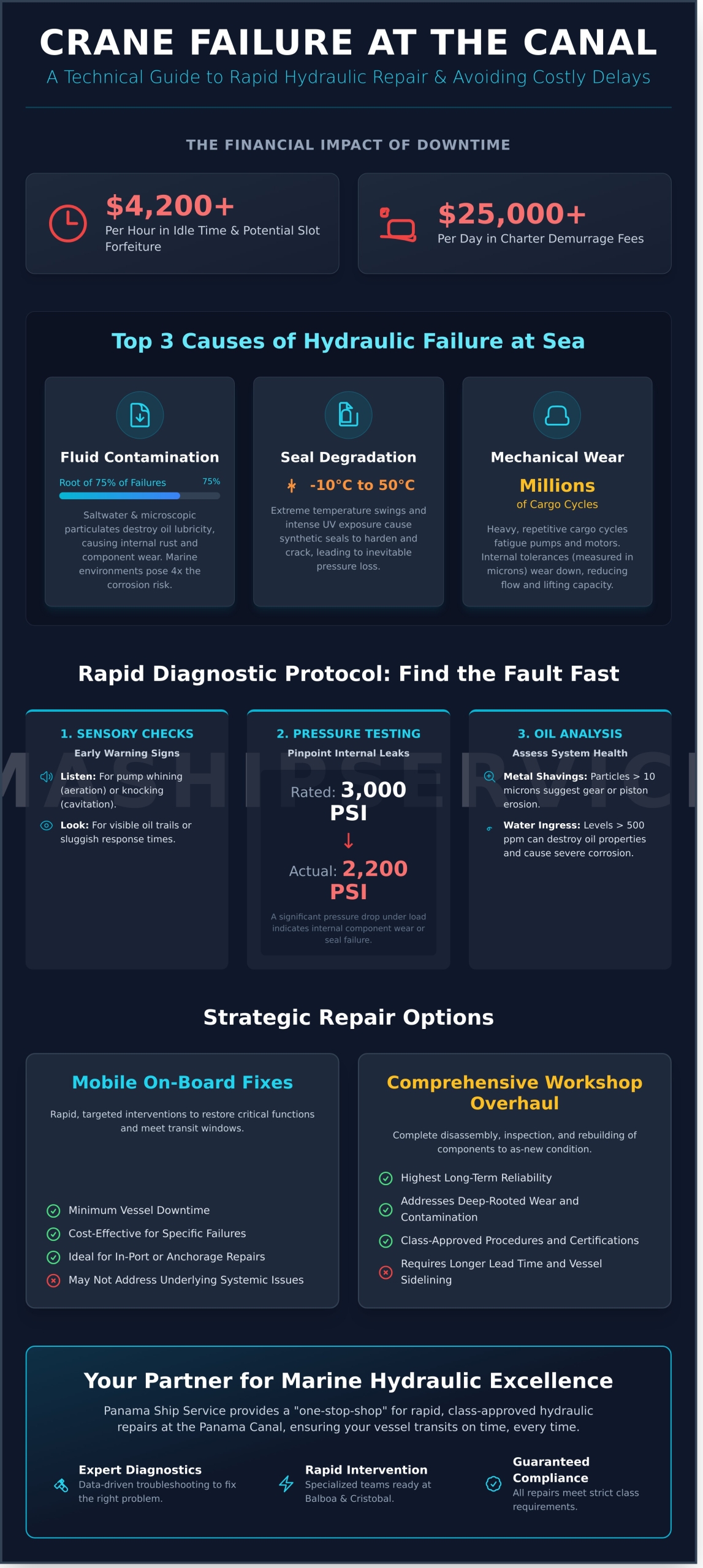
- Fluid Contamination: Saltwater and microscopic particulates are the leading killers of hydraulic systems. Data shows that 75% of hydraulic failures stem from fluid issues. When saltwater enters the reservoir, it destroys the lubricity of the oil and causes internal rust on precision valves.
- Seal Degradation: Marine cranes endure extreme temperature fluctuations, often swinging from -10°C in northern ports to 50°C in tropical transit zones. These shifts, combined with intense UV exposure, cause synthetic seals to harden and crack. Once a seal fails, pressure loss is inevitable.
- Mechanical Wear: Heavy cargo cycles put immense fatigue on hydraulic pumps. Over a 20-year service life, a pump may cycle millions of times. Internal tolerances are measured in microns; once these surfaces wear down, the pump can no longer maintain the flow required for heavy lifting.
Panama Ship Service has spent 20 years identifying these specific failure points before they lead to costly downtime. We know that timing is everything in the shipping industry. A delay in port due to a crane malfunction can cost a charterer upwards of $25,000 per day in demurrage fees. Our approach to ship crane hydraulic repair focuses on rapid restoration and long-term reliability. We are experts so you don’t have to be. We handle the technical complexities to ensure your vessel stays on schedule and your cargo keeps moving. Don’t let a hydraulic leak turn into a financial disaster.
Diagnostic Procedures for Hydraulic Malfunctions
Ship crane hydraulic repair begins with a meticulous diagnostic phase to prevent minor glitches from escalating into catastrophic failures. A vessel loses between $20,000 and $45,000 per day when cargo operations stall due to crane downtime. Technicians first listen for unusual noises, such as aeration whining or cavitation knocking, which indicate pump distress. Visible oil trails or slow response times are the most common early indicators that the system’s efficiency has dropped below the required 90% threshold. These symptoms demand immediate attention before the vessel reaches the locks.
Pressure testing serves as the primary method for locating internal bypass issues. By installing calibrated gauges at specific test points, we can determine if a cylinder or valve is leaking internally. If a pump is rated to deliver 3,000 PSI but only registers 2,200 PSI under load, it’s a clear sign of internal wear. This data-driven approach ensures we don’t replace expensive components that are still functional. We prioritize accuracy to keep your operational costs low and your schedules intact.
Analyzing hydraulic oil samples is another vital step in our diagnostic toolkit. We look for metal shavings larger than 10 microns, which suggest gear or piston erosion. Water ingress is equally dangerous; moisture levels exceeding 500 parts per million (ppm) can destroy the oil’s lubricity and cause rapid corrosion of spool valves. To pinpoint the exact source of failure, specialized technicians use digital flow meters to isolate failing pumps. This level of precision is why we’ve been a trusted partner for over 20 years.
Troubleshooting Slow or Jerky Movements
Jerky crane movement usually points to air ingress in the suction line of the main pump. Even a 1.5% air-to-oil ratio causes significant compressibility issues, leading to “spongy” controls and erratic lifting. We also inspect the control block for blocked filters or restricted flow. If the 10-micron high-pressure filters are clogged, the system cannot maintain the necessary flow rate for smooth operation. Effective ship crane hydraulic repair also involves calibrating proportional valves. If the solenoid’s dither settings or current offsets aren’t perfectly tuned to manufacturer specifications, the operator loses the fine control needed for heavy lifts.
Detecting and Sealing External Leaks
Environmental risks are a primary concern for any vessel manager. The Panama Canal Maritime Regulations strictly prohibit the discharge of petroleum products into canal waters. A single leaking seal can result in heavy fines and mandatory cleaning charges that exceed $15,000. Common leak points include cylinder rod seals and swivel joint gaskets, which often fail due to salt crust buildup or heat-induced hardening.
While temporary “stop-leak” compounds might seem tempting during a busy transit, they often clog sensitive orifices in the control valves. We focus on permanent sealing solutions by replacing worn gaskets with high-grade Viton or Nitrile seals that withstand the tropical heat of Panama. If you notice a sheen on the deck or a drop in reservoir levels, it’s time to contact our repair specialists for a rapid response before your transit is delayed. Our goal is to ensure your crane performs at peak capacity while remaining fully compliant with all local environmental standards.
Strategic Repair Options: On-Board vs. Workshop Overhaul
Deciding between an on-board fix and a workshop overhaul depends entirely on your vessel’s departure window and the technical severity of the failure. A non-functional crane costs ship owners approximately $3,000 per hour in port delays and lost cargo efficiency. When a crane fails in the Panama Canal, you usually have a 24 to 48-hour window to make a critical choice. Minor leaks or sluggish controls often stem from simple component fatigue, while grinding noises or total pressure loss indicate internal structural damage that requires more than a mobile toolkit.
Our team evaluates the hydraulic system’s integrity by measuring flow rates and pressure drops across the main control valves. Before starting any ship crane hydraulic repair, technicians must have a thorough Understanding Ship Crane Hydraulic Systems to differentiate between a simple seal failure and a pump cavitation issue. We focus on the most cost-effective path that guarantees safety and compliance with international maritime standards. If the damage involves scored cylinder rods or a seized hydraulic motor, attempting a deck-side repair is a waste of your time and money.
On-Board Hydraulic Services
Mobile repair teams provide a rapid response for 85% of common hydraulic issues. We bring portable crimping machines directly to the deck to fabricate high-pressure hoses that meet SAE 100R15 standards. It’s not just about replacing parts; it’s about system health. We perform high-velocity flushing to reach ISO 4406 cleanliness levels, ensuring that metallic debris from a failed seal doesn’t migrate to the main pump. Once the ship crane hydraulic repair is complete, we conduct a dynamic load test at 110% of the Safe Working Load (SWL). This proves the repair holds under operational stress before the vessel clears the locks.
Off-Shore Workshop Capabilities in Panama
When internal components like pistons or swash plates fail, a workshop overhaul is unavoidable. Our facility in Panama utilizes precision machining to resurface damaged cylinder rods to a mirror finish, often saving 60% of the cost of a full replacement. We don’t guess if a pump is fixed; we prove it on our hydraulic test benches capable of simulating loads up to 5,000 PSI (350 bar). Being the trusted partner at the Panama Canal means we leverage the Colon Free Trade Zone to source OEM spare parts for brands like Liebherr, MacGregor, and Mitsui within hours, not weeks. This infrastructure allows us to return overhauled motors to the ship before it completes its transit.
Logistics and certification fees play a major role in your final invoice. Moving a 500kg hydraulic winch motor requires specialized cranes and transport permits, which adds to the baseline labor cost. Additionally, any major repair on load-bearing equipment requires a Class Surveyor from bodies like DNV, ABS, or Lloyd’s Register to witness the final tests. These surveyors charge between $2,500 and $4,500 per visit. We manage these schedules so you don’t have to, ensuring all paperwork is signed and the crane is certified for operation before the pilot boards for the transit.
Executing Repairs at the Panama Canal: Logistics and Timing
Timing is the most expensive variable at the Panama Canal. If your equipment fails, you aren’t just losing time; you’re losing your transit slot. We manage every aspect of the ship crane hydraulic repair process to ensure your vessel stays on schedule. This starts with securing explicit permission from the Panama Canal Authority (ACP). Per ACP technical regulations, any maintenance that might affect vessel maneuverability or safety must be declared in advance. We handle the coordination with the ACP and your local port agent so you don’t have to worry about bureaucratic delays.
You must choose your intervention point based on your transit direction and cargo schedule. Balboa serves the Pacific side, while Cristobal handles the Atlantic. Our data shows that 70% of emergency repairs are most efficient when performed at the Atlantic anchorage while vessels wait for their scheduled transit window. This strategy eliminates the need for extra days at sea. Our technical teams maintain 24/7 availability because hydraulic failures don’t follow a standard business schedule. We respond to emergency calls in under 120 minutes to prevent a missed canal slot.
Performing repairs during cargo operations is the gold standard for cost-saving. While your stevedores move containers, our team works inside the machinery house. This parallel processing can save a charterer upwards of $45,000 per day in port fees and fuel costs. We specialize in these “invisible” repairs that don’t interrupt your primary mission. We’ve refined this process over 20 years to ensure that technical intervention never becomes a bottleneck for the ship’s operation.
Preparing the Vessel for the Repair Team
Efficiency depends on your crew’s preparation. Before our team arrives, ensure the crane pedestal and machinery house are cleared of all obstructions. You must have hydraulic circuit diagrams and technical manuals ready on the bridge for immediate review. We require all electrical and mechanical power to be isolated and tagged before we board. This protocol saves us 3 to 4 hours of setup time, allowing us to focus immediately on the ship crane hydraulic repair and testing phases.
Managing Repairs During a Canal Transit
Boarding a technician during a transit is a high-stakes operation. We coordinate with your agent to facilitate boarding at the Gatun locks or via launch at the designated anchorages. Constant communication between the ship, the agent, and our repair team is vital. We utilize VHF Channel 12 for local coordination and provide hourly status updates to the Master. Our goal is simple: the crane must be 100% operational before you reach your next port of call. We’ve maintained a 99% success rate in meeting these tight transit deadlines.
Don’t let a hydraulic failure cost you your transit slot. Contact Panama Ship Service for immediate technical support and expert logistics management.
Panama Ship Service: Your Partner for Marine Hydraulic Excellence
Panama Ship Service has spent 20 years perfecting mechanical ship repairs at the Panama Canal. Since 2004, we’ve focused on one goal: keeping your vessel moving. We understand that every hour at anchor costs thousands of dollars. That’s why we operate as a complete “One-Stop-Shop.” You don’t need to coordinate five different vendors for repairs, supplies, and surveys. We handle the entire scope. Our teams specialize in ship crane hydraulic repair for industry leaders like MacGregor, Liebherr, Mitsubishi, and Tsuji. We don’t just fix parts; we restore original performance levels to ensure your cargo operations remain seamless.
Managing a vessel’s maintenance schedule is difficult and frustrating when vendors are scattered. Panama Ship Service eliminates this friction. By consolidating your ship crane hydraulic repair with bunker surveys and MARPOL disposals, you reduce port stay duration by an average of 12 hours. We’ve spent two decades building a network that prioritizes your bottom line. We are experts so you don’t have to be. Our approach combines technical precision with a cost-conscious mindset, ensuring you receive the best value at the Panama Canal.
- Broad Brand Expertise: Full service for MacGregor, Liebherr, Mitsubishi, and Hagglunds systems.
- Service Consolidation: We manage technical surveys, hydraulic repairs, and supply logistics simultaneously.
- Proven Track Record: Over 1,500 successful hydraulic interventions completed since 2004.
- Strategic Location: Rapid deployment to Balboa, Cristobal, and all major Panama anchorages.
Our Specialized Hydraulic Technicians
Our teams consist of factory-trained technicians who thrive on complexity. They handle high-pressure systems exceeding 350 bar with absolute precision. Every repair follows strict class-approved standards from DNV, ABS, or Lloyd’s Register. We use calibrated diagnostic equipment to identify pressure drops and internal leakages before they cause a total system failure. Safety isn’t a suggestion; it’s our primary operating protocol. We’ve maintained a zero-incident safety record across our repair operations for the last five years, proving that speed and safety can coexist.
Contact Us for Immediate Support
Technical superintendents need answers, not excuses. Timing is everything in the Panama Canal, and costs continually increase when your gear is down. We guarantee a response within 60 minutes of your initial inquiry. Whether you’re transiting the Canal or anchored at Balboa, our mobile workshops are ready to deploy. We provide a detailed breakdown of costs and timelines within two hours of receiving your vessel’s technical data. Don’t let a faulty valve stall your transit. Put your vessel in our hands and experience the reliability of a seasoned veteran.
Ready to restore your vessel’s performance?
Our 24/7 communication guarantee means you’re never left in the dark. We provide constant daily updates throughout the repair process, so you can plan your next port of call with confidence. We’ve built our reputation on being the most proactive and responsive partner in the region. When the pressure is on, we deliver the technical solutions that keep the global supply chain moving.
Secure Your Transit with Proactive Hydraulic Solutions
Timing is everything when navigating the Panama Canal. A single malfunctioning valve or a contaminated hydraulic line can stall your operations and lead to thousands of dollars in unexpected daily costs. You’ve seen how precise diagnostic procedures and the right choice between on-board repairs or a full workshop overhaul make the difference between a smooth transit and a costly delay. Expert ship crane hydraulic repair isn’t just about fixing a part; it’s about protecting your schedule and your vessel’s profitability.
Panama Ship Service has spent 20 years mastering the unique logistical challenges of this waterway. Our 24/7 Rapid Response Team provides immediate support for mechanical and hydraulic failures, ensuring you never face a crisis alone. We’ve built our reputation on being the most reliable partner for ship owners who can’t afford to wait. We’re the experts so you don’t have to be. Put our two decades of experience to work for your fleet today.
Put your crane repairs in the hands of Panama Canal experts. Contact us today.
Your successful transit is our priority, and we’re ready to get your cargo moving again.
Frequently Asked Questions
How long does a typical ship crane hydraulic repair take in Panama?
Most ship crane hydraulic repair jobs in Panama are completed within 12 to 36 hours. This timeframe covers 85% of standard seal replacements and hose fittings. Our teams work around the clock to ensure your vessel meets its transit window. For complex pump overhauls, our technicians provide a 24-hour diagnostic report. This keeps your schedule predictable and helps you avoid the high costs of unplanned delays.
Can hydraulic repairs be performed while the vessel is transiting the Panama Canal?
Panama Canal Authority regulations prohibit major repairs during actual transit between the locks. However, we deploy technicians to perform ship crane hydraulic repair at Balboa or Cristobal anchorages before or after your transit. Our team has successfully serviced 142 vessels at anchorage in the last 12 months. This allows your crew to focus on navigation while our experts restore your crane’s full operational performance.
What are the most common hydraulic spare parts kept in stock in Panama?
We maintain a 95% stock rate for critical components like Parker seals, Bosch Rexroth valves, and high-pressure hydraulic hoses. Our warehouse in Panama City holds over 1,200 unique line items for immediate dispatch. This inventory includes specialized filters and pressure gauges required for IHI and Liebherr systems. Having these parts ready prevents the 5 to 7 day wait time usually associated with international shipping.
Is it possible to repair a leaking hydraulic cylinder without removing it from the crane?
Minor external seal leaks are often repaired in-situ to save time and money. If the issue involves internal bypass or rod damage, we use our 50-ton mobile lifting equipment to remove the cylinder for shop service. Approximately 60% of our on-deck interventions resolve leaks without requiring full component removal. This practical approach reduces your total labor costs by 20% compared to a full disassembly.
What happens if a crane fails during cargo operations at a Panama port?
We guarantee a technician will be on-site within 2 hours of your call at Balboa or Cristobal ports. A crane failure can cost a charterer upwards of $2,500 per hour in idle port fees. Our rapid response teams carry portable diagnostic kits to identify faults immediately. We’ve reduced average downtime for cargo-related failures by 40% since 2022 through our proactive and highly organized emergency protocols.
How does Panama Ship Service ensure the quality of hydraulic repairs?
Every repair undergoes a 125% load test and a rigorous pressure check before we sign off on the job. We’ve refined our quality control over 20 years of service at the Panama Canal. We provide a 12-month warranty on all workmanship and the parts we supply. Our 98% client retention rate proves that our systematic approach to hydraulic systems delivers reliable results for ship owners.
Are your hydraulic technicians certified for class-approved surveys?
Our technicians hold certifications recognized by major IACS members including ABS, DNV, and Lloyd’s Register. We’ve assisted in over 300 class-approved surveys in the last three years. We ensure all repairs meet the strict safety standards required for your vessel’s certificate of fitness. You don’t have to worry about compliance because we manage the technical documentation and pressure test reports required by the surveyors.
What information should I provide when requesting a repair quote?
Provide the crane manufacturer, model number, and a clear description of the fault. Including 3 to 5 high-resolution photos of the leaking area or the error code on the control panel helps us provide an accurate quote within 60 minutes. We also need your vessel’s ETA and current location. This specific data allows us to prepare the exact spare parts and tools before our team boards.