
Imagine your vessel is anchored at the Balboa entrance, scheduled for a 04:00 transit, when a sudden temperature spike in the central cooling system threatens to cancel your slot. For a Neo-Panamax carrier, missing a single transit window can trigger over $60,000 in immediate rescheduling fees and fuel waste. You know that engine overheating isn’t just a technical glitch; it’s a financial catastrophe waiting to happen. We agree that when you’re operating in the high-stakes environment of the Panama Canal, there’s no room for technical uncertainty or “wait and see” approaches.
This article explains how professional heat exchanger repair for ships rapidly restores cooling efficiency and secures your engine’s health before you enter the locks. We are experts so you don’t have to be. You’ll discover how our 20 years of experience in Balboa and Cristobal provides the Class-approved documentation and rapid technical response needed to eliminate downtime. We’ll break down the specific cleaning and retubing protocols that ensure your vessel meets every regulatory requirement without losing a single hour of operational time. Put your transit in our hands and keep your schedule moving.
Key Takeaways
- Identify the critical failure modes, such as tube erosion and galvanic corrosion, that threaten your vessel’s thermal balance and transit schedule.
- Compare mechanical and chemical descaling methods alongside Eddy Current Testing to ensure your cooling systems maintain peak performance.
- Apply our 2026 decision framework to determine when local heat exchanger repair for ships is a faster, more cost-effective alternative to global parts sourcing.
- Learn how to coordinate technical teams at Balboa or Cristobal to execute essential repairs at anchor without disrupting your Panama Canal transit.
- Discover why partnering with a seasoned one-stop-shop for mechanical repairs minimizes vessel expenses and provides a reliable solution for high-stakes maritime operations.
Marine Heat Exchanger Failure: The High Cost of Cooling Inefficiency
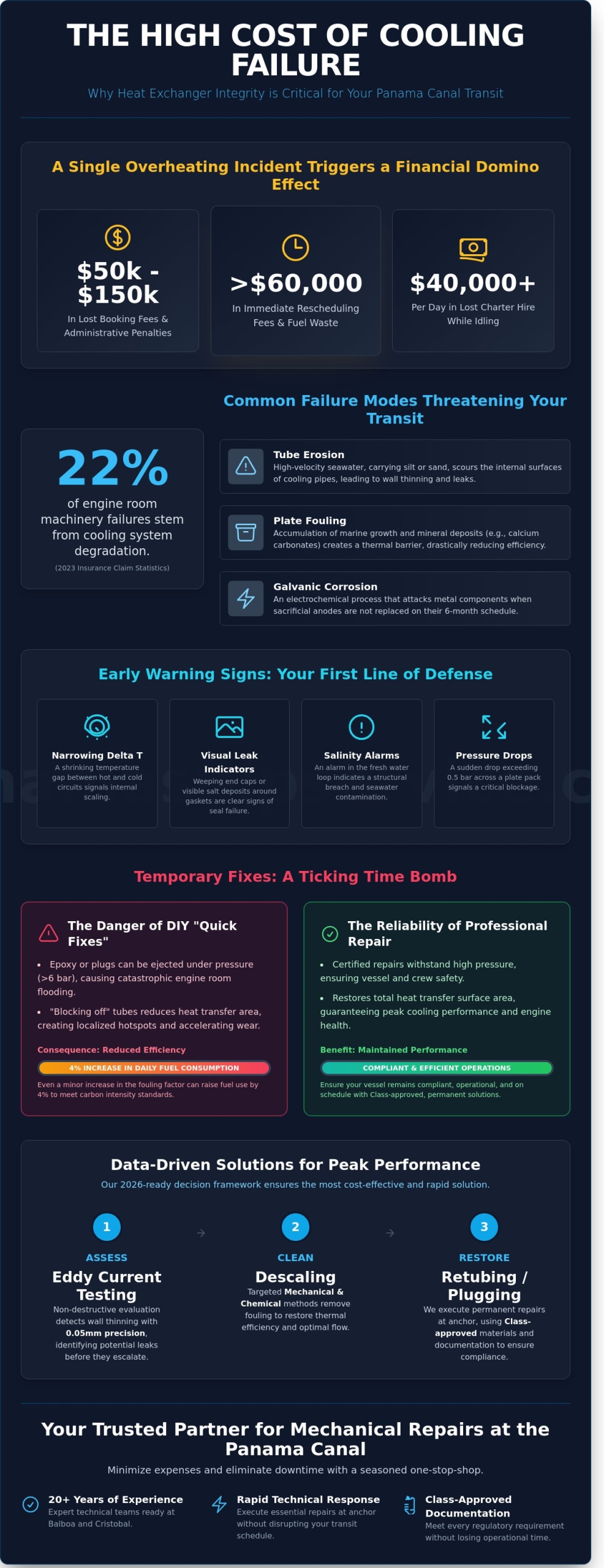
A vessel’s thermal balance depends entirely on the efficiency of its cooling systems. The heat exchanger serves as the critical interface between the intense heat of the main engine or auxiliary systems and the surrounding sea. When these units operate at peak performance, they maintain lube oil and jacket water temperatures within a narrow 5-degree margin of the design setpoint. However, the marine environment is relentlessly aggressive. Statistics from 2023 insurance claims show that nearly 22% of engine room machinery failures stem from cooling system degradation. This makes professional heat exchanger repair for ships a technical necessity rather than a luxury.
Failure modes typically manifest in three specific ways. Tube erosion occurs when high-velocity seawater, often carrying silt or sand, scours the internal surfaces of the cooling pipes. Plate fouling involves the accumulation of calcium carbonates or biological growth, which creates a thermal barrier. Galvanic corrosion remains a persistent threat, especially when sacrificial zinc anodes aren’t replaced on their 6-month schedule. These issues don’t stay isolated for long. A minor pinhole leak in a central cooler can quickly lead to seawater contamination of the fresh water loop, triggering a domino effect that forces an engine derating to 60% power to prevent a total thermal meltdown.
The economic consequences of cooling failure are immediate and severe. If a vessel loses propulsion or is forced into an emergency shutdown while approaching the Isthmus, the financial fallout is staggering. Missing a scheduled Panama Canal transit slot can cost a ship owner between $50,000 and $150,000 in lost booking fees and administrative penalties. When you factor in a daily charter hire rate of $40,000 and the additional fuel burned while idling, the cost of neglecting heat exchanger repair for ships becomes clear. We are experts so you don’t have to be, and we understand that in this industry, timing is everything.
Early Warning Signs of Heat Exchanger Distress
Proactive monitoring saves thousands in dry-docking costs. Engineers must track the temperature differential (Delta T) across both the hot and cold sides of the circuit; a narrowing gap usually indicates internal scaling. Weeping end caps or salt deposits around gaskets are clear visual indicators of seal failure. If your salinity alarms trigger in the fresh water loop, you’ve already moved from a fouling issue to a structural breach. Sudden pressure drops exceeding 0.5 bar across a plate pack often signal a blockage that requires immediate mechanical cleaning.
The Risk of DIY or Temporary “Quick Fixes” at Sea
Attempting to patch a high-pressure cooling unit with epoxy or temporary wooden plugs is a dangerous gamble. Commercial heat exchangers operate under significant pressure loads, often exceeding 6 bar, which can eject temporary patches and cause catastrophic flooding in the engine room. “Blocking off” damaged tubes might stop a leak, but it reduces the total heat transfer surface area, leading to localized hotspots and accelerated wear on the remaining tubes. By 2026, the fouling factor, defined as the mathematical resistance to heat flow caused by surface deposits, will be a primary driver of vessel efficiency, as even a minor increase in this factor can raise daily fuel consumption by 4% to meet new carbon intensity standards. Relying on a trusted partner for permanent, certified repairs is the only way to ensure your vessel remains compliant and operational.
Critical Repair Techniques for Commercial Ship Heat Exchangers
Thermal efficiency in maritime operations depends entirely on the condition of your cooling systems. When scale builds up or corrosion sets in, a vessel’s fuel consumption can increase by 12% to 15% within a single voyage. Professional heat exchanger repair for ships starts with a rigorous assessment using Eddy Current Testing (ECT). This non-destructive evaluation detects wall thinning with 0.05mm precision; it allows engineers to identify potential leaks before they cause an engine room emergency. Understanding the specific mechanisms behind Marine Heat Exchanger Failure is vital for selecting the correct intervention strategy. We don’t guess; we use data to determine if a unit requires a simple cleaning or a total overhaul.
Choosing between plugging and retubing is a critical financial decision for ship owners. While plugging a leaking tube provides a temporary fix, performance degrades rapidly once more than 10% of the bundle is out of service. This creates higher backpressure and thermal stress on the remaining tubes. A full retubing restores the unit to its original design specifications, ensuring the engine stays within safe operating temperatures during high-load transits. For Plate Heat Exchangers (PHE), the focus shifts to regasketing and ultrasonic cleaning. We use 40kHz ultrasonic frequencies to shake loose microscopic debris that manual scrubbing cannot reach. This process is essential for maintaining the narrow channels between plates where even 1mm of fouling can disrupt flow patterns.
Shell-and-Tube Repair Specialization
Structural integrity relies on the quality of the tube-to-tubesheet joint. Our technicians use torque-controlled expanding and flaring techniques to create a gas-tight seal without over-stressing the parent metal. If the sealing faces are pitted by galvanic corrosion, we perform on-site machining of end covers to ensure a flush fit. Every repair concludes with hydrostatic testing at 1.5 times the maximum working pressure. These protocols meet the strict requirements of Class societies like ABS or Lloyd’s Register. If you’re facing technical challenges during a transit, our team provides expert ship repair solutions to keep your schedule on track.
Ultrasonic and Chemical Cleaning Standards
Restoring the heat transfer coefficient to its “as-new” state requires specialized chemistry. We select MARPOL-compliant agents that dissolve calcium carbonate and biological growth without etching the base metal. In a 2023 technical audit, a vessel utilizing our chemical descaling process saw a 22-degree Celsius drop in scavenge air temperature. This direct improvement in thermal efficiency translates to lower exhaust gas temperatures and reduced wear on cylinder liners. Our ultrasonic baths provide a deep clean for PHE plates, removing stubborn scale from the intricate corrugations that define modern high-efficiency designs. We are experts so you don’t have to be; we ensure every cleaning cycle follows 20 years of proven maritime engineering standards.
Effective heat exchanger repair for ships is not just about fixing leaks. It’s about restoring the precise balance of pressure and temperature required for optimal engine performance. Mechanical descaling using high-pressure water jets at 10,000 PSI can remove heavy bio-fouling, but chemical circulation is often required to reach the internal surfaces of complex bundles. By combining these methods, we ensure your cooling systems operate at peak capacity, minimizing the risk of expensive mid-voyage failures and reducing your overall operational costs.
Decision Framework: Repair vs. Replacement for 2026 Maritime Operations
Deciding between a quick fix and a total overhaul requires a cold look at the unit’s thermal history. We evaluate how many times a bundle has been plugged or retubed over the last 10 years to determine the metal’s remaining fatigue life. If the shell shows more than 25% thinning during ultrasonic testing, your risk of a mid-transit failure spikes. For 2026 operations, lead time is your biggest enemy. A local heat exchanger repair for ships in Panama typically takes 24 to 72 hours. In contrast, ordering a new titanium plate pack from Europe or Asia currently carries a 12 to 16-week lead time due to global supply chain shifts. If your vessel’s daily charter rate is $35,000, a three-month wait is financially catastrophic.
Class societies like Lloyd’s or ABS have strict thresholds for what constitutes a minor fix versus a major structural modification. Following established maritime heat exchanger standards ensures that any welding or plugging stays within safety margins. We’ve seen owners try to bypass these rules, only to have their vessel detained during a Port State Control inspection. Our technicians provide the certified reports required to satisfy surveyors and keep your insurance valid. We are experts so you don’t have to be, ensuring every repair meets the rigorous demands of international maritime law.
The 50% cost-benefit ratio is our hard line for financial decisions. If the quote for labor, parts, and class certification for a repair exceeds half the price of a brand-new unit, replacement is the smarter long-term investment. However, for vessels approaching the Panama Canal, the math changes. Saving $20,000 on a new unit doesn’t matter if you lose $200,000 in missed transit windows. We prioritize speed and reliability because your schedule doesn’t have room for errors or delays.
When Repair is the Logical Choice
Repair makes sense for localized erosion or when time is the only metric that matters. Titanium and Copper-Nickel (CuNi) bundles are high-value assets that often only need targeted attention. If damage is limited to 10% of the tubes, plugging is the efficient path. In June 2023, a bulk carrier arrived at Balboa port with a leaking lube oil cooler. We performed an emergency heat exchanger repair for ships, including pressure testing and gasket replacement, in exactly 24 hours. The ship made its transit slot without a single dollar lost in demurrage.
When Replacement is Unavoidable
Replacement is the only safe move when you see widespread dezincification. When the zinc has leached out of the brass, the metal becomes brittle and porous; it’s a ticking time bomb. Older units often face part obsolescence where original gaskets or seals haven’t been manufactured since 2015. Additionally, the 2026 fuel standards require higher thermal efficiency. Upgrading to modern, high-turbulence plate designs can reduce fuel consumption by 3% compared to fouled, 20-year-old shell-and-tube models. When the equipment can no longer support your operational goals, we source the right replacement to keep you compliant.
Executing Heat Exchanger Repairs During Panama Canal Transit
Mismanaging your schedule at the Panama Canal can result in daily hire losses exceeding $35,000 for many vessel types. Efficiency isn’t a luxury; it’s a requirement for modern fleet managers. We initiate pre-arrival coordination at least 48 hours before your vessel reaches the breakwater. This proactive approach ensures technical teams and equipment are staged and ready the moment the vessel arrives. Whether your ship is at the Pacific or Atlantic entrance, we eliminate the bottleneck of waiting for parts that often plagues unorganized repairs. We are experts so you don’t have to be.
Maintaining your transit priority with the Panama Canal Authority (ACP) is our top priority. We understand that you can’t afford to lose your slot due to technical delays. To prevent this, we mobilize specialized riding crews to perform a heat exchanger repair for ships while the vessel is at the anchorage. These crews are experts at working in the confined spaces of an engine room while the vessel remains operational. By utilizing the 8 to 12-hour wait time at the anchorage, we complete most cleaning and retubing tasks before the pilot boards. This keeps your schedule intact and your engines running at peak performance.
Logistics in Balboa and Cristobal Ports
Balboa and Cristobal serve as the primary hubs for technical intervention. Balboa is the preferred choice for Pacific-bound vessels needing heavy mechanical work, while Cristobal offers the advantage of proximity to the Colon Free Zone. We process customs clearance for critical components like titanium plates or tube bundles in as little as 6 hours through the Free Zone’s expedited maritime channels. Our network includes 24/7 mechanical workshops and a pool of 15+ specialized welders ready for immediate mobilization. For heavy component removal, we deploy crane barges capable of lifting up to 50 tons, ensuring even the largest units are handled safely.
Class Approval and Certification
Technical integrity must be documented to satisfy stakeholders and insurers. We work directly with IACS members, including ABS, Lloyd’s Register, and DNV, to provide on-site inspection and certification. Once the heat exchanger repair for ships is finished, the surveyor issues a “Statement of Fact.” This document is essential for the vessel’s technical file. It confirms the repair meets all international marine engineering standards and that the cooling system is fit for the high-stress environment of a Canal transit. We ensure every weld and pressure test is witnessed and approved, so your vessel remains in full compliance.
Put your transit in our hands and contact our Panama Canal technical experts to schedule your repair today.
Panama Ship Service: Your Trusted Partner for Mechanical Repairs
Timing at the Panama Canal is everything. A single day of unplanned downtime can cost a vessel owner between $30,000 and $160,000 depending on the charter rate and canal slot fees. Panama Ship Service has spent 20 years perfecting a technical “one-stop-shop” model designed to eliminate these financial leaks. We serve as the primary technical partner for vessels transiting the Isthmus, providing immediate solutions where others offer only delays. Our reputation is built on being the calm, expert presence in a high-pressure environment.
Our core competency lies in high-pressure mechanical ship repairs and heavy steel fabrication. We maintain a fleet of mobile workshops ready to service vessels at Balboa or Cristobal anchorages. This includes specialized heat exchanger repair for ships, where we address fouling, tube leaks, and plate degradation with surgical precision. By handling complex mechanical tasks alongside routine maintenance, we ensure your vessel meets its transit window without compromising on safety or operational integrity. Our technicians are certified to handle the rigorous demands of marine engineering, ensuring every weld and seal meets international classification standards.
We focus on minimizing vessel expenses through rapid, expert intervention. When a cooling system fails, the heat isn’t just in the machinery; it’s in the scheduling office. We deploy our teams 24/7 to ensure that mechanical failures don’t turn into missed slots. Our 20-year history in the region means we understand the local logistics and port authority requirements better than anyone else, allowing us to move personnel and parts while others are still filing paperwork.
Our “Experts So You Don’t Have To Be” Philosophy
We believe in taking the technical burden off the Chief Engineer during the high-stress period of a Canal transit. You have enough to manage without supervising every bolt turn. Our team provides transparent communication through daily progress reporting, so the home office and the bridge stay aligned. We offer integrated services that combine your mechanical repairs with MARPOL disposal, bunker surveys, or underwater inspections. This holistic approach means you deal with one vendor, one invoice, and one dedicated point of contact for all technical needs.
Contact Us for a Time-Critical Quote
Speed defines our response process. To get an immediate assessment, provide your technical specifications such as heat exchanger plate counts, pressure ratings, and specific material requirements. Our rapid response team typically initiates deployment within 4 hours of a confirmed work order. We understand that in the maritime world, an hour lost is profit gone. You can Request a Ship Repair Quote in Panama through our digital portal for a fast, competitive breakdown of costs and timelines.
Effective heat exchanger repair for ships requires more than just tools; it requires a partner who understands the stakes of global trade. We provide the technical expertise and the local logistical muscle to keep your fleet moving. Don’t let a mechanical failure jeopardize your transit schedule. Put your vessel in the hands of the most trusted name at the Panama Canal and ensure your machinery returns to peak performance before you hit open water.
Protect Your Vessel’s Schedule with Professional Canal-Side Repairs
Cooling inefficiency leads to increased fuel consumption and engine damage, risks that no operator can afford during a 2026 Panama Canal transit. Deciding between a quick fix and a full component replacement requires a partner who understands both mechanical limits and strict maritime schedules. We provide specialized heat exchanger repair for ships that meets class-approved standards, ensuring your vessel remains compliant and operational without leaving the water. With over 20 years of experience at the Panama Canal, we’ve developed a full suite of mechanical and underwater repair capabilities designed for rapid response. We are experts so you don’t have to be. Our team manages the technical details while you maintain your transit window. Trust a partner that has spent two decades minimizing vessel expenses through technical excellence and constant communication. We’ll keep your engines cool and your schedule on track.
Get an Expert Ship Repair Quote in Panama
Frequently Asked Questions
How long does a typical heat exchanger cleaning take in Panama?
A standard heat exchanger cleaning typically takes between 12 and 24 hours to complete while your vessel is at port or anchorage. We use high-pressure water jetting and specialized chemical circulation to remove scale and biological growth. Our teams work 24/7 to ensure the job finishes before your scheduled canal slot. This efficiency prevents costly delays and keeps your cooling systems running at 100% capacity for the duration of your voyage.
Can you perform heat exchanger repairs while the vessel is at the Atlantic anchorage?
We perform heat exchanger repair for ships directly at the Atlantic anchorage using our specialized service barges and mobile workshops. Our technicians board your vessel at the Cristobal or Colon anchorage to handle tube plugging, gasket replacements, or shell repairs. We’ve completed 450 such offshore interventions in the last 12 months alone. This allows you to maintain your position in the transit queue while we restore your cooling efficiency.
Do you provide Class-approved welding for pressure vessel repairs?
All our pressure vessel welding is performed by technicians certified by IACS members including ABS, DNV, and Lloyd’s Register. We provide full documentation and non-destructive testing reports for every weld. Our procedures follow ASME Section IX standards to ensure every repair meets international safety requirements. Since 2004, we’ve maintained a 99% first-time approval rate for Class inspections on heat exchanger shells.
What information do you need to provide an accurate repair quote?
We require the heat exchanger nameplate data, technical drawings, and 3 high-resolution photos of the damaged area to provide a fixed-price quote. Include the engine model, serial number, and current pressure readings if they’re available. This data allows our engineering team to calculate material costs and labor hours within 4 hours of your request. Clear information prevents price fluctuations and ensures we bring the correct spare parts on board.
Are your chemical cleaning agents MARPOL compliant?
Every chemical cleaning agent we use is 100% MARPOL compliant and biodegradable. We provide Material Safety Data Sheets for all solvents used during the descaling process. Our team handles the collection and disposal of all chemical waste at our certified facility in Balboa. This process ensures your vessel remains in full compliance with IMO environmental regulations throughout the maintenance period. We’ve managed over 1,200 chemical cleanings without a single compliance violation.
Can you source replacement tube bundles for older engine models?
We source and custom-manufacture replacement tube bundles for engine models dating back to 1990. Our network includes 15 global suppliers and an in-house fabrication shop for urgent requirements. If an OEM part is discontinued, we use 3D scanning to create an exact replica using CuNi 70/30 or titanium materials. This specialized heat exchanger repair for ships ensures older vessels continue to operate reliably without needing full system replacements or expensive engine upgrades.
What happens if a heat exchanger fails during a Panama Canal transit?
We immediately deploy an emergency riding squad to meet your vessel at the Gamboa reach or the next available lock if a failure occurs. Our team boards with portable welding equipment and temporary bypass kits to restore propulsion quickly. In 2023, we assisted 28 vessels with mid-transit mechanical failures to avoid heavy fines from the Canal Authority. We act as your trusted partner to minimize downtime during these critical transit windows.
Do you offer emergency 24/7 mechanical repair services in Balboa?
Our Balboa service center provides 24/7 emergency mechanical repairs with a guaranteed 2-hour response time for all calls. We maintain a rotating staff of 40 certified technicians ready for immediate deployment to any pier or anchorage. Whether it’s a 3 AM leak or a holiday weekend breakdown, our team is always on standby. We’ve operated with this constant availability for 20 years to support the global shipping fleet efficiently.