
Miscalculating the distance between the Atlantic and Pacific entrance buoys by just eight miles can derail a vessel’s 2026 arrival window. While many operators ask how long is the panama canal expecting a simple figure, the reality involves complex variables between deep-water anchorages and shoreline boundaries. If you’re managing a fleet, you already know that a 12 percent error in distance calculations leads to missed slots and mounting port fees. We’re experts in this waterway so you don’t have to be.
We agree that uncertainty is the enemy of maritime efficiency. Timing is everything when fuel and labor costs continually increase. This article promises to provide the precise measurements of the 50-mile span and explains how each segment affects your transit logistics. You’ll gain a technical understanding of the canal’s dimensions to help you minimize downtime and navigate the specific challenges of the 2026 transit season. We’ll break down the three critical segments that every master and charterer must master to ensure a profitable, efficient voyage through the locks.
Key Takeaways
- Understand exactly how long is the Panama Canal by distinguishing between shoreline measurements and deep-water boundaries to better plan your vessel’s approach.
- Break down the 50-mile journey into its core segments, from the initial Atlantic entrance to the 23-mile crossing of the Gatun Lake reservoir.
- Master the 2026 transit window by learning why a 50-mile span requires 8 to 12 hours and which operational factors can extend your time on the water.
- Explore how the Neopanamax expansion and the addition of the Agua Clara and Cocoli locks have increased transit capacity without physically lengthening the route.
- Identify strategies to maximize efficiency during your crossing by consolidating technical repairs and bunker surveys to minimize downtime and vessel expenses.
Defining the Distance: Exactly How Long is the Panama Canal?
Determining how long is the Panama Canal requires more than a single data point. The standard navigational length is 80 kilometers, which translates to approximately 50 miles. This distance connects the Atlantic Ocean at Cristobal to the Pacific Ocean at Balboa. Engineers selected this specific route because it represents the narrowest point of the Isthmus of Panama. Since its opening on August 15, 1914, this 50-mile stretch has served as the critical link for global trade, saving vessels an 8,000-mile journey around Cape Horn. This efficiency is why timing and precision are vital for every transit we manage.
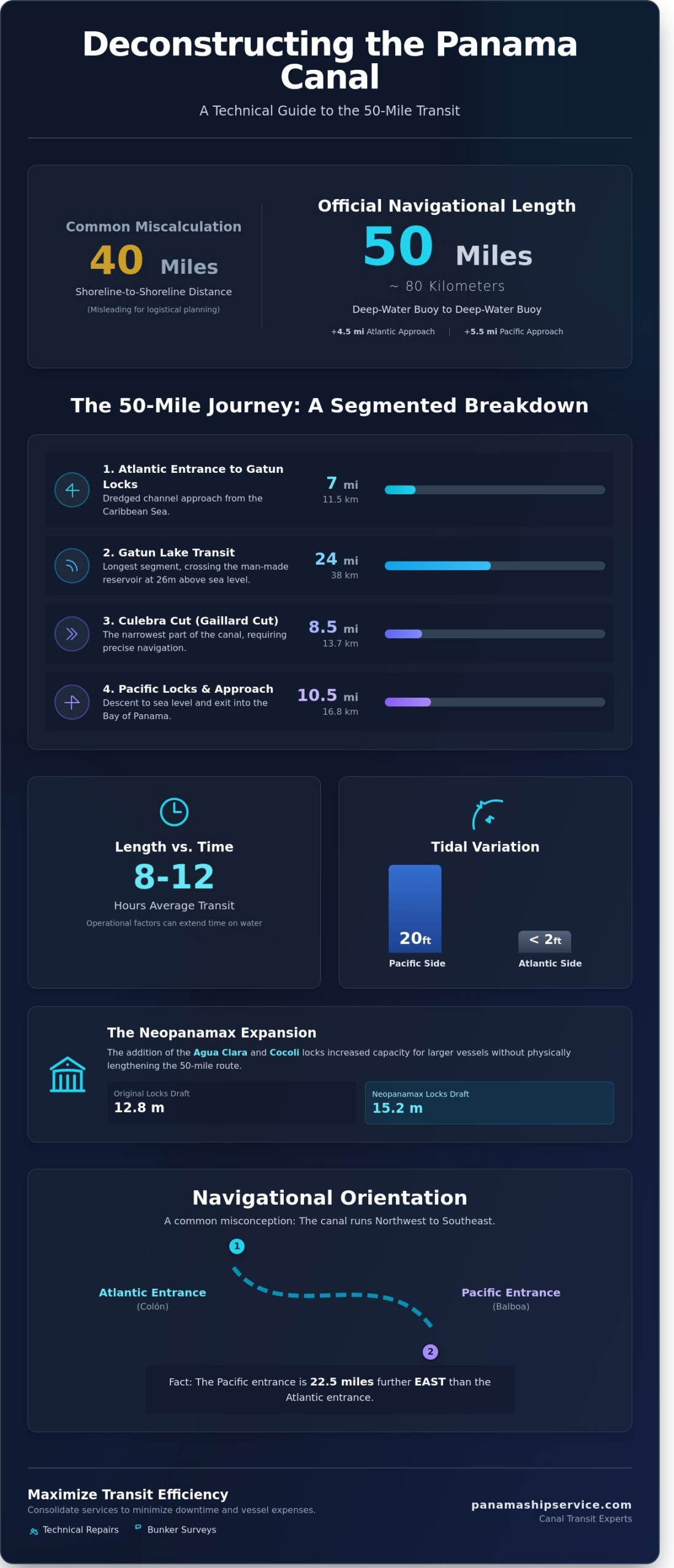
Shoreline measurements often cite a distance of 40 miles. For a ship master or charterer, this figure is misleading and can result in poor logistical planning. The 50-mile transit begins and ends at deep-water markers, not at the physical coast. Dredging extends the channel deep into the sea to ensure safe drafts for heavy vessels. This Panama Canal overview highlights that the dredged approach in Limon Bay adds nearly 4.5 miles to the Atlantic side. On the Pacific side, the approach from the Bay of Panama adds another 5.5 miles. We provide the technical expertise to navigate these specific markers, ensuring your vessel meets every depth requirement.
Shoreline vs. Deep-Water Measurements
The discrepancy between the 40-mile shoreline distance and the 50-mile navigational channel is a matter of maritime safety. Deep-water dredging is essential because the natural coastal depths are insufficient for modern container ships. Tides also influence the perceived length and difficulty of the transit. The Pacific entrance experiences tide fluctuations of up to 20 feet, whereas the Atlantic side sees less than 2 feet of change. These variations mean the entry into the 50-mile channel requires different approach speeds and pilotage techniques depending on the time of day.
The Canal’s Orientation: North to South or East to West?
A common misconception among those asking how long is the Panama Canal is that it runs East to West. The “S” curve of the Isthmus dictates a different reality. The canal actually runs Northwest to Southeast. When you enter from the Atlantic side, you’re sailing Southeast to reach the Pacific. In fact, the Pacific entrance at Balboa is roughly 22.5 miles further East than the Atlantic entrance at Colon. Mariners entering from the Caribbean Sea must maintain specific bearings, typically around 180 degrees, to stay within the 50-mile navigational path. Miscalculating these bearings leads to transit delays and increased fuel costs.
Length interacts directly with width and depth constraints throughout the transit. In the Culebra Cut, the channel narrows to 180 feet in specific sections, requiring absolute precision from the pilot and the crew. While Gatun Lake provides a wider transit area, ships must stay within the 500-foot to 1,000-foot wide markers to avoid grounding. The original locks maintain a minimum depth of 12.8 meters, while the Neopanamax locks allow for drafts up to 15.2 meters. We monitor these technical dimensions daily to provide accurate guidance to our clients. Understanding the breakdown of the transit distance helps in calculating accurate arrival times:
- Atlantic Entrance to Gatun Locks: 11.5 kilometers (7 miles)
- Gatun Lake Transit: 38 kilometers (24 miles)
- Culebra Cut (Gaillard Cut): 13.7 kilometers (8.5 miles)
- Pacific Locks and Approach: 16.8 kilometers (10.5 miles)
Put your transit in our hands to ensure these 50 miles are handled with professional care. We are experts so you don’t have to be. Our team manages the technical details of the 80-kilometer journey, from draft surveys to bunker coordination, so your vessel moves through the Isthmus without unnecessary friction.
Mapping the 50-Mile Journey: A Segmented Breakdown
To accurately answer how long is the Panama Canal, you’ve got to look beyond a single number. The transit is a 50-mile (80-kilometer) engineering feat divided into four distinct stages. Each segment presents unique operational challenges that dictate the speed and safety of the vessel. The journey begins at the Atlantic Entrance. Here, ships navigate an 11.3-kilometer (7-mile) dredged channel from the Caribbean Sea to the Gatun Locks. This initial approach requires steady piloting to align with the massive lock chambers that lift ships 26 meters above sea level.
Crossing Gatun Lake: The Heart of the Transit
This 37-kilometer (23-mile) stretch represents the longest portion of the canal’s total length. Gatun Lake is a massive man-made freshwater reservoir created between 1907 and 1913. It serves as the primary water source for the entire operation. Every time a ship passes through a lock, approximately 197 million liters of water are released. This makes the lake’s volume critical for year-round transit. While vessels can maintain higher speeds in the open water of the lake compared to the narrow channels, this remains the most time-consuming segment due to the distance covered.
Environmental factors heavily influence this part of the journey. The Panama Canal Authority closely monitors water levels, especially during the dry season from January to May. In 2023, severe drought conditions led to strict draft restrictions, limiting how deep a ship could sit in the water. These fluctuations mean that knowing how long is the Panama Canal is only half the battle; operators must also know the current depth availability. For many shipowners, securing reliable shore-side support is the best way to manage these shifting variables and avoid costly delays.
The Culebra Cut: The Engineering Marvel
The Culebra Cut, or Gaillard Cut, is a 13.7-kilometer (8.5-mile) stretch that carves through the Continental Divide. It’s the most difficult section to maintain. Engineers had to excavate through layers of shale and clay, which frequently led to landslides during construction. Even today, the 152-meter wide channel requires constant attention. Dredging barges work 24 hours a day to remove sediment and debris that could narrow the passage. They don’t take breaks because even a small buildup can disrupt the flow of global trade.
Traffic management in the Cut is rigorous. Because of the narrow width, the Canal Authority often prohibits two-way traffic for Neopanamax vessels or ships carrying hazardous materials. This means a vessel might wait at the entrance of the Cut for several hours until the channel is clear. This 8.5-mile segment often determines the overall efficiency of the entire 50-mile transit. It’s a bottleneck that requires perfect timing and coordination from the bridge team.
The final stage of the journey involves the Pacific Locks and the approach to the Bay of Panama. After exiting the Culebra Cut, ships enter the Pedro Miguel Locks for a single-step descent into Miraflores Lake. They then navigate across this small lake to reach the Miraflores or Cocoli Locks for the final drop back to sea level. A final 13.2-kilometer (8-mile) channel leads the vessel out into the Pacific Ocean, completing the crossing. Each of these segments contributes to the average 8 to 10 hours spent in active transit, proving that understanding how long is the Panama Canal requires a deep dive into its complex geography.
Length vs. Time: Calculating the 2026 Transit Window
Understanding how long is the panama canal requires looking beyond the 50-mile physical distance. For a master or a charterer, the “operational length” is measured in hours, not miles. While the transit itself typically spans 8 to 12 hours, the total time from arrival at the sea buoy to clearing the final lock can exceed 24 to 48 hours depending on scheduled slots and congestion. In 2026, managing these windows will be the difference between a profitable voyage and a costly delay.
Why 50 Miles Takes 10+ Hours
The transit is a complex engineering feat that prioritizes safety over speed. Moving a vessel through the canal involves lifting it 26 metres (85 feet) above sea level via three sets of locks. This process is meticulous. Ships don’t move under their own power at full speed; instead, they are guided by high-traction locomotives, known as mules, and specialized tugboats. Within the Culebra Cut, the narrowest stretch of the waterway, speed limits are strictly enforced to prevent bank suction and collisions. These operational constraints mean your vessel will average roughly 4 to 6 knots during the passage.
Efficiency is the priority at Panama Ship Service. We understand that every hour spent at anchor increases your daily running costs. According to U.S. Census Bureau data, the historical volume of traffic through this zone has always demanded precise scheduling to avoid bottlenecks. In 2026, transit windows are expected to remain tight, making your choice of local partner critical. We act as your expert eyes on the ground to ensure your vessel moves from the “waiting room” in Limon Bay or the Pacific entrance into the canal system without unnecessary delays. Our team provides constant daily communication so you are never in the dark about your vessel’s position in the queue.
Panama vs. Suez: A Comparative Overview
Comparing the two most famous canals highlights why Panama is unique. The Suez Canal is 120 miles long but operates as a sea-level waterway without locks. Ships there can often maintain higher speeds. Conversely, the Panama Canal is only 50 miles long, yet the transit times are often comparable or longer due to the lockage requirements. Shorter distance does not equal a faster journey in this geography.
- Panama (50 miles): Lock-based, fresh water (Gatun Lake), requires technical pilotage and tug assistance throughout.
- Suez (120 miles): Sea-level, salt water, primarily a straight-line transit through the desert.
Because the Panama transit is so technically demanding, local support isn’t just a luxury; it’s a requirement for cost-conscious operators. Weather patterns in 2024 and 2025 have shown that water levels in Gatun Lake can fluctuate, directly impacting draft limits and transit speeds. We provide the rapid response and technical surveys needed to navigate these variables. We are experts so you don’t have to be. By managing the logistical hurdles of the 2026 transit window, we help you minimize vessel expenses and maintain your schedule. Put your transit in our hands to ensure that knowing how long is the panama canal is the only thing you have to worry about.
The Expanded Canal: How Neopanamax Changed the Map
The Panama Canal expansion, completed on June 26, 2016, represents the most significant architectural shift since the waterway opened in 1914. This massive engineering project introduced two new lock complexes: Agua Clara on the Atlantic side and Cocoli on the Pacific. These new lanes do not technically change the geographic answer to how long is the panama canal, which remains approximately 80 kilometers (50 miles) from deep water to deep water. However, the expansion fundamentally altered the canal’s functional capacity by allowing much larger vessels to navigate the shortcut. Ships that once had to bypass the isthmus and sail around Cape Horn can now shave 8,000 miles off their journey.
The Neopanamax locks operate differently than the original 1914 locks. Instead of using locomotives to pull ships through, these new chambers use high-powered tugboats to position vessels. This change requires precise technical coordination and increased pilotage expertise. The reality is that the expansion was not about making the canal longer; it was about making it wider and deeper to accommodate the shift in global ship manufacturing.
The Neopanamax Lane Dimensions
The new locks provide a massive leap in scale. Each chamber measures 427 meters long by 55 meters wide. This allows the canal to handle vessels up to 366 meters (1,200 feet) in length and 49 meters in beam. Efficiency is a core focus here. The system uses nine water-saving basins that recycle 60% of the water used per transit. Looking toward 2026, the Panama Canal Authority (ACP) is implementing strict water management protocols to maintain a reliable 15.24-meter (50-foot) draft for Neopanamax vessels, even during fluctuating rainfall periods.
Scheduling and Priority in the New Lanes
Managing two distinct lane systems requires a complex scheduling dance. The ACP prioritizes vessels based on their booking slot and ship type. Neopanamax transits are more resource-intensive and require specialized pilotage. This makes technical readiness a non-negotiable requirement. If your vessel arrives with faulty equipment or fails to meet the updated 2026 boarding requirements, you risk heavy fines and indefinite delays. Global trade routes have shifted because of this capacity; 90% of the world’s LNG tankers can now fit through the expanded lanes.
Navigating these technical requirements is difficult. Miscalculating your ship’s specifications or failing to prepare for the specific demands of the Neopanamax lanes leads to increased costs. We provide the expert Panama Canal transit support you need to ensure your vessel meets every ACP standard before arrival.
The impact on transit times is clear. While the physical distance hasn’t grown, the complexity of moving a 14,000 TEU vessel through the locks means scheduling is tighter than ever. A standard transit takes 8 to 10 hours, but the preparation starts months in advance. You must account for several factors:
- Specific tugboat requirements for the new locks.
- Updated mooring configurations for Neopanamax vessels.
- Stricter environmental compliance under the 2026 sustainability goals.
The expansion didn’t just change the map; it changed the vessel design industry. Ships are now built specifically to fit these 427-meter chambers. Understanding how long is the panama canal in a modern context means looking beyond the 80-kilometer distance and focusing on the 427-meter lock capacity that dictates global shipping logistics. We are experts so you don’t have to be. Put your transit in our hands to avoid the frustrations of the expanded lane system.
Maximizing Efficiency During the 50-Mile Transit
Understanding how long is the panama canal involves more than just measuring the 50 miles of water between the Atlantic and Pacific oceans. For a ship owner, the actual transit time typically spans 8 to 10 hours of active movement; however, the total time spent in Panama waters can extend much longer due to scheduling, inspections, and anchorage. Mechanical readiness isn’t a suggestion; it’s a requirement to avoid costly delays or fines from the Panama Canal Authority. A single engine failure or a malfunctioning winch during lockage can halt traffic for hours, leading to massive surcharges and reputational damage. We ensure your vessel is prepared for the high-stakes environment of the locks.
Panama Ship Service acts as your one-stop-shop to ensure these 50 miles are navigated without incident. We focus on consolidating technical services during the waiting period. By handling repairs, surveys, and supplies simultaneously, we minimize vessel downtime. We’ve spent 20 years refining these processes so you don’t have to worry about the logistics. Our team coordinates with your crew to ensure every technical requirement is met before the pilot boards. This proactive management reduces the risk of being “not ready” for your scheduled slot, which can cost thousands in re-booking fees. We are experts so you don’t have to be.
Technical Services While at Anchor
While your vessel waits at the Atlantic or Pacific entrance, our teams perform critical maintenance that would otherwise require a dry dock. We conduct marine and underwater surveys using high-definition video to verify hull integrity. If our divers find significant biofouling, our hull cleaning and propeller polishing services can reduce fuel consumption by 5% to 12% on your subsequent voyage. Our mobile workshops handle steel fabrication and mechanical repairs immediately. This ensures your ship is fit for the 50-mile crossing and prevents the canal authorities from declaring your vessel a safety risk.
Compliance and Disposal: Meeting MARPOL Standards
Meeting international and local environmental standards is mandatory for a successful transit. We manage MARPOL-compliant disposal for sludge, bilge water, and solid waste. Our teams handle the discharge of Annex I and Annex V materials using certified barges, providing the necessary documentation for your logs. This prevents legal complications that could otherwise delay your departure from Panama waters. We also provide bunker surveys and draft surveys to ensure your cargo and fuel measurements are precise, protecting your interests during the transfer. Our goal is to handle the difficult and frustrating paperwork for you.
Sanitary compliance is another hurdle we clear for your crew. We provide professional fumigation and pest control services, ensuring your vessel meets all health regulations and possesses a valid Deratting Certificate before entering the locks. We understand that timing is everything in the shipping industry. Our operations desk maintains constant daily communication with your captain and agents. This proactive approach ensures that when the time comes to answer how long is the panama canal transit, your answer is a record-breaking, efficient crossing. Put your transit in our hands and experience the reliability of a seasoned partner.
Navigate Your Next Transit with Precision
Understanding how long is the panama canal is just the first step in planning a successful crossing. While the physical distance spans 50 miles from deep water to deep water, the operational reality involves navigating three sets of locks and the narrow Culebra Cut. With the Neopanamax expansion now handling vessels up to 1,200 feet in length, the margin for error has narrowed. Owners must account for the 2026 transit windows where operational efficiency is the only way to protect your bottom line. Technical failures during this 50-mile journey lead to costly delays and missed slots.
We are experts so you don’t have to be. With over 20 years of maritime expertise, our team provides 24/7 emergency mechanical repairs to keep your engines running. We also ensure your vessel meets environmental standards through MARPOL-compliant disposal services. Don’t let a mechanical glitch stall your schedule. Minimize your vessel’s downtime; contact Panama Ship Service for expert technical support at the Canal. Your vessel’s successful crossing is our priority.
Frequently Asked Questions
How long does it take to go through the Panama Canal?
A typical vessel takes between 8 and 10 hours to complete a full transit from deep water to deep water. Total time in canal waters often extends to 24 hours when you include mandatory anchorage and scheduling wait times. We’re experts so you don’t have to be, ensuring your vessel maintains its strict schedule despite these complex traffic patterns.
How many miles long is the Panama Canal from sea to sea?
The Panama Canal is exactly 50 miles long when measured from the deep water anchorage in the Atlantic to the deep water entrance in the Pacific. This distance includes the excavated approach channels and the transit through the man-made Gatun Lake. Understanding how long is the Panama Canal helps operators calculate precise fuel consumption and arrival windows at the next port.
What is the narrowest part of the Panama Canal?
Culebra Cut, formerly known as Gaillard Cut, is the narrowest section of the waterway, measuring 630 feet wide at its tightest point. This 8.5 mile stretch required the excavation of 100 million cubic yards of earth and rock through the Continental Divide. Pilots exercise extreme precision here, especially when two large vessels must pass each other in the restricted channel.
How much does it cost for a ship to transit the Panama Canal in 2026?
Transit costs in 2026 depend on the Panama Canal Authority’s updated toll structure, but current projections for a Neopanamax vessel often exceed $1,000,000 per crossing. Smaller feeder ships typically pay between $150,000 and $300,000 based on their PC/UMS net tonnage and specific cargo capacity. We provide cost-conscious solutions to help you manage these increasing operational expenses and avoid unexpected surcharges.
Can any size ship go through the Panama Canal?
Not every vessel can transit, as the canal has strict maximum dimensions for Neopanamax ships that cannot be exceeded. Vessels must stay within 1,215 feet in length, 168 feet in beam, and 50 feet in tropical freshwater draft to safely navigate the locks. Massive ships like Valemax ore carriers or TI-class supertankers are too large for the infrastructure and must use alternative routes.
What are the dimensions of the Neopanamax locks?
The Neopanamax locks measure 1,400 feet long, 180 feet wide, and 60 feet deep to accommodate the world’s largest commercial fleets. These chambers allow for the passage of container ships carrying up to 15,000 TEUs. These locks utilize rolling gates and water-saving basins that recycle 60 percent of the water used during each lockage cycle to preserve the local ecosystem.
How many locks are in the Panama Canal?
There are 12 lock chambers in total across the entire canal system, operating in sets to lift and lower ships. The original locks include Gatun, Pedro Miguel, and Miraflores, while the 2016 expansion added the Cocoli and Agua Clara complexes. Each lock acts as a massive water elevator, lifting ships 85 feet above sea level to reach the interior Gatun Lake.
Why is the Panama Canal 50 miles long instead of shorter?
The canal is 50 miles long because engineers followed the path of least resistance through the Isthmus of Panama’s rugged geography. Instead of a straight line, the route utilizes the natural Chagres River valley and the lowest point in the Continental Divide at Culebra. This path was more efficient than digging a sea-level trench through solid rock at a shorter, more direct distance.