
What if your next Panama Canal transit was the most profitable leg of your voyage instead of the most expensive? For ship owners in 2026, the Canal is frequently viewed through the lens of rising transit fees and increasingly strict MARPOL compliance. You already know that a single administrative error or a mechanical failure during passage can lead to thousands of dollars in fines or unforeseen delays. We agree that the operational pressure is at an all-time high. This expert guide will show you how to master the complexities of the panama canal transit by optimizing your booking strategy and leveraging your time in the zone for critical vessel maintenance. You’ll learn how to navigate the latest ACP regulations and complete essential repairs without adding a single day to your voyage. We are experts so you don’t have to be. We will break down the logistics of booking, the technical requirements for compliance, and the specific ways to maximize efficiency while your vessel is in our hands.
Key Takeaways
- Analyze the 2026 maritime landscape to understand how the projected 2.8% increase in traffic and energy demands affect priority for LNG and tanker vessels.
- Master the updated VUMPA registration and auction protocols to secure your panama canal transit slot without risking costly scheduling delays.
- Turn mandatory wait times into operational advantages by leveraging world-class repair hubs at Balboa and Cristóbal for critical mechanical and engine maintenance.
- Navigate rigorous 2026 MARPOL Annex compliance and watershed disposal requirements to ensure environmental standards are met without interrupting your schedule.
- Discover the financial benefits of consolidating repairs, supplies, and agency services through a single “one-stop-shop” partner to minimize overall vessel expenses.
The Panama Canal Transit Landscape in 2026
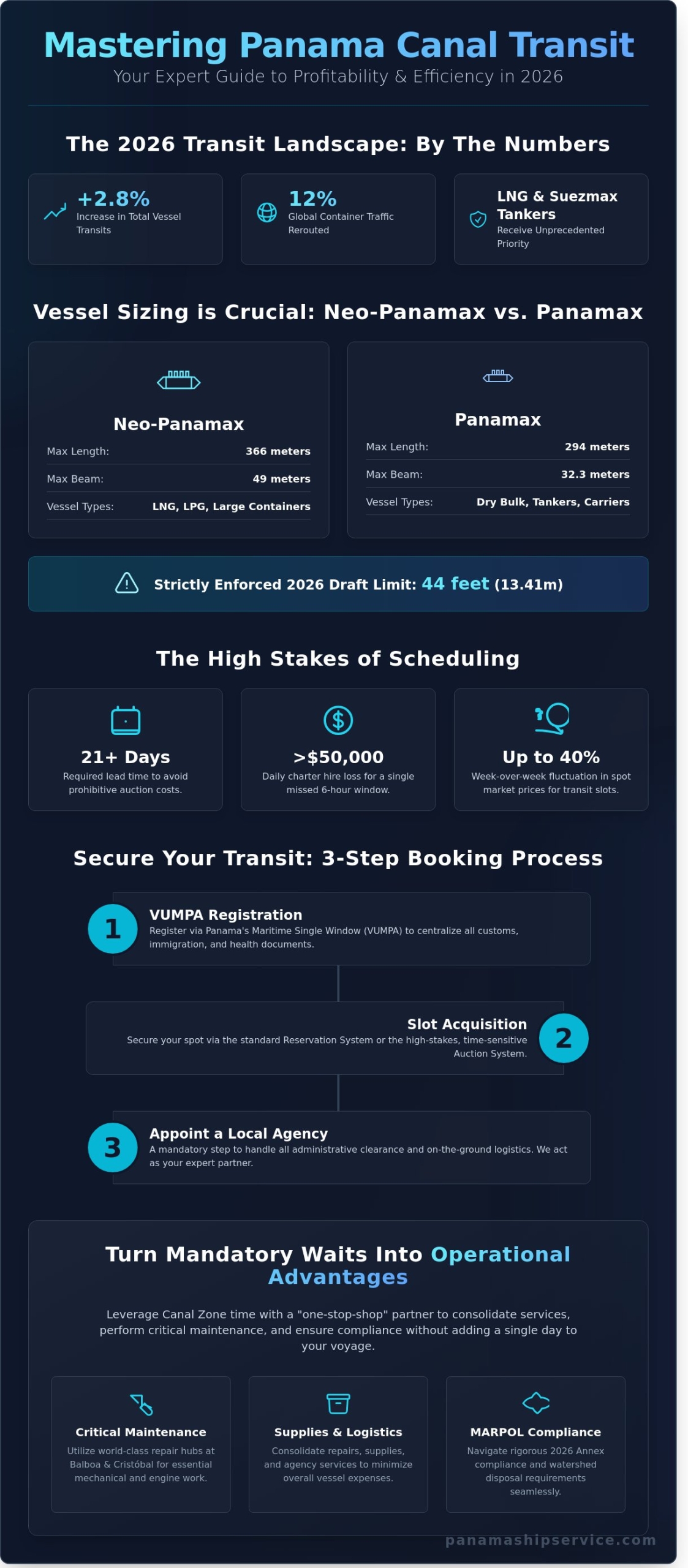
The 2026 maritime fiscal year has opened with a 2.8% increase in total vessel transits. This uptick reflects a global shipping industry that’s increasingly reliant on the Isthmus to bypass volatile alternative routes. Energy demand remains the primary driver of this growth. Liquefied Natural Gas (LNG) carriers and Suezmax tankers now receive unprecedented priority in the booking hierarchy. The Panama Canal Authority (ACP) has responded by implementing a tiered auction system that favors high-value, time-sensitive energy cargoes. For ship owners, securing a panama canal transit slot now requires a lead time of at least 21 days to avoid the prohibitive costs of last-minute auctions.
Geopolitical tensions in the Red Sea and the South China Sea have rerouted approximately 12% of global container traffic toward Panama in early 2026. This shift has placed immense pressure on the ACP to maintain operational fluidity. Understanding the Panama Canal history and operations provides perspective on why the current infrastructure is being pushed to its limits. The ACP currently manages 34 to 36 transits per day, a delicate balance that relies on precise water management and tugboat availability. We are experts in these operational shifts so you don’t have to be. Our role is to ensure your vessel doesn’t become a statistic in the growing backlog of unbooked arrivals.
Neo-Panamax vs. Panamax: Understanding Capacity
Vessel size dictates your entire 2026 transit strategy. The Neo-Panamax locks accommodate ships with a maximum length of 366 meters and a beam of 49 meters. In contrast, the older Panamax locks are restricted to vessels of 294 meters by 32.3 meters. Hydrology data for Gatun Lake in 2026 indicates a steady draft limit of 44 feet. This is a critical metric. If your vessel exceeds this draft, you’ll face mandatory cargo offloading at the Port of Balboa or Cristobal. We provide real-time draft monitoring to prevent these costly delays. Your choice between these locks isn’t just about size; it’s about the specific booking slots available for each chamber type.
- Neo-Panamax: Primarily for LNG, LPG, and large container ships over 10,000 TEUs.
- Panamax: Best for dry bulk, smaller tankers, and vehicle carriers.
- Draft Requirements: 2026 limits are strictly enforced at 44 feet for Neo-Panamax during the dry season.
Geopolitical and Economic Drivers
The shift in US-Asia trade routes has fundamentally altered wait times at the canal. In the first quarter of 2026, export volumes from the US Gulf Coast to North Asia rose by 15%. This surge coincided with new 2026 tariff structures that penalize delayed deliveries of raw materials. Consequently, the cost of a missed window has never been higher. Planning your panama canal transit requires a deep dive into these economic shifts. Transit volatility is currently at a three-year high, with spot market prices for transit slots fluctuating by as much as 40% week-over-week. We track these trends daily to provide our clients with competitive advantages in slot procurement. Efficiency isn’t just a goal; it’s a financial necessity in this high-stakes environment.
Timing is everything in 2026. Misjudge your arrival by even six hours and you lose your slot, resulting in daily charter hire losses exceeding $50,000. Panama Ship Service acts as your proactive partner, managing the technical and operational hurdles of the ACP’s complex 2026 regulations. We focus on minimizing vessel expenses through rapid response and constant communication. Don’t leave your transit to chance when the global economy is this unpredictable.
How to Book and Schedule Your Panama Canal Transit
Securing a panama canal transit requires more than just a vessel and a destination. It demands a rigorous adherence to a multi-step scheduling process dictated by the Panama Canal Authority. Missing a single deadline or submitting incorrect data results in costly delays or the total loss of your transit slot. You must treat the booking process as a high-stakes logistical operation where precision is the only currency that matters.
- Step 1: VUMPA Registration. Every vessel must register through the Panama’s Maritime Single Window (VUMPA). This digital platform centralizes all required documentation for maritime authorities, including customs, immigration, and health clearances.
- Step 2: Slot Acquisition. You’ll secure your spot through either the standard Reservation System or the Auction System. This depends on your vessel class and how much lead time you have.
- Step 3: Agency Appointment. You’re required to appoint a local shipping agency to handle administrative clearance. We act as your boots on the ground to ensure every document meets local regulations. You can request a transit consultation to streamline this requirement.
- Step 4: ETA and Specifications. Provide your Estimated Time of Arrival (ETA) at least 96 hours in advance. You must also submit exact vessel specifications. Even a minor discrepancy in beam or draft measurements can trigger immediate penalties.
- Step 5: Tolls and Payments. All tolls and maritime service charges must be paid in full before the vessel arrives. The canal operates on a pre-payment basis; without cleared funds, your ship won’t move.
The Transit Reservation System
The booking window opens 365 days before your intended transit date. The 1st period runs from a year out down to 22 days before transit. The 2nd period covers 21 to 4 days, and the 3rd period is a tight 3 to 2 day window. If you’re a frequent user, obtaining a Customer Code Issuance is vital for tracking your transit history and ranking. To win in the competitive auction system, you need real-time data on daily traffic. Auctions often occur when demand exceeds the standard 36 slots per day, and winning bids can significantly exceed standard reservation fees.
Minimizing Delays and Penalties
Technical deficiencies are the leading cause of avoidable delays. If your pilot ladders, chocks, or bitts don’t meet specific ACP requirements, your vessel will be barred from entry until repairs are made. Paperwork errors, such as incorrect cargo declarations, are equally damaging. If you misjudge your timing and miss your slot, the “lost slot” fee can equal 100% of your reservation cost. We maintain constant daily communication with canal coordinators to monitor weather and traffic shifts. This proactive approach ensures you’re never surprised by a sudden change in the transit schedule. We are experts so you don’t have to be, managing the 48-hour fund clearance window and technical inspections with 20 years of local experience. Efficiency here isn’t just about speed; it’s about avoiding the 24-hour waiting periods that plague unprepared operators.
Strategic Maintenance: Using the Transit Window
Smart operators don’t view the anchorage time at Balboa or Cristóbal as lost hours. They see it as a high-value maintenance window. These locations stand as the world’s most efficient repair hubs because they allow for technical interventions without deviating from the trade route. By scheduling repairs during the mandatory wait for your panama canal transit, you eliminate the need for costly deviations that can add $30,000 to $50,000 in fuel and charter costs alone.
We provide a calm, expert presence in a high-pressure environment. Our teams handle mechanical ship repairs, addressing engine and rudder issues while the vessel is at anchorage. This proactive approach ensures that minor technical glitches don’t escalate into transit denials by the Panama Canal Authority (ACP). We are experts so you don’t have to be. Put your vessel’s technical readiness in our hands to ensure a seamless passage between the oceans.
Mechanical and Steel Repairs
Timing is everything in the shipping industry. We offer 24/7 rapid response for emergency mechanical repairs that could otherwise jeopardize your schedule. Our technicians handle transit-critical issues, from governor calibrations to winch repairs, ensuring your ship meets all ACP safety standards. For structural needs, we provide on-site steel fabrication and welding to maintain structural integrity. We also prioritize crew comfort and cargo safety through specialized A/C and refrigeration repairs. A malfunctioning cooling system in the tropical heat of Panama can lead to cargo loss or crew exhaustion; we fix these issues before they impact your bottom line.
Underwater Hull and Propeller Services
Fuel efficiency is the primary driver of profitability in 2024. With the shipping industry facing stricter 2026 carbon-tax environments and CII ratings, hull cleanliness is no longer optional. A fouled hull can increase fuel consumption by 15% or more. Our diving teams perform precision hull cleaning at anchor, removing biofouling to optimize performance for the transoceanic leg. Propeller polishing is another low-cost task that delivers a high ROI, often paying for itself within the first 48 hours of steaming.
Regulatory compliance remains a top priority for every owner. All vessels must strictly adhere to Panama Canal MARPOL requirements regarding fuel quality and emissions. To support this, we facilitate class-approved Underwater Inspection in Lieu of Drydocking (UWILD) surveys. These inspections allow you to meet mandatory regulatory requirements while at anchor, avoiding the massive expense of an unscheduled drydocking. We use high-definition video and photography to provide documented evidence of hull condition for class surveyors and insurance providers.
Our service model focuses on minimizing vessel expenses through systematic coordination. We provide constant daily communication, so you always know the status of your repairs. By integrating maintenance into your panama canal transit schedule, you transform a period of idle waiting into a strategic operational advantage. We provide the solutions; you maintain the momentum of your global supply chain. Our 20 years of local expertise ensures that every repair is timely, cost-effective, and performed to the highest maritime standards.
Compliance and MARPOL Requirements for 2026
Compliance isn’t optional for a successful panama canal transit. By 2026, the Panama Canal Authority (ACP) will enforce even stricter environmental safety standards to protect the Gatun Lake watershed. This freshwater source provides drinking water for over 2.1 million people; consequently, any discharge violation carries heavy penalties. Fines for illegal dumping or MARPOL non-compliance can exceed $1,000,000 depending on the severity of the spill or discharge. You need a partner who understands the technical nuances of MARPOL Annex I, IV, and V to avoid these catastrophic costs and the legal entanglements that follow.
The ACP 2026 roadmap prioritizes “Zero Discharge” protocols within the canal waters. This means your crew must be fully trained on specific local requirements that often exceed standard international maritime law. We’ve seen vessels delayed for over 48 hours because of minor discrepancies in their garbage management plans or faulty oily water separators. Our role is to audit your documentation before the boarding officer steps on deck, ensuring a seamless transition through the locks without the frustration of regulatory red tape.
Waste Management and Disposal
Effective waste handling requires pre-booked logistics at the Pacific or Atlantic terminals. We manage the removal of MARPOL-compliant sludge and bilge water through certified barges. ACP inspectors require 100% accuracy in your Oil Record Book and garbage logs. For 2026, ensure your MARPOL receipts are audit-ready before the boarding officer arrives. This prevents administrative holds that can delay your schedule by 24 to 36 hours. Our disposal services include:
- Oily water separator (OWS) sludge removal via certified MARPOL barges.
- Category A, B, and C garbage disposal with full Annex V documentation.
- Bilge water processing that meets the 15 ppm alarm standard for local discharge.
Sanitary and Health Inspections
Sanitary inspections are mandatory to prevent quarantine delays. Every vessel must carry a valid Ship Sanitation Control Exemption Certificate (SSCEC) or a Ship Sanitation Control Certificate (SSCC). If your certificate is older than 180 days, you’ll face immediate inspection and potential fines. We coordinate with the Ministry of Health (MINSA) to facilitate these reviews. We also ensure wood packaging meets ISPM 15 standards to avoid entry denial. Our health compliance services cover:
- SSCEC and SSCC renewals coordinated with local health authorities.
- Phytosanitary fumigation for timber, grain, and wood packaging.
- Vector control and deratting services to maintain international health standards for your panama canal transit.
Maintaining these standards protects your reputation and your bottom line. We provide a comprehensive checklist for your Chief Officer to follow, covering every aspect of the 2026 regulations. We are experts so you don’t have to be. Our team provides constant daily communication and rapid response times to handle any unexpected compliance issues that arise during the voyage. We’ve spent 20 years as a trusted partner at the canal, positioning ourselves as the indispensable one-stop-shop that gets the job done without fuss. Put your transit in our hands and avoid the rising costs of non-compliance.
Ready to ensure your vessel is fully compliant with the latest ACP environmental standards? Contact our MARPOL experts today to secure your 2026 compliance strategy and avoid costly fines.
Panama Ship Service: Your Trusted Partner at the Canal
Panama Ship Service brings 20 years of specialized experience to your fleet operations. We understand that for a ship owner, the Panama Canal represents both a vital shortcut and a potential bottleneck. Our team operates on a clear mandate: “We are experts so you don’t have to be.” We eliminate the friction of local bureaucracy and technical hurdles. By acting as a comprehensive one-stop-shop, we consolidate essential tasks like MARPOL disposals, engine repairs, and provision supplies under a single management umbrella. This isn’t just about convenience; it is about survival in a time-sensitive industry where every minute counts.
Communication is the foundation of our service. We provide constant daily updates and rapid responses to ensure you are never left guessing about your vessel’s status. A 12-hour delay at the locks can cost thousands in fuel and port fees, so we prioritize proactive problem-solving. Our staff remains on the ground, coordinating with authorities and technical crews to ensure your panama canal transit proceeds without avoidable interruptions. We act as your eyes and ears in Panama, providing a calm, expert presence in a high-stakes maritime environment.
Our commitment to ship owners involves optimizing every hour your vessel spends in Panamanian waters. We don’t just manage the transit; we maximize the window of opportunity. Whether it is performing a Bunker Survey while at anchor or coordinating a Draft Survey during cargo operations, we ensure that technical requirements do not extend your stay. This systematic approach allows us to minimize vessel expenses by preventing redundant movements and reducing idle time at expensive berths.
Why Consolidate Services?
Fragmented service chains create communication gaps and scheduling conflicts. Consolidating your needs with a single point of contact reduces administrative overhead by approximately 25%. We sync repairs with your panama canal transit schedule to prevent missed slots. This integrated model provides cost-conscious solutions through competitive pricing on technical maritime services, saving fleet managers roughly 15 hours of administrative coordination per vessel visit.
Get Your Transit Quote
Our technical team is available 24/7 to provide specialized quotes for mechanical repairs, underwater hull cleanings, and electrical work. We offer customized transit agency packages designed for the specific needs of fleet managers. From prompt issuance of Deratting Certificates to complex logistics, we handle the details so you can focus on your core business. Put your transit in our hands-Contact Panama Ship Service today for a detailed and transparent quote.
Master Your 2026 Canal Strategy
Navigating the complex logistics of a panama canal transit in 2026 requires precise timing and absolute technical compliance. You’ve seen how critical it’s to align your vessel’s arrival with strategic maintenance windows and updated MARPOL requirements. These aren’t just suggestions; they’re the difference between a profitable voyage and costly idle time. With over 20 years of maritime experience in Panama, we provide the specialized support you need to stay on schedule. Our team delivers certified MARPOL disposal and class-approved surveys that meet the highest industry standards. If an unexpected mechanical failure occurs, our 24/7 rapid response team is ready to provide emergency repairs at a moment’s notice. We’re the experts on the ground so you don’t have to worry about the fine details of local regulations. Put your fleet in the hands of a partner that understands the high-stakes nature of global shipping. We’re ready to help you navigate 2026 with confidence and total operational efficiency.
Maximize your transit efficiency, Get a quote from Panama Ship Service
Frequently Asked Questions
How long does a typical Panama Canal transit take in 2026?
A typical Panama Canal transit takes between 8 and 10 hours for the actual lockage process. However, total time in canal waters usually ranges from 24 to 48 hours when including wait times at the Atlantic or Pacific anchorages. We monitor ACP schedules in real-time to ensure your vessel stays on its 2026 transit timeline. Efficiency is our priority to avoid costly delays.
What are the current tolls for a Neo-Panamax vessel transit?
Current tolls for a Neo-Panamax vessel are based on a combination of fixed fees and capacity charges. For a 14,000 TEU ship, the total cost often exceeds $1,000,000 when including the freshwater surcharge and booking fees. These rates are updated as of January 2026 to reflect current water levels. We provide exact calculations so you can manage your budget with total confidence.
Can I perform underwater hull cleaning while waiting for my transit slot?
You can perform underwater hull cleaning at the designated anchorages if you obtain the necessary permits from the Panama Canal Authority. Using a qualified diving team helps maintain vessel speed and fuel efficiency during your panama canal transit. We coordinate these specialized services while you wait for your slot. This proactive approach ensures your ship remains in top condition without affecting your scheduled transit time.
What happens if my vessel fails a technical inspection before transit?
A vessel that fails a technical inspection is denied entry until all deficiencies are corrected to ACP standards. This typically results in a 24 to 72 hour delay and additional administrative fines. Our technical teams offer immediate support to fix issues like engine room leaks or faulty steering gear. We act as your trusted partner to resolve these high-stakes problems before they impact your bottom line.
Is MARPOL disposal mandatory for all ships transiting the canal?
MARPOL disposal isn’t mandatory for every transit, but all vessels must comply with international waste regulations under Annex I and V. Many ships use the time spent at anchorage to discharge sludge and oily water to avoid port state control issues later. We manage the entire disposal process and provide official certificates. Our team ensures your vessel stays 100% compliant with 2026 maritime environmental laws.
How can a local shipping agency help reduce my transit costs?
A local shipping agency reduces costs by optimizing your slot booking and preventing expensive idle time at the locks. We’ve helped owners save between 5% and 12% on total operational expenses by managing logistics and bunkering efficiently. We are experts so you don’t have to be, handling every detail to avoid Panama Canal Authority penalties. Our local knowledge turns a complex process into a streamlined operation.
What documents are required for a vessel to enter the Panama Canal?
Vessels must submit 12 essential documents including the Ship’s Plans, International Tonnage Certificate, and the Panama Canal Ship Data Bank form. These must be uploaded to the ACP system at least 96 hours before your arrival at the canal. Our team reviews every document to ensure accuracy and prevent administrative hold-ups. We handle the paperwork so your crew can focus on a safe and successful passage.
Are there 24/7 emergency repair services available at Balboa Port?
Balboa Port provides 24/7 emergency repair services for all vessel types transiting the Pacific side. Our technicians handle mechanical, electrical, and structural repairs on a rapid response basis to minimize downtime. Whether it’s a pump failure or a hull issue, we supply the specialized labor needed to get your panama canal transit back on track. We offer reliable solutions in a difficult and frustrating environment.