
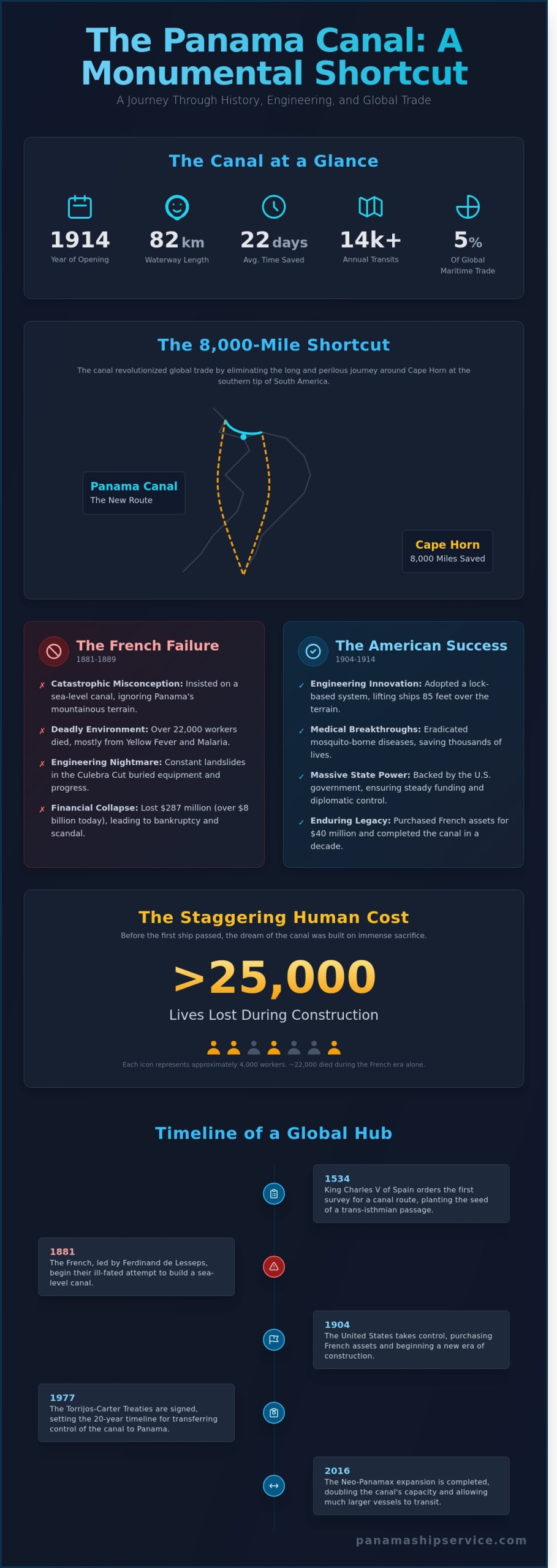
Before the first vessel officially transitioned the Isthmus in 1914, more than 25,000 workers lost their lives and over $639 million was spent to bridge the Atlantic and Pacific Oceans. It is a staggering cost for a 50 mile shortcut, but it is one that redefined global trade forever. You already know that in the shipping industry, timing is everything and costs continually increase. Mismanaging a transit through this corridor is not an option when your bottom line is at stake, and the complexity of the region can be frustrating without the right expertise.
Beyond its engineering significance, the creation of Gatun Lake also formed a rich biodiverse region. The flooded jungle hilltops became islands, now home to abundant wildlife and the site of unique cultural excursions, such as the popular Monkey Island & Indian Village Tour.
We have spent 20 years as a trusted partner at the canal, so we understand that the history of the panama canal is more than just a timeline of diplomatic dates. It is a blueprint for the modern technical and operational challenges you face every day. By reading this article, you will discover how the canal’s evolution from a US construction project to a Panamanian led global hub shaped today’s maritime logistics. We will provide a clear breakdown of the 1999 handover and explain how the 2016 Neo-Panamax expansion changed the scale of ship services forever. We are experts so you don’t have to be.
Key Takeaways
- Trace the evolution of the waterway from 16th-century Spanish exploration to its status as a vital 82 km link between the Atlantic and Pacific Oceans.
- Examine the monumental engineering hurdles of the American Era, including the massive excavation efforts and diplomatic treaties that shaped the canal’s early years.
- Gain insights into the transition of sovereignty and how the 1977 Torrijos-Carter Treaties paved the way for modern Panamanian management.
- Discover how the history of the panama canal and its original lock dimensions continue to influence global ship design and maritime logistics standards.
- Identify why the canal’s historic infrastructure makes specialized technical support and expert mechanical repairs essential for minimizing delays and vessel expenses.
What is the Panama Canal? Defining a Century of Maritime Progress
The Panama Canal is an 82 km (51 mile) artificial waterway that serves as the critical link between the Atlantic and Pacific Oceans. It’s not just a feat of civil engineering; it’s a vital artery for global commerce that handles over 14,000 transits annually. By cutting through the Isthmus of Panama, the canal revolutionized international trade by eliminating the 8,000-mile hazardous journey around Cape Horn. For modern ship owners and charterers, this route represents the difference between a profitable voyage and a logistical nightmare. Today, the Panama Canal Authority (ACP) manages this infrastructure, ensuring that the 5% of global maritime trade passing through these locks moves with precision and safety.
The history of the panama canal is a narrative of human persistence against brutal environmental conditions. Understanding this legacy is essential for any maritime professional navigating the canal in 2024. The waterway functions through a sophisticated system of locks that lift ships 26 meters (85 feet) above sea level to the Gatun Lake, allowing them to cross the continental divide before descending on the opposite side. This process saves vessels an average of 22 days of travel time compared to the southern route around South America.
The Early Vision: From Charles V to the French Attempt
The dream of a trans-isthmian passage dates back to the 16th century. In 1534, King Charles V of Spain ordered the first survey for a canal route. He recognized that a shortcut would provide his empire a massive strategic advantage in reaching the Orient. While his explorers identified the potential, the technology of the 1500s couldn’t conquer the dense jungles and mountains of Panama. The project remained dormant for centuries until the success of the Suez Canal sparked renewed interest.
In 1880, Ferdinand de Lesseps led the French effort under the Compagnie Universelle du Canal Interocéanique. De Lesseps was a hero in France, but he ignored the fundamental differences between the flat sands of Suez and the mountainous, rain-soaked terrain of Panama. You can find more details on these early exploratory efforts in the Complete History of the Panama Canal. Despite raising $287 million from thousands of small investors, the French project was doomed by administrative hubris and a refusal to adapt to the local geography.
Why the French Failed: Technical and Medical Hurdles
The French failure was rooted in a catastrophic misconception. De Lesseps insisted on a sea-level canal, similar to Suez, which required excavating through the massive Culebra Cut. This proved impossible. The steep banks of the cut triggered constant landslides, swallowing equipment and burying years of progress in minutes. Technical failures were only half the problem. The human cost was staggering. Between 1881 and 1889, an estimated 22,000 workers died on the project. Most succumbed to yellow fever and malaria, diseases that were poorly understood at the time.
The financial impact was equally devastating for France. The company couldn’t keep up with the rising costs of labor and machinery in such a hostile environment. The French bankruptcy of 1889 served as the definitive turning point that cleared the path for US intervention in the region. This collapse wasn’t just a business failure; it was a national scandal that saw de Lesseps and his son prosecuted for fraud. The history of the panama canal changed forever when the United States purchased the French assets for $40 million in 1904, bringing a new approach to engineering and tropical medicine.
- 82 kilometers: Total length of the waterway from deep water to deep water.
- 8,000 miles: Distance saved by avoiding the Strait of Magellan.
- $287 million: Total capital lost during the initial French attempt.
- 22,000 deaths: Estimated worker fatalities during the 1880s excavation.
The American Era: Engineering the “Big Ditch” (1904-1914)
The United States took control of the canal project in 1904, following the French failure. Theodore Roosevelt viewed the canal as vital to American national security and global trade. He employed “Big Stick” diplomacy to support Panama’s independence from Colombia in 1903. This political move led directly to the Hay-Bunau-Varilla Treaty, which granted the U.S. permanent rights to a ten-mile wide Canal Zone. This era is the most critical chapter in the history of the panama canal, marking the transition from a failed private venture to a massive state-funded engineering triumph.
Success required more than just digging. It demanded a complete overhaul of the existing infrastructure. Detailed diplomatic and logistical records regarding Building the Panama Canal highlight the immense pressure the American government faced to deliver results where others had collapsed. The project officially concluded on August 15, 1914, when the SS Ancon performed the first official transit, forever changing global maritime routes.
Engineering Marvels: The Lock Systems and Gatun Lake
The American plan abandoned the sea-level canal idea for a lock-and-lake system. This design used massive locks to lift ships 26 metres above sea level to a man-made lake. John Frank Stevens, the Chief Engineer from 1905 to 1907, treated the project as a massive railroad logistics problem. He built the infrastructure needed to move millions of tons of earth efficiently. George Washington Goethals later took over, overseeing the completion of the locks and the Gatun Dam. This dam created Gatun Lake, which was the largest man-made lake in the world at the time of its completion in 1913.
None of this would’ve been possible without the work of William C. Gorgas. As the Chief Sanitary Officer, Gorgas tackled the yellow fever and malaria outbreaks that decimated the French workforce. He implemented a rigorous sanitation program to eliminate mosquito breeding grounds. By 1906, yellow fever was effectively eradicated in the Canal Zone. This health breakthrough saved thousands of lives and ensured the project had a stable labor force.
The Human and Financial Cost of Construction
The scale of the “Big Ditch” required unprecedented resources. The United States invested approximately $375 million into the construction by 1914. This figure included $40 million paid to the French company and $10 million to the Republic of Panama. The physical effort was equally staggering. In the Culebra Cut alone, workers excavated over 100 million cubic yards of earth while facing constant landslides and tropical heat.
- Labor Force: Over 75,000 individuals worked on the canal during the American era.
- Demographics: The majority of the workforce consisted of laborers from the West Indies, primarily Barbados and Jamaica.
- Casualties: Records show that 5,609 workers died from diseases and accidents between 1904 and 1914.
The engineering standards established during this decade continue to influence the maritime industry. The original dimensions of the locks set the “Panamax” ship size standard that lasted for a century. Today, these historical constraints still play a role in calculating vessel downtime panama canal variables for modern operators. Efficiency is the priority in this history of the panama canal. If you want to ensure your ship avoids modern delays, it’s vital to partner with experienced transit experts who understand the canal’s complex operational requirements.
From US Control to Panamanian Sovereignty
The modern history of the Panama Canal changed forever on September 7, 1977. On that day, the Torrijos-Carter Treaties were signed, effectively ending the era of U.S. territorial control. This agreement wasn’t an immediate exit but a 20-year roadmap. It established a transition period from 1979 to 1999, during which a joint Panama Canal Commission managed operations. U.S. officials and Panamanian professionals worked side-by-side to ensure the waterway remained a reliable artery for global trade. By 1989, more than 80% of the canal’s workforce was Panamanian, proving the local capacity to handle complex maritime logistics.
On December 31, 1999, at exactly 12:00 PM, Panama assumed full, undisputed control. This was a historic moment for national identity and global commerce. The Autoridad del Canal de Panamá (ACP) took the reins as a constitutionally autonomous government entity. This independence is critical; it keeps canal revenue and management decisions shielded from shifting political tides. For ship owners and charterers, this transition meant the “Master Key” to the world was now in the hands of a dedicated, service-oriented administration. We understand that timing is everything in this industry. The ACP’s focus on technical excellence ensures your transit doesn’t suffer from the bureaucratic delays often found in government-run utilities.
The Impact of the Handover on Global Shipping
Maintaining neutrality is the ACP’s primary mandate. Under the Treaty Concerning the Permanent Neutrality and Operation of the Panama Canal, the waterway must remain open to all nations on equal terms. Since the handover, the ACP has invested over $2 billion in maintenance and modernization, excluding the expansion project. They’ve introduced satellite-based tracking and advanced hydraulic systems to improve safety. You can find more detailed Panama Canal Facts and History regarding how these administrative shifts moved the canal from a military asset to a commercial powerhouse. Today, the ACP manages roughly 13,000 to 14,000 transits annually with a level of precision that minimizes vessel expenses and port turnaround times.
The 2016 Expansion: Accommodating Neopanamax Vessels
The history of the panama canal entered its most ambitious chapter with the Third Set of Locks project. Completed on June 26, 2016, this $5.4 billion expansion was an economic necessity. Before this, the largest ships, known as Panamax, were limited to a 32-meter beam. The new Cocoli and Agua Clara locks introduced the Neopanamax standard. These locks are 70 feet wider and 18 feet deeper than the originals. This allows vessels carrying up to 14,000 TEUs to pass, nearly tripling the previous 5,000 TEU limit.
- Increased Capacity: The expansion doubled the canal’s throughput capacity.
- Water Conservation: New basins recycle 60% of the water used in each transit.
- Market Reach: 79% of the world’s cargo fleet can now fit through the canal.
For modern fleet owners, the 2016 expansion isn’t just a feat of engineering; it’s a tool for better economies of scale. Larger ships mean lower costs per container, but they also require more precise technical support during transit. We are experts so you don’t have to be. As the history of the panama canal continues to evolve in 2024, the focus has shifted toward water management and digital logistics. Every minute saved in the locks is money back in your pocket. Put your transit in our hands to navigate these modern complexities with confidence.
The Mariner’s Perspective: How History Shaped Modern Transit
The history of the Panama Canal serves as the literal blueprint for modern vessel architecture. When the canal opened in 1914, its lock dimensions of 1,000 feet by 110 feet created the original Panamax standard. This constraint forced naval architects to design ships specifically for this narrow passage for over a century. While the 2016 expansion introduced Neopanamax capabilities, the legacy locks still handle the majority of daily transits. This historical footprint means precision is mandatory. Miscalculating a vessel’s dimensions by even a few inches leads to immediate rejection by the Panama Canal Authority (ACP).
Understanding the history of the Panama Canal helps operators anticipate the technical rigor required for a successful crossing. The transition from US control to the ACP in 1999 brought about a more commercially focused but strictly regulated environment. Today, the ACP maintains 24/7 surveillance and strict boarding officer inspections that trace their roots back to early safety protocols. Modern route planning must account for these historical standards to ensure that equipment, from mooring winches to chocks, meets the specific heavy-duty requirements established over decades of canal operations.
Navigational Challenges Rooted in History
The Culebra Cut remains the most demanding stretch of the waterway. Historically known as the Gaillard Cut, this 8.5-mile valley was carved through the continental divide where frequent landslides, like the massive 1915 event that closed the canal for seven months, established a precedent for rigorous maintenance. Modern pilots face these same geological pressures. To manage these risks, we conduct marine surveys panama to verify that every vessel meets the ACP’s strict draft and trim requirements before entering the cut. Historical siltation patterns from the Chagres River continue to deposit sediment, making regular dredging and specialized hull maintenance essential to prevent grounding in these shallow, narrow segments.
Minimizing Delays in a High-Traffic Waterway
The shift from early 20th-century steam propulsion to modern diesel and LNG engines has increased the technical complexity of transit. High temperatures in the tropical environment put immense strain on cooling systems and engine components during the 8 to 10-hour crossing. When propulsion issues arise, operators require immediate mechanical ship repairs panama to avoid being towed, which can cost upwards of $30,000 in additional fees. Panama Ship Service leverages 20 years of operational experience to provide a one-stop-shop model. We consolidate technical inspections and repairs into a single window, ensuring that historical bottlenecks don’t derail your 2024 schedule.
Our team handles the technical details so you don’t have to. We understand that in this waterway, timing is everything. A delay at the Gatun locks can ripple through a global supply chain, costing charterers thousands of dollars per hour. By utilizing a “one-stop-shop” approach for repairs and surveys, we eliminate the need for multiple vendors and reduce the risk of communication breakdowns. Our goal is to move your vessel through these historic waters with the efficiency that modern commerce demands.
Put your transit in our hands. Contact Panama Ship Service today for expert technical support and rapid response repairs.
Panama Ship Service: Your Expert Partner in a Historic Canal
The history of the panama canal spans more than 110 years, yet the vessels transiting this engineering marvel today are more complex than ever. While the canal’s concrete locks and gravity-fed systems remain a testament to early 20th-century ingenuity, modern shipping demands 21st-century technical precision. Panama Ship Service bridges this gap by providing specialized support for vessels that must meet strict Panama Canal Authority (ACP) regulations. We’ve spent over 20 years perfecting our operational and technical services to ensure your transit is seamless and safe.
Managing a successful crossing requires more than just a slot in the schedule; it demands a vessel that is mechanically sound and compliant with international standards. We provide a calm, expert presence in a high-stakes environment. Our team handles the technical complexities of your transit so you can focus on your broader logistics. We are experts so you don’t have to be. By putting your transit in our hands, you gain a partner dedicated to minimizing risk and maximizing uptime.
Modern Solutions for a Century-Old Route
Vessels built for global trade must often undergo specific modifications or repairs to safely navigate the narrow locks and unique conditions of the canal. We offer specialized mechanical repairs and steel fabrication tailored for these requirements. Whether it’s repairing winch systems or ensuring hull integrity, our technicians work within the tight windows provided by your schedule. Our 20 years of experience allows us to anticipate common points of failure before they become transit-blocking issues.
Maintaining efficiency also means keeping the hull in peak condition. We provide underwater hull cleaning and propeller polishing that strictly adhere to MARPOL and ACP environmental standards. A fouled hull increases drag and fuel consumption, which can be a liability during the long wait times often associated with the history of the panama canal operations. Our expert marine surveys ensure your vessel is “Canal-ready” by identifying potential compliance issues before the ACP inspectors board your ship.
- Specialized engine and auxiliary machinery repairs.
- Certified steel fabrication and welding for structural integrity.
- Underwater inspections using high-definition video and photography.
- Propeller polishing to improve fuel efficiency by up to 5 percent.
Why Reliability Matters at the Panama Canal
Timing is everything in the shipping industry. A single day of delay at the canal can cost a ship owner between $50,000 and $150,000 in charter hire and operational expenses. In an environment where costs continually increase, you need a rapid-response technical partner who understands the urgency of your timeline. We prioritize speed without compromising on the quality of our repairs, ensuring your vessel doesn’t lose its valuable transit slot due to mechanical failure.
Our team maintains 24/7 availability at both the Balboa and Cristobal ports, covering both the Pacific and Atlantic entrances. This constant presence allows us to respond to emergencies or routine maintenance requests at a moment’s notice. We provide constant daily communication, so you’re never left wondering about the status of your repairs. If you are planning a transit and need to ensure your vessel meets all technical requirements, contact us today for a ship repair quote panama to secure your transit and protect your bottom line.
Our commitment is simple: we provide the technical expertise and local knowledge necessary to keep your fleet moving. We understand the pressures faced by ship owners and charterers. We deliver cost-conscious solutions that prevent small mechanical issues from turning into expensive, multi-day delays. Trust the veteran team that knows the canal inside and out.
Navigate Your Transit with Century-Old Expertise
The history of the panama canal proves that navigating this 50 mile stretch remains a feat of both engineering and logistics. Since the canal first opened in 1914, it has transformed global trade by cutting 8,000 miles off the journey between the Atlantic and Pacific oceans. Today, modern shippers face complex MARPOL regulations and tight schedules that leave no room for error. Panama Ship Service provides the reliability you need to maintain your competitive edge. With over 20 years of experience in the region, we offer MARPOL-compliant disposal and class-approved underwater surveys to keep your fleet compliant. Our teams provide 24/7 rapid response for mechanical repairs to ensure your vessel stays on track. We’re the experts so you don’t have to be. Trust your transit to a partner who understands the high stakes of the shipping industry. We’re ready to help you optimize your next crossing with efficiency and precision.
Get a Quote for Ship Services at the Panama Canal
Frequently Asked Questions
When was the Panama Canal completed and officially opened?
The Panama Canal officially opened on August 15, 1914. This followed a decade of American construction that began in 1904. The SS Ancon was the first cargo ship to transit the waterway. It marked the end of a project that required moving 232 million cubic yards of earth. Today, understanding the history of the panama canal helps operators appreciate the engineering precision required for modern transits.
Who originally started building the Panama Canal?
France initiated the first attempt to build the canal in 1881 under the leadership of Ferdinand de Lesseps. He previously completed the Suez Canal and sought a sea-level passage through the Isthmus. However, the French effort collapsed by 1889 due to financial bankruptcy and the deaths of 22,000 workers from yellow fever and malaria. This failure is a critical chapter in the history of the panama canal that led to American intervention.
How did the Panama Canal impact global shipping routes?
The canal reduced the shipping distance between New York and San Francisco from 13,000 miles to roughly 5,200 miles. By eliminating the dangerous journey around Cape Horn, transit times dropped by 20 days for average steamships. This efficiency lowered fuel costs and revolutionized global trade patterns. Modern logistics still rely on this 50-mile shortcut to maintain competitive delivery schedules for global markets.
Why did the United States take over the canal project from the French?
The United States took over the project in 1904 after the French New Panama Canal Company failed to secure enough funding. President Theodore Roosevelt recognized the canal’s strategic military value following the Spanish-American War in 1898. The U.S. purchased the French assets for $40 million. They also supported Panamanian independence to secure the 1903 Hay-Bunau-Varilla Treaty, which granted them control over the Canal Zone.
What is the significance of the 2016 Panama Canal expansion?
The expansion project, completed on June 26, 2016, added a third lane of traffic through new Cocoli and Agua Clara locks. This upgrade allows the transit of Neopanamax vessels, which carry up to 14,000 TEUs. Before this, the canal limited ships to roughly 5,000 TEUs. The $5.4 billion investment doubled the waterway’s capacity and ensured its relevance in a market dominated by massive container ships.
How much did it cost to build the Panama Canal in today’s money?
The American construction phase cost $375 million by its 1914 completion date. When adjusted for inflation to 2024 values, this total equals approximately $11.5 billion. This figure includes the $40 million paid to the French and $10 million paid to Panama. It remains one of the most expensive infrastructure projects in history, reflecting the massive scale of the excavation and lock construction.
Who owns and operates the Panama Canal today?
The Republic of Panama owns and operates the canal through the Panama Canal Authority (ACP). This autonomous government agency took full control on December 31, 1999. The transition resulted from the 1977 Torrijos-Carter Treaties, which ended nearly a century of American administration. Today, the ACP manages all daily operations, maintenance, and transit scheduling to ensure the waterway remains a reliable link for international commerce.
What are the main differences between Panamax and Neopanamax ships?
Panamax ships are designed to fit the original 1914 locks, with a maximum beam of 106 feet. Neopanamax vessels utilize the 2016 locks and can have a beam of up to 168 feet. While Panamax ships carry about 5,000 TEUs, Neopanamax ships handle up to 14,000 TEUs. This size difference requires precise draft surveys and specialized technical support to ensure safe passage through the differing lock dimensions.