
Why does a 50 mile shortcut often take 10 hours to complete, and why do so many operators still struggle to pin down exactly how long is Panama Canal when planning their 2026 schedules? In an industry where timing is everything, miscalculating your transit window by just 60 minutes can lead to thousands of dollars in fuel waste or missed berthing slots. You already know that precision is the only way to maintain a competitive edge, yet the difference between shoreline distance and deep water approach remains a frequent source of confusion for even seasoned mariners.
We are experts so you don’t have to be. This guide provides the precise physical and operational measurements required to maximize your vessel’s efficiency. You will discover the exact mileage data from the Atlantic to the Pacific, a realistic lock to lock timeline for the Neo Panamax era, and a breakdown of critical service waypoints at Balboa and Cristobal. We will show you how to turn a complex transit into a predictable, cost effective passage by identifying exactly where technical services can be performed during your journey.
Key Takeaways
- Differentiate between shoreline distance and deep-water channel measurements to ensure precise navigation planning for your vessel.
- Understand exactly how long is panama canal by breaking down the 80-kilometer journey into its critical geographic segments and technical waypoints.
- Analyze why the 50-mile transit averages 8 to 10 hours in 2026 and how pilotage requirements impact your operational timeline.
- Identify strategic hubs in Balboa and Cristobal for conducting essential repairs and bunker surveys during your scheduled transit.
- Discover how to optimize transit efficiency by consolidating technical services and supplies with a trusted local partner.
Understanding the Dimensions: How Long is the Panama Canal Physically?
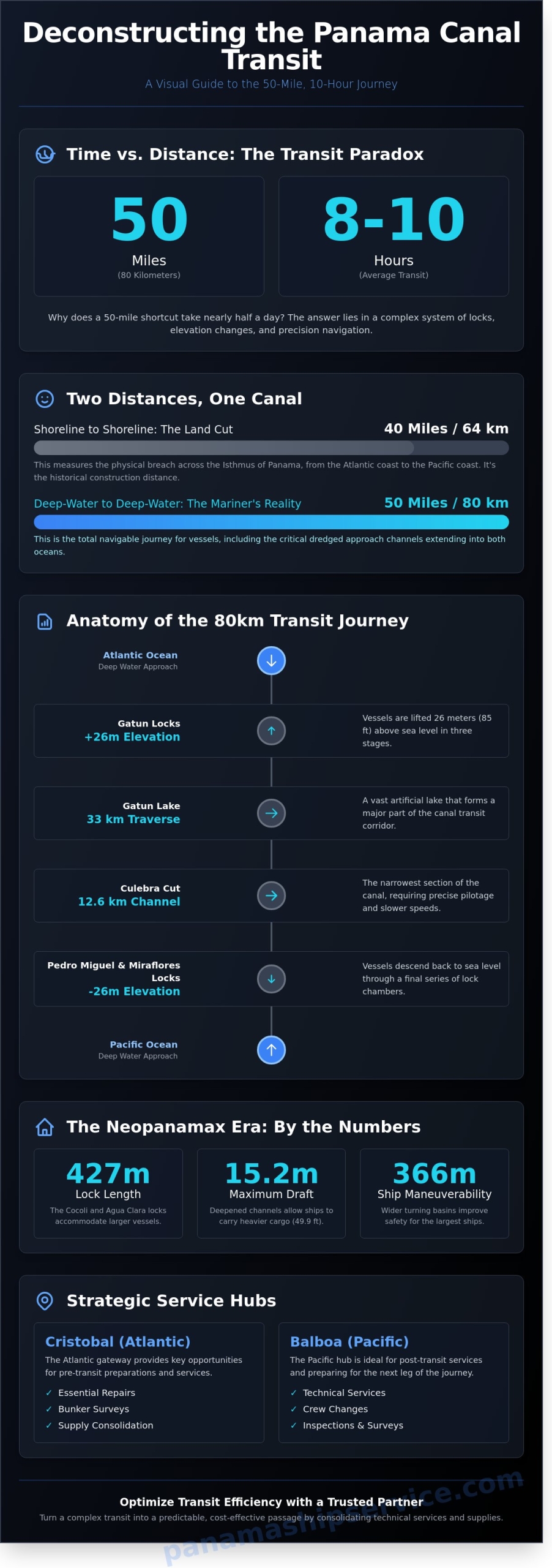
Ship owners and charterers need precise data to manage transit schedules and bunker requirements effectively. When asking how long is panama canal, the answer depends on whether you measure the shoreline land cut or the total navigable deep-water channel. The standard measurement used by the Panama Canal Authority and maritime professionals is approximately 80 kilometers, which translates to 50 miles from deep water in the Atlantic to deep water in the Pacific. We provide these technical insights because timing is everything in this industry; miscalculating the physical scale of the transit can lead to costly delays at the locks.
Shoreline to Shoreline: The 40-Mile Mark
The physical breach across the Isthmus of Panama is significantly shorter than the total transit length required for a vessel. From the shoreline at Colon on the Atlantic side to the shoreline at Panama City on the Pacific side, the distance is roughly 40 miles (64 kilometers). This was the original footprint established during the 1914 construction. Unlike the Suez Canal, which stretches 193 kilometers through relatively flat terrain, the Panama Canal requires a complex system of locks to lift vessels 26 meters above sea level to reach Gatun Lake. This shorter physical distance doesn’t mean a faster transit. The elevation changes and lock cycles dictate the operational timeline more than the mileage itself.
Deep-Water to Deep-Water: The 50-Mile Reality
Mariners must account for the dredged approach channels that extend well into the sea. These channels ensure that heavy cargo vessels have sufficient depth before entering the lock systems. The Atlantic entrance at Cristobal and the Pacific entrance at Balboa add roughly 10 miles to the total journey. This brings the effective navigable length to the 50-mile mark. The impact of channel depth on the effective length is a critical factor for heavy cargo. If a vessel is loaded to its maximum draft, the “length” of the transit feels longer because the pilot must maintain lower speeds to manage the hydrodynamic effects in the narrowest sections, such as the Culebra Cut.
The 2016 expansion modified the navigable footprint for Neopanamax vessels in several ways:
- Increased Lock Dimensions: The new Cocoli and Agua Clara locks are 427 meters long and 55 meters wide.
- Deepened Channels: Dredging projects increased the maximum allowable draft to 15.2 meters (49.9 feet) in Gatun Lake.
- Wider Turning Basins: New basins allow 366-meter ships to maneuver safely, effectively expanding the operational area of the canal.
Operational efficiency is our priority at Panama Ship Service. We understand that how long is panama canal is a question of time as much as distance. For a Neopanamax vessel, the 50-mile journey involves navigating tight tolerances where the beam and draft of the ship dictate the speed. A vessel with a 51.25-meter beam requires more precise tug assistance and slower speeds through the 12.6-mile Culebra Cut. We are experts so you don’t have to be. Our team monitors these variables to ensure your vessel moves from deep water to deep water without unnecessary expenses. Put your transit in our hands to navigate these 50 miles with maximum efficiency.
The Anatomy of the 80km Transit Journey
To understand how long is panama canal, you must look beyond the 80 kilometer (50 mile) map distance. The transit is a complex operational sequence divided into distinct geographic segments. Each segment demands specific pilotage and technical precision. A standard transit takes 8 to 10 hours, but the physical path is only one part of the equation. The journey is a vertical and horizontal navigation through the Isthmus of Panama, starting from the deep waters of either the Atlantic or Pacific oceans.
Vessels enter the channel and are immediately met with the challenge of elevation. Ships must be raised 26 meters above sea level to reach the interior waterway. This elevation change happens through a series of gravity-fed lock chambers. Once at the summit, ships traverse Gatun Lake for 33 kilometers. This artificial body of water acts as both a reservoir and a transit corridor. After the lake, the channel narrows into the Culebra Cut for 12.6 kilometers before descending back to sea level through the final lock sets. The lock placement dictates the rhythm of the entire journey. Ships move in scheduled convoys, meaning a delay in one segment ripples through the entire 80km stretch.
The Lock Systems: Miraflores, Pedro Miguel, and Gatun
The original locks, which opened in 1914, feature chambers measuring 304.8 meters long and 33.5 meters wide. These dimensions limited vessel size for over a century. The 2016 expansion introduced the Cocoli and Agua Clara locks. These Neopanamax chambers are 427 meters long and 55 meters wide, allowing 14,000 TEU container ships to pass. Each locking cycle takes approximately 45 to 60 minutes. These cycles add “time-length” to the physical distance. If a vessel is not prepared for the technical requirements of these locks, the transit time can double. Efficient vessel coordination is essential to prevent these technical stages from becoming costly bottlenecks for owners and charterers.
Navigating Gatun Lake and the Culebra Cut
Gatun Lake is the heart of the canal’s operation. It sits 26 meters above sea level and provides the water necessary to operate the locks. Navigating this 33km stretch requires constant monitoring of water levels, especially during the dry season between January and April when draft restrictions often change. Following the lake, ships enter the Gaillard (Culebra) Cut. This 12.6km stretch was carved through the continental divide. The Culebra Cut is the most difficult excavation in the canal’s history. During the U.S. construction of the Panama Canal, engineers faced constant landslides and geological instability in this specific area. Today, it remains the narrowest part of the transit. Pilots must manage tight tolerances, and large vessels often require tugboat assistance to maintain steerage and safety.
Managing the logistics of how long is panama canal requires more than just a map. It requires an understanding of draft restrictions and scheduling windows. We are experts so you don’t have to be. Our team provides the technical support needed to ensure your vessel meets every requirement before arrival, minimizing the risk of delays during the 80km passage. Timing is everything in this industry, and misjudging the transit rhythm can lead to significant financial loss.
Time vs. Distance: Why 50 Miles Takes 8 to 10 Hours
Understanding how long is panama canal requires looking past the 50-mile physical distance. For a standard vessel in 2026, the transit itself averages 8 to 10 hours. It’s not a straight sail. Every ship must navigate three sets of locks, cross Gatun Lake, and traverse the narrow Culebra Cut. According to Britannica, the Panama Canal length and transit time are defined by the complex engineering that lifts ships 85 feet above sea level. This elevation change alone consumes hours of the journey.
Vessel class dictates the pace. In 2026, Panamax vessels typically complete the move in 8.5 hours. Neopanamax ships, carrying up to 14,000 TEUs, often require 10 to 12 hours. The increased duration for larger ships stems from the precision needed in the Cocoli and Agua Clara locks. Speed is strictly limited to 6 to 12 knots. Pilotage is mandatory; Panama Canal Authority (ACP) pilots take command of the bridge for the entire 50-mile stretch. Tug assistance is constant for Neopanamax vessels because they don’t use the traditional locomotives (mules) found in the older locks.
The 50-mile transit is only one part of the operational timeline. Ship owners frequently ask how long is panama canal in terms of total operational time, which often exceeds 24 to 30 hours. This “Anchorage to Anchorage” window includes waiting for the pilot, mandatory inspections, and staging at the Atlantic or Pacific entrances. Efficiency depends on coordination. We ensure your vessel is ready for inspection the moment it arrives to prevent these 30-hour windows from stretching into days.
Operational Bottlenecks and Traffic Management
The ACP manages every minute of the schedule to maximize throughput. In 2026, Neopanamax vessels face stricter windows because they can’t pass each other in certain sections of the Culebra Cut. Climate patterns in early 2026 have kept Gatun Lake levels at approximately 80 feet. This has led to draft restrictions of 44 feet instead of the maximum 50 feet. Ships carry less cargo, yet transit times remain high due to the increased safety protocols required during lower water levels. We track these daily fluctuations so you don’t have to.
Wait Times and Booking Slots
Timing is everything in maritime logistics. Booked transits are prioritized and usually begin within 12 hours of arrival. Ships in the “queue” without a pre-booked slot can wait 5 to 10 days during peak congestion. You can minimize downtime by securing slots weeks in advance. A local agency is essential for this. We manage your timeline to ensure your vessel arrives exactly when the ACP is ready. Mismanaging this leads to thousands of dollars in daily fuel and charter costs. Put your transit in our hands to avoid these expensive delays.
- Panamax Transit: 8 to 9 hours
- Neopanamax Transit: 10 to 12 hours
- Total Time (Anchorage to Anchorage): 24 to 30+ hours
- Queue Wait Time: 5 to 10 days without a slot
Technical Waypoints: Services Along the Canal Route
The Panama Canal is a high-pressure environment where every minute translates to significant operational costs. When operators ask how long is panama canal, they aren’t just looking for the 80-kilometer measurement. They’re looking for a logistical strategy. This 50-mile transit creates a unique “one-stop-shop” for vessels that can’t afford to deviate from their global trade routes. Instead of stopping at a distant port for maintenance, savvy owners use the canal’s entrances as technical waypoints to handle everything from engine parts to waste disposal.
Balboa on the Pacific side and Cristobal on the Atlantic side are the two primary pillars of this service system. These locations offer deep-water anchorages where ships often wait for their scheduled transit window. We turn this waiting period into productive time. Whether your vessel needs a deratting certificate or a critical engine component, these hubs provide the necessary infrastructure. With over 20 years of experience at these entrances, we’ve refined the process of getting technicians on and off ships without affecting the Panama Canal Authority’s strict schedule. We are experts so you don’t have to be.
Mechanical Repairs and Underwater Services
Ship owners often face a difficult choice: stay on schedule or fix a mounting mechanical issue. Our team eliminates that conflict. You can schedule mechanical ship repairs panama to coincide exactly with your arrival at the Pacific or Atlantic anchorage. This prevents any transit disruption. If your vessel is waiting for its slot, it’s the perfect time for underwater hull services panama. We deploy specialized dive teams for hull cleaning or propeller polishing while the ship is stationary, maximizing fuel efficiency for the rest of the voyage. Emergency repairs at the canal entrances are handled with extreme urgency to ensure you don’t lose your transit slot.
Surveys and Compliance Inspections
Regulatory compliance is not optional in these waters. Because of how long is panama canal and the complexity of its lock systems, every vessel must meet strict standards before the pilot boards. We conduct marine surveys panama at the anchorage to ensure your ship is ready for the 8 to 10-hour journey. Our surveyors perform draft surveys to verify weight and bunker surveys to confirm fuel quantities with high precision. We also manage MARPOL Annex I, IV, and V disposals. This ensures all waste is offloaded according to international law before you enter the environmentally sensitive lake systems. We provide constant daily communication so you’re never in the dark about your vessel’s status.
- Strategic Hubs: Balboa (Pacific) and Cristobal (Atlantic) offer full-service support.
- Efficiency: Utilize 8-10 hours of transit or anchorage time for essential maintenance.
- Compliance: Complete MARPOL disposals and surveys to avoid Canal Authority fines.
- Expertise: 20 years of localized experience in managing technical ship requirements.
Optimizing Your Transit with Panama Ship Service
Panama Ship Service functions as your technical master key for every transit. While the physical answer to how long is panama canal is approximately 50 miles from deep water to deep water, the operational length of your stay depends entirely on technical readiness. We’ve spent 20 years refining our presence at the Canal to ensure that your vessel doesn’t spend a single unnecessary hour at anchor. Our team understands that for ship owners and charterers, time is the most expensive commodity in the maritime industry.
When calculating how long is panama canal transits will take, you must account for more than just the distance between the Atlantic and Pacific. You have to consider the time required for inspections, bunker surveys, and potential technical hurdles. We minimize this operational window by providing proactive communication and immediate technical support. Our goal is to handle the complexities of the local environment so your crew can focus on safe navigation.
Efficiency is built through the consolidation of essential services. Instead of managing multiple vendors, we provide a streamlined solution that covers:
- Technical Surveys: Comprehensive bunker, draft, and condition surveys performed by qualified experts.
- MARPOL Disposals: Certified waste management that complies with all international and local regulations.
- Rapid Repairs: Immediate mechanical and electrical interventions to prevent transit delays.
- Logistical Support: Coordination of supplies and spare parts delivery during the transit window.
A One-Stop-Shop for Ship Owners and Charterers
Our “Experts so you don’t have to be” philosophy is the foundation of our service model. We recognize that the regulatory environment at the Panama Canal is dense and often frustrating for those unfamiliar with local ACP requirements. By consolidating technical services, we significantly reduce vessel expenses. You won’t deal with the administrative overhead of five different contractors; you deal only with us. This centralized approach saves owners an average of 15 percent on total port call costs compared to fragmented service procurement.
Vessel operators heading into 2026 must prepare for tighter schedules and stricter enforcement of environmental standards. We’ve optimized our rapid response teams to handle emergency repairs within a 24-hour window, ensuring that minor technical failures don’t turn into week-long delays. Our 20 years of local expertise allow us to anticipate problems before they manifest, keeping your vessel moving through the locks without interruption.
Contact Us for a Seamless Canal Experience
Local knowledge is the only way to navigate the complex regulatory landscape of the Isthmus. Whether it’s securing a Deratting Certificate or managing a complex underwater repair, our team has the established relationships and technical certifications to get it done. We operate with a sense of urgency because we know that a missed slot at the Canal can cost tens of thousands of dollars in lost revenue and fuel consumption.
To start optimizing your next transit, reach out to our operations desk for a detailed consultation. We provide transparent, competitive pricing for all technical surveys and mechanical repairs. Don’t leave your schedule to chance in a high-stakes environment. Get a Quote for Your Panama Canal Ship Services today and put your vessel in the hands of the most reliable technical partner in the region.
Master Your Next Canal Transit
Navigating the 80km stretch between the Atlantic and Pacific Oceans requires more than just knowing how long is panama canal physically. While the distance spans roughly 50 miles, the 8 to 10 hours spent in transit involve complex lock sequences and high-stakes timing. Success on this route means coordinating technical waypoints and essential services without missing your scheduled window. Every minute of downtime translates to increased costs for ship owners and charterers. Efficiency is the only way to protect your bottom line in this environment.
Panama Ship Service provides the reliability you need through 20+ years of operational expertise at the canal. We operate as a comprehensive one-stop-shop, offering specialized MARPOL disposals and technical repair capabilities designed to minimize vessel expenses. We’re experts so you don’t have to be, ensuring your ship remains compliant and functional throughout its journey. Our team delivers rapid responses and constant communication to keep your operations moving forward without frustration. Put your trust in a partner that understands the urgency of the maritime industry.
Put your transit in our hands; Contact Panama Ship Service today
We look forward to helping you achieve a seamless and cost-effective crossing on your next voyage.
Frequently Asked Questions
How long is the Panama Canal in miles and kilometres?
The Panama Canal is approximately 50 miles (80 kilometers) long when measured from deep water in the Atlantic to deep water in the Pacific. Measuring from shoreline to shoreline, the distance is roughly 40 miles (64 kilometers). Understanding how long is panama canal helps operators plan fuel consumption and crew rotations accurately. This 50 mile transit saves vessels roughly 8,000 nautical miles compared to sailing around Cape Horn.
How long does it take for a ship to pass through the Panama Canal?
A typical vessel takes between 8 and 10 hours to complete the actual transit from one ocean to the other. Total time spent in canal waters often reaches 24 to 30 hours because of scheduling and traffic density. We provide expert coordination to minimize these wait times. Efficient passage is critical since every hour of delay increases operational costs for ship owners and charterers.
What is the deepest part of the Panama Canal?
The deepest sections of the navigation channel are found within Gatun Lake and the Culebra Cut. The Panama Canal Authority maintains a minimum depth of 40 feet (12 meters) in the old locks and up to 50 feet (15.2 meters) in the Neopanamax lanes. These depths fluctuate based on seasonal rainfall levels in the Gatun Lake watershed. We monitor these draft restrictions daily to ensure your vessel meets all technical requirements.
Can ships pass through the Panama Canal 24 hours a day?
Ships transit the canal 24 hours a day, 365 days a year, regardless of weather conditions or holidays. The Panama Canal Authority employs specialized lighting systems and tugboat assistance to maintain a constant flow of traffic through the locks at night. This around the clock operation allows the canal to handle an average of 35 to 40 vessels every single day. Our team provides 24/7 support to handle any technical needs during night transits.
How many locks does a ship go through in the Panama Canal?
A vessel passes through a total of 12 lock chambers during a complete transit from the Atlantic to the Pacific. There are three sets of locks: Gatun, Pedro Miguel, and Miraflores. Each set lifts or lowers the ship 85 feet (26 meters) above sea level to reach Gatun Lake. Navigating these locks requires precision and experienced pilotage to prevent hull damage or costly delays.
What is the maximum ship size allowed in the Panama Canal in 2026?
By 2026, the maximum vessel size for the Neopanamax locks remains 1,200 feet (366 meters) in length and 168 feet (51.25 meters) in beam. The maximum tropical fresh water draft is set at 50 feet (15.24 meters), though this can change based on Gatun Lake water levels. Knowing how long is panama canal and its specific dimensions is vital for fleet managers ordering new builds. We help you navigate these technical specifications to ensure compliance.
Why do ships have to pay to use the Panama Canal?
Ships pay tolls to cover the high operational and maintenance costs of the canal infrastructure, which includes the locks, dams, and dredging equipment. These fees also fund the 10,000 employees who manage the waterway’s daily traffic. Tolls vary significantly based on vessel type and capacity; some large container ships pay over $1,000,000 per transit. We act as your cost conscious partner to ensure all fees are calculated correctly.
Where can I get ship repairs done while transiting the canal?
Specialized ship repairs are available at the ports of Balboa on the Pacific side and Cristobal on the Atlantic side. Panama Ship Service offers comprehensive technical support including engine repairs, underwater hull cleaning, and MARPOL disposals at these locations. We’re experts so you don’t have to be; our teams provide 24/7 rapid response to keep your vessel moving. Contact us to coordinate repairs without disrupting your transit schedule.