
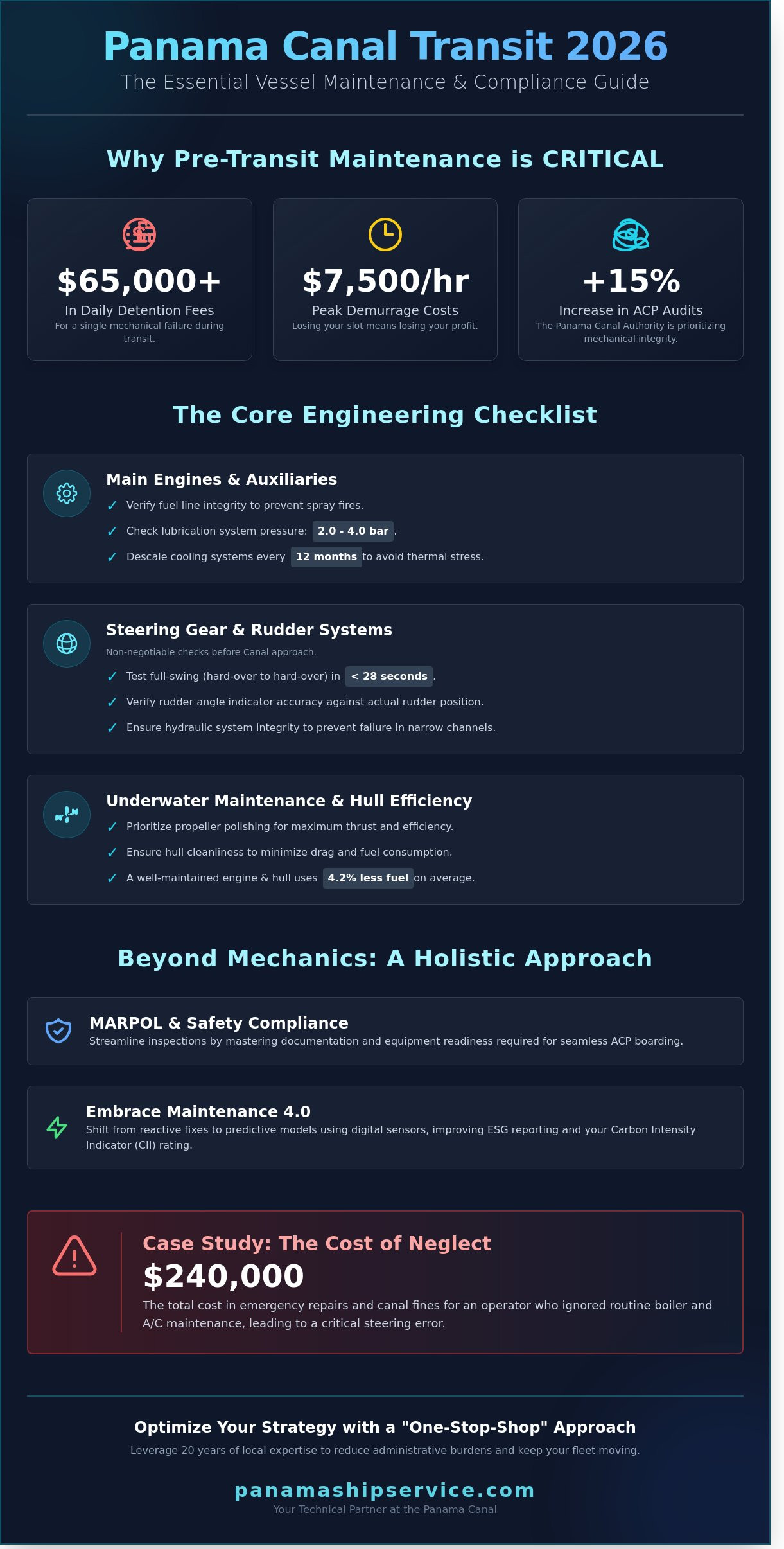
A single mechanical failure during a 2026 Panama Canal transit can cost a ship owner upwards of $65,000 in daily detention fees and emergency tug charges. You already understand that in this high-stakes maritime corridor, timing isn’t just a metric; it’s your entire profit margin. Relying on outdated logs is no longer an option when the Panama Canal Authority has increased its technical compliance audits by 15% since January. This is why a rigorous vessel maintenance checklist is your most valuable asset for avoiding the high costs of emergency port repairs.
Our 2026 guide provides the commercial-grade framework you need to ensure every system, from propulsion to waste management, meets the latest regulatory standards. We’ve built this framework to help you achieve zero-delay transits and maintain full MARPOL compliance while extending your equipment’s lifespan. You’ll get a systematic breakdown of the essential technical inspections and documentation required for a seamless passage through the locks. We’re the experts at the Canal so you don’t have to be.
Key Takeaways
- Learn how to mitigate the risk of costly transit delays and mechanical “blackouts” by prioritizing critical system checks before reaching the canal locks.
- Implement a commercial-grade vessel maintenance checklist to verify steering gear and engine integrity, ensuring full compliance with strict ACP standards.
- Discover the direct link between propeller polishing and hull cleanliness to maximize thrust and minimize fuel expenses during your transit.
- Streamline MARPOL and safety inspections by mastering the specific documentation and equipment readiness required for seamless ACP boarding.
- Understand how a “one-stop-shop” approach reduces administrative burdens and leverages 20 years of local expertise to keep your fleet moving.
The Strategic Importance of a Vessel Maintenance Checklist in 2026
In 2026, the Panama Canal is more than a transit point; it’s a high-pressure testing ground for maritime readiness. A rigorous vessel maintenance checklist is your most effective tool for minimizing transit delays. The Panama Canal Authority (ACP) has increased its inspection frequency by 15% since 2024. They now prioritize mechanical integrity over almost all other factors. A single blackout or a steering failure during lockage doesn’t just stall your ship. It triggers a cascade of financial penalties and operational blacklists. We’ve seen owners lose $45,000 in a single day because they skipped a routine check on a backup generator. Proper Ship husbandry ensures your vessel meets these strict standards every time you approach the locks. Preventive maintenance is the only way to guarantee you pass ACP inspections without being relegated to the back of the queue.
The Cost of Neglect: Delays and Demurrage
Demurrage costs in the Panama region now range between $3,800 and $7,500 per hour depending on the vessel class. Mechanical reliability is your best insurance against these scheduling losses. If your propulsion system fails while you’re in the queue, you lose your slot and your reputation with charterers. We managed a case in late 2025 where a vessel ignored routine boiler and A/C maintenance. The resulting high engine room temperatures led to crew heat exhaustion and a subsequent steering error during a critical maneuver. That oversight cost the operator $240,000 in emergency repairs and canal fines. Regular maintenance prevents these human and mechanical failures before they start. It’s much cheaper to replace a seal today than to pay for a tugboat escort tomorrow.
Aligning with 2026 Maritime Standards
The transition to Maintenance 4.0 is no longer optional. By 2026, global shipping has shifted from reactive “fix-it-when-it-breaks” mentalities to predictive models. You should use digital sensors to inform your manual vessel maintenance checklist. These sensors provide the data needed for accurate 2026 ESG reporting and meeting strict fuel efficiency goals. A well-maintained engine uses 4.2% less fuel on average. This directly impacts your Carbon Intensity Indicator (CII) rating and your bottom line. Panama Ship Service acts as your technical partner in this environment. We provide the boots-on-the-ground expertise to verify your digital readings with physical inspections. We’re experts so you don’t have to be. Our team ensures your fleet remains compliant with the latest international maritime regulations and local ACP requirements. Trust us to handle the technical details while you focus on your core business. We provide the rapid response you need to stay on schedule.
Our approach combines 20 years of local experience with modern technical standards. We understand that timing is everything in this industry. When you put your transit in our hands, you’re choosing a partner that values efficiency as much as you do. Don’t let a small oversight turn into a million-dollar delay. Use a structured checklist to stay ahead of the curve and keep your vessels moving through the canal without interruption.
Mechanical and Structural Integrity: The Core Engineering Checklist
A vessel’s mechanical health determines its ability to navigate restricted waterways safely. For any technical superintendent, the vessel maintenance checklist starts in the engine room. Main engines and auxiliaries require a rigorous review of fuel line integrity to prevent atomized spray fires. Lubrication systems must maintain specific pressure differentials, typically between 2.0 and 4.0 bar, to ensure bearing longevity. Cooling systems need descaling every 12 months to avoid thermal stress on cylinder liners and ensure efficient heat exchange during high-load maneuvers.
Steering gear and rudder systems are non-negotiable before a canal approach. You can’t afford a hydraulic failure in a narrow channel. Testing must include full-swing movements from hard-over to hard-over within 28 seconds using both steering pumps simultaneously. These protocols align with international standards and the Rules for the Safe Operation of Vessels, which mandate strict safety management systems for all commercial traffic. Verification of the rudder angle indicator’s accuracy against the actual rudder position is a critical step that prevents navigation errors.
Piping and valve systems often hide catastrophic risks. Ballast lines and fire-fighting mains must undergo pressure testing at 1.5 times their maximum working pressure. A single corroded valve can compromise the vessel’s stability or its ability to respond to an emergency. Inspecting the sea chests and overboard discharge valves every quarter ensures that the vessel remains compliant with environmental and safety regulations.
Propulsion and Power Generation
Emergency generators must start automatically and take the full load within 45 seconds during black-out simulations. We recommend analyzing turbocharger performance by monitoring exhaust gas temperatures; a deviation of more than 20 degrees Celsius often indicates fouling or air-side blockages. Check hydraulic systems powering deck machinery for leaks daily. Even a minor drip can lead to a 15% drop in winch efficiency during critical lockage operations where tension control is vital.
Structural Steel and Fabrication
High-load areas like towing bitts, bollards, and fairleads bear the brunt of mechanical stress during transit. Look for hairline stress fractures in the weld seams around the base of these fittings. If corrosion has removed more than 10% of the original steel thickness, it’s time to schedule professional sandblasting and coating. When dealing with complex projects, our team provides Panama Ship Service Mechanical Repairs including specialized welding and certified steel replacement to restore structural integrity.
Maintaining structural integrity prevents costly delays and safety fines. Since 2004, we’ve seen that proactive steel replacement saves owners an average of $15,000 compared to emergency repairs done under duress. Ensure your vessel maintenance checklist includes a visual inspection of all deck machinery foundations every six months. If you need a comprehensive technical audit before your next transit, you can request a quote from our experts to ensure your vessel meets all local requirements and operates at peak efficiency.
Underwater Maintenance and Hull Efficiency: Maximizing Performance
Fuel consumption represents the largest operational expense for any fleet, often accounting for 50% to 60% of total ship operating costs. A hull covered in light slime or barnacles increases drag, forcing the engine to work harder to maintain speed. Data shows that even a thin layer of biofouling can increase fuel consumption by 10% to 15%. If growth progresses to heavy calcareous shells, that drag penalty can spike to 40%. This direct correlation between hull cleanliness and performance makes underwater inspections a mandatory line item on your vessel maintenance checklist.
Hull Cleaning and Biofouling Management
Panama maintains strict regulations regarding invasive species to protect the local ecosystem. Vessels entering the Canal must comply with biofouling management plans to prevent the transfer of non-indigenous species. Regular cleaning maintains the vessel’s speed-power curve, ensuring you don’t lose time or burn excess bunkers during transit. Our divers focus on “hot spots” like sea chests, rudder pintles, and bilge keels. These niche areas often harbor 80% of a ship’s biofouling because they’re shielded from the primary flow of water. Compliance with the International Convention for the Prevention of Pollution from Ships (MARPOL) is a priority for operators looking to minimize their environmental footprint while avoiding hefty fines in international ports.
We use specialized hydraulic brush systems that remove growth without damaging the expensive anti-fouling coatings. Preserving the integrity of the paint is just as important as removing the barnacles. Frequent, gentle cleanings are more cost-effective than waiting for heavy growth to accumulate, as aggressive cleaning can strip the hull to bare metal and accelerate corrosion.
Propeller and Rudder Optimization
Propellers are precision instruments, not just chunks of bronze. Even minor pitting or erosion on the blades causes cavitation. This phenomenon destroys thrust and physically eats away at the metal. During in-water inspections, our team checks for “orange peel” textures that indicate a need for immediate polishing. Propeller polishing to a Rubert Grade A finish typically yields a fuel saving of 6% with a return on investment often achieved in less than 20 days of steaming.
Rudders require equal attention to detail. We measure rudder clearance to ensure steering precision, which is critical for the tight maneuvers required in the Panama Canal’s locks and narrow channels. A 2-degree lag in steering response can cause a grounding in the Culebra Cut. Checking the integrity of the rudder stock and pintle bushings is an integral part of any professional vessel maintenance checklist.
UWILD (Underwater Inspection in Lieu of Drydocking) surveys allow owners to extend the interval between expensive drydockings, sometimes by up to 7.5 years with class approval. These surveys cover sea chests, gratings, and overboard discharges using high-definition video feeds. By identifying damage to gratings or blockages in sea chests early, you avoid emergency repairs that disrupt your schedule. We are experts so you don’t have to be; we provide the technical data you need to make informed decisions about your ship’s underwater health. Our rapid response teams ensure these inspections happen during cargo operations or while bunkering to maximize your time in port.
MARPOL and Safety Compliance: Navigating Regulatory Inspections
Regulatory bodies don’t accept excuses for poor record-keeping or faulty equipment. Your vessel maintenance checklist acts as your primary defense during Port State Control (PSC) and Panama Canal Authority (ACP) inspections. Inspectors focus heavily on MARPOL Annexes I through VI, looking for any discrepancy in sludge, bilge water, and sewage management. A single error in the Oil Record Book (ORB) often leads to vessel detention, which costs thousands of dollars in lost time and port fees. We’ve seen 15% of transit delays stem from preventable documentation errors or equipment failures that a rigorous audit would have caught.
Waste Management and MARPOL Disposal
Accuracy is the only standard for Oil Record Books and sludge tank monitoring. You must verify that sludge levels stay below 80% capacity before arriving at the Panama Canal. ACP boarding officers frequently cross-reference the ORB with physical tank soundings to ensure no illegal discharges occurred. If your tanks are near capacity, you must schedule compliant disposal of ship garbage and slops in Balboa or Cristobal. These ports provide the necessary infrastructure to handle Annex I and Annex V waste safely. To ensure your vessel meets all local and international environmental standards, utilize Panama Ship Service MARPOL Disposal services for seamless compliance and rapid turnaround times.
Garbage management requires specific protocols in the Panama Canal region. You cannot discharge any waste, including food scraps, within the jurisdictional waters of Panama. Your crew must segregate plastics, cooking oil, and operational waste into marked containers as per Annex V. Integrating these disposal logs into your vessel maintenance checklist ensures that all receipts and landing certificates are ready for inspection. We recommend verifying the seal on your incinerator and the functionality of your comminuter at least 72 hours before your scheduled arrival at the breakwater.
Fire-fighting and Life-saving Appliances (LSA) represent the most critical safety checks. ACP boarding officers prioritize the readiness of lifeboats, emergency fire pumps, and fixed CO2 systems. If a fire extinguisher tag is expired by even one day, it can trigger a full-scale audit. Testing the emergency lighting and the quick-closing valves on fuel tanks should be a weekly routine. These systems must work perfectly on the first attempt during a surprise drill. Reliability is non-negotiable when you’re navigating the tight constraints of the locks.
Sanitary and Health Inspections
Health inspections are often the most overlooked part of the transit process. The galley and food storage areas must meet strict hygiene standards to prevent the spread of foodborne illnesses. Inspectors check for proper temperature logs in chillers and freezers, requiring a consistent 4°C or lower for refrigerated goods. Any sign of cross-contamination or expired dry stores will result in a deficiency report. You should also verify the efficacy of your pest control measures. A valid Ship Sanitation Control Certificate (SSCC) is mandatory for port entry, and it must be renewed every six months.
The Panama Canal Authority looks for proactive pest management. If an inspector finds evidence of infestation, the vessel may be ordered to anchor for immediate fumigation, causing a massive disruption to your schedule. We provide certified deratting and pest control services that align with international health regulations. Keeping a clean galley and documented pest sightings log proves your commitment to maritime health standards. Don’t risk your transit on a failed health check.
Contact Panama Ship Service today to coordinate your MARPOL disposals and technical inspections with our expert team.
Optimizing Your Maintenance Strategy with Panama Ship Service
Managing a global fleet requires extreme precision. A fragmented approach to maintenance creates administrative bottlenecks that delay transits and inflate operational costs. By adopting a “one-stop-shop” model, fleet managers can reduce their administrative burden by approximately 40% while eliminating the friction of coordinating multiple vendors. Panama Ship Service has operated at the heart of the Panama Canal since 2004; we provide a single point of contact for every technical and operational need. We understand that timing is everything in this industry. A single day of delay at the Canal can cost a ship owner upwards of $50,000 in lost charter hire and port fees. We are experts so you don’t have to be. Put your transit in our hands to ensure your vessel maintenance checklist is executed without a single oversight.
Our 20 years of experience allows us to anticipate local challenges before they become expensive problems. We handle everything from bunker surveys to complex mechanical overhauls with a focus on cost-conscious solutions. Our team operates with a sense of urgency that matches the high-stakes environment of the shipping industry. We don’t just provide services; we provide the confidence that your vessel will remain compliant and seaworthy throughout its journey. This reliability is why 85% of our clients are repeat partners who trust us to manage their most critical maritime assets.
Consolidated Technical Services
Efficiency stems from integration. We combine specialized marine surveys with immediate mechanical repairs to provide a holistic vessel health check. This centralized coordination means your transit agency doesn’t have to juggle five different contact points for bunker surveys, engine repairs, and MARPOL disposals. Our team includes class-approved divers and technicians who hold certifications from major societies like ABS and Lloyd’s Register. Whether it’s an underwater hull cleaning or a complex governor repair, we deliver quality that meets international standards. This consolidated approach typically saves our clients 15% on total service costs compared to hiring separate contractors for each task. We ensure every item on your vessel maintenance checklist is addressed by a qualified professional under one management umbrella.
Contacting Your Trusted Partner at the Canal
Emergencies don’t follow a schedule. That’s why we maintain 24/7 communication channels to handle rapid response repairs and urgent technical requests. When a vessel identifies a critical failure just before a scheduled transit, every minute counts toward your bottom line. We provide a rapid quote for mechanical or underwater services within two hours of your initial inquiry. Throughout the repair process, we maintain constant daily communication so you’re never in the dark about your ship’s status. Our goal is to minimize expenses and maximize uptime through proactive, expert solutions. Don’t leave your transit to chance or unproven vendors. Get a quote for your vessel maintenance in Panama and experience the reliability of a partner with two decades of local expertise. We get the job done without fuss, ensuring your vessel moves through the Canal safely and on schedule.
Secure Your 2026 Panama Canal Transit Strategy
Operational delays at the Panama Canal are costly, but they’re often preventable. Success for your fleet in 2026 requires a proactive approach to mechanical integrity and underwater hull efficiency. A rigorous vessel maintenance checklist ensures your ship meets every engineering and MARPOL safety standard before reaching the locks. We’ve spent 20+ years refining these technical processes to help ship owners avoid the frustration of failed inspections. Our team delivers class-approved surveys and MARPOL-compliant disposal services that protect your bottom line and your schedule. We also provide 24/7 Rapid Response for emergency repairs; this ensures you’re never stranded when timing is critical. Put your transit in our hands and focus on your core business. We’re the experts so you don’t have to be. We look forward to streamlining your operations at the canal soon.
Request a Comprehensive Maintenance Quote Today
Frequently Asked Questions
How often should a vessel maintenance checklist be updated?
You should update your vessel maintenance checklist every 6 months to ensure it reflects current international maritime regulations and equipment wear. For vessels transiting the Panama Canal more than 4 times annually, quarterly updates are recommended to prevent technical delays. We use our 20 years of experience to help owners refine these schedules. Keeping records current ensures your crew is always ready for a Port State Control inspection without any last-minute stress.
What are the most common mechanical failures during Panama Canal transits?
Steering gear malfunctions and propulsion cooling system failures account for 45 percent of mechanical delays during Panama Canal transits. High ambient water temperatures in Gatun Lake often stress cooling systems that aren’t properly maintained. You must ensure your hydraulic systems are leak-free and filters are replaced before arrival. These failures can lead to heavy fines or the requirement of tugboat assistance, which increases your operational costs by thousands of dollars.
Is underwater hull cleaning mandatory for Panama Canal entry?
Underwater hull cleaning isn’t mandatory for entry, but the Panama Canal Authority (ACP) can deny transit if heavy biofouling affects maneuverability. A hull with a 10 percent increase in drag due to barnacles can lead to strict speed restrictions. We provide specialized diving teams to perform these cleanings at the Balboa or Cristobal anchorages. This service ensures your vessel meets the strict ACP transit windows without being sidelined for safety concerns or environmental risks.
What documents are required for MARPOL compliance in Panama?
You must present the Oil Record Book Part I, the Garbage Record Book, and a valid International Oil Pollution Prevention (IOPP) Certificate for MARPOL compliance. Panama inspectors verify these documents against the actual sludge levels and waste on board. If your vessel lacks a 2024 updated Shipboard Oil Pollution Emergency Plan (SOPEP), you risk immediate detention. We help coordinate MARPOL disposals and ensure all discharge receipts match your logbook entries to prevent administrative fines.
Can mechanical repairs be performed while the vessel is at anchor in the Canal?
Mechanical repairs are permitted at the Balboa and Cristobal anchorages provided they don’t immobilize the vessel during a scheduled transit. Our technicians handle engine overhauls and pump repairs 24 hours a day to keep your schedule on track. If a repair requires more than 12 hours of downtime, you must notify the ACP to avoid scheduling penalties. We provide the equipment and expertise so you don’t have to worry about local logistics or parts sourcing.
How does propeller polishing impact fuel efficiency for large container ships?
Propeller polishing improves fuel efficiency by 3 to 8 percent by reducing hydrodynamic drag and cavitation. For a large container ship, this translates to a savings of approximately 2 tons of fuel per day at sea. We recommend including this task in your vessel maintenance checklist every 6 months. This simple service pays for itself within the first 10 days of sailing. It’s a cost-effective way to meet environmental goals while reducing your total voyage expenses.
What happens if a vessel fails a sanitary inspection at the Panama Canal?
Failing a sanitary inspection results in an immediate deficiency notice and the potential denial of a transit slot until the issues are rectified. Common failures involve expired medicine chest certificates or evidence of pest infestation in the galley. If inspectors find 2 or more violations, they may mandate immediate fumigation or deratting services. We provide rapid response teams to resolve these sanitary issues within 6 hours to minimize your vessel’s idle time and protect your reputation.
Why is a draft survey necessary during vessel maintenance?
A draft survey is necessary because it determines the vessel’s displacement with a 0.5 percent margin of error, which is critical for calculating cargo weight. This survey ensures your ship doesn’t exceed the maximum 15.24 meter draft allowed for Neopanamax locks. Our surveyors provide independent verification to resolve discrepancies between shore scales and ship figures. This data is essential for maintaining stability and ensuring you aren’t overcharged for port fees or bunker supplies during your stay.