
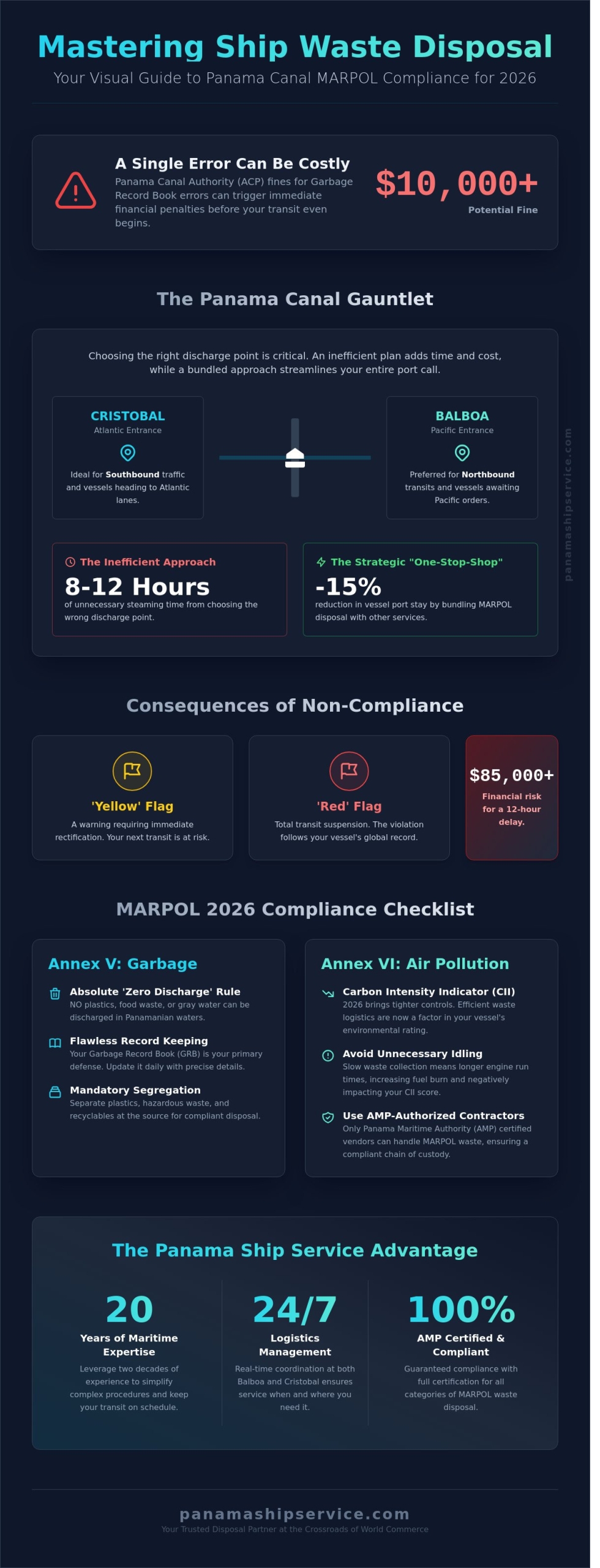
A single administrative error in your Garbage Record Book can trigger Panama Canal Authority (ACP) fines exceeding $10,000 before your vessel even reaches the Miraflores Locks. You already know that managing the intersection of international MARPOL standards and local ACP regulations is a high-stakes balancing act where timing is everything. Mismanaging your offloading schedule doesn’t just hurt the environment; it risks your transit slot and your bottom line.
We are experts so you don’t have to be. This guide provides the exact framework needed to master ship waste disposal panama for the 2026 season. You will gain the technical knowledge to secure full MARPOL documentation and consolidate services to minimize vessel expenses during port calls. We will break down current port procedures, required certifications, and the specific logistical shortcuts that keep your transit on schedule and your records audit-ready.
Key Takeaways
- Identify the strategic reception points at Balboa and Cristobal to streamline your waste offloading process before or after Canal transit.
- Navigate the latest 2026 MARPOL Annex V and VI requirements, including crucial updates on carbon intensity that impact modern waste logistics.
- Secure efficient ship waste disposal panama services for all categories of liquid slops and solid garbage while maintaining full AMP certification.
- Master the “Golden Window” for waste removal to avoid costly operational delays and meet strict Panama Canal Authority notification deadlines.
- Leverage 20 years of maritime expertise to simplify complex disposal procedures, ensuring your vessel remains compliant so you can focus on the transit.
The Logistics of Ship Waste Disposal at the Panama Canal
Efficient ship waste disposal panama operations are not merely about offloading trash; they’re a high-stakes coordination of international law and local transit schedules. Since the 2016 expansion of the Neopanamax locks, the volume of waste generated by larger vessels has increased by nearly 35 percent. Every ship entering Panamanian waters must strictly adhere to the MARPOL 73/78 international convention. This regulatory framework dictates how sludge, bilge water, and solid waste are documented and discharged. Panama Ship Service handles these complexities so you don’t have to. We treat waste management as a critical link in your supply chain, ensuring that environmental compliance never becomes a bottleneck for your transit.
The geography of the Isthmus creates two primary theater operations: Balboa on the Pacific side and Cristobal on the Atlantic. These aren’t just ports; they’re strategic gates. Choosing the wrong discharge point can add 8 to 12 hours of unnecessary steaming time. We advocate for a “one-stop-shop” model where MARPOL disposals are bundled with technical repairs or underwater inspections. This approach typically reduces vessel port stay by 15 percent. Instead of coordinating multiple contractors and barge movements, you consolidate everything under one expert umbrella. This saves time, reduces administrative friction, and ensures your vessel is ready for its slot the moment the Panama Canal Authority (ACP) gives the signal.
Balboa vs. Cristobal: Where to Plan Your Discharge
Operational logic dictates your choice of anchorage. Balboa is the preferred hub for Northbound transits or vessels awaiting orders in the Pacific. It features deeper draft anchorages but can experience higher congestion during peak seasons. Cristobal serves Southbound traffic and offers more immediate access to Atlantic shipping lanes. Factors like current berth availability and your specific cargo operations will influence the final decision. Panama Ship Service manages logistics at both canal entrances 24/7, providing real-time updates on barge availability. We ensure your discharge happens at the most cost-effective location based on your vessel’s unique trajectory and the current ACP scheduling queue.
The Cost of Non-Compliance: Fines and Delays
The ACP enforces environmental standards with clinical precision. If your waste manifests are inconsistent or your storage tanks don’t match your logbook entries, you risk receiving a ‘Yellow’ or ‘Red’ flag during inspection. A ‘Yellow’ flag signifies a warning that requires immediate rectification before the next transit, while a ‘Red’ flag can lead to a total transit suspension. These flags don’t just stay in Panama; they follow your vessel’s record globally. Beyond the immediate fines, which can reach tens of thousands of dollars, the hidden costs of delays are staggering. In 2026, a 12-hour transit delay for a Neopanamax vessel carries a projected financial risk exceeding $85,000 in lost charter hire and fuel consumption costs. Our 20 years of experience ensures your paperwork is flawless, keeping your vessel moving and your budget intact.
MARPOL Annex V & VI: Staying Compliant in 2026
Panama’s maritime landscape is moving toward stricter enforcement as we approach 2026. The Panama Maritime Authority (AMP) maintains a rigorous certification process for all waste contractors. You can’t just hire anyone; only AMP-authorized companies are permitted to handle MARPOL Annex I and V materials. This ensures that every liter of sludge and every bag of garbage is tracked from the ship’s rail to the final processing plant. Failure to use a certified contractor results in immediate fines and potential vessel detention.
The 2024 and 2025 amendments to MARPOL Annex VI introduced tighter controls on carbon intensity. These rules mean that waste logistics must be more efficient to avoid unnecessary fuel burn during idling. Optimized ship waste disposal panama is now a component of your vessel’s overall Carbon Intensity Indicator (CII) rating. If your waste collection is slow, your engine runs longer, and your rating drops. We focus on rapid response to keep your transit on schedule and your emissions low.
Annex V: Prohibited Discharges and Record Keeping
The “Zero Discharge” rule is absolute in Panamanian waters. You cannot throw plastics, food waste, or even gray water overboard while waiting for transit. Everything must stay on board or go to a certified shoreside facility. We’ve seen a 15% increase in fines for improper Garbage Record Book (GRB) entries over the last 18 months. Documentation is your primary defense during a Port State Control inspection. Your GRB must be updated daily; missing entries or vague descriptions of waste categories lead to immediate detentions.
- Segregation: Separate plastics, hazardous waste, and recyclables at the source. This speeds up offloading by 30%.
- Certification: We provide the MARPOL receipts and stamped delivery notes required to prove compliance.
- Prohibited Items: Items like incinerator ashes and cooking oil must never enter the water.
Ensuring your vessel is equipped with the right industrial drums and totes is a key part of this process. For sourcing bulk containers suitable for maritime use, you can visit Container Authority.
Annex I & VI: Sludge, Slops, and Air Emissions
Managing oily waste requires precision. Since the 2025 updates to Annex VI, monitoring sulfur limits is more critical than ever. Vessels must maintain accurate Bunker Delivery Notes (BDN) for at least three years. Discrepancy in sludge volume is a major source of disputes between owners and charterers. We use calibrated flow meters and certified sounding tapes to ensure every cubic meter is accounted for. For the latest regulatory updates on fuel and waste, always consult the Panama Canal Authority’s official notices to stay ahead of local requirements.
Panama’s inspectors check sludge tank levels against your Oil Record Book (ORB) entries. If the math doesn’t add up, the vessel stays at anchor. We provide verified volume measurements during every discharge to prevent these delays. Our processing facilities use centrifugal separation to recover oil and minimize the environmental footprint. We are experts so you don’t have to be. If you need to streamline your next transit, you can request a MARPOL disposal quote to ensure your vessel meets all 2026 standards.
Our team has been a trusted partner at the Panama Canal for over 20 years. We understand that timing is everything. By coordinating your ship waste disposal panama with your arrival at the breakwater, we minimize your vessel’s expenses and maximize operational efficiency. Don’t leave your compliance to chance; put your transit in our hands.
Types of Maritime Waste Handled in Panama
Panama handles over 14,000 transits annually. Each vessel generates a specific waste profile that requires precise management to avoid Canal delays. Ship waste disposal panama services cover everything from engine room residues to galley refuse. We ensure your vessel remains compliant with international standards while maintaining its strict schedule. Local authorities enforce rigorous protocols for discharging waste. It’s essential to follow these rules; mismanaging them can lead to fines exceeding $50,000 and significant operational downtime. We provide a calm, expert presence to help you manage these requirements with confidence.
Liquid Waste: Sludge and Oily Water Recovery
Engine room operations produce significant volumes of oily water and sludge. In Panama, collection occurs via specialized barges at anchorage or vacuum trucks at pier-side. Barge-to-ship transfers are more common for larger vessels at the Balboa or Cristobal anchorages. These operations typically handle flow rates between 50 and 100 cubic meters per hour. Handling noxious liquid substances under Annex II requires dedicated chemical tank washings equipment and specialized permits. Looking ahead to 2026, new guidance focuses on high-viscosity sludge management. High-viscosity residues often require heating to at least 60 degrees Celsius before pumping to ensure total removal from storage tanks. Our teams use high-capacity specialized pumps to handle these heavy fuels and lubricants without causing delays to your bunkering schedule.
Solid Garbage and Domestic Waste
Managing solid waste involves strict segregation at the source. Panama’s facilities process thousands of tons of maritime garbage every month. You must separate food waste from recyclable plastics before it reaches the deck. Under MARPOL Annex V regulations, commingling these streams is a violation that prevents offloading at most Panamanian terminals. Cargo operations generate dunnage, lining, and packing materials. These items often occupy significant deck space and require immediate removal to maintain vessel safety and stability. We also provide specialized grease trap cleaning for large galleys. Cooking oil disposal is handled separately from general food waste to prevent pipe blockages and environmental contamination. Efficient ship waste disposal panama protocols ensure these materials never compromise your transit timeline.
Specialized and Passenger Vessel Waste
Passenger vessels and ships with crews exceeding 20 people generate high volumes of grey water and sewage. Panama’s infrastructure includes dedicated treatment plants designed to handle these biological loads safely. We also manage hazardous materials that require expert handling. This includes:
- Lead-acid and lithium-ion batteries
- Expired pyrotechnics and flares
- Outdated medicines and medical waste
- Fluorescent tubes and electronic waste
Handling these items requires certified technicians who understand the local environmental regulations. We provide the necessary documentation to prove your vessel followed legal disposal routes. This keeps your records clean for Port State Control inspections and prevents future legal complications. We’re experts so you don’t have to be. Our team manages the logistics so your transit stays on track. Put your transit in our hands for a reliable, cost-conscious solution to all maritime waste challenges.
Coordinating Disposal with Your Canal Transit Schedule
Timing is the difference between a smooth transit and a costly delay at the anchorage. Miscalculate your offloading window by even two hours and you risk missing your scheduled slot. The “Golden Window” for waste management occurs while your vessel is at the Pacific or Atlantic anchorages awaiting the pilot. To maximize this time, you must align your requirements for ship waste disposal panama with the Canal’s strict arrival sequence. The Panama Canal Authority (PCA) requires precise data via the Maritime Service Portal. We recommend submitting your waste declaration at least 48 hours before your ETA. This ensures all barge or truck logistics are locked in before you arrive.
Managing the “Transit-Disposal-Repair” triad is how top operators stay profitable. Instead of treating waste as a separate chore, integrate it with other technical needs. We often coordinate MARPOL disposals alongside underwater hull cleaning or engine room repairs. This strategy reduces the number of service craft alongside your vessel. It also keeps the deck clear for transit preparations. Our team improves the efficiency of ship waste disposal panama by combining logistics with technical maintenance, ensuring your vessel is ready for the locks without extra idle time.
Step-by-Step Scheduling Guide for Captains
Captains must follow a strict protocol to avoid administrative bottlenecks. Efficiency at the Panama Canal is built on clear communication and early action. We handle the technical details so your crew can focus on navigation. Follow these three steps for a seamless experience:
- 48-hour pre-notification: Send your MARPOL categories and estimated volumes to your agent. Include your last port of call and any hazardous material declarations.
- Arrival at anchorage: Confirm your exact position and ETA with the disposal team immediately. Our barges are positioned to meet you as soon as you drop anchor.
- Verification and receipting: Complete all sludge or garbage receipts before the pilot boards at the sea buoy. This prevents paperwork delays during the actual transit.
Minimizing Downtime: The Expert Advantage
Our rapid response teams are trained to operate under extreme time pressure. We know that every minute at anchor costs money. In a recent operation on August 14, 2023, a Neo-Panamax container ship avoided an 8-hour delay by utilizing our synchronized logistics. We managed 45 cubic meters of sludge removal while technical teams performed a rudder bearing inspection. This saved the client approximately $19,000 in operational costs and kept them on their strict PCA schedule. We use high-capacity pumps and specialized barges to move waste faster than standard service providers.
Put your transit in our hands and eliminate the stress of logistics. We are experts so you don’t have to be.
Why Panama Ship Service is Your Trusted Disposal Partner
Panama Ship Service delivers 20 years of operational experience directly to your vessel’s side. We are experts so you don’t have to be. Handling the specific local requirements of the Panama Canal Authority requires more than just a manual; it requires a deep network of local contacts and a fleet of specialized equipment. We operate 24/7 across both the Atlantic and Pacific entrances, covering Balboa and Cristobal ports with equal efficiency. Our team understands that for ship owners and charterers, every minute spent at anchor is money lost. We’ve optimized our ship waste disposal panama protocols to sync perfectly with your transit window. In the last year alone, we’ve successfully managed over 450 disposal operations without a single delay to a vessel’s scheduled lockage.
Our team maintains full MARPOL compliance and holds current AMP-certified disposal credentials. This isn’t just paperwork; it’s a guarantee against heavy fines and vessel detention. Since 2022, we’ve seen an 18% increase in environmental inspections at the Canal. Our documentation is designed to pass these audits without friction. We provide direct communication lines between our coordinators and your bridge team. This removes the middleman, reduces the risk of miscommunication, and keeps our solutions cost-conscious. We don’t just provide a service; we provide a shield against the complexities of local maritime law. Our staff stays updated on every shift in Panama Maritime Authority (AMP) regulations, ensuring your ship is never caught off guard by a new policy or fee structure.
- 24/7 attendance at Balboa and Cristobal ports
- Full MARPOL Annex I, II, IV, and V compliance
- Direct coordination with vessel agents and authorities
- Consolidated technical and operational support
Our Commitment to the Marine Environment
Sustainability is a core component of our strategy. We utilize eco-friendly disposal routes that prioritize waste segregation and recovery. By partnering with 12 different certified recycling facilities, we ensure that glass, metal, and plastic waste stays out of the ocean. We actively support the ‘Green Route’ initiative of the Panama Canal, helping vessels achieve better environmental scores. You can also learn more about our Underwater Hull Services to find out how our biofouling removal techniques further support eco-friendly operations.
The One-Stop-Shop Advantage
Efficiency thrives on simplicity. Most fleet managers struggle with the administrative burden of coordinating five different vendors for a single stop. We solve this by consolidating surveys, technical repairs, and ship waste disposal panama. This one-stop-shop model reduces your overhead and creates a single, transparent billing point. You get a clear picture of your expenses without the headache of chasing multiple invoices. Our team provides constant daily communication from the moment you enter the anchorage.
In 2023, 95% of our clients reported that consolidating services with us saved them at least 4 hours of administrative work per transit. Don’t leave your logistics to chance. Put your transit in our hands and focus on your core operations. Request a MARPOL Disposal Quote for Your Next Transit and put your vessel in the hands of the canal’s most reliable partner.
Secure Your 2026 MARPOL Compliance Today
Navigating the strict MARPOL Annex V and VI regulations in 2026 requires more than just basic knowledge. It demands a partner who understands the razor-thin timing windows of a Canal transit. Mismanaging your schedule leads to expensive delays that impact your bottom line. By coordinating your waste removal directly with your arrival at Balboa or Cristobal, you ensure your vessel remains compliant without sacrificing speed.
Panama Ship Service brings 20+ years of maritime experience to every operation. We provide 24/7 rapid response services that are fully AMP and MARPOL certified. We handle the technical complexities of ship waste disposal panama so you don’t have to. Our team operates with the efficiency your charterers demand, providing a reliable one-stop-shop for all disposal needs. We’re the experts on the ground, ensuring your documentation is perfect and your turnaround is fast.
Don’t let waste management become a bottleneck in your operations. Get a Competitive Quote for Ship Waste Disposal in Panama today. We’re ready to help you navigate the Canal with confidence.
Frequently Asked Questions
Is ship garbage disposal mandatory when transiting the Panama Canal?
Yes, the Panama Canal Authority mandates strict adherence to the OP Notice to Shipping N-1-2024 regarding waste management. All vessels must store or dispose of waste according to international standards before entering the canal waters. We manage these requirements so you don’t face delays or fines during your transit. Our team ensures your vessel complies with 100% of local environmental regulations.
What are the MARPOL Annex V requirements for vessels in Panamanian waters?
Vessels must strictly prohibit the discharge of all plastics and most solid waste into the water under MARPOL Annex V. You’re required to maintain an updated Garbage Management Plan and a Garbage Record Book for inspection. Panama maritime authorities conduct spot checks on 95% of transiting vessels to verify these logs. We provide the certified reception facilities needed to keep your records accurate and compliant.
Can I dispose of sludge and slops at both Balboa and Cristobal ports?
Yes, barge and truck reception facilities are available at both the Balboa and Cristobal terminals 24 hours a day. We coordinate these disposals to match your specific transit schedule on either the Pacific or Atlantic side. This flexibility ensures your ship waste disposal panama remains efficient regardless of your direction of travel. Our logistics team handles the paperwork to prevent any scheduling conflicts.
How much does ship waste disposal cost in Panama?
Costs depend on volume and waste type, but standard garbage removal typically starts at 450 USD per trip for small volumes. Sludge disposal fees fluctuate based on water content and current market rates for oil recovery. We provide a detailed, fixed-price quote within 120 minutes of your request. This transparency helps you manage your vessel’s budget without worrying about hidden local fees or surcharges.
What documents will I receive after offloading waste to a reception facility?
You’ll receive a formal Waste Delivery Receipt and a MARPOL certificate immediately after the offloading process is complete. These documents serve as your official proof of compliance during future Port State Control inspections. You must keep these original receipts in your Garbage Record Book for at least 2 years. We ensure every document meets the 1973 MARPOL Convention standards for international shipping.
How far in advance should I book waste disposal services for my transit?
You should book your disposal services at least 48 to 72 hours before your estimated arrival at the sea buoy. This lead time allows us to secure the necessary barge slots and coordinate with the Panama Canal Authority’s daily schedule. Booking within this window avoids the 20% premium often charged for emergency or last-minute logistics. We prioritize pre-booked vessels to ensure zero downtime.
Does Panama Ship Service handle hazardous waste and medical supplies?
Yes, we manage the specialized collection and incineration of hazardous materials including expired medicines and chemical residues. All hazardous ship waste disposal panama follows the strict guidelines set by the Basel Convention. We use certified transport units to ensure 100% containment during the transfer process. Our experts handle the complex manifest requirements so your crew can focus on navigation and safety.
Can waste disposal be performed simultaneously with other ship repairs?
Yes, we specialize in performing multiple services simultaneously to minimize your vessel’s time at anchorage. Our team can coordinate garbage removal while technicians perform engine repairs or underwater hull cleanings. This integrated approach saves operators an average of 10 hours per port call. We act as your single point of contact to streamline all technical and operational requirements during your stay.