
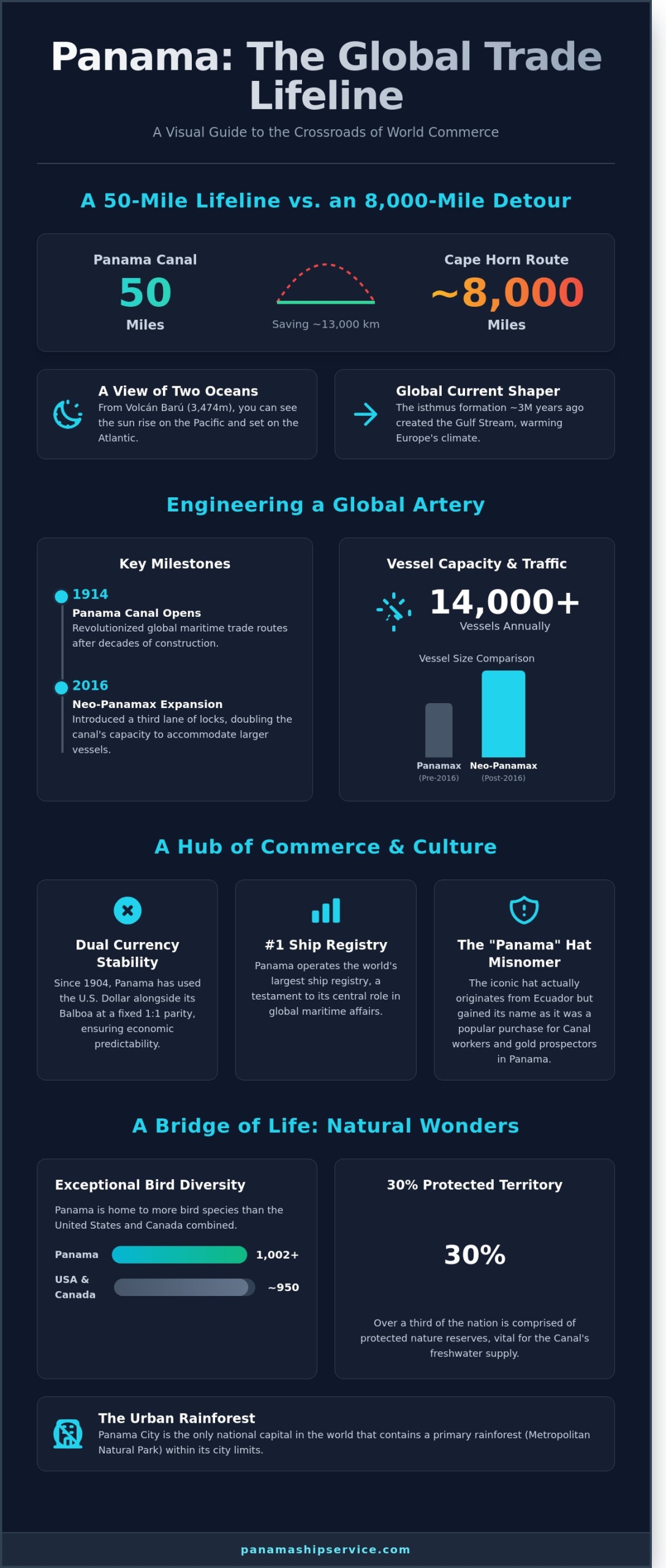
Panama isn’t just a bridge between two continents; it’s the 50-mile lifeline that prevents a 13,000-kilometer detour around Cape Horn for over 14,000 vessels every year. If you’re a ship owner or a traveler planning a 2026 transit, you likely realize that timing is everything and fragmented information often leads to costly delays. We know that searching for essential facts about Panama can be frustrating when you’re met with vague timelines and technical jargon that doesn’t actually help your operation or itinerary.
You deserve a partner that simplifies the complex because we’re experts so you don’t have to be. This guide provides the expert clarity you need by distilling the most critical geographical, historical, and maritime data into a single, reliable resource. We’ll explore the strategic importance of the 1914 Canal opening, the impact of the 2016 Neo-Panamax expansion, and the specific economic shifts that make this country the heartbeat of global trade today. By the end of this article, you’ll have a professional’s perspective on why this narrow isthmus remains the most vital link in the global supply chain.
Key Takeaways
- Understand the unique geographical positioning of the Isthmus and how its formation created a vital bridge between two continents and two oceans.
- Explore the critical economic impact of the Panama Canal and the engineering milestones that continue to drive global maritime trade today.
- Trace the historical evolution of the region, from the founding of the oldest Pacific settlement to the nation’s strategic path toward independence.
- Gain professional insights into the world’s largest ship registry and other essential facts about panama that help mariners optimize their transit operations.
- Identify the key infrastructure and container hubs that establish Panama as a high-efficiency leader in modern maritime logistics and vessel services.
Surprising General Facts About Panama
Panama serves as a critical global junction. Understanding the essential facts about panama requires looking beyond the Canal infrastructure. It’s a land of extremes and unique records. For instance, it’s the only place on earth where you can watch the sun rise over the Pacific Ocean and set over the Atlantic from the same spot. This occurs at the summit of Volcán Barú, the nation’s highest point at 3,474 meters. On a clear day, both oceans are visible from this single peak, a phenomenon made possible by the country’s unique “S” shape.
Unique Geographical Phenomena
The formation of the Isthmus roughly 3 million years ago created a land bridge that fundamentally altered global ocean currents. This geological shift separated the Atlantic and Pacific, leading to the creation of the Gulf Stream which warms the climate of Europe. Within the borders of the Republic of Panama, you’ll find Panama City, which remains the only national capital to contain a primary rainforest within its limits. The Metropolitan Natural Park covers 232 hectares, providing a habitat for sloths, Geoffroy’s tamarin monkeys, and tropical birds just minutes from the central banking district.
Cultural and Monetary Curiosities
Economic stability is a hallmark of the Panamanian market. Since 1904, the country has used the U.S. Dollar alongside the local Balboa at a fixed 1:1 parity. While the Balboa exists in coin form for smaller transactions, paper currency is exclusively USD. This arrangement minimizes exchange rate risks for international shipping partners and provides a level of financial predictability rare in the region. Other historical and biological facts about panama include:
- Coca-Cola: In 1906, Panama became the first country outside the United States to bottle and sell the beverage.
- The Panama Hat: This iconic accessory actually originated in Ecuador. It gained its name because gold prospectors during the 1850s and Canal workers in the early 1900s purchased them in Panamanian ports before heading to their final destinations.
- Biodiversity: The country hosts over 1,002 bird species. This figure surpasses the combined bird population of the continental United States and Canada.
For ship owners and charterers operating in these waters, these details highlight why the region is more than just a transit point. It is a highly specialized environment with a deep history of international cooperation. We are experts in this landscape so you don’t have to be. Understanding these nuances helps in managing the expectations of crews and ensuring efficient operations during every transit.
Geography and Nature: The Bridge of Life
Panama is much more than a transit point; it’s a geological miracle that changed the world. The Isthmus of Panama formed approximately 3 million years ago. This event joined North and South America, altered global ocean currents, and triggered a massive exchange of species between the two continents. Today, these facts about panama define its unique role as a biological bridge. The country manages a massive maritime footprint with over 1,500 islands scattered across both the Caribbean and Pacific coasts.
Biodiversity and Ecosystems
Panama protects its natural assets aggressively. More than 30% of the national territory consists of protected nature reserves. This commitment supports over 900 bird species, which is more than the United States and Canada combined. This makes the country a premier destination for global birdwatchers. The health of these ecosystems isn’t just an environmental concern; it’s a critical infrastructure requirement. The surrounding rainforests capture the massive amounts of freshwater needed for the operation of the locks. Historical data from the Panama Canal Authority (ACP) shows how watershed management remains vital for maintaining global trade flows. This region also serves as a key segment of the Mesoamerican Biological Corridor, allowing wildlife to migrate between continents through protected zones.
The Archipelago Systems
The island chains offer distinct environments for different operational and recreational needs. The Guna Yala archipelago, also known as San Blas, contains 365 islands. This allows for a “one island for every day of the year” experience under the autonomous leadership of the Guna people. In contrast, the Pearl Islands on the Pacific side carry a rich colonial history. Divers found the famous 55.95-carat “La Peregrina” pearl here in the 16th century. For those seeking raw nature, Coiba National Park stands as a UNESCO World Heritage site. It functioned as a penal colony from 1919 to 2004, which unintentionally preserved its pristine reefs and forests from commercial development. These essential facts about panama illustrate a landscape that is both rugged and highly regulated. If you’re coordinating maritime logistics near these sensitive areas, you’ll need expert local guidance to ensure compliance and efficiency.
While Panama’s archipelagos are a wonder, those interested in premier luxury charters in other renowned sailing destinations, such as Southern California, can find bespoke experiences with Bella Boating.
The Panama Canal: Engineering and Economic Facts
The Panama Canal isn’t just a waterway; it’s the heartbeat of the nation’s financial system. These facts about panama reveal that the Canal generates approximately 33% of the country’s entire Gross Domestic Product (GDP). Operations began officially on August 15, 1914, when the SS Ancon made the first official transit. Today, the waterway serves over 14,000 vessels annually, linking 1,700 ports across 160 different countries. In 2016, the Cocoli and Agua Clara locks opened as part of the Neo-Panamax expansion. This $5.25 billion project effectively doubled the canal’s capacity, allowing ships carrying up to 14,000 TEUs to bypass previous size restrictions.
Key Statistics for Mariners
Efficiency is the priority for every master and owner. An average transit takes between 8 to 10 hours to complete. Original locks measure 110 feet wide by 1,000 feet long; however, the newer Neo-Panamax locks extend to 180 feet wide and 1,400 feet long. Tolls are calculated based on vessel type and capacity. While modern container ships pay hundreds of thousands of dollars, the lowest toll ever recorded was $0.36. This was paid by adventurer Richard Halliburton to swim the length of the canal in 1928. Mariners also appreciate the linguistic trivia of the famous palindrome: “A man, a plan, a canal; Panama.”
Economic Impact on Global Trade
The Canal’s primary value lies in its geography. It eliminates the 12,000-km detour around Cape Horn, saving weeks of fuel and labor costs. This shortcut is vital for the “just-in-time” supply chain. Projections for 2026 indicate that the Canal will handle over 500 million Panama Canal tons (CP/SUAB) as global trade volumes shift and water management strategies stabilize. According to the CIA World Factbook on Panama, the country assumed full control of the waterway on December 31, 1999. The Panama Canal Authority (ACP) now manages operations as an autonomous legal entity. This governance ensures the waterway remains a neutral, efficient artery for global commerce. Understanding these facts about panama helps ship owners and charterers recognize the canal as a pillar of maritime reliability.
- Annual Transits: 14,000+ vessels
- Time Saved: Up to 22 days compared to Cape Horn
- Expansion Date: June 26, 2016
- Ownership Transfer: December 31, 1999
Historical Milestones of the Isthmus
Panama City’s establishment on August 15, 1519, marked it as the first European settlement on the Pacific coast. Its strategic location defined its future. The region’s timeline includes two distinct breaks from colonial power: independence from Spain on November 28, 1821, and separation from Colombia on November 3, 1903. These are essential facts about panama for anyone analyzing its current maritime dominance. In 1855, the Panama Railroad became the world’s first transcontinental railway; it proved the isthmus was the most efficient route for global trade long before the canal opened.
The Era of Conquest and Pirates
Captain Henry Morgan’s 1671 attack left Panama Viejo in ruins. The survivors moved the city 8 kilometers southwest to Casco Antiguo in 1673, using the new site’s natural reefs and thick walls for protection. During the 16th and 17th centuries, the isthmus served as the primary transit point for Spanish gold arriving from Peru. To protect these riches, the Spanish built massive defensive structures like the San Lorenzo Fort and the Portobelo fortifications. These sites remain standing today as evidence of the country’s historical role as a global treasure hub. It’s a history built on logistics and security.
Modern History and Sovereignty
Modern sovereignty was defined by the Torrijos-Carter Treaties signed on September 7, 1977. This agreement scheduled the full transfer of the Canal from U.S. to Panamanian control, which finalized on December 31, 1999. The path to democracy included the U.S. invasion on December 20, 1989, known as Operation Just Cause. Following this conflict, Panama made a bold constitutional move in 1990 by permanently abolishing its standing military. This decision shifted national resources toward internal security and social development. Understanding these facts about panama helps explain why the nation is such a reliable logistics partner today.
- 1519: Foundation of Panama City.
- 1671: Destruction of the original city by Henry Morgan.
- 1855: Completion of the first transcontinental railroad.
- 1999: Full Panamanian control of the Canal.
Put your vessel’s logistics in the hands of a trusted partner at the Panama Canal to ensure efficient transit.
Maritime Infrastructure: Facts for Modern Vessel Operators
Panama’s maritime infrastructure is the backbone of global trade. It’s more than a waterway; it’s a comprehensive service ecosystem designed for efficiency. When looking at facts about panama, its role as a logistical nerve center is undeniable. The country has built a massive support network that ensures ships don’t just pass through, but leave fully serviced and compliant with international law.
The Panama Ship Registry (Flag of Convenience)
Panama maintains the world’s largest ship registry, with over 8,500 vessels flying its flag as of 2023. This accounts for roughly 16% of the global fleet’s total deadweight tonnage. The Panama Maritime Authority (AMP) enforces strict international compliance standards. Owners choose this registry because it offers a stable legal framework and administrative advantages that simplify global operations. It’s a system built on 107 years of experience, providing a level of reliability that global financiers and insurers expect from a top-tier flag state.
Technical Services and Logistics
The ports of Balboa and Cristobal handled 8.3 million TEUs in 2022, solidifying their status as the busiest container hubs in Latin America. For operators, Panama serves as a “one-stop-shop” where time is the primary currency. Efficient transit requires more than just movement; it demands technical readiness. The following services are critical for maintaining tight schedules:
- Technical Repairs: Specialized teams provide underwater hull cleaning and complex mechanical repairs while vessels are at anchor.
- MARPOL Compliance: Panama is a primary hub for MARPOL-compliant disposal. We handle oily water (Annex I), sewage (Annex IV), and garbage (Annex V) to keep your vessel in line with strict environmental laws.
- Operational Support: The region is optimized for rapid crew changes, draft surveys, and bunker surveys.
Timing is everything at the Canal. Costs increase every hour a ship sits idle. We are experts so you don’t have to be. For expert technical support during your transit, contact Panama Ship Service. We act as your trusted partner at the Panama Canal, ensuring your vessel remains cost-conscious and compliant. These facts about panama highlight why the country remains the preferred choice for the 14,000 transits occurring annually. We provide the rapid response and specialized knowledge required to navigate this high-stakes environment without frustration.
Master Your Next Panama Canal Transit
Panama remains the world’s most critical maritime hub as we move through 2026. The 50-mile canal continues to serve as the primary artery for global trade, while the isthmus itself protects over 10,000 species of vascular plants as the Bridge of Life. These essential facts about panama demonstrate that the region is a complex, high-stakes environment where timing and technical precision determine your bottom line. You can’t afford delays when navigating these waters.
We’ve spent 20+ years perfecting maritime support at the Panama Canal. Panama Ship Service provides a comprehensive one-stop-shop for mechanical repairs, bunker surveys, and MARPOL disposal. We understand that maritime emergencies don’t follow a schedule; therefore, we offer 24/7 rapid response for all vessel services. We’re the experts on the ground so you don’t have to be. Put your transit in our hands to ensure a smooth, cost-conscious journey through the isthmus.
Maximize your transit efficiency with Panama Ship Service and secure your vessel’s performance today. We look forward to seeing you at the locks.
Frequently Asked Questions
What are 5 interesting facts about Panama?
Panama is the only place on Earth where you can see the sun rise over the Pacific and set over the Atlantic from the same spot. These facts about panama highlight its unique geography. The country hosts over 10,000 plant species, which is more than the entire United States. It uses the U.S. Dollar as its primary currency. Additionally, 40% of its land remains protected as national parks or reserves.
Why is Panama so famous in maritime history?
Panama serves as the Bridge of the World because its 50 mile wide isthmus connects the Atlantic and Pacific Oceans. Since the 1500s, it’s acted as the primary transit point for Spanish gold and silver fleets. The 1914 opening of the Panama Canal revolutionized global trade by eliminating the 8,000 mile journey around Cape Horn. It remains the most critical shortcut in maritime history for ship owners and charterers.
Is Panama a safe country for international travelers and mariners in 2026?
Panama remains one of the safest destinations in Latin America for 2026, maintaining a Level 1 safety rating from the U.S. Department of State. The government employs a specialized Tourism Police force and the SENAN maritime service to protect its 2,500 kilometers of coastline. Mariners find the ports secure due to strict ISPS Code compliance and 24 hour surveillance. It’s a stable environment for both business and leisure.
Can you see both the Atlantic and Pacific oceans from one spot in Panama?
You can see both the Atlantic and Pacific Oceans simultaneously from the summit of Volcan Baru. This peak reaches 3,474 meters and is the highest point in the country. On clear days, the view spans across the narrow isthmus. It’s one of the most remarkable facts about panama for hikers and nature enthusiasts visiting the Chiriqui province. This unique vantage point is only possible due to the country’s slender shape.
What is the significance of the Panama Canal for global shipping?
The Panama Canal facilitates approximately 6% of all global maritime trade, serving over 140 trade routes. In a typical year, more than 14,000 vessels transit the locks. This infrastructure saves ships up to 22 days of travel time compared to sailing around South America. For ship owners, this translates to massive fuel savings and reduced operational costs. We are experts in managing these transits so you don’t have to be.
What language is spoken in Panama?
Spanish is the official language of Panama, but English is the primary language for business and maritime operations. Roughly 14% of the population speaks English fluently. In the shipping sector, all communications with the Panama Canal Authority occur in English. This bilingual environment makes the country an accessible hub for international commerce and logistics. It ensures clear communication for crews and technical service providers during port calls.
What is the best time of year to visit or transit Panama?
The dry season, which runs from mid-December to mid-April, offers the most reliable conditions for visiting or transiting the region. During these 4 months, rainfall is minimal, which helps maintain predictable schedules for vessel maintenance and hull cleanings. While the rainy season from May to November brings daily showers, maritime operations continue 24/7 without interruption. Timing is everything when planning your arrival to minimize vessel expenses.
Who actually owns and operates the Panama Canal today?
The Republic of Panama owns and operates the canal through the Panama Canal Authority (ACP), an autonomous government entity. Control officially transferred from the United States on December 31, 1999. Since then, the ACP has managed all 3 sets of locks and completed a 5.25 billion dollar expansion in 2016. This project added a third lane to accommodate Neopanamax vessels, ensuring the canal remains a competitive leader in global logistics.