
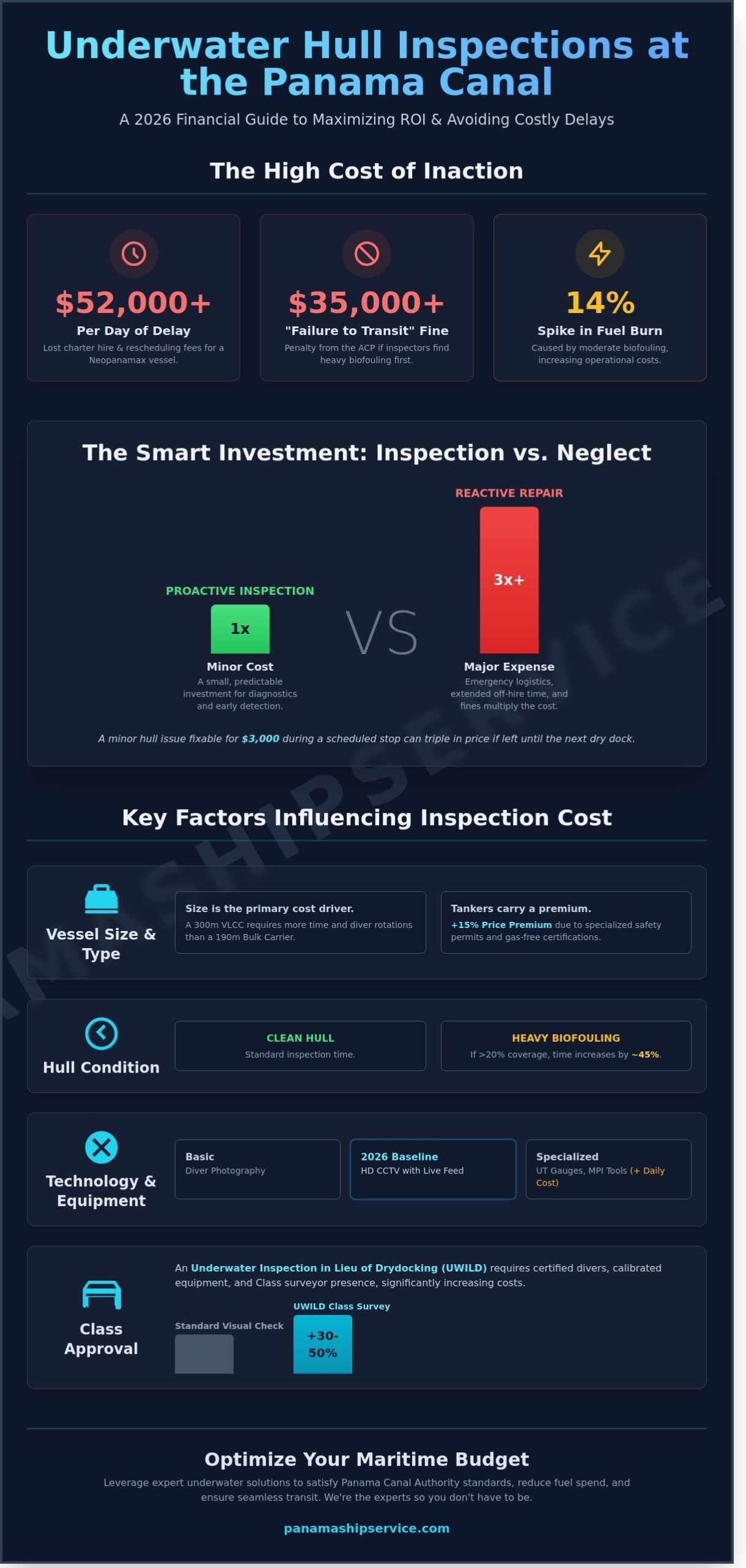
A single day of delay at the Panama Canal can cost a Neopanamax vessel over $52,000 in lost charter hire and rescheduling fees. The cost of underwater hull inspection is a minor investment compared to the financial disaster of a failed ACP inspection or the 14% spike in fuel consumption caused by moderate biofouling. You already know that misjudging your timing or your budget in Panama leads to immediate revenue loss. We’ve spent 20 years as a trusted partner at the Canal because we understand that in shipping, timing is everything. We’re the experts so you don’t have to be.
This 2026 price guide provides the exact data you need for accurate budgeting and seamless operational planning. You’ll get a clear breakdown of current market rates and the specific variables, like vessel class and water clarity, that influence your final quote. We’ll also show you how to satisfy Panama Canal Authority standards while significantly reducing your annual fuel spend through verified hull cleanliness. Let’s look at the current pricing tiers and how you can optimize your maritime budget before your next transit.
Key Takeaways
- Learn how regular inspections prevent fuel surcharges and mechanical wear, protecting your vessel’s bottom line during transit.
- Understand how vessel size and technology choice—from ROVs to high-definition CCTV—impact the total cost of underwater hull inspection.
- Compare current market rates and mobilization fees for commercial tankers versus private yachts to budget accurately for 2026.
- Discover strategic scheduling techniques to eliminate unnecessary mobilization fees and avoid heavy biofouling surcharges at the Panama Canal.
- Leverage professional insights from Panama Ship Service to optimize your maritime budget with expert underwater solutions tailored for Canal transits.
Understanding the True Value of Underwater Hull Inspections
An underwater hull inspection is a high-stakes diagnostic tool for vessel health. It isn’t just a line item on a budget spreadsheet. For a bulk carrier or tanker approaching the Panama Canal in 2026, this assessment determines if your ship is fit for transit or a liability. We see it daily; owners who skip these checks face sudden mechanical wear that halts operations. The cost of underwater hull inspection is a small fraction of the price paid for a propulsion failure in the middle of the Culebra Cut.
- Routine Maintenance: Proactive checks focused on fuel efficiency and early detection of coating failures.
- Class Surveys: Mandatory regulatory inspections required by IACS members to maintain vessel certification.
Early detection prevents minor issues from becoming disasters. A small patch of hull blistering or a slight misalignment in the rudder can often be fixed for $3,000 during a scheduled stop. If left until your next dry dock, that same repair often triples in price due to emergency logistics and extended off-hire time. We identify these 5mm cracks before they become 50cm fractures.
Why Timing at the Panama Canal Matters
Timing is everything when you’re managing a Canal schedule. The Panama Canal Authority (ACP) maintains strict biofouling regulations to protect the Gatun Lake ecosystem. If our divers find heavy growth during a pre-transit check, we can arrange cleaning immediately. If the ACP inspectors find it first, they’ll deny transit. You’ll face “failure to transit” fines that often exceed $35,000, plus the nightmare of rescheduling a slot in a crowded 2026 queue.
The ROI of Regular Hull Monitoring
A clean hull is a profitable hull. Industry data shows that even light slime increases vessel drag by 10% to 15%. For a standard Panamax vessel, this translates to an extra $4,500 in fuel costs for a single transoceanic voyage. We treat these inspections as a strategic cost-saving measure. By identifying corrosion early, you protect the long-term integrity of your steel. We’re experts so you don’t have to be, ensuring your cost of underwater hull inspection delivers a measurable return through optimized speed and reduced bunker consumption.
Key Factors Influencing the Cost of Underwater Hull Inspections
The final bill for a dive survey isn’t a flat rate. Calculating the total cost of underwater hull inspection requires looking at four specific operational pillars. Vessel size is the primary driver. A 300-meter VLCC (Very Large Crude Carrier) requires significantly more bottom-time and diver rotations than a 190-meter bulk carrier. Tankers often carry a 15% price premium because of the specialized safety permits and gas-free certifications needed before a dive team enters the water.
Hull condition also changes the math. A vessel that hasn’t been cleaned in 12 months may have heavy calcareous growth. If barnacles or tubeworms cover more than 20% of the niche areas, visibility drops and inspection time increases by roughly 45%. This neglected boat pricing reflects the extra air, time, and safety monitoring required to navigate fouled hulls safely without damaging the coating system.
Technology and Equipment Impact on Price
Basic diver photography is the entry-level option, but it’s rarely enough for 2026 compliance standards. High-definition CCTV with live-feed surface monitoring is now the baseline for insurance claims and pre-purchase assessments. While mobilization for a standard diver team starts at a fixed rate, adding specialized equipment like ultrasonic thickness (UT) gauges or magnetic particle inspection tools will increase the daily cost. These tools provide the data-rich reports that prevent expensive transit delays. If you’re preparing for a scheduled arrival, it’s efficient to check current equipment availability to secure the best rates.
Class Approval and Regulatory Standards
A standard visual check is vastly different from an Underwater Inspection in Lieu of Drydocking (UWILD). A UWILD must meet strict criteria set by societies like ABS, Lloyd’s Register, or DNV. This requires certified divers, calibrated equipment, and a Class surveyor present or reviewing the live feed. Because of the high stakes, these surveys often cost 30% to 50% more than non-class inspections. Panama Ship Service provides the experts so you don’t have to be one, ensuring every report meets the 2026 Panama Canal Authority (ACP) requirements. We handle the technical compliance so your crew can focus on the transit.
Price Breakdown: Commercial Vessels vs. Private Yachts
The total cost of underwater hull inspection depends on the vessel’s displacement and the technical requirements of the reporting standards. In 2026, Panama Canal operators prioritize speed to avoid costly transit delays. Commercial vessels over 150 meters face base rates between $2,500 and $4,800 for a standard CCTV inspection. Private yachts under 25 meters usually see flat rates from $600 to $1,300. We focus on efficiency because we know your schedule is fixed.
Commercial Shipping Cost Structures
Large scale hull surveys for bulk carriers and tankers are typically quoted as flat rates for Class-approved inspections (ABS, Lloyd’s, DNV). If the vessel’s beam exceeds 32 meters, expect the inspection duration to increase by 20%, which may trigger additional labor fees. For 2026, hourly rates for technical diving teams in Panama average $450 to $600. Commercial operators must account for:
- Vessel Draft: Deep-draft vessels require specialized decompression planning for divers, increasing costs by 15%.
- Rapid Response: Emergency inspections requested within 24 hours of transit carry a 25% premium.
- Reporting Standards: High-definition video and real-time surface monitoring are standard for commercial hulls to satisfy insurance mandates.
Yacht and Leisure Craft Pricing in Panama
Smaller vessels transiting the Canal have different priorities. We offer flat-rate performance cleanings and inspections for this segment to keep your budget predictable. Most yacht owners pay between $800 and $1,500 for a full pre-transit check. To avoid unexpected surcharges, follow this checklist:
- Verify the last cleaning date; hulls with over 30% barnacle coverage incur a “heavy fouling” fee of $400.
- Check your location; mobilization fees to remote anchorages can add $300 to your bill.
- Confirm if zinc replacement is needed; labor is cheaper when combined with the initial cost of underwater hull inspection.
Additional charges often include propeller polishing, which adds approximately $1,800 to $3,200 for commercial ships. Port fees at Balboa or Cristobal typically add a fixed $500 to $900 fee depending on the specific anchorage coordinates. We provide transparent quotes so you don’t face surprises at the end of your transit. Put your vessel in our hands and we’ll ensure your hull is ready for the Canal.
How to Minimize Inspection Costs During a Panama Canal Transit
Managing the cost of underwater hull inspection requires proactive planning rather than reactive fixes. You’ll reduce total expenditure by 15% to 20% simply by eliminating unnecessary mobilization fees. Most operators lose money when they request divers while at anchor without prior coordination. We recommend providing vessel specifications and exact GPS coordinates at least 72 hours before arrival. This allows our teams to prep equipment and secure permits, preventing idle time that drives up hourly rates.
Environmental factors also dictate your final bill. In the Panama Canal, water visibility changes based on seasonal rainfall. During the rainy season from May to December, increased silt can double the time a diver needs to complete a survey. By monitoring local conditions and scheduling during high-visibility windows, you ensure the job finishes faster. Additionally, maintaining a regular cleaning cycle prevents heavy biofouling surcharges. Removing hard growth like barnacles takes 3 times longer than wiping away light slime, directly impacting your labor costs.
Strategic Scheduling at Balboa and Cristobal
Timing is everything. You should schedule inspections during scheduled port stays at Balboa or Cristobal to avoid the high costs of separate mobilization. Coordinate with your Canal transit agent to align the inspection with bunker operations or crew changes. Booking 14 days in advance during the peak 2026 transit season secures competitive rates before local service capacity reaches its limit. We are experts so you don’t have to be; we handle the logistics to keep your vessel moving.
Combining Services for Maximum Value
The most cost-conscious approach involves a “one-stop-shop” strategy. Instead of paying for separate dive teams, combine your cost of underwater hull inspection with propeller polishing or sea chest cleaning. Consolidating these technical needs reduces total downtime and eliminates redundant equipment setup fees. A single mobilization for multiple services can save an operator upwards of $2,500 per call. We provide a unified report for all services, simplifying your compliance documentation and technical records.
- Avoid surcharges: Maintain a 6-month cleaning interval to prevent heavy fouling.
- Data accuracy: Provide draft and hull coating types in advance to streamline the dive plan.
- Efficiency: Use a single trusted partner for inspections, repairs, and MARPOL disposals.
Don’t let hidden fees inflate your transit budget. Contact us today to get a transparent quote for your next Panama Canal inspection.
Panama Ship Service: Expert Underwater Solutions at Competitive Rates
Panama Ship Service has operated as a trusted partner at the Panama Canal for 20 years. We focus on speed and precision because we know that misjudging your timing leads to lost revenue. Our team delivers a comprehensive range of underwater services, including high-definition CCTV surveys and hydraulic propeller polishing. We’ve built a one-stop-shop model that minimizes vessel expenses by consolidating all technical needs under one management team. This efficiency helps lower the overall cost of underwater hull inspection for ship owners and charterers.
We maintain a 24-hour rapid response protocol to handle urgent requests. You’ll receive constant daily communication from our project managers until your vessel clears the locks. We don’t just provide a service; we provide a solution that protects your schedule and your bottom line. We’re experts so you don’t have to be.
Qualified Experts for Critical Maritime Assets
Our divers follow rigorous safety and technical standards to ensure the integrity of your fleet. We provide Class-approved surveys for major societies like ABS, DNV, and Lloyd’s Register, ensuring your vessel stays compliant with international regulations. By using 4K imaging technology and calibrated sensors, we deliver reports that are detailed and accurate. We’re the grounded choice for global fleets transiting the Isthmus, offering reliability that specialized maritime operations require. Our team is trained to handle the specific challenges of the Canal’s brackish waters and high-traffic anchorages.
Get a Timely and Cost-Effective Quote Today
Securing a competitive cost of underwater hull inspection is simple through our streamlined process. You can access our online portal to request a customized assessment and receive a detailed breakdown in under 120 minutes. We prioritize transparency in our pricing to ensure there are no surprises during your transit. Don’t let technical delays or uncoordinated vendors slow your operations. Contact our team now for a quote that balances quality with value. Put your transit in our expert hands.
Maximize Your 2026 Transit Efficiency and Savings
Navigating the Panama Canal in 2026 requires more than just a schedule; it demands a clear strategy for vessel maintenance. Your operational efficiency depends on managing the cost of underwater hull inspection against the potential for massive fuel losses or unexpected Canal delays. Ship owners who prioritize Class-approved surveys avoid the $10,000+ daily penalties often associated with hull fouling or mechanical issues discovered too late. Panama Ship Service brings 20 years of local expertise to every dive, providing a one-stop-shop for technical surveys, MARPOL disposals, and urgent repairs. Our technical teams ensure your vessel meets all regulatory standards before you reach the locks. Don’t let maintenance costs spiral out of control due to poor planning or inexperienced divers. We are the experts at the Canal so you don’t have to be. Request a Competitive Underwater Inspection Quote Now to protect your bottom line. We’re ready to make your next transit your most efficient one yet.
Frequently Asked Questions
How much does a standard underwater hull inspection cost in Panama?
A standard inspection for a commercial vessel in 2026 typically costs between $2,800 and $4,500 depending on the vessel size. This price covers a full CCTV dive with a written report and digital media. The total cost of underwater hull inspection often fluctuates based on whether you’re anchored at the Balboa or Cristobal side of the canal.
Is an underwater hull inspection mandatory for Panama Canal transit?
No, the Panama Canal Authority doesn’t mandate inspections for every vessel. However, they require one if your ship shows draft discrepancies or if there’s suspected structural damage. Statistics from 2025 show that 12% of vessels were flagged for mandatory inspections due to visible fouling or mechanical concerns that could risk canal safety.
What is included in a professional hull inspection report?
A professional report includes high-definition CCTV footage, 30 to 50 digital photographs, and a technical assessment of the hull’s condition. We document the state of the sea chests, rudder, propeller, and sacrificial anodes. You’ll receive a clear summary of any coating failures or biofouling levels to help you make immediate maintenance decisions.
How long does a typical underwater inspection take for a commercial vessel?
A standard inspection takes between 3 and 6 hours to complete from the time the divers enter the water. Larger Neopanamax vessels usually sit at the higher end of that range because of their increased surface area. We work fast to ensure your vessel meets its scheduled transit window without any avoidable delays.
Can an inspection be performed while the vessel is at anchorage?
Yes, we perform the majority of our inspections at the Pacific or Atlantic anchorages while ships wait for their transit slot. This approach saves you money on berthing fees and keeps your schedule on track. Our dive boats are fully equipped to operate at the Pacific Entrance anchorage areas 1 through 3 regardless of the tide.
What happens if the inspection reveals significant hull fouling?
If we find biofouling exceeding a Level 2 rating on the NSTM scale, we recommend an immediate hull cleaning. Heavy fouling can increase your fuel consumption by 18% and may lead the Panama Canal Authority to deny transit if they suspect invasive species. We provide an immediate quote for cleaning so you don’t lose your slot.
Do you provide Class-approved UWILD surveys in Panama?
Yes, we provide Class-approved Underwater Inspections in Lieu of Drydocking (UWILD) certified by ABS, DNV, Lloyd’s Register, and BV. Our divers follow the strict 2026 regulatory guidelines for these surveys. We coordinate directly with the Class surveyor to ensure all technical requirements are met so your certificates stay valid and your vessel stays in service.
Are there additional costs for inspections during weekends or holidays?
Yes, holiday and weekend surcharges usually add 30% to the base cost of underwater hull inspection. Panama has 11 official national holidays where labor rates are higher by law. If you want to keep expenses low, it’s best to schedule your inspection for a standard Tuesday or Wednesday workday when our regular rates apply.