
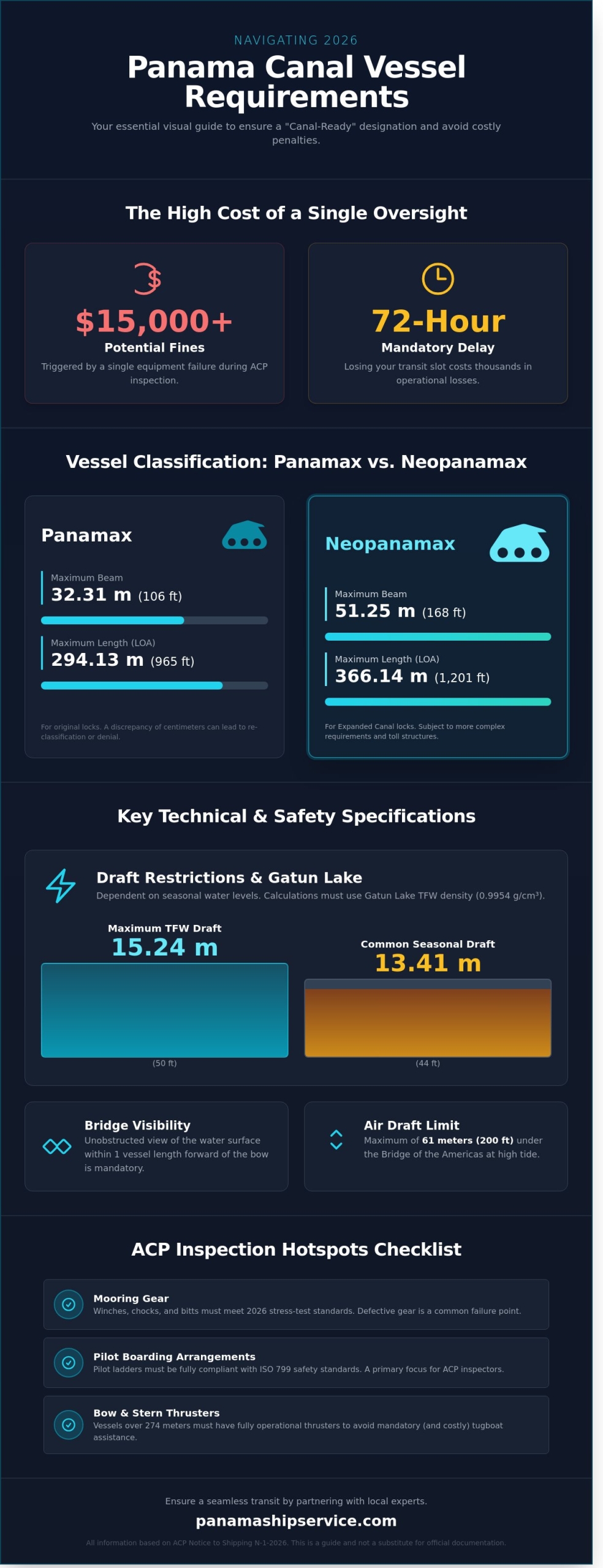
A single equipment oversight during an ACP inspection can trigger fines exceeding $15,000 and force your vessel into a 72-hour delay. You know that timing is everything in the shipping industry. Misjudging your compliance needs means losing thousands in operational costs and risking your reputation with charterers. We understand the high-stakes pressure of meeting strict deadlines while managing the evolving maritime laws of the Autoridad del Canal de Panamá. This guide will help you master the 2026 panama canal vessel requirements so you can secure a seamless transit without the stress of unexpected penalties or equipment failures. We are experts so you don’t have to be. You’ll learn how to handle the specific beam limits for Neopanamax and Panamax vessels, update your hardware to meet the latest standards, and calculate your transit costs with total accuracy. We will preview the critical documentation needed for a successful inspection and show you how to minimize time spent in port through proactive planning.
Key Takeaways
- Navigate the updated ACP Notice N-1-2026 to ensure your vessel meets the latest maritime standards for a “Canal-ready” designation.
- Master the critical technical specifications for 2026, including maximum LOA and seasonal draft limitations dictated by Gatun Lake water levels.
- Verify that your mooring gear and pilot ladders meet specific panama canal vessel requirements and ISO 799 safety standards to avoid costly transit rejections.
- Implement a proactive pre-transit compliance checklist and professional survey strategy to identify and resolve technical deficiencies before reaching Panama waters.
- Leverage 20 years of local expertise to streamline repairs and logistics, transforming complex regulatory hurdles into a cost-effective, delay-free passage.
Understanding the ACP Notice to Shipping N-1-2026
The Panama Canal Authority (ACP) updates its regulatory framework annually to ensure the waterway remains the world’s most efficient maritime shortcut. For the 2026 calendar year, the N-1-2026 notice is the definitive compliance manual. Being “Canal-ready” in 2026 means your vessel adheres to every technical specification regarding mooring gear, bridge visibility, and engine reliability. We are experts so you don’t have to be. Missing a single detail in these 2026 updates can result in your vessel being declared “non-ready,” leading to massive operational headaches.
The N-1-2026 notice is the primary tool for ship owners to avoid unnecessary expenses. It introduces stricter oversight on environmental compliance and maneuvering equipment compared to the 2025 requirements. Since timing is everything in this industry, understanding these rules before your arrival at the terminal is the only way to protect your bottom line. Failure to comply doesn’t just delay one ship; it disrupts entire supply chains and triggers steep financial penalties.
Panamax vs. Neopanamax: 2026 Classification
Vessel classification dictates your transit priority and your final invoice. For 2026, the ACP confirms the maximum beam for Panamax vessels at 32.31 meters. If your vessel’s beam exceeds this limit, you must meet the more complex Neopanamax requirements for the Expanded Canal locks. This distinction is critical because it changes your toll structure and available transit slots. Accurate measurement is vital; a discrepancy of just a few centimeters can shift your vessel into a higher pricing tier or cause a total transit denial.
The Role of the ACP Board of Inspectors
The inspection process begins immediately upon arrival at the Balboa or Cristobal anchorages. ACP inspectors board the vessel to verify that all panama canal vessel requirements are met in real-time. They focus heavily on pilot boarding arrangements and the condition of mooring winches. Common reasons for failure include defective chocks or bitts that don’t meet the 2026 stress-test standards. If the Board of Inspectors finds a deficiency, your vessel loses its slot. With daily charter rates for many tankers and bulkers exceeding $35,000, the financial impact of a “non-ready” status is devastating. Put your transit in our hands to ensure a clean inspection report every time.
Vessel Dimensions and Technical Specifications for 2026
Compliance starts with precise measurements. For the 2026 season, meeting the panama canal vessel requirements for dimensions is the first step toward a successful transit. The Panama Canal Authority (ACP) maintains strict Maximum Length Overall (LOA) limits that leave no room for error. Neopanamax vessels are capped at 366.14 meters, while Panamax vessels must not exceed 294.13 meters. If your ship exceeds these marks by even 10 centimeters, you face immediate transit denial or significant fines.
Visibility is another non-negotiable factor. The ACP enforces the 1-vessel-length rule. From the bridge conning position, the pilot must be able to see the water surface within one ship’s length forward of the bow. This ensures safe navigation through the narrow Culebra Cut. If cargo or equipment blocks this view, you’ll need to install temporary cameras or mirrors that meet ACP standards before arrival. We’ve seen ships delayed for days because of simple bridge wing obstructions that could’ve been cleared in port.
Draft and Air Draft Restrictions
Safe transit depends on Gatun Lake water levels. While the maximum Neopanamax draft is 15.24 meters in Tropical Fresh Water, seasonal droughts often reduce this to 13.41 meters. You must calculate your draft based on the specific density of Gatun Lake water, which averages 0.9954 g/cm3. We recommend performing a professional draft survey to ensure your calculations account for trim and list. Air draft is limited to 61 meters under the Bridge of the Americas at high tide.
Beam Limits and Maneuverability
The 2026 beam limit for Neopanamax locks is 51.25 meters. For Panamax locks, it remains 32.31 meters. These measurements must include any protrusions; nothing can hang over the hull during lockage. Maneuverability requirements are also increasing. Ships over 274 meters must have fully operational bow and stern thrusters. Navigating these panama canal vessel requirements ensures your ship doesn’t require extra tugboat assistance, which can add $5,000 to $15,000 in unplanned costs per transit.
- Neopanamax LOA: 366.14 meters (1,201 feet)
- Panamax LOA: 294.13 meters (965 feet)
- Maximum Beam: 51.25 meters for Neopanamax / 32.31 meters for Panamax
- Visibility: Must see water surface within one ship length forward
Essential Equipment and Safety Requirements
Meeting the 2026 panama canal vessel requirements demands more than a cursory inspection; it requires a rigorous audit of your ship’s mechanical and safety hardware. The Panama Canal Authority (ACP) doesn’t tolerate equipment failure because a single stalled vessel can disrupt the entire transit schedule. We’ve seen that 12% of transit delays stem from preventable gear issues. Your vessel must arrive with fully operational mooring systems, navigation aids, and health certifications to avoid being sent to the back of the queue.
Mooring and Towing Gear Standards
The ACP enforces strict rules for the number and placement of chocks and bitts used for locomotive attachments. For Neopanamax vessels, you’ll typically need between 12 and 16 chocks, depending on your total length. Each piece of hardware must meet a Safe Working Load (SWL) of at least 64 metric tons, while larger vessels often require a 90-ton SWL to handle the stresses of the locks. If your ship’s current configuration is outdated, Mechanical Ship Repairs can retro-fit or reinforce non-compliant gear to ensure you meet the latest 2026 benchmarks. Don’t risk a “not ready” status because of corroded bitts or poorly welded chocks.
When extensive retrofitting becomes cost-prohibitive, many operators find it more economical to upgrade their fleet. If you are exploring the market for a new or used vessel that already meets these modern transit standards, you can discover BTR Marine Services LLC for specialized ship brokering.
Pilotage and Boarding Compliance
Safety for ACP pilots is a top priority. Your pilot ladder must strictly adhere to ISO 799:2019 standards. Common defects that trigger immediate delays include worn side ropes, steps with wedges, or ladders that aren’t properly secured to the hull. The pilot platform must be clear of obstructions and provide a safe transition to the deck. Beyond the physical ladder, your vessel’s sanitary status is under scrutiny. You’re required to maintain a valid Ship Sanitation Control Exemption Certificate, often called a Deratting Certificate, issued within the last 180 days. For 2026, the ACP has also increased focus on pest control; vessels arriving from designated high-risk regions must show proof of fumigation within 72 hours of arrival.
Presenting a professional image extends to your crew as well. Properly branded uniforms and high-visibility safety wear not only enhance team identity but also contribute to a smoother, more organized inspection process. For companies looking to upgrade their crew’s apparel, you can visit Captain Printing for custom solutions.
Navigation equipment is equally critical for a smooth transit. Your bridge must be equipped with:
- Class A AIS: Must be fully integrated with a pilot plug located near the conning position.
- Redundant GPS: Two independent systems are required to ensure continuous positioning.
- Dual Radar Units: Both X-band and S-band radars must be operational to eliminate blind spots.
We’re experts in these technical nuances so you don’t have to be. Ensuring your hardware is compliant before you reach the breakwater saves time and protects your bottom line.
Pre-Transit Compliance Checklist and Surveys
Operational delays at the Panama Canal cost ship owners upwards of $5,000 per hour in lost time and fuel. To avoid these setbacks, performing a comprehensive self-audit 96 hours before arrival is mandatory for meeting panama canal vessel requirements. Relying on luck during an ACP boarding inspection often results in “not ready” status. This pushes your vessel to the back of the queue, potentially causing a 48 hour delay. A professional pre-transit marine survey identifies mechanical or structural discrepancies that your crew might overlook. We act as your eyes and ears on the ground, ensuring every winch, chalk, and bitt meets the specific 2026 standards.
Underwater Hull and Propeller Readiness
Biofouling remains a primary cause for transit denials and increased operational costs. Even moderate growth on the hull increases fuel consumption by 15% and can lead to immediate environmental fines from the ACP. We recommend scheduling Underwater Hull Services while at anchor to ensure your vessel is clean. Our team provides Class-approved UWILD (Under Water Inspection in Lieu of Drydocking) surveys. These inspections verify propeller integrity and hull condition. They provide the documented proof required for regulatory peace of mind before you enter the locks.
Waste Management and MARPOL Annexes
The ACP enforces a zero-discharge policy within the Panama Canal Watershed. Your vessel must have sufficient storage capacity for sludge, bilge water, and garbage during the entire transit period. Coordinating MARPOL Disposal before you reach the canal entrance prevents port delays. It ensures you remain compliant with MARPOL Annex I, IV, and V. You must have all documentation ready for inspection, including updated Garbage Record Books and hazardous waste manifests. Our specialized teams manage the collection and certification process. We are experts so you don’t have to be.
Don’t risk your schedule on avoidable compliance errors. Contact Panama Ship Service today to schedule your pre-transit surveys and ensure your vessel meets all 2026 panama canal vessel requirements.
Panama Ship Service: Your Expert Partner for Canal Readiness
Navigating the complex landscape of the Panama Canal requires more than just a manual. Since 2004, Panama Ship Service has provided the technical expertise needed to meet every regulation. We’ve spent 20 years building a legacy of reliability at both the Atlantic and Pacific entrances. We are experts so you don’t have to be. Our team maintains constant, daily communication with the Panama Canal Authority (ACP) to ensure your vessel meets the latest panama canal vessel requirements without delay. We act as your one-stop-shop, providing everything from MARPOL disposals to specialized technical surveys. Timing is everything in this industry. A delay at the locks impacts your entire charter. We eliminate that risk by being on the ground when you need us.
Mechanical and Structural Repair Solutions
Compliance often demands physical modifications. Our rapid response teams specialize in on-site steel fabrication for mooring gear adjustments, ensuring your chocks and bitts meet 2026 specifications. We provide 24/7 mechanical support at Balboa and Cristobal ports. If your engines or thrusters underperform, our technicians arrive within 120 minutes to restore maneuverability and safety standards. We focus on getting the job done right the first time to avoid costly re-inspections.
- Precision welding for heavy-duty towing equipment to meet ACP standards.
- Main engine and auxiliary power troubleshooting to prevent transit rejection.
- Hydraulic system repairs for steering gear reliability.
- On-site structural reinforcement for boarding facilities and pilot platforms.
Consolidated Technical Support
A single failed inspection can cost a vessel over $50,000 in lost time and fines. Our marine surveys identify these risks before the ACP inspector boards. We streamline your transit by managing all technical needs through a single point of contact. This reduces administrative friction and keeps your schedule on track. We’ve helped over 1,500 vessels achieve successful transits since our inception. Our goal is to minimize your vessel expenses while maximizing operational uptime.
Our surveyors provide detailed reports that mirror the ACP’s own checklist, giving you a clear roadmap to compliance. Don’t leave your panama canal vessel requirements to chance. Contact us today for a tailored compliance and service quote to secure your 2026 transit window. Put your transit in our hands and experience the efficiency that two decades of experience provides.
Secure Your 2026 Transit with Proactive Compliance
Navigating the updated ACP Notice to Shipping N-1-2026 requires more than just a cursory review; it demands precise technical alignment. Meeting the 2026 panama canal vessel requirements means your fleet must strictly adhere to new equipment standards and dimension tolerances to avoid costly delays. Misjudging a single technical specification can result in significant fines or a total loss of your transit slot. Proactive compliance is your only safeguard against the operational pressures of 2026.
Panama Ship Service brings 20+ years of maritime expertise to every inspection. We provide Class-approved underwater and mechanical services with a 24/7 rapid response team stationed at both canal entrances. We are experts so you don’t have to be. Our team handles the technical complexity while you focus on your cargo. Put your transit in our hands and eliminate the guesswork from your arrival.
Ensure your vessel is Canal-ready with Panama Ship Service. Your successful transit starts with the right preparation today.
Frequently Asked Questions
What is the maximum beam for a Panamax vessel in 2026?
The maximum beam for a Panamax vessel remains 32.31 meters (106 feet) according to the 2026 ACP regulations. This measurement is strict for the original locks to ensure safe clearance between the ship’s hull and the lock walls. If your vessel’s beam exceeds this by even a few centimeters, it’s reclassified as Neo-Panamax and must use the newer, larger locks at a different tariff rate.
Can a vessel transit the Panama Canal without a working bow thruster?
Yes, you can transit without a working bow thruster, but the ACP requires you to report the deficiency 48 hours before arrival. The Canal Authority will likely assign additional tugboats to assist your maneuvers, and the cost of these extra units falls on the ship owner. Expect a deficiency surcharge starting at $2,500, depending on the vessel’s size and the complexity of the scheduled transit.
How often are the Panama Canal vessel requirements updated?
The Panama Canal Authority updates its formal requirements annually through the OP Notice to Shipping N-1. However, they issue supplemental Advisories to Shipping throughout the year, sometimes twice in a single month, to address water levels or new safety protocols. We track these constant changes daily so you don’t have to worry about missing a critical technical update that could delay your voyage.
What happens if my vessel fails the ACP pilot ladder inspection?
If your vessel fails the pilot ladder inspection, the pilot will refuse to board and your transit slot is immediately canceled. This failure results in a minimum $2,500 fine plus the administrative costs of rescheduling. You’ll need to replace the ladder with an ISO 799-1:2019 compliant model from a local supplier like Panama Ship Service before the ACP will allow a second inspection.
Do I need a specific marine survey before entering the Panama Canal?
Every vessel must undergo an official ACP Admeasurement survey during its first visit to determine its PC/UMS net tonnage for toll calculations. For subsequent transits, we recommend a pre-arrival bunker survey to verify fuel grades against the 2026 panama canal vessel requirements. These proactive inspections prevent disputes with the Canal Authority over fuel specifications or cargo weight declarations that lead to costly fines.
Are there special requirements for LNG carriers in the 2026 regulations?
LNG carriers must comply with specific 2026 safety mandates including gas-tight housing for all mooring equipment and specialized vapor control systems. Since January 2024, the ACP has required these vessels to provide detailed cooling records for cargo tanks to ensure stability during the 10 hour transit process. These ships often receive priority daylight slots but must meet higher escort tug requirements than standard bulk carriers.
How does Gatun Lake water level affect my vessel’s maximum draft?
Gatun Lake water levels have a direct 1:1 impact on your allowable draft; when the lake level drops below 25 meters, the ACP reduces the maximum draft. During the 2023 drought, the maximum draft was cut from 15.24 meters to 13.41 meters for Neo-Panamax ships. We provide real-time updates on lake levels so you can adjust your cargo load before leaving the departure port.
What MARPOL documentation is required for a Canal transit?
You must present a valid International Oil Pollution Prevention certificate and the Electronic Cargo Record Book to the ACP inspectors. They specifically check Annex VI documentation to confirm your fuel’s sulfur content is below the 0.50% global limit or 0.10% if you’re entering certain protected waters. If your records are incomplete, the ACP can detain your vessel at the Balboa anchorage for a full environmental audit.