
A single hour of operational delay at the canal can inflate a vessel’s daily running costs by $4,500 or more in 2026. You know that timing is the difference between a profitable transit and a logistical nightmare, yet many operators still struggle with laggy official feeds and a lack of context regarding lock positions. It is frustrating to watch a pixelated screen without knowing if your ship is entering the chamber or waiting on a pilot swap. We believe that professional mariners deserve better than guesswork when navigating the world’s most critical shortcut.
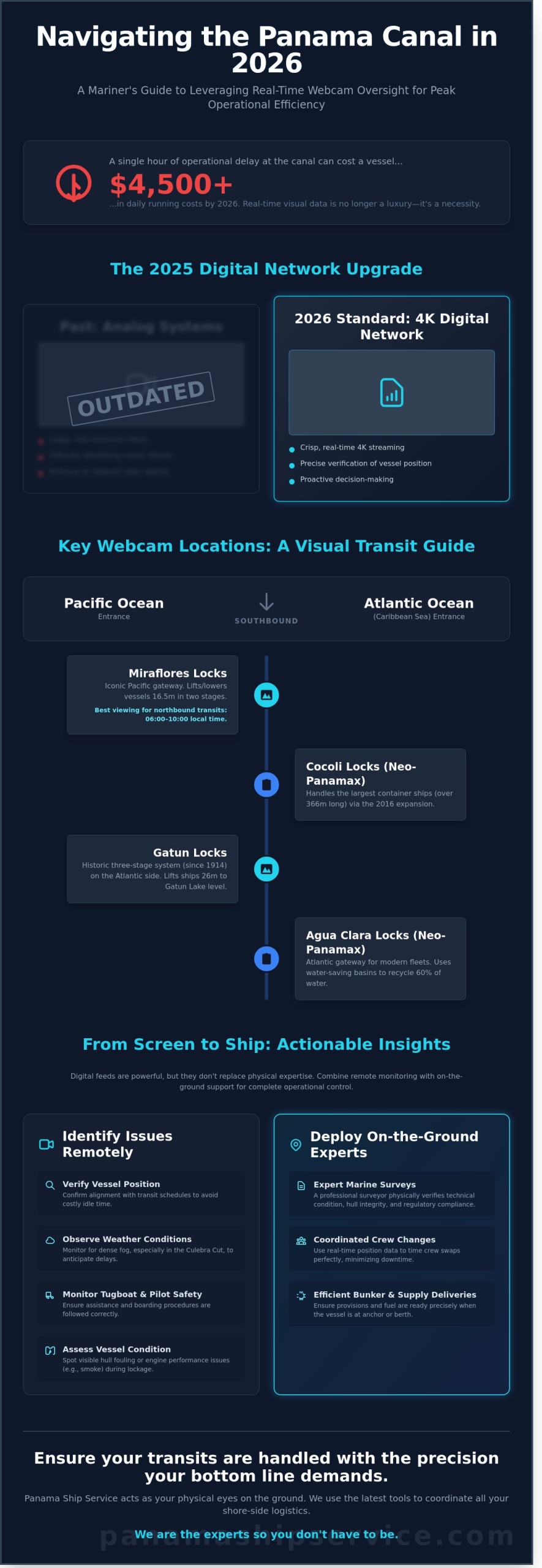
We understand that you need clear, actionable data to manage your fleet effectively. This guide provides direct, high-speed links to every essential panama canal webcam at Miraflores, Gatun, and the Neo-Panamax Cocoli locks. Beyond just a live view, we will show you how to interpret the transit timeline and identify critical maintenance needs while your vessel is at anchor. We are the experts on the ground so you don’t have to be; let’s ensure your 2026 transits are handled with the precision your bottom line demands.
Key Takeaways
- Gain a strategic advantage by leveraging the updated 2026 ACP multimedia network for real-time oversight of global trade transits.
- Navigate the primary viewing locations at Miraflores and Gatun Locks to maintain a visual line of sight from the Pacific to the Atlantic.
- Leverage a live panama canal webcam to identify visible hull fouling or engine performance issues during lockage to prevent operational setbacks.
- Optimize your monitoring schedule by aligning with Panama’s peak transit windows and time zones to avoid missing critical lockage events.
- Discover how to transition from remote visual observation to expert physical inspections to ensure your vessel’s efficiency and regulatory compliance.
The Panama Canal Webcam Network: A Mariner’s Eye on Transit
The Panama Canal Authority (ACP) completed a major overhaul of its multimedia infrastructure in January 2025. This upgrade replaced aging analog systems with a high-definition digital network. Today, the panama canal webcam system provides 4K streaming from every major lock complex. This visibility is vital for a waterway that handles roughly 6% of global trade. Ship owners and charterers no longer rely on delayed radio reports. They use a panama canal webcam feed to verify vessel arrival and monitor real-time progress. Understanding the Panama Canal’s history and operations helps clarify why this visual data is a cornerstone of modern maritime logistics.
The shift from low-resolution analog to high-definition digital streaming has changed how technical oversight is managed. In the past, grainy images made it difficult to distinguish vessel names or identify specific tugboat movements. The 2026 digital standard allows for crisp, real-time oversight that reduces the margin for error in scheduling. This isn’t just about watching a ship pass; it’s about verifying that the vessel is positioned correctly for its assigned slot. When a transit slot can cost hundreds of thousands of dollars, visual confirmation is a mandatory layer of operational security.
Why Visual Monitoring Matters in 2026
Visual data provides immediate operational truth. In 2026, transit slots are more competitive than ever. Operators use the feeds to:
- Verify vessel position against the official transit schedule to avoid costly idle time.
- Observe local weather conditions, such as the dense fog that frequently impacts the Culebra Cut.
- Monitor tugboat assistance and pilot boarding procedures to ensure safety protocols are followed.
A 30-minute delay in fog can ripple through a week of scheduling. Seeing the weather in real-time allows for better proactive decision-making.
The One-Stop-Shop Perspective
Digital feeds are powerful, but they don’t replace physical expertise. These visual checks perfectly complement marine surveys in Panama. While a webcam shows the ship entering the lock, a professional surveyor on-site verifies the technical condition and cargo integrity. Panama Ship Service acts as your physical eyes on the ground. We use these tools to coordinate shore-side logistics, such as timing crew changes and bunker deliveries. Put your transit in our hands. We are experts so you don’t have to be.
Key Webcam Locations: From the Pacific to the Atlantic
Monitoring vessel traffic requires precise timing and reliable data. The panama canal webcam network allows operators and enthusiasts to track progress through every critical stage of the 50-mile transit. By utilizing the official Panama Canal Authority webcams, you gain a real-time perspective on the most complex maritime shortcut in the world. Each lock location serves a specific operational purpose, and knowing which one to watch depends on the vessel’s size and its direction of travel.
- Miraflores Locks: The primary gateway for vessels entering from the Pacific Ocean.
- Pedro Miguel Locks: The single-stage “middle” step that moves ships toward the Gaillard Cut.
- Gatun Locks: The historic three-stage system on the Atlantic side, operational since 1914.
- Cocoli and Agua Clara: The high-tech Neo-Panamax locks that doubled the canal’s capacity in 2016.
The Pacific Side: Miraflores and Cocoli
Miraflores provides the most iconic views of the Pacific entrance. Here, vessels are lifted or lowered 16.5 meters in two distinct stages. The best time to view northbound transits is typically between 06:00 and 10:00 local time. Just a few kilometers away, the Cocoli Locks handle the largest container ships in the world. These Neo-Panamax vessels, often exceeding 366 meters in length, require the specialized infrastructure of the 2016 expansion. Tracking these views is essential for logistics managers who need to minimize vessel expenses by confirming lockage times.
The Atlantic Side: Gatun and Agua Clara
Agua Clara serves as the Atlantic gateway for modern Neo-Panamax fleets. This facility uses innovative water-saving basins that recycle 60 percent of the water used during each transit. It’s the best spot to see massive LNG carriers and 14,000 TEU container ships entering the Caribbean. In contrast, the historic Gatun Locks offer a view of the three-stage lift that brings ships up 26 meters to the level of Gatun Lake. From these cameras, you can also identify vessels waiting at the Limon Bay anchorage. This area often holds 50 or more ships during peak congestion periods, making it a critical point for monitoring regional shipping delays.
Operational Oversight: What Ship Owners See on Camera
A professional panama canal webcam feed serves as a remote diagnostic station for ship owners and technical managers. While a vessel is stationary within the locks, high-definition views allow shore-side teams to spot visible hull fouling or significant biological growth. This visual evidence is the primary trigger for scheduling underwater hull services to restore hydrodynamic efficiency. Seeing the physical condition of the hull in real time eliminates guesswork and allows for data-driven maintenance decisions.
Managers also use these views to monitor engine performance through smoke emissions. Persistent dark smoke during lock maneuvers often signals poor fuel combustion or mechanical wear. The Panama Canal Authority Webcams provide a clear vantage point to verify if a ship maintains MARPOL compliance during its transit. Furthermore, technical teams assess the interaction between the vessel and the “mules,” the silver locomotives that guide ships. They look for any potential impact or scraping against the lock walls that might require a formal damage survey upon exit.
Condition Monitoring from Afar
Visual cues from the cameras often dictate the urgency of propeller polishing. Removing marine growth can improve fuel efficiency by as much as 6% on the subsequent transoceanic leg. We use these feeds to help clients identify paint degradation or cathodic protection issues before they become critical. It’s a proactive approach to maritime management. If the camera shows a vessel is riding high or low on its marks, we immediately cross-reference that with our draft survey data to ensure total accuracy for the charterer.
Reducing Vessel Downtime
Efficiency in the canal is measured in minutes, not hours. We use visual timing from the panama canal webcam to coordinate mechanical ship repairs in Panama, ensuring our technical teams are positioned for the exact moment of arrival. This precise coordination eliminates idle time at the wharf. Owners use these live views to provide real-time status updates to charterers and stakeholders, proving the vessel’s progress. When we see a ship clearing the final chamber, we finalize the logistics for spare parts and provisions delivery. We are experts in this environment so you don’t have to be; we ensure every transit is as short and cost-effective as possible.
How to Get the Best View: Tips for 2026
Monitoring the panama canal webcam requires more than just opening a browser; it demands an understanding of maritime logistics and local timing. Panama operates on Eastern Standard Time (UTC-5) throughout the year. Peak transit activity typically occurs between 06:00 and 18:00 local time. Most Neopanamax vessels begin their approach to the Agua Clara locks during the early morning hours to maximize daylight for complex maneuvers.
If the official ACP feed experiences downtime, don’t wait for a refresh. Switch to secondary maritime aggregators or local port feeds immediately. High-traffic windows often cause server strain, especially during the 08:00 morning rush. If you encounter lag, reduce your stream quality to 720p to maintain a stable frame rate for vessel identification. We are experts so you don’t have to be, and we know that timing is everything in this industry.
Optimizing Your Viewing Experience
Visual clarity is highly dependent on Panama’s tropical cycles. Between May and December, the rainy season brings heavy afternoon downpours that can obscure the panama canal webcam lens at Gatun Lake by 14:00 local time. For the sharpest views of hull markings and IMO numbers, prioritize the 07:00 to 11:00 window. While mobile apps offer portability, a desktop setup remains the professional standard. It allows for multi-window management, which is essential for simultaneous monitoring of multiple lock chambers and technical data feeds.
Syncing AIS with Live Video
Professional observers use Automatic Identification System (AIS) data to eliminate uncertainty. By tracking a vessel’s speed and heading on a live map, you can predict its entry into the camera frame within a 120-second margin. This method is the only way to distinguish between sister ships or identify specific fleet movements in real-time. AIS data removes guesswork from webcam monitoring by providing exact vessel coordinates and arrival windows.
Put your transit in our hands to ensure every detail is handled with precision. Contact our expert team for professional ship services at the Panama Canal.
Beyond the Screen: On-the-Ground Support in Panama
A panama canal webcam offers a 24/7 window into traffic flow, but visual monitoring is only the first step in successful vessel management. Seeing your ship on a screen doesn’t reveal engine room temperatures, hull fouling levels, or fuel compliance issues. In a high-stakes environment where a single day of delay can cost upwards of $50,000 in charter rates, digital observation must be backed by physical expertise. Panama Ship Service provides the technical bridge between what you see on a monitor and the actual operational health of your vessel. We turn visual data into actionable maintenance and repair solutions.
Your Trusted Partner at the Canal
Since 2004, Panama Ship Service has acted as the essential local partner for owners and charterers navigating the ACP’s complex requirements. We provide expert mechanical and underwater services that a panama canal webcam simply cannot capture. Our team acts as your local eyes, performing critical hull cleanings and propeller polishings that improve fuel efficiency by up to 10%. With 20 years of experience, we manage the technical details so you don’t have to. We specialize in underwater inspections, class-approved welding, and emergency technical support that keeps your transit on schedule.
Schedule Your Next Service
Efficiency at the canal requires consolidating technical tasks during your scheduled stop to minimize downtime. Our team coordinates multiple service streams, from technical inspections to waste management, ensuring your vessel remains productive. You can request immediate quotes for mechanical ship repairs to address issues identified during transit. We also ensure your vessel maintains strict MARPOL Annex V and VI compliance through certified waste disposal and bunker surveys. Our rapid response teams are available at both Balboa and Cristobal ports to handle urgent requirements.
- Underwater Inspections: CCTV and high-resolution photography for class extensions.
- Mechanical Expertise: Main engine repairs, pump overhauls, and hydraulic troubleshooting.
- MARPOL Services: Sludge and bilge water removal with full certification.
- Technical Surveys: Draft, bunker, and on/off-hire surveys conducted by qualified professionals.
Don’t leave your transit to chance or a remote camera feed. Put your vessel in the hands of seasoned professionals who understand the urgency of the maritime industry. Contact Panama Ship Service for a comprehensive technical quote.
Secure Your 2026 Transit Strategy
Navigating the world’s most critical waterway in 2026 requires more than just a clear view from a panama canal webcam. While live feeds from Miraflores to Gatun provide essential visual data for ship owners, they’re only one part of a successful transit strategy. You need technical experts on the ground to manage the complexities that cameras simply can’t resolve. Timing is everything in this corridor, and even a minor mechanical delay can lead to thousands of dollars in lost revenue. Real-time monitoring helps, but local operational support ensures your vessel actually stays on schedule.
Panama Ship Service brings 20 years of maritime expertise to every vessel we support. We operate as a comprehensive one-stop-shop for bunker surveys, MARPOL disposal, and critical hull repairs. If an emergency mechanical issue arises, our teams provide a 24/7 rapid response to keep your schedule on track. We’re the experts so you don’t have to be. We handle the difficult logistics and technical surveys so your crew can focus on the voyage ahead. Put your transit in our hands and ensure your vessel meets every regulatory requirement without the stress. Maximize your transit efficiency with Panama Ship Service. We’re ready to secure your success at the canal today.
Frequently Asked Questions
Is there a live webcam for the Panama Canal?
Yes, the Panama Canal Authority (ACP) operates multiple live feeds across the waterway. You can access real-time views from the Miraflores Locks on the Pacific side, Gatun Locks on the Atlantic side, and the newer Agua Clara Locks. These cameras provide a continuous stream of vessel traffic, allowing ship owners and enthusiasts to monitor operations. We recommend checking the official ACP website for the most stable panama canal webcam links.
What is the best time to watch ships on the Panama Canal webcam?
The best time to watch is between 06:00 and 18:00 local time (GMT-5). Daylight hours provide the clearest visibility for identifying vessel types and observing lock operations. Traffic peaks usually occur mid-morning and late afternoon when convoys transition between the Atlantic and Pacific. For those tracking specific Neo-Panamax vessels, the Agua Clara Locks often show high activity between 08:00 and 15:00.
Can I see my specific ship transiting the canal on camera?
You can view a specific ship if you coordinate its transit schedule with the live feed. Use AIS tracking data from platforms like MarineTraffic to find the vessel’s exact ETA at a specific lock. Ships appearing on the panama canal webcam are usually identifiable by their hull color and superstructure. It’s critical to remember that schedules can shift by 2 to 4 hours due to operational adjustments or weather conditions.
Why is the Panama Canal webcam often down or blurry?
Technical interruptions typically result from Panama’s extreme tropical climate. High humidity levels, which often exceed 90%, cause lens condensation and fogging. Additionally, the region’s 2,500 mm of annual rainfall can obstruct the view or trigger temporary power surges that reset the equipment. Maintenance crews usually resolve these hardware glitches within 24 to 48 hours to restore the feed for global viewers.
Are the Panama Canal webcams free to use?
Access to the official Panama Canal Authority webcams is entirely free for the public. You don’t need a subscription or registered account to view the standard low-resolution or high-definition streams. Some third-party maritime sites offer enhanced tracking features or archived footage for a fee; however, the primary live views remain a complimentary service for the shipping community and the general public.
For the general public, watching these massive ships can be inspiring. If viewing the canal sparks your interest in getting out on the water, you can find more hands-on experiences elsewhere. For instance, in popular tourist destinations like Florida, companies such as Salty’s Water Sports offer everything from boat rentals to guided water tours for a different kind of maritime adventure.
Which locks have the best cameras for Neo-Panamax ships?
The Agua Clara Locks on the Atlantic side and Cocoli Locks on the Pacific side offer the best views of Neo-Panamax ships. These locks, inaugurated in June 2016, were specifically designed to handle vessels up to 366 meters in length. The camera angles at Agua Clara provide a superior perspective of the rolling gates and the massive container ships that now dominate the canal’s expanded lane traffic.
How long does it take for a ship to pass through the webcam view?
A single vessel typically remains within the webcam’s field of view for 45 to 90 minutes. This duration includes the time spent entering the lock chamber, the water leveling process, and the final exit. Larger vessels requiring multiple tugboat assists move slower than smaller private yachts. Monitoring a full transit through a single lock set requires a dedicated time block of at least 60 minutes.
Do the Panama Canal webcams operate at night?
The cameras operate 24 hours a day, 365 days a year. Since the canal never closes, the locks use high-intensity floodlighting to facilitate night transits. While the image quality is lower than during daylight, you can still see the silhouettes of ships and the movement of the lock gates. Night viewing is essential for tracking vessels scheduled for late-night or early-morning slots to avoid transit delays.