
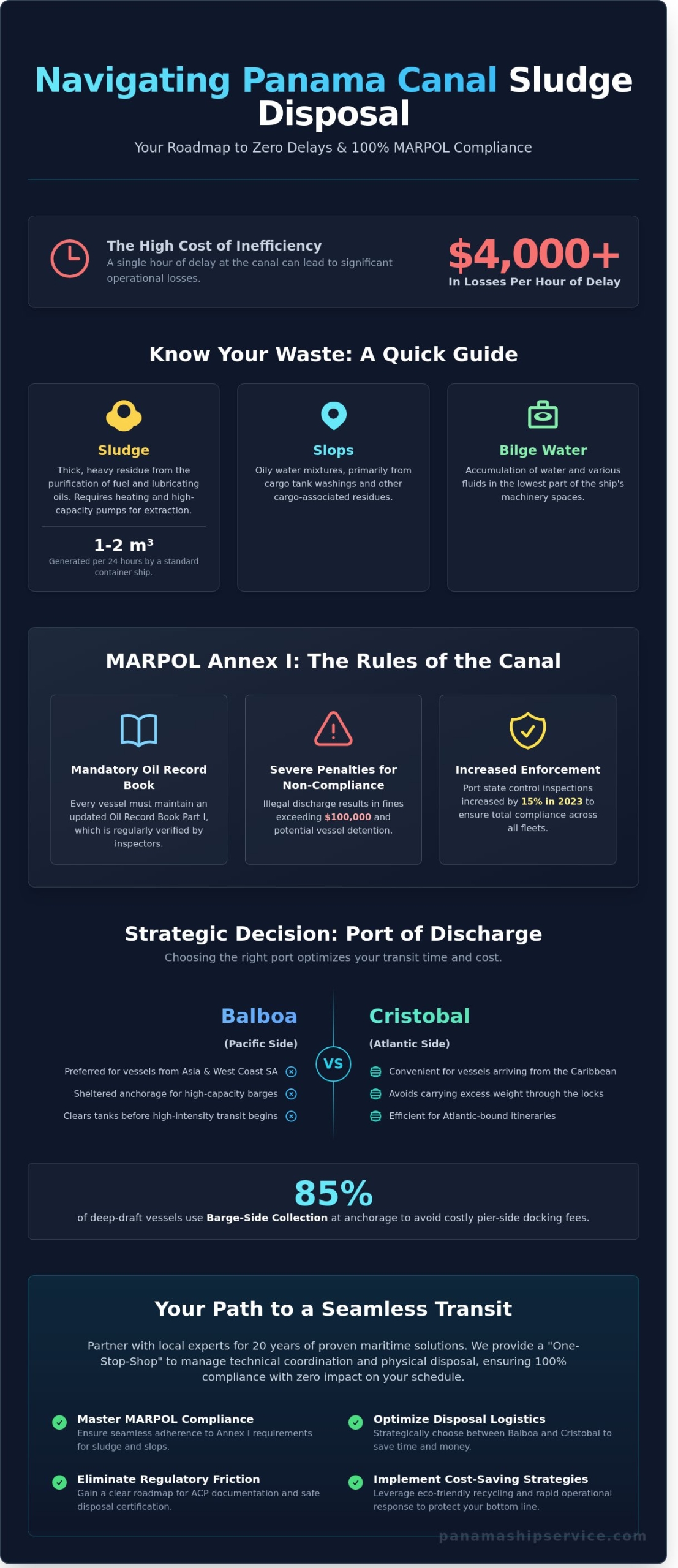
A single hour of delay at the Panama Canal can cost a Panamax vessel upwards of $4,000 in operational losses and missed scheduling windows. When your vessel is queued for transit, the last thing you need is a compliance bottleneck. Managing sludge disposal panama canal logistics isn’t just a waste management task; it’s a critical component of your operational efficiency. You understand that the difference between a smooth crossing and a costly detention often comes down to how quickly you can clear your tanks and secure proper MARPOL certification.
We’ve spent 20 years perfecting these maritime solutions so you don’t have to. You’ll master the logistics, navigate the regulatory differences between Balboa and Cristobal, and implement cost-saving strategies for your sludge and slop disposal. This guide provides the exact roadmap to achieve zero impact on your transit schedule while maintaining 100% compliance with international standards. We’ll break down the specific discharge protocols and documentation required to keep your ship moving without a second of wasted time.
Key Takeaways
- Understand the specific MARPOL Annex I requirements for sludge and slops to ensure seamless compliance during your Panama Canal transit.
- Evaluate the logistical advantages of discharging at Balboa versus Cristobal to optimize your sludge disposal panama canal strategy and save time.
- Learn how proactive waste management prevents engine room performance issues and preserves your vessel’s operational flexibility.
- Gain a clear roadmap for ACP documentation and safe disposal certification to eliminate regulatory friction and avoid costly delays.
- Implement cost-saving strategies by partnering with local experts who prioritize eco-friendly recycling and rapid operational response.
Understanding Sludge Disposal Requirements at the Panama Canal
Managing engine room residues is a high-stakes operation for every vessel transiting the 50-mile Panama Canal. Sludge consists of the waste oil, oily water, and sediment resulting from the purification of fuel and lubricating oils. Slops, as defined by MARPOL Annex I, include residues from tank washings and cargo-associated oily mixtures. Panama is a critical global hub because over 14,000 vessels transit the waterway each year. This concentration of traffic makes sludge disposal panama canal a logistical priority for ship owners and charterers. Understanding Sludge Disposal Requirements helps technical managers navigate the complexities of waste treatment and maritime law. The environmental impact of engine room residues on the Canal ecosystem is severe. Gatun Lake provides drinking water for 2 million residents. Even a minor oil spill can disrupt this vital resource and halt Canal operations. Panama Ship Service offers a “One-Stop-Shop” approach to manage these risks. We are experts so you don’t have to be. We handle the technical coordination and the physical disposal so you can focus on your transit.
Sludge vs. Slops vs. Bilge Water
Technical differences dictate how waste is handled. Sludge is the thick, heavy residue from fuel separators. Slops are the oily water mixtures from cargo tank cleaning. Bilge water is the accumulation in the lowest part of the ship’s machinery spaces. Each requires specific equipment for safe removal. Sludge often needs heating and high-capacity vacuum pumps for extraction. A standard transcontinental container ship generates between 1 and 2 cubic meters of sludge every 24 hours. Mismanaging these volumes leads to storage overflows and operational delays. We provide the specialized barges and qualified personnel necessary for efficient extraction during your stay in Panamanian waters.
The Role of MARPOL Annex I in Panama
MARPOL Annex I establishes the global standards for preventing oil pollution. Panama enforces these IMO guidelines through the Panama Canal Authority (ACP) and the Panama Maritime Authority (AMP). Every vessel must keep an updated Oil Record Book Part I. Inspectors verify these records and tank levels regularly. Illegal discharge within the Canal Zone is a serious offense. It results in fines exceeding $100,000 and potential vessel detention. In 2023, the frequency of port state control inspections increased by 15% to ensure total compliance across all transiting fleets. Put your transit in our hands to avoid these penalties. We ensure your sludge disposal panama canal meets every international and local regulation without compromising your schedule.
Logistics of Sludge Removal: Balboa vs. Cristobal
Selecting the right port for waste discharge is not just about geography. It is about protecting your bottom line. The decision to perform sludge disposal panama canal at either Balboa or Cristobal depends on your vessel’s direction, draft, and upcoming transit slot. Timing is everything in this corridor. A delay of just four hours in waste offloading can result in a missed transit window, leading to thousands of dollars in anchorage fees and lost operational time.
Operational managers must choose between barge-side collection and shore-side truck disposal. Barge-side remains the standard for 85% of deep-draft vessels because it occurs at anchorage. This method eliminates the need for expensive pier-side docking fees and pilotage. Shore-side disposal is typically reserved for smaller vessels or those already scheduled for terminal work. We manage these logistics so you don’t have to, ensuring all documentation aligns with Regulatory Compliance and Safe Disposal Certification standards.
The choice of port is also influenced by the vessel’s next destination. If a ship is heading into the Atlantic, discharging in Balboa ensures the tanks are clear before the high-intensity transit begins. Conversely, vessels arriving from the Caribbean may find Cristobal more convenient to avoid carrying excess weight through the locks. We provide constant daily communication to ensure your discharge happens exactly when the barge is scheduled, preventing any friction with the Panama Canal Authority (ACP) timeline.
Disposal Services in Balboa (Pacific Side)
Balboa is the preferred choice for vessels arriving from Asian or West Coast South American routes. The Pacific Anchorage areas, specifically Anchorage 1 and 2, provide sheltered conditions for high-capacity barges. These barges often carry up to 800 metric tons, making them ideal for large tankers needing to clear multiple tanks. Balboa’s proximity to the PSA Panama International Terminal and major engine repair hubs allows for consolidated service. You can coordinate your sludge disposal panama canal alongside technical repairs or underwater inspections. This approach reduces your vessel’s idle time by an average of 18% compared to splitting services across different ports.
Disposal Services in Cristobal (Atlantic Side)
Cristobal serves vessels entering from the Caribbean, US East Coast, and Europe. Logistics here are often integrated with bunker surveys and fresh provision deliveries. Efficiency is the priority. However, the Atlantic side is prone to “Northers” between December and March. These weather systems bring wind speeds exceeding 25 knots, which can suspend barge operations for 12 to 24 hours. Successful operators account for these seasonal impacts by scheduling disposals well ahead of the storm fronts. Integrating waste removal with bunker delivery in Cristobal is a smart move, as it minimizes the number of barge movements alongside your hull. For a seamless transition through the Atlantic locks, planning your waste logistics with a local expert is the most reliable way to avoid seasonal bottlenecks.
Operational Efficiency: Impact on Vessel Performance
Excessive sludge buildup is a silent performance killer that compromises engine room safety and vessel reliability. When centrifuges and separators work overtime to process poor-quality fuel or heavy residues, the risk of mechanical fatigue increases. Efficient sludge disposal panama canal isn’t just a regulatory checkbox; it’s a preventative maintenance strategy. Removing these waste products ensures that fuel systems maintain optimal pressure and prevents the “off-spec” bunker issues that arise when new fuel mixes with old, oxidized residues at the bottom of the tanks.
Choosing Panama for disposal offers a clear cost-benefit advantage over other regional ports in the Caribbean or Central America. While some ports lack the specialized infrastructure for rapid MARPOL discharge, Panama’s integrated maritime cluster allows for simultaneous operations. You can coordinate waste removal during your scheduled wait time, turning idle hours into productive maintenance windows. This proactive approach prevents the accumulation of “deadweight” that can subtly increase fuel consumption by 1% to 2% over long voyages.
Vessel Stability and Tank Management
Managing tank capacity is vital for maintaining the precise draft required for a safe Canal transit. Every centimeter of draft matters when the Panama Canal Authority (ACP) issues seasonal restrictions based on Gatun Lake levels. By clearing waste tanks, chief engineers gain greater flexibility in managing ballast and fuel distribution. This optimization directly reduces the risk of mechanical failure during the transit’s high-stress maneuvers. Understanding the Logistics of Sludge Removal and following established discharge protocols keeps your vessel’s stability within safe margins, ensuring long-term fuel efficiency through a cleaner, lighter hull profile.
Minimizing Transit Downtime
Timing is everything at the Canal. A missed transit slot due to engine room issues or delayed waste clearance is a financial disaster. For a standard Panamax vessel, a 24-hour delay can cost between $65,000 and $110,000 in lost charter hire and additional port fees. Rapid response sludge disposal panama canal services eliminate these bottlenecks. Our team ensures that waste removal is completed without interfering with your arrival schedule. If your vessel requires more than just waste removal, you can streamline your stay by scheduling mechanical ship repairs alongside your MARPOL disposal. This “one-stop-shop” approach minimizes downtime and keeps your transit on track, proving that expert coordination is the best way to protect your bottom line.
Regulatory Compliance and Safe Disposal Certification
Managing sludge disposal panama canal requires precise coordination between the vessel and licensed shore facilities. The process begins with a formal request submitted via the VUMPA (Vessel Traffic Management and Information System) at least 24 hours before arrival. Once the discharge is complete, the contractor issues a Waste Delivery Receipt (WDR). This document is the only legal proof that the transfer occurred according to MARPOL Annex I standards. We handle these logistics so your crew can focus on the transit itself.
The Safe Disposal Certificate (SDC) is the most critical document in this chain. It confirms that the sludge reached a treatment plant authorized by the Panama Maritime Authority (AMP) and the Ministry of Environment (MiAmbiente). Without this certificate, the vessel remains legally responsible for the waste even after it leaves the ship’s manifold. Our team ensures every gallon is accounted for through certified downstream processing.
Required Documentation for Ship Owners
Ship owners must ensure the Oil Record Book (ORB) Part I accurately reflects every cubic meter of sludge moved. Entries belong under Code C, Item 11.4. You shouldn’t settle for unverified providers. Always verify the contractor’s ACP license number and their specific “Resolución” from MiAmbiente. These credentials guarantee that the service provider meets the 2024 environmental standards for maritime waste handling. Discrepancies in these records are the primary cause of delays during the boarding process.
- Waste Delivery Receipt (WDR): Must include the date, vessel name, and exact volume in cubic meters.
- ORB Entries: Must be signed by the Chief Engineer and the Master immediately after the operation.
- Contractor Credentials: Verify that the barge or truck is specifically authorized for MARPOL Annex I waste.
ACP Boarding Officer Requirements
The ACP Boarding Officer conducts a Sanitary Inspection to confirm the vessel isn’t a pollution risk. They specifically look for the SDC to close out the disposal record. If the volumes in the ORB don’t match the shore receipts, fines often exceed $10,000. Officers also check for proper sealing of overboard discharge valves. We provide a pre-inspection checklist to ensure your vessel meets every requirement of the ACP OP Notice N-1-2024. This proactive approach eliminates the risk of costly administrative holds.
Don’t risk your transit schedule with improper documentation. Contact Panama Ship Service to secure your certified sludge disposal and MARPOL compliance.
Why Panama Ship Service is Your Trusted Disposal Partner
Managing a vessel transit through the Panama Canal requires precision and deep local knowledge. For 20 years, Panama Ship Service has acted as the primary technical partner for ship owners facing the strict requirements of sludge disposal panama canal regulations. We operate with a clear philosophy: we are experts so you don’t have to be. This allows your crew to focus on navigation while we handle the complexities of MARPOL compliance and waste management at both the Atlantic and Pacific terminals.
Our commitment to the environment goes beyond basic compliance. We utilize eco-friendly recycling methods that transform waste oil into usable fuel products, ensuring that your vessel’s environmental footprint remains minimal. When emergencies arise, our rapid response teams deploy within two hours of notification. This speed is vital because a single missed transit slot can cost a charterer over $65,000 in late fees and additional fuel burn. We provide a calm, expert presence to resolve these high-stakes situations quickly and effectively.
Efficiency increases when you consolidate your technical needs. By combining waste removal with marine surveys in Panama, we eliminate the need for multiple service providers. This streamlined approach reduces the number of personnel boarding your vessel and simplifies your port documentation, saving your officers valuable time during the busy transit window.
Our Comprehensive Disposal Solutions
We maintain a fleet of state-of-the-art barges and vacuum trucks specifically for sludge disposal panama canal operations. These units handle slops, sludge, and oily bilge water with zero risk of spill or contamination. Our team manages ship garbage strictly under MARPOL Annex V protocols, providing all necessary certificates for your records. We offer transparent, competitive rates for all vessel classes, from Panamax bulkers to the largest Neopanamax container ships. Our pricing models are fixed; you won’t face hidden surcharges after the job is finished.
Put Your Transit in Expert Hands
Communication is the foundation of a successful canal transit. Our operations team provides constant daily updates, ensuring you’re never in the dark about your vessel’s status or compliance paperwork. We minimize your expenses by consolidating services, which often results in a 14% to 19% reduction in total port costs compared to hiring separate contractors for each task. Don’t leave your compliance to chance in a difficult and frustrating regulatory environment. Contact us today for a customized disposal quote and experience the reliability of a seasoned maritime partner.
Streamline Your Vessel Operations at the Panama Canal
Effective waste management ensures your vessel remains compliant and operational during its transit. Timing is everything in this industry. Mismanaging your waste discharge leads to port delays and heavy fines that impact your bottom line. By coordinating your sludge disposal panama canal requirements ahead of time, you eliminate the risk of operational bottlenecks at both the Pacific and Atlantic terminals. Proper certification isn’t just a legal necessity; it’s a safeguard for your reputation and fleet efficiency.
Panama Ship Service acts as your expert partner to handle these complexities. We bring 20 years of maritime experience and status as a fully licensed MARPOL contractor to every operation. Our teams provide 24/7 rapid response at Balboa and Cristobal to keep your schedule on track. We’re experts so you don’t have to be. You can rely on our proven track record to handle the logistics while you focus on navigating the canal safely. Put your transit in our hands and move forward with total confidence.
Request an Immediate Sludge Disposal Quote
Frequently Asked Questions
Is sludge disposal mandatory for all ships transiting the Panama Canal?
Sludge disposal isn’t mandatory for every transit, but maintaining MARPOL Annex I compliance is a legal requirement for all 14,000 vessels crossing the canal annually. If your tanks are at 85% capacity or higher, the Panama Canal Authority requires discharge before you enter the locks. We manage these requirements to prevent costly delays. Our team ensures your vessel meets the specific standards outlined in the OP’s Notice to Shipping N-1-2024.
How long does the sludge removal process typically take in Balboa?
A standard sludge removal operation in Balboa takes between 4 and 6 hours for volumes under 50 cubic meters. Larger discharges might extend to 8 hours depending on your pump rates and barge availability. We coordinate with the authorities to ensure the barge arrives within 30 minutes of your arrival at the Pacific Anchorage. This level of efficiency keeps your schedule intact and avoids unnecessary idle time.
What is the cost of sludge disposal services at the Panama Canal?
The cost for sludge disposal panama canal services typically starts with a base mobilization fee of $2,500 plus a per-cubic-meter rate ranging from $45 to $75. Total pricing depends on the specific gravity and water content of the waste. We provide a transparent, fixed-price quote within 2 hours of your inquiry. This helps you avoid the hidden surcharges that often inflate port expenses by 20% or more.
Can I dispose of sludge and ship garbage at the same time?
You can dispose of sludge and ship garbage simultaneously using our multi-purpose service barges. This dual operation saves you approximately 3 hours of idle time at anchor. We handle MARPOL Annex I and Annex V waste in a single mobilization to streamline your port stay. Our logistics team coordinates the different collection units to ensure all waste is offloaded before your scheduled pilot boarding time.
What happens if my vessel is found in violation of MARPOL in Panama?
MARPOL violations in Panama result in immediate detention and fines ranging from $10,000 to $1,000,000 depending on the severity of the record-keeping error. The Panama Canal Authority may also suspend your transit slot, costing you an additional $50,000 in daily operational losses. We’ve spent 20 years helping owners navigate these regulations. We ensure your Oil Record Book is accurate and compliant before inspectors board the vessel.
Do I need to be at anchor to discharge slops and sludge?
All sludge and slop discharges must occur while the vessel is at the designated Pacific or Atlantic anchorages. Operations are prohibited while the vessel is in motion through the canal or inside the locks. We typically schedule these services at Anchorage Area F in Balboa or the Cristobal Inner Anchorage. Our barges are equipped to handle transfers safely in sea states up to 1.5 meters.
Will sludge disposal affect my Panama Canal transit schedule?
Professional sludge disposal panama canal services won’t impact your transit schedule if the operation is completed 4 hours before your pilot time. We monitor your ETA and the transit sequence 24/7 to adjust the barge arrival. Since timing is everything, we prioritize rapid mobilization and fast pumping rates. Our goal is to finish the discharge while your crew completes other arrival formalities and inspections.
Does Panama Ship Service provide certificates for MARPOL compliance?
We provide official MARPOL certificates and waste delivery receipts for every operation we conduct. These documents are essential for your Oil Record Book and satisfy all Panama Canal Authority and Port Authority inspections. You’ll receive a digital copy within 60 minutes of completion and the physical originals before the vessel sails. We’re experts so you don’t have to be, ensuring your documentation is flawless.