
A single pest infestation or an expired Ship Sanitation Control Exemption Certificate (SSCEC) can halt a vessel for over 48 hours at the Pacific entrance, costing operators upwards of $65,000 in daily detention fees. You understand that in the high-stakes world of maritime logistics, timing is everything and costs continually increase. Dealing with the Panamanian health authorities (MINSA) and coordinating ship pest control panama canal requirements is a complex process that often leads to frustration and avoidable transit delays for unprepared crews. It’s a risk your schedule cannot afford.
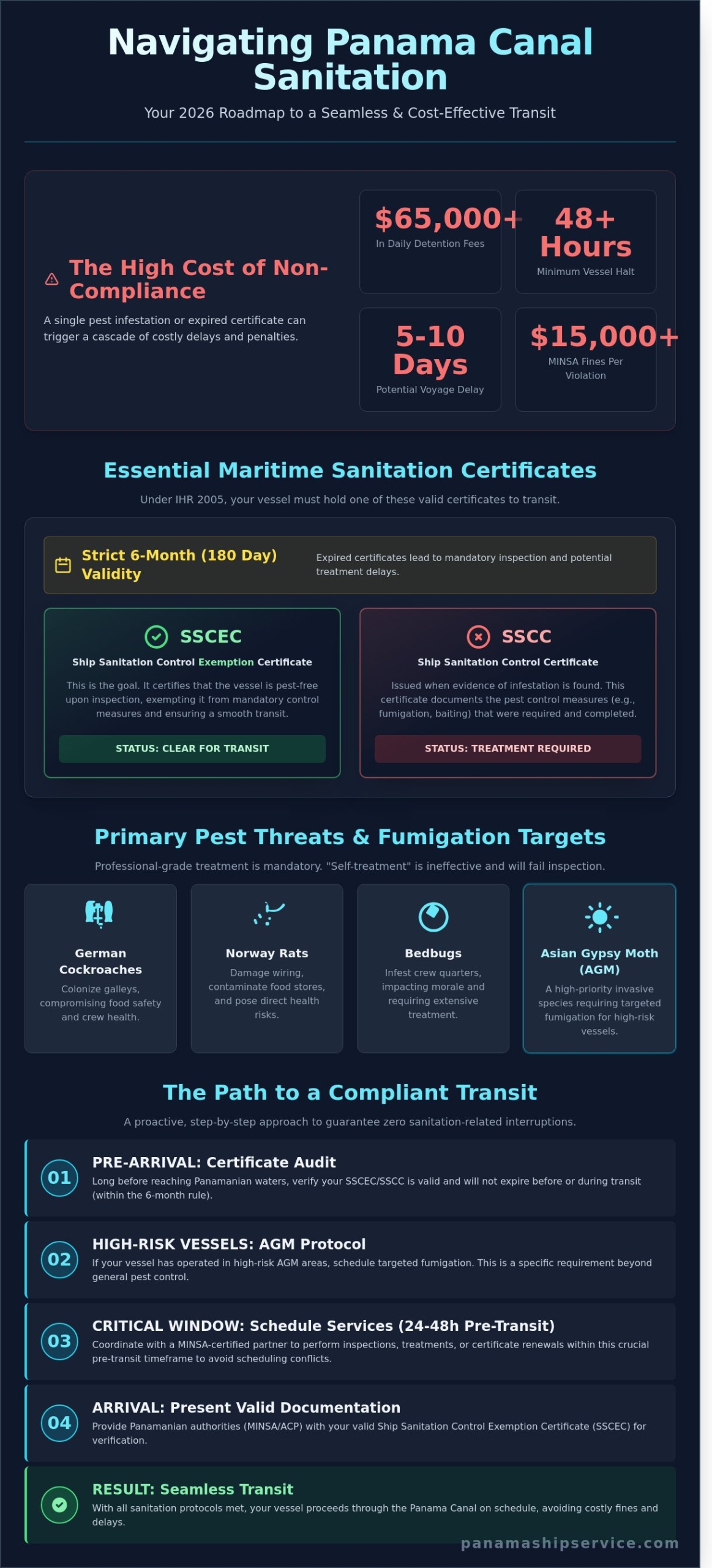
We are experts so you don’t have to be. This guide provides the exact roadmap to mastering maritime sanitation protocols for the 2026 season. Our goal is to ensure your vessel achieves a seamless transit with zero sanitation-related interruptions. You will learn how to maintain a valid SSCEC, manage targeted Asian Gypsy Moth (AGM) fumigation, and ensure total compliance with updated international maritime health standards. We break down the specific steps to protect your cargo and crew while maintaining the rigid schedule required for a successful Canal crossing as your trusted partner on the ground.
Key Takeaways
- Navigate complex IHR 2005 regulations and MINSA requirements to ensure your vessel meets all mandatory maritime sanitation standards before arrival.
- Master the management of SSCC and SSCEC certificates, including the strict 6-month validity rule, to prevent administrative hold-ups during transit.
- Implement targeted fumigation strategies for effective ship pest control panama canal transits, specifically addressing Asian Gypsy Moth (AGM) risks for high-risk vessels.
- Coordinate with certified technicians during the critical 24-48 hour pre-transit window to seamlessly integrate sanitation services into your operational schedule.
- Reduce vessel expenses and transit friction by consolidating expert sanitation services with technical repairs through a trusted, authorized partner.
Regulatory Compliance: Why Ship Pest Control is Mandatory for Panama Canal Transit
Vessel transit through the Panama Canal is a high-stakes operation where timing is everything. Beyond mechanical readiness, every ship must meet strict health protocols defined by the International Health Regulations (IHR 2005). Specialized ship pest control panama canal services are not optional; they’re a legal prerequisite for clearance. The Panama Canal Authority (ACP) works in direct coordination with the Ministry of Health (MINSA) to ensure no vessel introduces pathogens or invasive species into the local ecosystem or urban centers.
Failure to maintain a pest-free environment leads to immediate operational bottlenecks. If an inspector identifies an active infestation, the consequences are swift. MINSA can impose fines exceeding $15,000 per violation. More critically, a vessel may be ordered into mandatory quarantine at a designated anchorage. This results in the immediate loss of your scheduled transit slot. In 2026, with transit demand remaining high, a missed slot can delay a voyage by 5 to 10 days, costing ship owners upwards of $50,000 daily in operational overhead and port fees.
The Legal Framework: MINSA and PMA Requirements
The Panama Maritime Authority (PMA) has updated its 2026 standards to align with stricter global biosecurity trends. Every vessel must present a valid Ship Sanitation Control Exemption Certificate (SSCEC) or a Ship Sanitation Control Certificate (SSCC) before entering Panamanian waters. These documents prove the ship has undergone professional inspection and treatment within the last six months. There’s a direct link between the Panama Canal history and these modern regulations; the project nearly failed in the early 1900s due to mosquito-borne diseases. Today, ship pest control panama canal protocols prevent the cross-continental spread of modern threats like the Asian Tiger mosquito or invasive rodent species that threaten local biodiversity.
Identifying High-Risk Infestations
Merchant vessels are prime targets for three primary pests: German cockroaches, Norway rats, and bedbugs. Cockroaches quickly colonize galleys, compromising food safety and triggering health code violations during ACP inspections. Rodents pose a dual threat; they destroy electrical wiring and contaminate stores, posing a direct risk to crew health. While some crews attempt “self-treatment” using over-the-counter sprays, these efforts almost always fail class inspections. Professional-grade baiting and fumigation are required because maritime pests have developed significant resistance to standard retail chemicals. We are experts so you don’t have to be. Professional intervention ensures your sanitation certificates remain valid and your transit stays on schedule.
Essential Maritime Sanitation Certificates: SSCC, SSCEC, and Deratting
Ship operators face strict scrutiny when approaching the locks. To maintain compliance for ship pest control panama canal, you must carry either a Ship Sanitation Control Certificate (SSCC) or a Ship Sanitation Control Exemption Certificate (SSCEC). These documents serve as proof that your vessel is free from vectors, reservoirs of disease, and pests that threaten public health. Under International Health Regulations, both certificates carry a rigid 6-month validity period. On long-haul voyages exceeding 180 days, your bridge team must track these dates with precision. If a certificate expires while the vessel is at sea, you risk mandatory fumigation or significant transit delays upon arrival.
While the term “deratting” sounds like a relic from the early 20th century, it remains a standard part of the vocabulary in the Panama Canal Sanitation Regulations. Panama maintains this terminology to ensure legal consistency with older maritime codes, even though modern inspections cover everything from cockroaches to bedbugs. If your vessel is found to have an infestation, you’ll receive an SSCC after treatment is completed. If the ship is clean, you’ll be granted an exemption.
Understanding the SSCEC (Exemption Certificate)
The SSCEC is the goal for 95% of well-maintained modern fleets. MINSA (Ministerio de Salud) issues this when an inspection finds no evidence of pests or sanitary risks. Utilizing professional marine surveys in Panama before your arrival helps you identify potential red flags in the galley or storage areas. This proactive step ensures you receive an exemption rather than a control order, keeping your vessel’s record clean and your transit on schedule.
The Inspection Process: What MINSA Officers Look For
MINSA officers focus on four critical zones: the galley, dry food storage, crew quarters, and waste management areas. They don’t just look for pests; they look for the conditions that attract them. You must have the following documentation ready for review:
- Medical Log: Evidence of crew health and any reported illnesses.
- Potable Water Analysis: Recent lab results, typically from within the last 30 days.
- Garbage Record Book: Proof of compliant waste disposal and storage.
Common failures often stem from stagnant water in lifeboat bilges or improper sealing of flour and grain containers in the dry stores. To avoid these issues, your crew should conduct a deep clean 48 hours before reaching the Balboa or Cristobal anchorages.
Renewing certificates at the anchorage is the most efficient way to maintain ship pest control panama canal standards without disrupting your schedule. We coordinate with MINSA inspectors to board your vessel while you wait for your transit slot, managing the logistics so you don’t have to. If your certificate expires within 15 days of your ETA, request a renewal survey to prevent any last-minute administrative bottlenecks at the locks.
Targeted Fumigation Services: From Asian Gypsy Moth (AGM) to General Pest Eradication
Panama’s tropical climate and the Canal’s status as a global crossroads make ship pest control panama canal a critical operational requirement. Effective transit planning in 2026 demands more than just basic spraying. It requires a technical approach to eliminate invasive species and persistent infestations that can trigger costly delays or quarantine orders from the Panama Canal Authority (ACP).
Asian Gypsy Moth (AGM) Inspections
Vessels arriving from high-risk ports in East Asia between May and September face mandatory AGM clearance protocols under the latest 2026 maritime safety updates. These invasive moths lay egg masses that can survive extreme conditions, making them a primary target for ACP inspectors. Our teams conduct thorough visual sweeps of the superstructure, deck machinery, and cargo gear. For comprehensive compliance, ship owners should coordinate these inspections with underwater hull services to ensure the vessel is clean both above and below the waterline. This dual approach eliminates 100% of biological risks before the vessel reaches the Gatun Locks.
Accommodation and Galley Fumigation
German cockroaches remain the most resilient threat in vessel living quarters. These pests exploit cable trunks, ventilation ducts, and the spaces behind galley panels to avoid standard treatments. We’ve found that one-time emergency sprays rarely solve the root cause. Instead, we implement Integrated Pest Management (IPM) strategies that utilize a combination of gel baits and residual insecticides. This method has shown a 95% reduction in pest populations within 48 hours of application. We focus on the “hidden” areas where 80% of the population typically resides, ensuring long-term control rather than a temporary fix.
Our chemical protocols prioritize both efficacy and vessel safety. We utilize two primary methods based on the specific infestation:
- Fogging Machines: These are used for large volume saturation in cargo holds or engine rooms to reach airborne pests and deep crevices.
- Residual Spraying: This is the standard for accommodation areas, creating a long-lasting barrier on surfaces that remains active for up to 90 days.
Safety is our absolute priority during any fumigation. We enforce strict crew evacuation procedures and seal the treated zones completely. Before the crew can re-enter, our technicians perform gas testing using calibrated detectors. We don’t clear a space for re-entry until gas levels are confirmed below 0.3 ppm for phosphine or equivalent safety thresholds for other agents. To maintain MARPOL compliance, we ensure that all ventilation of gases occurs at least 12 nautical miles from the coast. We also manage the disposal of chemical containers and residues as hazardous waste, providing the necessary documentation to prove the vessel met all environmental obligations during its stay in Panama.
Optimizing Your Transit Timeline: Scheduling Pest Control at the Panama Canal
Timing is the most critical variable for a successful canal crossing. A single day of delay in the 2026 maritime environment can cost ship owners upwards of $35,000 in operational losses and missed slot fees. You must integrate ship pest control panama canal services into the 24 to 48 hour pre-transit window to ensure all sanitation documentation is valid before the pilot boards. Our team coordinates directly with your local agent to ensure technicians board at the precise moment your vessel reaches the Balboa or Cristóbal anchorage, preventing any friction with the Panama Canal Authority (ACP) schedule.
Performing these services during mechanical ship repairs represents the most cost-effective strategy for modern fleets. When your vessel is already stationary for technical maintenance or engine overhauls, our teams complete fumigation or inspections without adding a single minute to your idle time. We maintain a policy of constant daily communication. We provide real-time updates between the Master and our operations desk to keep every stakeholder informed of the vessel’s compliance status. This proactive approach eliminates the “difficult and frustrating” surprises that often occur during health inspections.
The 72-Hour Pre-Arrival Checklist
Your preparation begins exactly 72 hours before arrival. You should notify your agency of your Ship Sanitation Control Exemption Certificate (SSCEC) expiration dates 3 days out to avoid last-minute surges in service fees. It’s essential to clean all galley areas and organize health logs to streamline the MINSA (Ministry of Health) inspection process. Ensure safe pilot ladder access is ready for both health officials and our pest control technicians. This prevents boarding delays that could push back your assigned transit slot by 12 hours or more.
Minimizing Downtime at Anchor
We specialize in simultaneous operations to protect your bottom line. Our teams manage ship pest control panama canal requirements alongside bunkering, sludge removal, or provision loading. This parallel processing ensures you receive your certificates in hand before the ACP boarding officer arrives. If an inspector identifies a pest during the official boarding, we trigger an emergency response. We treat the vessel immediately, often resolving the issue within a 4-hour window to save your scheduled transit. We are experts in these high-pressure scenarios so you don’t have to be.
Don’t risk your transit slot over expired paperwork or failed inspections. Contact our expert team to schedule your inspection today.
Panama Ship Service: Your Trusted Partner for Maritime Sanitation
Panama Ship Service operates as a comprehensive one-stop-shop, consolidating your ship pest control panama canal requirements with essential technical repairs and MARPOL disposals. We’ve spent 20 years perfecting our navigation through the specific bureaucracy of the Panama Canal. Since our establishment in 2004, we have focused on minimizing vessel expenses while maintaining 100 percent compliance with local regulations. Our technicians are fully authorized by the Panama Maritime Authority and MINSA. We ensure every certificate meets the strict 2026 transit criteria before the inspector even steps on board.
Timing is everything in this corridor. Misjudging your window can result in thousands of dollars in daily losses. We provide rapid response 24/7 to ensure our team works around your scheduled transit slot, not the other way around. By integrating sanitation with other technical services, we reduce the number of vendors on your deck, streamlining your port stay and reducing administrative friction.
The Expert Advantage: “We are experts so you don’t have to be”
Our deep-rooted local relationships with port authorities and health officials accelerate the certification process significantly. We understand the nuances of Panamanian maritime law and the specific expectations of canal inspectors. We focus on cost-conscious, high-efficiency maritime solutions that protect your bottom line. In 2025, fleet managers using our proactive management reported a 15 percent reduction in sanitation-related delays compared to those using fragmented service providers. We handle the complex paperwork and the technical inspections so your crew can focus entirely on the voyage. Our goal is to provide a calm, expert presence in what can often be a frustrating regulatory environment.
Contact Us for a Comprehensive Sanitation Quote
Our operations team remains available right now for immediate scheduling and deployment to any port in the Republic of Panama. We don’t believe in generic solutions; we create customized pest management plans tailored for fleet-wide compliance across all vessel types, from bulkers to neo-panamax tankers. Our ship pest control panama canal protocols are designed to be thorough yet non-disruptive to your onboard operations. Direct communication and daily updates are standard parts of our service package. Protect your transit slot and request a quote today to secure your 2026 canal passage and ensure your vessel remains in peak operational condition.
Secure Your 2026 Transit with Expert Maritime Sanitation
Maintaining compliance in 2026 requires more than just basic cleaning; it demands a rigorous approach to SSCC and SSCEC certification. A single failed inspection for Asian Gypsy Moths can stall your transit for days. Professional ship pest control panama canal services ensure your vessel meets every requirement from the Panama Maritime Authority before you reach the locks. We offer 24/7 rapid response at Balboa and Cristobal to prevent scheduling bottlenecks. With 20 years of experience, we manage the technical compliance so you don’t have to. Our team handles the documentation and fumigation with total precision. Trust a partner that values your time as much as you do.
Get a Quote for Ship Pest Control and Certification
Your successful transit is our priority; let’s get your ship cleared for 2026.
Frequently Asked Questions
How long is a Ship Sanitation Control Exemption Certificate (SSCEC) valid in Panama?
A Ship Sanitation Control Exemption Certificate (SSCEC) is valid for 6 months from the date of issue. If the inspection can’t be performed at the current port, Panama authorities may grant a single 30-day extension. We ensure your documentation remains compliant with International Health Regulations (IHR 2005) to avoid transit delays. Our team handles the renewal process efficiently so you don’t face fines or quarantine holds.
Can a vessel transit the Panama Canal with an expired sanitation certificate?
No vessel can transit the Panama Canal with an expired sanitation certificate. The Panama Canal Authority (ACP) and MINSA require a valid SSCEC or SSCC as part of the pre-arrival notification process. If your certificate expires before your scheduled arrival, you must arrange for an inspection at the Balboa or Cristobal anchorages. We provide rapid solutions to renew these documents and keep your schedule on track.
What is the difference between fogging and spraying for ship pest control?
Fogging utilizes ultra-low volume (ULV) machines to create a fine mist that kills flying insects and reaches hidden voids; spraying applies liquid residual insecticide directly to surfaces where crawling pests travel. For effective ship pest control panama canal, we often combine both methods. Spraying provides 3 months of protection on galley floors, while fogging clears immediate infestations in storage areas. We’ll tailor the approach based on your cargo and vessel type.
What happens if MINSA finds evidence of rodents during a ship inspection?
MINSA officials will issue a Ship Sanitation Control Certificate (SSCC) requiring immediate deratting if they find rodent droppings or live specimens. The vessel won’t be cleared for transit and may be ordered to anchor at a designated zone until a certified provider completes the treatment. This process typically adds 12 to 24 hours to your port stay. We act fast to resolve these issues, minimizing the impact on your transit slot.
Is Asian Gypsy Moth (AGM) certification required for all ships in Panama?
Asian Gypsy Moth (AGM) certification is only mandatory for vessels that visited regulated ports in East Asia during the female moth flight season, typically between May and September. If your vessel called at a high-risk port in Russia, Japan, Korea, or China within the last 24 months, you must present a valid certificate of freedom from AGM. We help you verify your port history to ensure you meet all ACP environmental requirements.
How long does a standard ship fumigation take at the Balboa anchorage?
A standard ship fumigation at the Balboa anchorage takes between 4 and 8 hours for common areas like the galley, pantry, and crew quarters. If you require full cargo hold fumigation, the process can extend to 24 or 48 hours depending on the volume and gas concentration required. We coordinate with your agent to ensure the service happens during your scheduled wait time. Our goal is to maximize your efficiency while at anchor.
Who is responsible for issuing the Deratting Certificate in Panama?
The Ministry of Health (MINSA) is the only official body authorized to issue a Deratting Certificate or a Ship Sanitation Control Certificate in Panama. While private contractors perform the actual pest eradication, MINSA inspectors must verify the results before the document is granted. We manage the entire coordination between the pest control technicians and government officials. This ensures your vessel receives its 6-month clearance without administrative friction.
Can ship pest control be performed while the crew is on board?
Yes, we perform ship pest control panama canal while the crew is on board by using targeted gel baits and low-toxicity residual sprays in non-living areas. If the treatment requires gas fumigation or ULV fogging, the crew must vacate the specific zone for 2 to 4 hours to ensure safety. We prioritize your team’s health while delivering professional results. Our technicians provide clear safety instructions to the Master before any application begins.