
Your vessel’s transit schedule lives or dies by the quality of its documentation before it ever reaches the Gatun Locks. We understand that inconsistent reporting formats and unexpected hull fouling are more than just a nuisance. They are expensive bottlenecks that can derail your entire voyage. A comprehensive underwater hull inspection report is no longer just a checkbox; it’s your primary defense against regulatory friction. You likely feel the mounting pressure from the Panama Canal Authority (ACP) to prove vessel readiness, especially since 2023 IMO data shows that even light biofouling can spike fuel consumption by 25 percent.
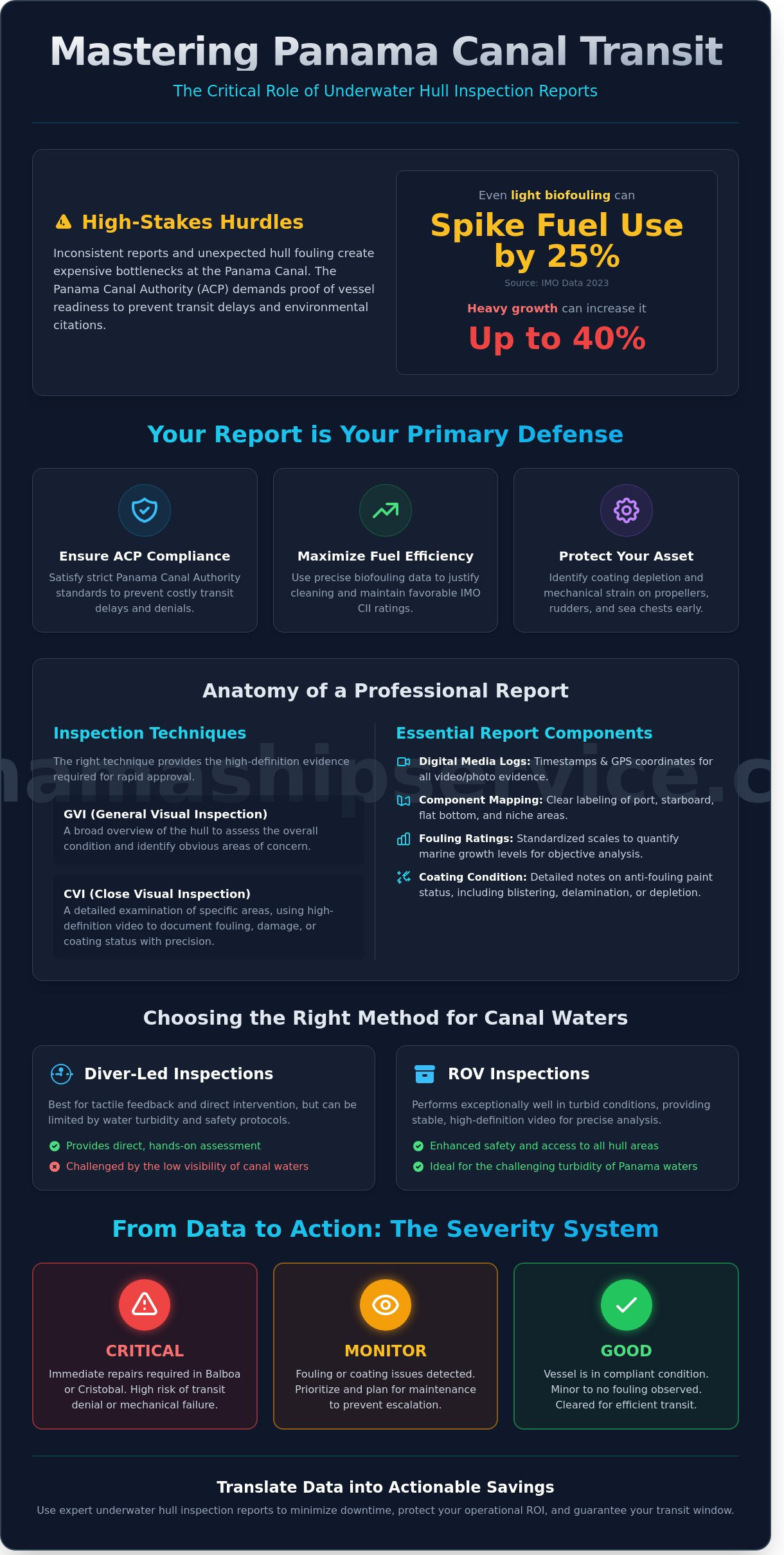
In this guide, you’ll learn how to interpret and utilize every technical detail of an underwater hull inspection report to eliminate transit delays and maximize fuel efficiency. We’ll show you how to turn raw data into actionable fuel savings and ensure your documentation is class-approved for a seamless transit. We are experts so you don’t have to be. We’re going to cover everything from ACP compliance to the specific data points that prevent environmental citations and keep your fleet moving on schedule.
Key Takeaways
- Understand how to satisfy strict Panama Canal Authority (ACP) standards to prevent costly transit delays and ensure full environmental compliance.
- Learn to distinguish between GVI and CVI techniques to ensure your underwater hull inspection report delivers the high-definition technical evidence required for rapid approval.
- Compare diver-led and ROV inspection methods to determine which technology performs best in the challenging turbidity of Panama Canal waters.
- Master the “Traffic Light” severity system to prioritize critical repairs in Balboa or Cristobal and maximize your vessel’s fuel efficiency.
- Discover how to translate complex technical data into actionable maintenance plans that minimize vessel downtime and protect your operational ROI.
Beyond the Paperwork: Why Underwater Hull Inspection Reports are Critical for Canal Transit
Timing is everything at the Panama Canal. An underwater hull inspection report is far more than a routine document; it’s a comprehensive technical audit of your vessel’s submerged surfaces. For owners and operators, this report serves as a vital health check that ensures compliance with Panama Canal Authority (ACP) standards. The ACP prioritizes safety and environmental protection, meaning any sign of structural instability or excessive biofouling can lead to immediate transit denials. We are experts so you don’t have to be, providing the technical clarity needed to avoid last-minute cleaning orders that disrupt tight schedules and increase port fees.
Regulatory Compliance and Class Approval
Maintaining class status requires rigorous adherence to IACS (International Association of Classification Societies) standards. An underwater hull inspection report generated during a UWILD (Underwater Inspection in Lieu of Drydocking) survey is essential for vessels on a five-year drydock cycle. The ACP demands full transparency regarding hull conditions to prevent maritime accidents within the narrow confines of the locks. Proper documentation proves your vessel meets these international safety benchmarks. It integrates naturally into broader ship husbandry practices, ensuring that your technical records are always ready for official scrutiny by port state control or canal inspectors.
The Economic Impact of Biofouling Data
The data within these reports has a direct financial consequence. Biofouling isn’t just an aesthetic issue; it’s a performance killer. Even light slime can increase hull friction, while heavy calcareous growth can raise fuel consumption by up to 40 percent. This data is now critical for maintaining a favorable Carbon Intensity Indicator (CII) rating under IMO 2023 regulations. A poor rating doesn’t just hurt the environment; it devalues your asset and limits your chartering options.
- CII Ratings: High drag leads to higher emissions and lower ratings. Detailed reports allow you to track fouling trends and intervene before your rating drops.
- Identifying Hot Spots: Reports pinpoint specific areas like sea chests, rudder pintles, and propellers where fouling clusters and causes mechanical strain.
- Informed Interventions: Use the report data to justify immediate underwater hull cleaning before fuel costs spiral out of control.
By identifying mechanical strain and coating depletion early, you protect your engine and maintain the specific speeds required for strict Canal scheduling. We act as your trusted partner at the Panama Canal, ensuring your underwater hull inspection report translates into tangible operational savings and a guaranteed transit window. Don’t leave your compliance to chance when the stakes involve thousands of dollars in potential delays.
Anatomy of a Professional Hull Inspection Report: GVI vs. CVI
A high-quality underwater hull inspection report serves as a vessel’s permanent technical record. It provides the objective data required to justify dry-docking expenses or delay them safely. Modern reporting relies on high-definition video and photography to eliminate ambiguity. Without this visual proof, a report is merely a subjective opinion. Every ship component, including the rudder, propeller, and sea chests, must be clearly identified and logged. Referencing U.S. inspection and certification standards helps ensure your documentation aligns with global safety mandates. This systematic approach creates a baseline that allows technical managers to track hull degradation across a 60-month survey cycle.
Technical components of a professional report include:
- Digital Media Logs: Timestamps and GPS coordinates for all video and photo evidence.
- Component Mapping: Clear labeling of port and starboard sections to prevent data overlap.
- Fouling Ratings: Standardized scales used to quantify marine growth levels.
- Coating Condition: Detailed notes on anti-fouling performance and areas of paint detachment.
GVI: General Visual Inspection Standards
GVI focuses on the macro environment of the vessel. Divers evaluate the overall structural integrity and look for significant biofouling or widespread coating failures. This stage is designed to catch major issues like impact damage from tugs or grounding. GVI is a broad-spectrum visual audit conducted at a moderate distance to detect obvious structural anomalies. It provides a cost-effective way to monitor the hull between major dry-dock periods without the need for intensive surface preparation.
CVI: Close Visual Inspection Requirements
CVI is triggered when GVI reveals specific areas of concern or when class requirements demand high-detail scrutiny. This involves a close-up look at high-stress areas such as the bilge keel or propeller blades. Divers utilize hand scrapers or specialized cleaning tools to strip away marine growth, exposing the substrate for a clear view of the steel condition. A professional underwater hull inspection report also includes data on cathodic protection, specifically measuring sacrificial anode depletion levels. These readings are critical for maintaining the hull’s electrical balance and preventing corrosion. If you’re preparing for a Canal transit, you can rely on our technical experts to deliver these precise insights.
By distinguishing between GVI and CVI, owners can allocate their maintenance budgets more effectively. GVI offers the necessary overview for routine compliance, while CVI provides the deep-dive data required for complex repairs. Maintaining both types of records ensures that your fleet remains compliant with international maritime regulations while operating at peak fuel efficiency.
Choosing the Right Method: Diver-Led vs. ROV Inspections
Selecting the correct inspection method directly impacts your vessel’s bottom line and transit schedule. Every hour spent at anchor in Balboa or Cristobal adds to your operational costs. Panama Ship Service provides both human and robotic solutions to ensure your underwater hull inspection report meets strict Class Society standards. The decision rests on the specific conditions of your hull and the environmental variables of the Panama Canal. High turbidity in Gatun Lake often reduces visibility to less than 1.5 meters, requiring specialized technology to capture clear data.
Diver-Led Inspections: The Traditional Gold Standard
Divers provide a level of tactile feedback that current sensors cannot replicate. A diver can physically feel for structural irregularities or identify the specific hardness of biofouling through touch. This human presence allows for immediate action. If a diver identifies a fouled sea chest, they can perform cleaning on the spot. This immediate repair capability is a significant advantage for vessels on tight schedules.
There are limitations to consider. Diver fatigue is a factor in the 28 to 30-degree Celsius tropical waters of Panama. Safety protocols in high-traffic canal zones require extensive mobilization. A standard dive team requires at least three qualified professionals and a support vessel. These logistical requirements can increase the time needed for mobilization by 20% compared to robotic alternatives.
ROV Inspections: Speed, Safety, and Digital Data
Remotely Operated Vehicles (ROVs) eliminate “man-in-water” risks entirely. This makes them the preferred choice for port authorities and ship owners who prioritize safety. Modern ROVs utilize multi-beam sonar and low-light 4K cameras to navigate murky waters where human visibility fails. As the maritime industry modernizes underwater survey guidelines, the adoption of ROV technology has become a benchmark for efficiency.
- Real-Time Review: ROVs provide a live, high-definition feed to the ship’s superintendent, allowing for instant decision-making.
- Hazardous Access: Robots can enter narrow spaces or areas with dangerous currents where divers cannot safely operate.
- Cloud Integration: Digital data from an ROV integrates directly into cloud platforms. This allows global offices to access the underwater hull inspection report within minutes of completion.
The Hybrid Approach: Maximum Efficiency
We often recommend a hybrid strategy to our clients. We use an ROV for a rapid, comprehensive hull scan to identify specific areas of concern. If the ROV detects damage or heavy fouling, we deploy divers to those exact coordinates for targeted repairs. This method reduces diver bottom time by approximately 45% and minimizes vessel expenses. We are experts so you don’t have to be. With over 20 years of experience in Panama, we determine the most cost-effective path to keep your transit on track.
From Data to Action: Utilizing Inspection Reports for Maintenance and ROI
A professional underwater hull inspection report is more than a compliance document; it’s a strategic financial tool. Most high-tier reports utilize a “Traffic Light” system to categorize component health. Green indicates optimal condition. Yellow signals areas that require monitoring or scheduled maintenance during the next port call. Red demands immediate action to prevent mechanical failure or significant performance loss. By following this hierarchy, ship owners can prioritize urgent repairs in Balboa or Cristobal without wasting time on non-critical issues.
Efficiency is the priority in Panama’s busy waters. If the report identifies roughness or biofouling on the blades, you can immediately schedule propeller polishing to recover lost speed and improve fuel economy. This data-driven approach also settles charter party disputes by providing objective evidence of a vessel’s performance capabilities at a specific point in time. During pre-purchase assessments, these reports reveal hidden liabilities that could cost thousands in future dry-docking fees.
Predictive Maintenance Strategies
Streamlining Canal Transit with Accurate Data
The Panama Canal Authority (ACP) maintains strict standards for hull cleanliness and structural integrity. Presenting a recent, clear underwater hull inspection report serves as proof of compliance. This documentation helps you avoid “Clean Hull” citations that often lead to transit refusal or heavy fines. We coordinate with marine surveys in Panama to ensure all documentation is in order before you reach the locks. We are experts so you don’t have to be. Put your transit in our hands by securing a professional survey before your arrival.
The Panama Ship Service Advantage: Expert Underwater Reports
Timing is everything at the Panama Canal. For over 20 years, Panama Ship Service has acted as the trusted partner for ship owners and charterers navigating these high-stakes waters. We understand that a delay isn’t just an inconvenience; it’s a massive financial hit. Our team combines deep technical marine expertise with a practical grasp of local operational pressures. We are experts so you don’t have to be, allowing you to put your transit in our hands with complete confidence.
We operate as a true one-stop-shop. If an inspection reveals a critical fault, you won’t need to scramble for a second contractor or wait days for a mobilization. We move directly from identifying issues to executing mechanical ship repairs. This seamless transition keeps your transit on schedule and your vessel compliant with international standards. Our commitment to rapid response includes constant daily communication, ensuring you receive real-time updates and never have to guess about your ship’s status.
Qualified Technical Teams and Equipment
Our technical teams utilize high-definition imaging and class-approved methodology to ensure every underwater hull inspection report meets the rigorous standards of global classification societies. We don’t just provide raw data or blurry footage. Our trained professionals understand the nuance of maritime maintenance, distinguishing between a routine “pass” and a developing “problem” that could lead to a future detention or emergency dry-docking.
We prioritize a rapid turnaround for report delivery. Since our inception in 2004, we’ve refined our internal processes to deliver documentation faster than the industry average. This speed ensures you have the necessary evidence for authorities and class societies well before your scheduled lock entry, keeping your logistics chain moving without friction.
Comprehensive Maritime Solutions in Panama
Operational efficiency comes from consolidation. By integrating your hull reports with other essential services, we minimize your vessel’s total expenses and administrative burden. Our comprehensive solutions include:
- Integration of hull reports with MARPOL disposal and environmental compliance.
- Coordinating ship supply and technical provisions alongside inspection schedules.
- Consolidating technical services to reduce the “per-service” cost for owners.
- Direct liaison with canal authorities to ensure report acceptance.
Dealing with a single, seasoned partner for technical, operational, and environmental requirements prevents the logistical conflicts that occur when juggling multiple vendors. It’s a proactive approach designed to save you time and capital. Contact us today to secure a reliable, expert-led underwater hull inspection report and ensure your vessel is fully prepared for its Panama Canal transit.
Maximize Your Vessel Performance and Canal Compliance
Timing is everything at the Panama Canal. A professional underwater hull inspection report is more than a regulatory hurdle; it’s a strategic asset that ensures your vessel meets IACS compliant survey standards while protecting your bottom line. By utilizing precise data from GVI or CVI surveys, you can identify hull fouling or structural issues before they lead to costly transit delays or fuel inefficiencies. We’ve spent 20 years mastering the complexities of local maritime requirements so your crew can focus on the voyage ahead.
Panama Ship Service delivers a 24/7 rapid operational response to meet the high-stakes demands of the shipping industry. We’re experts so you don’t have to be. Our team provides the technical clarity needed to turn inspection data into immediate maintenance actions, ensuring your fleet remains both compliant and competitive. Put your transit in our hands and experience the reliability of a partner who understands that every hour in port impacts your ROI.
Get an Expert Underwater Hull Inspection Quote Today
We look forward to securing your next successful transit through the Isthmus.
Frequently Asked Questions
What is included in a standard underwater hull inspection report?
A standard underwater hull inspection report includes high-definition video footage, still photography, and a detailed technical assessment of the hull’s coating condition. Our divers document the state of sea chests, gratings, and the propeller’s surface roughness using the industry-standard Rubert Scale. We also quantify anode depletion, specifically noting if wear exceeds 50 percent of the original volume. These technical findings provide the data you need to plan immediate maintenance or future dry-docking schedules without guesswork.
How long does an underwater hull inspection take in the Panama Canal?
A typical inspection at the Balboa or Cristobal anchorages takes between 2 and 4 hours to complete. The exact timing depends on the vessel’s size, such as a 366-meter Neo-Panamax container ship versus a smaller bulk carrier. We coordinate closely with your schedule to ensure the dive team finishes within your window at anchor. This efficiency prevents any interference with your assigned Panama Canal transit slot.
Do I need a class-approved diver for my hull inspection?
You must use class-approved divers if the inspection is for an In-Water Survey (IWS) in lieu of dry-docking. Classification societies like ABS, DNV, and Lloyd’s Register require diving companies to hold specific certifications to validate the findings. We maintain these credentials to ensure your underwater hull inspection report meets all international regulatory standards. Using non-certified divers often results in the survey being rejected, which leads to costly re-inspections and administrative delays.
Can an ROV inspection replace a diver-led survey for class requirements?
Remotely Operated Vehicles (ROVs) can perform visual inspections, but they don’t replace divers for comprehensive class-approved surveys. Most IACS members require a diver’s tactile feedback and the ability to clean specific areas, like the rudder pintle or sea chest gratings, during the process. While ROVs work well for quick checks in hazardous areas, 90 percent of mandatory class inspections still rely on human divers. This ensures a level of detail that sensors alone cannot provide.
What happens if the inspection report finds significant biofouling before transit?
The Panama Canal Authority (ACP) may restrict transit if the report identifies heavy biofouling that risks the introduction of invasive species. According to ACP OP Notice to Shipping N-1-2024, vessels must maintain a clean hull to ensure maneuverability and environmental safety. If calcareous growth exceeds 10 percent of the surface area, you’ll likely need to perform hull cleaning at the anchorage before receiving clearance. We coordinate these services immediately to keep your schedule on track and avoid hefty fines.
How often should a vessel undergo an underwater hull inspection?
Vessels should undergo an inspection every 6 to 12 months to monitor fouling and coating integrity. While the mandatory intermediate survey occurs every 2.5 years, frequent checks prevent the buildup of hard growth in high-risk areas. This proactive approach is essential for ships operating in the warm, high-fouling waters of the Pacific and Caribbean. Regular monitoring allows you to address minor issues before they become expensive repairs or cause transit delays.
Does the Panama Canal Authority require a specific format for hull reports?
The ACP doesn’t mandate a single template, but they require reports to be clear, dated, and accompanied by high-quality visual evidence. Documentation must prove the vessel is free from significant biofouling as defined in their current environmental guidelines. Our reports follow a structured format that local authorities and class surveyors recognize instantly. We focus on providing the exact data points the ACP inspectors look for to streamline your clearance process.
How much can I save on fuel by acting on the findings of a hull report?
Acting on the findings of an underwater hull inspection report can reduce fuel consumption by 10 to 15 percent. The International Maritime Organization (IMO) states that even a thin layer of slime, just 0.5 millimeters thick, increases a ship’s GHG emissions and fuel costs significantly. By identifying and removing this friction, you optimize your vessel’s performance for the long transoceanic voyage following your canal transit. These savings often cover the cost of the inspection within the first seven days of sailing.