
In the high-stakes world of maritime logistics, a five-minute delay in visual confirmation can lead to thousands of dollars in wasted operational costs during a 50-mile transit. You already know that misjudging your timing at the locks means losing your slot and your profit margin. Relying on outdated reports or clunky interfaces often adds more frustration than clarity when you need to monitor repairs or verify a transit status. We understand these pressures because we’ve spent 20 years managing these exact logistics for ship owners and charterers.
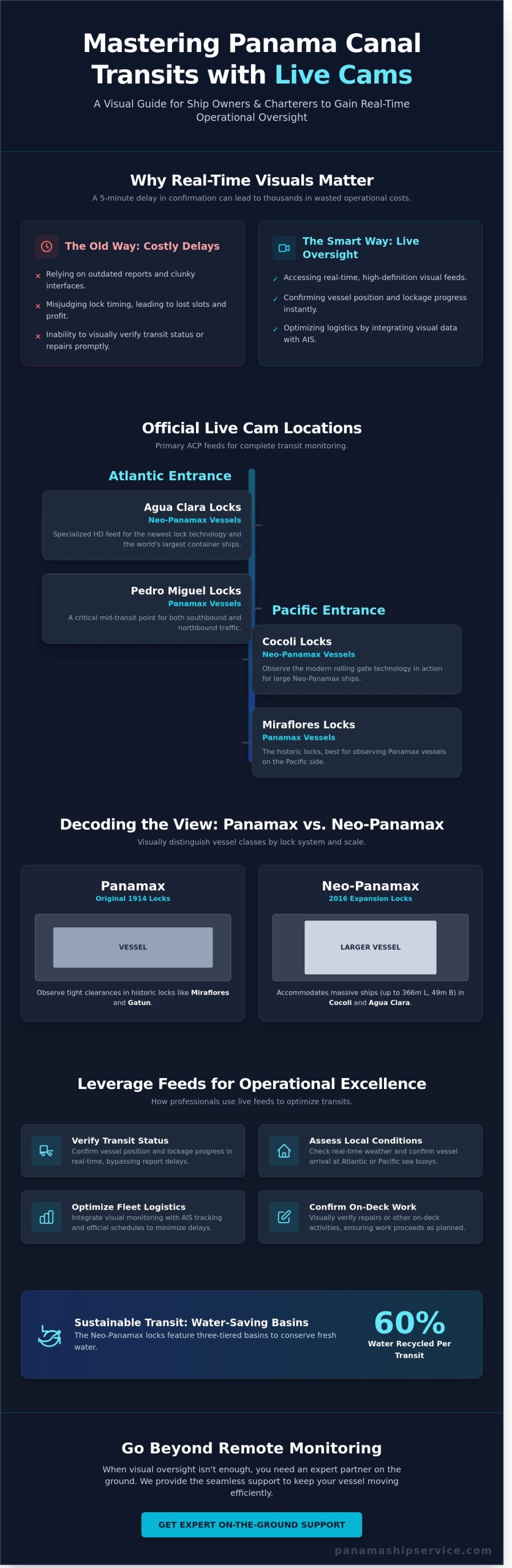
This guide shows you how to leverage the live cam panama canal feeds to gain real-time visual oversight of your fleet. We’ll help you bypass the technical hurdles of official multimedia portals so you can focus on your schedule; we are experts so you don’t have to be. You will discover where to access the highest-quality feeds for all lock systems, how to use these cams for operational oversight, and how to connect with local experts who provide the on-the-ground support necessary to keep your vessel moving.
Key Takeaways
- Identify the primary official sources and specific lock locations required for real-time vessel monitoring and transit verification.
- Learn to interpret technical lock views to distinguish between Panamax and Neopanamax operations for enhanced situational awareness.
- Leverage the live cam panama canal to assess local weather conditions and confirm vessel arrival at Atlantic or Pacific sea buoys.
- Integrate visual monitoring with AIS tracking and official schedules to optimize fleet logistics and minimize operational delays.
- Understand how to transition from remote monitoring to professional on-the-ground support for a seamless and efficient passage.
Accessing Live Panama Canal Cams in 2026: Official Feeds
The Panama Canal Authority (ACP) multimedia hub is the primary source for reliable, real-time maritime data. Ship owners and charterers depend on these feeds to verify vessel positions and lockage progress. For 2026, the ACP has upgraded its infrastructure to provide low-latency, high-definition streams across all major transit points. This includes the historic Miraflores and Pedro Miguel locks, alongside the massive Neo-Panamax chambers. Accessing a live cam panama canal feed allows for immediate visual confirmation of transit timing, which is vital when every hour of delay increases operational costs.
Reliable monitoring requires understanding the specific camera locations available through the official portal:
- Miraflores Locks: Best for observing Panamax vessels on the Pacific side.
- Pedro Miguel Locks: A critical mid-transit point for southbound and northbound traffic.
- Gatun Locks: Provides a view of the Atlantic side’s three-tier chamber system.
- Cocoli and Agua Clara: Dedicated HD feeds for Neo-Panamax traffic.
Timing is everything at the canal. Misjudge your schedule and you lose thousands in fuel and port fees. Using these official feeds provides the technical oversight needed to keep your fleet moving. Remote fleet managers should note that while high-definition video is standard, the ACP interface offers adjustable bitrates. This ensures that managers on vessels or in remote offices with limited satellite bandwidth can still maintain a visual on their assets without crashing their local network.
The Pacific Entrance: Miraflores and Cocoli Locks
The Pacific entrance serves as the gateway for vessels arriving from Asia and the West Coast of the Americas. At the Miraflores locks, you can monitor the transit of Panamax vessels through the historic chambers. For larger Neo-Panamax ships, the Cocoli locks offer a clear view of the rolling gate technology in action. Peak traffic at the Pacific locks typically occurs between 06:00 and 10:00 local time for northbound vessels. Afternoon windows usually favor southbound traffic returning to the Pacific anchorage. Monitoring these schedules through a live cam panama canal helps managers anticipate arrival times at the next waypoint.
The Atlantic Entrance: Gatun and Agua Clara
The Atlantic side features the massive Gatun Lock system and the modern Agua Clara expansion. Gatun remains a focal point with its three-tier chamber system that lifts vessels 26 meters to the level of Gatun Lake. The Agua Clara feeds provide a specialized look at the newest lock technology on the Atlantic side, handling the world’s largest container ships. These cameras allow you to visualize the transition from the Caribbean Sea into the interior lake system. We are experts so you don’t have to be; we recommend prioritizing the Agua Clara feed for Neo-Panamax vessels to ensure draft requirements and tug assignments are proceeding as planned.
Technical Breakdown: Understanding the Different Lock Views
The live cam panama canal feeds serve as a critical diagnostic tool for maritime professionals and enthusiasts alike. These cameras provide a real-time perspective on vessel positioning and lockage efficiency. The Panama Canal Authority maintains these high-definition visual assets to facilitate operational transparency for global shipping interests. By observing the feed, you can monitor the transition from the Pacific or Atlantic entrances into the complex lock systems. Each camera angle is positioned to show the precise clearance between the hull and the lock walls, providing a clear view of the technical precision required for a successful transit.
Panamax vs. Neo-Panamax Visual Indicators
Identifying vessel classes requires an understanding of scale and location. The original 1914 locks, such as Miraflores and Gatun, accommodate Panamax vessels. The 2016 expansion locks at Cocoli and Agua Clara handle the larger Neo-Panamax fleet. A Neo-Panamax vessel is defined by its 366-meter length and 49-meter beam. When watching the Cocoli feed, look for massive container ships or LNG carriers that utilize the full width of the chamber. Container ships are easily identified by their stacked tiers, while bulkers feature large deck hatches and tankers show intricate piping systems on the main deck.
Operational Symbols and Signals
Operational efficiency is visible through the movement of lock gates and culvert systems. On the live cam panama canal feeds at the new locks, you can observe the water-saving basins in action. These three-tiered basins recycle 60% of the water required for each transit, a vital feature for sustainable operations.
Pay close attention to the guidance methods used in each lock type. In the original 1914 locks, silver locomotives known as “mules” run on tracks to keep ships centered. In the Neo-Panamax locks, tugboats provide the necessary assistance, and you’ll see them positioned at the bow and stern of the vessel. High-resolution cameras also capture the lighting signals at the lock entrances. Green lights indicate the chamber is ready for entry, while red signals a hold. For ship owners, these details aren’t just scenery; they’re indicators of transit progress. If you need expert assistance managing these logistics, you can put your transit in our hands
Operational Oversight: How Professionals Use Live Feeds
Professionals treat the live cam panama canal as a high-precision data point rather than a scenic view. For ship owners and charterers, time is the most expensive variable in any voyage. Every hour of delay can cost thousands in fuel and port fees; therefore, we use these feeds to verify exactly when a vessel reaches the Atlantic or Pacific sea buoys. This visual confirmation allows us to assess a ship’s condition before and after it enters the locks, providing a record of the vessel’s state at key milestones.
Visual monitoring is vital when coordinating the start of mechanical ship repairs performed at anchor. Seeing the vessel’s arrival allows technical teams to mobilize immediately, reducing downtime. We handle the logistics so you don’t have to. Our team uses these feeds to manage several critical tasks:
- Verification of arrival times to adjust labor schedules.
- Visual condition checks to identify any obvious transit-related damage.
- Coordinating with local agencies for crew changes to ensure the launch is ready as the ship clears the locks.
- Monitoring the progress of 12,000+ annual transits to predict congestion.
Monitoring Repairs and Surveys Remotely
Using the live cam panama canal provides a layer of remote oversight for owners who cannot be on-site. We use these feeds to verify when a vessel is positioned correctly for underwater hull services, ensuring the dive team is ready the moment the ship is cleared. This transparency is essential for marine surveys in Panama, where technical teams must be coordinated based on visual transit progress through Gatun or Cocoli. We provide the expert presence needed to keep your vessel moving.
Logistics and Supply Coordination
Timing the delivery of ship supplies to coincide with lockage requires precision. We monitor the feeds to ensure that provisions and spare parts reach the vessel without forcing it to wait at anchor. Simultaneously, we ensure MARPOL disposal barges are on-site as the vessel clears the locks. Real-time communication with the Panama Ship Service operations desk ensures that every service is synchronized with the actual movement of the ship. We’ve spent 20 years refining this process, providing the rapid response ship operators require.
Planning Your Transit: Real-Time Monitoring and Logistics
Successful transits depend on more than just a reserved slot time. Technical operators must integrate live cam panama canal feeds with Automatic Identification System (AIS) tracking and official Panama Canal Authority (ACP) schedules. This layered approach allows for precise timing. If the live feed shows a backlog at the Miraflores Locks, you can adjust your approach speed to save fuel. Efficiency is the priority. Timing is everything in this 50-mile shortcut. Misjudge it, and your costs increase immediately. We provide the expert oversight needed to manage these variables 24 hours a day.
Weather and Environmental Factors
Tropical weather changes fast. A sudden downpour can reduce visibility to near zero in minutes. During the rainy season, which typically lasts from May to December, visibility issues often trigger temporary suspensions of vessel movements. Monitoring the live cam panama canal helps shoreside teams visualize these conditions before the pilot boards. In 2023, Gatun Lake water levels dropped to record lows, forcing the ACP to implement draft restrictions as low as 44 feet. Visualizing the impact of these environmental shifts, such as the seasonal Dry Season winds from January to April, is vital for safe maneuvering through the Culebra Cut. These winds can push high-profile container ships off center, requiring immediate tug intervention.
Reducing Vessel Downtime
Unplanned stops are expensive. By identifying traffic bottlenecks through visual data, you can proactively manage your schedule. If a delay is inevitable due to lock maintenance or congestion, use that window for essential technical work. We specialize in coordinating mechanical ship repairs in Panama while your vessel waits for its transit slot. This strategy turns idle time into productive maintenance, effectively eliminating extra days at anchor. Our technical teams provide a rapid response for issues identified during the 8 to 10 hour transit period. We focus on these key areas to keep you moving:
- Identifying congestion at the Pacific or Atlantic entrances before arrival.
- Scheduling emergency engine or deck repairs during scheduled wait times.
- Using visual data to verify vessel position for service boat arrivals.
- Minimizing the vessel expenses through better timing and expert local coordination.
Effective logistics require constant, daily communication. We act as your eyes on the ground, ensuring your vessel remains on schedule despite external variables. Our team handles the difficult and frustrating parts of canal logistics so your crew can focus on safe navigation. Put your transit in our hands and benefit from 20 years of local expertise.
Expert Maritime Support for Your Panama Canal Transit
While a live cam panama canal stream offers a window into the daily operations of the locks, it’s just one piece of the puzzle. Visual monitoring is a useful tool for tracking progress, but it can’t replace the technical and operational support required on the ground. A successful transit depends on more than just timing; it requires a vessel that’s fully compliant and technically sound. Panama Ship Service provides the physical presence and expert oversight needed to bridge the gap between digital monitoring and a completed voyage.
Navigating the Panama Canal Authority (ACP) regulations is a complex task that demands deep local knowledge. We ensure every vessel meets strict MARPOL standards and local environmental requirements to prevent costly fines or transit denials. We’ve spent 20 years building our reputation as the trusted partner at the Panama Canal. By acting as a one-stop-shop for all maritime needs, we consolidate services and minimize vessel expenses. We’re experts in the local landscape so you don’t have to be.
- 20 years of proven maritime expertise in Panamanian waters
- Strict adherence to ACP regulations and international MARPOL standards
- Consolidated service model to reduce total vessel overhead
- Proactive management to avoid administrative delays
Comprehensive Technical Solutions
Technical failures in a high-traffic waterway can lead to massive financial losses. Our certified technicians are stationed at both the Atlantic and Pacific entrances, ready to board at a moment’s notice. We provide a full range of services, from routine underwater inspections and hull cleaning to complex engine room repairs. If a vessel suffers structural damage, our teams execute rapid mobilization for emergency steel fabrication and welding. We maintain a 24/7 readiness posture because we know that in this industry, every hour at anchor is a lost opportunity. Using a live cam panama canal feed might show you the queue, but our technical team ensures you stay in it.
Partnering with Panama Ship Service
Efficiency is our primary metric for success. We maintain constant daily communication with ship owners and masters from the arrival at the sea buoy until the vessel clears the final lock. This transparency eliminates the anxiety of the “difficult and frustrating” transit process. Our cost-conscious approach focuses on protecting your bottom line while maintaining the highest safety standards. We manage the logistics and the paperwork so your crew can focus on navigation. Put your transit in our hands to ensure a smooth, professional experience. Contact our experts today to secure your next transit support and benefit from two decades of specialized canal experience.
Optimize Your Maritime Operations with Real-Time Data
Monitoring the live cam panama canal feeds provides the visual confirmation required to manage complex 2026 transit schedules. These digital views help professionals verify vessel positioning at the Neopanamax locks and anticipate timing adjustments. While cameras offer visibility, successful transits require ground-level technical support to manage the high-stakes environment of the waterway. Efficiency depends on combining real-time data with boots-on-the-ground expertise.
Panama Ship Service leverages 20+ years of maritime expertise to streamline your operations. We provide MARPOL-compliant disposal services and maintain 24/7 rapid response teams for emergency repairs. Our team acts as your trusted partner, ensuring that technical challenges don’t turn into costly delays. We’re experts so you don’t have to be; we focus on the logistics while you focus on your business.
Put your Panama Canal transit in our expert hands-Contact Panama Ship Service today
We look forward to making your next transit your most efficient one yet.
Frequently Asked Questions
Where can I find the official Panama Canal live camera feeds?
You can find the official live cam panama canal feeds on the Panama Canal Authority (ACP) website at pancanal.com. The ACP provides high-resolution views from three strategic locations: Miraflores Locks on the Pacific side, Gatun Locks, and the Agua Clara Locks on the Atlantic side. These feeds are the primary resource for ship owners and logistics managers to monitor vessel progress in real time across the isthmus.
Can I see a specific ship transiting the Panama Canal on the live cams?
Yes, you can see specific ships by cross-referencing the live feed with the ACP Daily Transit Schedule. Since a full transit takes 8 to 10 hours, you should check the vessel’s estimated time of arrival at the specific lock. For example, a ship entering the Miraflores Locks will be visible for approximately 30 minutes as it moves through the chambers. Accurate timing is essential for successful viewing.
Are the Panama Canal cameras available 24 hours a day?
The cameras operate 24 hours a day, 365 days a year, providing continuous surveillance of the waterway. Night viewing is effective because the locks use 1,000-watt high-pressure sodium lamps to illuminate the transit areas. This ensures that operations remain visible even during the 12 hours of daily darkness in the tropics. You won’t miss any critical movements regardless of the time you log in.
Which locks have the best cameras for viewing Neo-Panamax ships?
The Agua Clara Locks on the Atlantic side and the Cocoli Locks on the Pacific side offer the best views of Neo-Panamax ships. These locks were completed in June 2016 specifically to handle vessels up to 366 meters in length. The live cam panama canal at Agua Clara provides a wide-angle perspective that captures the scale of these massive container ships. This view is essential for those monitoring the canal’s most modern infrastructure.
Why is the live feed sometimes frozen or showing a static image?
Frozen feeds usually result from scheduled technical maintenance or local bandwidth fluctuations in the Canal Zone. During the rainy season from May to December, tropical storms with rainfall exceeding 50mm per hour can interfere with the wireless transmission of the video signal. If the image isn’t moving, refresh your browser or check the ACP’s official social media channels for service interruption notices. Technical glitches are usually resolved within minutes.
Can I use these cameras to verify if my ship is undergoing repairs?
These cameras are positioned for transit monitoring and won’t show ships in repair facilities. If your vessel requires technical attention, it will be moved to specialized dry docks such as the Braswell Shipyard or MEC facilities. For verification of maintenance work, you should contact your local agent. We provide direct oversight and daily reports for all technical services to ensure your vessel stays on schedule without guesswork.
How much delay is there on the Panama Canal live stream?
The live stream typically has a latency of 10 to 30 seconds compared to real-time events. This delay is a standard result of digital signal processing and internet routing from the locks to the ACP servers. While this lag is minimal, it’s important for operators coordinating time-sensitive ship services to account for these few seconds when tracking a vessel’s exact position in the lock chamber. Efficiency depends on acknowledging this brief timing gap.
What is the best time of day to watch ship traffic on the live cams?
The best time to watch is between 06:00 and 18:00 local time, which is GMT-5. Daylight provides the greatest visual clarity for identifying vessel names and structural details. With 35 to 40 ships transiting the canal daily, peak activity often occurs in the mid-morning. If you’re looking for heavy traffic, these hours offer the most consistent viewing experience for maritime professionals who need to see every detail clearly.