
Between 1881 and 1914, laborers excavated over 200 million cubic yards of earth to see the panama canal built into the world’s most critical maritime shortcut. For the modern ship owner or charterer, these locks aren’t just historical landmarks. They are high-stakes mechanical systems where precision is the only thing preventing a costly delay. You’ve likely found that most historical records are either too dry or fail to connect early 20th-century construction with the technical demands of a contemporary voyage.
We are experts in this waterway so you don’t have to be. This article provides a professional mariner’s look at the engineering breakthroughs and lock mechanisms that make this 50-mile transit possible. You’ll discover the specific technical challenges faced during construction, the physics of the original miter gates, and the modern operational requirements that keep your vessels moving safely. Timing is everything. Let’s look at the technical foundation of your next transit.
Key Takeaways
- Trace the evolution of the 50-mile waterway from early Spanish concepts to the strategic shifts that secured American success.
- Discover the specific technical strategies used during the decade the panama canal built its reputation as an engineering marvel.
- Gain a professional understanding of the gravity-fed lock mechanics and Gatun Lake operations that lift vessels 85 feet above sea level.
- Identify the modern technical challenges and maintenance requirements necessary to ensure efficient, delay-free transits for today’s maritime operations.
The Quest for a Shortcut: Early Concepts and the French Failure
The Panama Canal is a 50-mile man-made waterway that serves as the critical link between the Atlantic and Pacific Oceans. While the Panama Canal construction history officially began in the late 19th century, the vision for this transit point is centuries old. Spanish explorer Vasco Núñez de Balboa first identified the potential for a shortcut across the Isthmus in 1513. By the time of the 1849 California Gold Rush, the demand for a faster route reached a breaking point, as travelers sought to avoid the dangerous trek around Cape Horn.
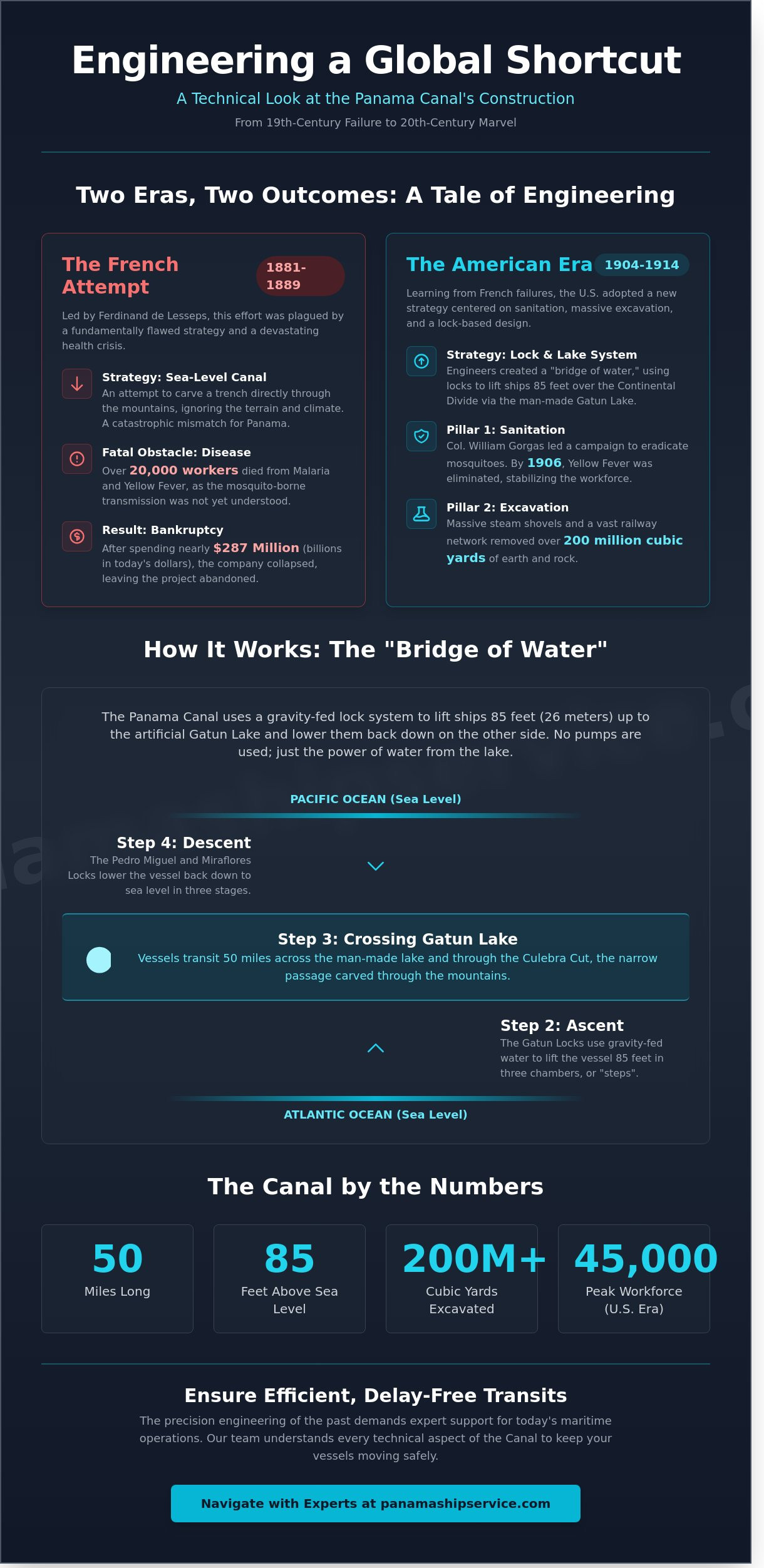
In 1881, the French, led by Ferdinand de Lesseps, began the first serious attempt to carve through the land. Fresh from his success at the Suez Canal, de Lesseps insisted on a sea-level design. This choice was a fundamental error. It ignored the massive elevation changes of the Continental Divide and the volatile nature of the Panamanian climate. The initial way the panama canal built its legacy was through these early, costly trials that defined the limits of 19th-century engineering.
The French Disaster: Malaria and Engineering Hubris
The Suez strategy was a catastrophic mismatch for the Panamanian jungle. Unlike the flat, sandy terrain of Egypt, Panama presented dense rainforests, torrential rains, and unstable soil. Tropical diseases proved more lethal than the engineering challenges themselves. Between 1881 and 1889, Yellow Fever and Malaria claimed the lives of over 20,000 workers. The medical community didn’t yet understand that mosquitoes transmitted these diseases, leaving crews defenseless. The Compagnie Universelle du Canal Interocéanique eventually collapsed into bankruptcy in 1889, after spending nearly $287 million and failing to complete the excavation.
The Shift to a Lock-Based Design
The French failure proved that a sea-level trench was impossible with the technology of the era. Engineers realized the project required a “bridge of water” using a system of locks to lift ships over the mountains. This technical pivot transformed the Chagres River from a constant flooding threat into a vital resource. By damming the river, engineers could create a massive inland lake to facilitate transit.
You can find more details on this transition in our Panama Canal history pillar. Understanding how the panama canal built its foundation on these early lessons is essential for any modern ship owner navigating the route today. The site sat dormant until the United States took over the project in 1904, applying these hard-won lessons to finally finish the work.
The American Era: Engineering the Isthmus (1904–1914)
The U.S. era began in 1904, following the Hay-Bunau-Varilla Treaty which granted the United States control over a 10-mile wide Canal Zone. Theodore Roosevelt viewed the project as a geopolitical necessity; he famously visited the site in November 1906, marking the first time a sitting U.S. President traveled outside the country. This era was defined by a shift from the failed French sea-level plan to a lock-and-lake design. The success of how the panama canal built its legacy rested on three critical pillars: sanitation, massive excavation, and the construction of the world’s largest locks. This period of American engineering and diplomacy transformed the isthmus into a global maritime hub, setting the stage for a century of international trade.
The American strategy focused on three operational priorities:
- Sanitation: Eradicating disease to protect the 45,000-strong workforce.
- Excavation: Carving through the Culebra Cut using 100-ton steam shovels and a massive railway network.
- Lock Construction: Building the massive concrete chambers at Gatun, Pedro Miguel, and Miraflores.
Winning the War on Tropical Disease
Construction couldn’t proceed without solving the health crisis that defeated the French. Colonel William Gorgas, the Chief Sanitary Officer, spearheaded an unprecedented campaign to eradicate yellow fever and malaria. By 1906, yellow fever was effectively eliminated from the Canal Zone. Gorgas implemented strict protocols: draining swamps, fumigating buildings, and installing window screens. These efforts weren’t just about saving lives; they were essential for maintaining a stable workforce. Today’s maritime quarantine and health standards still reflect these early industrial hygiene breakthroughs. We are experts so you don’t have to be; our team understands that operational success starts with meeting these high standards of safety and compliance.
The Culebra Cut: Moving Mountains
The most grueling technical challenge was the Culebra Cut, a nine-mile stretch through the Continental Divide. Engineers had to excavate over 100 million cubic yards of earth while battling constant landslides. The unstable geology, particularly the Cucaracha shale, caused the banks to collapse repeatedly, burying expensive equipment and railroad tracks. This era proved that the environment is a constant adversary in maritime logistics. Just as early engineers struggled with failing steam shovels, modern vessels face extreme mechanical stress during transit. If your ship encounters technical issues, you need expert mechanical ship repairs to ensure a safe passage.
The completion of the canal in 1914 didn’t just open a shortcut; it created a permanent need for specialized maritime support. Panama became a nexus for global shipping, requiring a reliable partner to manage the complexities of the route. If you are planning a transit, contact us today to see how our local expertise can streamline your operations.
The Mechanics of the Canal: How the Locks and Gatun Lake Work
The Panama Canal operates as a massive water bridge, lifting ships 26 meters (85 feet) above sea level to cross the Continental Divide. Unlike sea-level canals, this system relies entirely on gravity to move water. No pumps are used to fill the locks. Instead, water flows from Gatun Lake into the lock chambers through a system of enormous culverts. During the era when the U.S. construction of the Panama Canal was finalized, this design was the most ambitious hydraulic project in history.
The original locks consist of three main sets: Gatun on the Atlantic side, and Pedro Miguel and Miraflores on the Pacific side. Each lock chamber measures 1,000 feet long by 110 feet wide. These specific dimensions dictated global shipbuilding for decades, establishing the “Panamax” class. Ships larger than these dimensions couldn’t transit the waterway until the 2016 expansion. At the heart of this operation is Gatun Lake. Created by damming the Chagres River, it covers 164 square miles. At the time of its completion in 1913, it was the largest man-made lake in the world. It serves as the primary reservoir, holding the trillions of gallons of water required to operate the locks year-round.
The Lock Gates and Culverts
The miter gates are the canal’s primary moving parts. They range from 47 to 82 feet in height and are 7 feet thick. Engineers designed these massive steel structures to be hollow and airtight. This buoyancy reduces the stress on the hinges, allowing a relatively small electric motor to move the gates. To maintain vessel alignment, the canal uses “mules,” which are specialized electric locomotives. These machines run on rack-and-pinion tracks along the lock walls. They don’t pull the ships forward; instead, they provide tension and braking to keep vessels centered in the narrow chambers. While the panama canal built by the Americans initially used steam for heavy machinery, the locks have utilized electrical systems since 1914.
Water Management and the Freshwater Factor
Every single transit through the canal consumes roughly 52 million gallons of fresh water. This water is eventually discharged into the oceans. Because the system uses fresh water, vessels experience a change in buoyancy when entering the canal from the sea. Ships sit lower in the fresh water of Gatun Lake than they do in the salt water of the Atlantic or Pacific. This draft change makes professional underwater hull services essential for operators. Keeping a hull clean and properly surveyed ensures that the vessel maintains its calculated displacement and efficiency during this transition. To manage water levels during the dry season, the Madden Dam was completed in 1935. This secondary reservoir, Alajuela Lake, stores extra water to ensure the panama canal built
The Human and Economic Toll of Construction
The financial investment required to see the panama canal built reached $375 million by 1914, which equates to roughly $10 billion in today’s currency. This massive expenditure supported a workforce of over 50,000 people at its peak. Laborers arrived from the West Indies, particularly Barbados and Jamaica, alongside European workers from Spain and Italy and American technical staff. The human cost was staggering. Official records cite 5,609 deaths during the American construction period, though the total figure exceeds 25,000 when including the failed French attempt. Most lives were lost to yellow fever, malaria, and industrial accidents. The project culminated on August 15, 1914, when the SS Ancon made the first official transit. This voyage proved the canal was a functional reality, not just an engineering dream.
- Total Cost: $375 million (1914 USD).
- Workforce: Diverse labor pool from the Caribbean, Europe, and the U.S.
- Human Loss: Over 25,000 total lives lost across both French and American eras.
- Opening Date: August 15, 1914, marked by the SS Ancon’s passage.
A Revolution in Global Trade
The canal fundamentally altered global logistics by shortening the sea voyage between New York and San Francisco by nearly 8,000 miles. This reduction in distance provided the U.S. Navy with unprecedented mobility between the Atlantic and Pacific Oceans. It eliminated the dangerous journey around Cape Horn for thousands of commercial vessels annually. Control of the waterway remained with the United States until December 31, 1999. On that date, the Panama Canal Authority (ACP) assumed full operational responsibility. The transition ensured that the canal would function as a neutral international service provider. Today, the canal remains a critical chokepoint for 6% of global trade.
The Legacy of the Expansion (Neopanamax)
Modern shipping demands necessitated the 2016 expansion project, which introduced the Agua Clara and Cocoli locks. These Neopanamax locks allow vessels with nearly three times the capacity of original ships to transit. While the original panama canal built in 1914 featured lock chambers 110 feet wide, the expansion reflects a proactive approach to evolving vessel sizes. Larger ships bring higher operational risks and more complex technical requirements. Ship operators now rely on detailed marine surveys in Panama to ensure compliance and safety when navigating these massive lock systems. The expansion proves that the 1914 foundation was robust enough to support 21st-century upgrades.
Protect your vessel and stay on schedule by booking your next technical survey or MARPOL disposal with our expert team.
Maintaining the Legacy: Modern Vessel Operations and Technical Support
The original panama canal built a legacy of engineering that still stands, but 110 years of friction and salt water require constant technical vigilance. While the gravity-fed lock systems remain a masterclass in physics, the sheer scale of modern 14,000 TEU Neopanamax vessels leaves zero margin for mechanical error. A single failure in the lock chamber or the narrow Culebra Cut can halt global trade flow for hours. This high-traffic environment demands that every vessel maintains peak operational readiness before reaching the first set of gates.
Minimizing Transit Delays Through Technical Expertise
Transit delays are the primary enemy of shipping profitability. Since the 2016 expansion, the increased size of transiting vessels has placed higher stress on steering gear and propulsion systems. Pre-transit inspections are not just a recommendation; they are a necessity to meet strict Panama Canal Authority (ACP) safety standards. If a vessel fails to meet these criteria, it risks being sidelined at the anchorage, losing its scheduled slot and incurring massive daily costs.
Common mechanical issues often involve hydraulic failures in rudder systems or propeller damage that compromises maneuverability. If a boarding officer identifies a deficiency, the vessel is declared “not ready,” which can lead to the loss of a transit slot and significant financial penalties. Proactively managing mechanical ship repairs in Panama ensures that your vessel stays on schedule. Our technical teams address these issues at the anchorage, preventing the need for costly tug assistance or emergency dry-docking.
Your Trusted Partner at the Panama Canal
Panama Ship Service functions as a comprehensive one-stop-shop for ship owners and charterers. With 20 years of local experience, we understand the specific pressures of the canal’s schedule. We provide the technical support required to keep vessels moving without interruption. We specialize in navigating the complex regulatory environment of the isthmus, ensuring your vessel remains in full compliance with local and international law.
Our service portfolio focuses on efficiency and compliance:
- Emergency Repairs: Rapid response for engine, rudder, and deck machinery to satisfy ACP requirements.
- MARPOL Compliance: Certified disposal of sludge, bilge water, and garbage to avoid environmental fines.
- Technical Surveys: Accurate bunker and draft surveys to ensure cargo and fuel data integrity.
- Underwater Services: Hull cleaning and inspections to optimize fuel efficiency before the transit.
The panama canal built its history on bold technical solutions. We continue that tradition by providing the modern expertise needed to navigate its waters safely. We are experts so you don’t have to be. Put your transit in our hands to minimize expenses and maximize operational efficiency. Our goal is to ensure that your passage through this historic waterway is as reliable as the engineering that created it.
Secure Your Passage Through Maritime History
The transition from the failed 1880s French attempt to the successful 1904 to 1914 American era created a technical marvel that still dictates global shipping routes. By mastering the complex mechanics of Gatun Lake and the gravity-fed lock systems, engineers established a shortcut that saves thousands of miles per voyage. Understanding how the panama canal built the framework for modern international logistics is only the first step for ship owners. Managing the operational reality of this waterway requires a partner who understands the high stakes of every transit. Timing is everything in this industry. Misjudging your schedule means losing money, and costs continually increase during unexpected delays.
Panama Ship Service brings 20 years of expertise to your vessel’s technical needs. We provide Class-approved underwater and mechanical services with a 24/7 rapid response team ready for any emergency repair. We’re experts so you don’t have to be. Let us handle the technical complexities while you focus on your cargo. Put your transit in our hands, contact Panama Ship Service for expert technical support and ensure your vessel moves through the isthmus with peak efficiency. Your successful transit is our priority.
Frequently Asked Questions
When was the Panama Canal completed and opened to traffic?
The Panama Canal officially opened to traffic on August 15, 1914, with the transit of the SS Ancon. Construction ended two years ahead of the original 1916 deadline despite the immense engineering hurdles faced by the workforce. This 50 mile waterway successfully connected the Atlantic and Pacific Oceans, fundamentally changing maritime routes. We understand these historical timelines because we manage modern transits and technical services daily.
Who built the Panama Canal and who paid for it?
The United States government built the canal and provided the $375 million in funding required for its completion. This followed a failed French attempt led by Ferdinand de Lesseps in the 1880s that ended in bankruptcy. President Theodore Roosevelt spearheaded the American project, which was managed by the Isthmian Canal Commission. Knowing how the panama canal built by American engineers impacted global trade helps us serve our clients better today.
How many people died during the construction of the Panama Canal?
Records show that 25,609 workers died during the combined French and American construction periods. The French effort lost an estimated 20,000 lives, while the US construction phase between 1904 and 1914 saw 5,609 fatalities. Most deaths resulted from yellow fever, malaria, and industrial accidents. Colonel William Gorgas eventually mitigated these risks through aggressive mosquito control programs across the Canal Zone to protect the remaining workforce.
What is the Culebra Cut and why was it so difficult to build?
The Culebra Cut is a 9 mile man made valley carved through the Continental Divide to connect Gatun Lake to the Pacific locks. It was difficult because workers had to excavate 100 million cubic yards of earth while facing constant, massive landslides. These slides often buried expensive equipment and wiped out months of progress. The panama canal built through this ridge required innovative steam shovel technology and a complex railway system for debris removal.
How do the Panama Canal locks work without pumps?
The locks operate entirely by gravity, using water from Gatun Lake to raise and lower vessels. Each lock chamber fills or empties through massive culverts located in the center and side walls. Operators open valves to move water from higher elevations to lower ones, lifting ships 85 feet above sea level. This mechanical efficiency is why the canal remains a reliable transit point for our technical service and repair teams.
What did the Panama Canal allow for in terms of global shipping?
The canal shortened the voyage between New York and San Francisco by nearly 8,000 nautical miles. Before 1914, ships had to navigate the dangerous Strait of Magellan or Cape Horn at the tip of South America. This shortcut reduced transit times from 67 days to roughly 10 hours for the canal passage itself. It created a more efficient global supply chain, allowing for the rapid movement of cargo that we support today.
How deep is the Panama Canal and what is the maximum ship size?
The canal maintains a maximum authorized draft of 15.24 meters or 50 feet in the Neopanamax locks. Vessels can reach a maximum length of 366 meters and a width of 51.25 meters. These dimensions allow Neopanamax ships to carry up to 14,000 TEUs through the waterway. We provide draft surveys and bunker surveys to ensure your vessel meets these precise operational requirements during its scheduled transit.
Is the Panama Canal still expanding or being renovated?
The Panama Canal completed a major expansion on June 26, 2016, with the opening of the Cocoli and Agua Clara locks. This $5.25 billion project doubled the waterway’s capacity and allowed for much larger vessels. Currently, the Panama Canal Authority is investing $2 billion in a new water management system to ensure draft reliability through 2050. We stay updated on these renovations so our clients always have the most accurate transit data.