
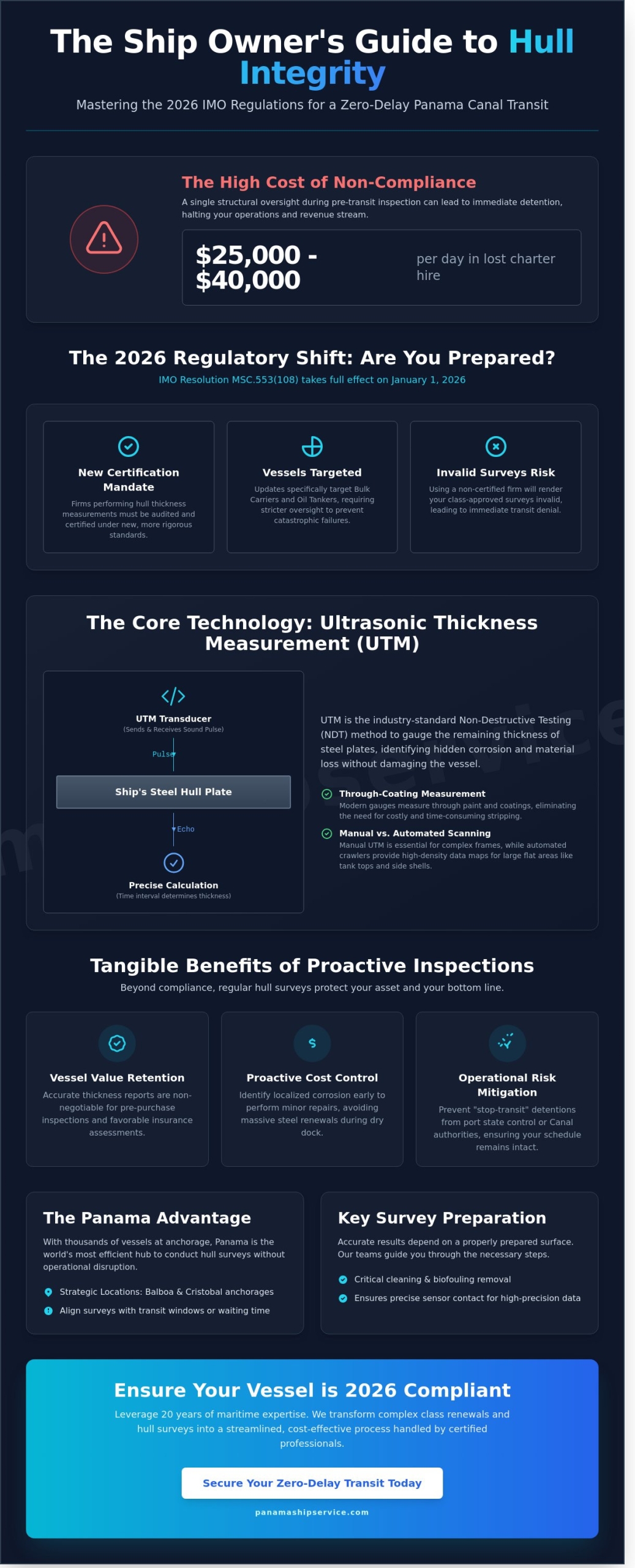
A single structural oversight identified during a pre-transit inspection can trigger an immediate detention, costing ship owners an average of $25,000 to $40,000 per day in lost charter hire. With the IMO MSC.553(108) amendments taking full effect on January 1, 2026, the margin for error regarding your hull thickness measurement panama has effectively disappeared. You likely feel the pressure of these looming technical deadlines and the anxiety of potential transit delays due to evolving audit requirements.
We understand that your priority is a seamless crossing without the sting of unscheduled drydocking fees. We’re experts so you don’t have to be, and we’ve built this guide to help you master the latest 2026 technical standards and documentation needs. You’ll learn how to secure a certified hull thickness report that satisfies both class renewal and Panama Canal Authority inspectors. We’ll walk through the specific audit steps, mandatory reporting formats, and the exact timeline you need to follow for a successful, zero-delay transit.
Key Takeaways
- Navigate the updated 2026 IMO regulations and ESP Code requirements to ensure your vessel remains fully compliant for international transit.
- Master the technical standards for hull thickness measurement panama to accurately assess steel integrity and meet stringent NDT inspection criteria.
- Learn how to strategically align your hull surveys with Panama Canal transit windows or anchorage time to eliminate costly operational delays.
- Identify critical cleaning and biofouling removal protocols necessary for achieving precise sensor contact during high-precision technical inspections.
- Leverage 20 years of maritime expertise to transform complex class renewals into a streamlined, cost-effective process handled by certified professionals.
What is Hull Thickness Measurement and Why is it Critical in 2026?
Maintaining structural integrity is the single most important factor for vessel safety and regulatory compliance. Ultrasonic Thickness Measurement (UTM) is the industry-standard non-destructive testing (NDT) method used to gauge the remaining thickness of a ship’s steel plates. By using high-frequency sound waves, technicians identify internal corrosion and material loss that often remains hidden behind paint or marine growth. For ship owners, this data is the only way to prove a vessel is seaworthy and capable of handling the stresses of ocean voyages.
Panama serves as a strategic hub for these inspections. With thousands of vessels passing through the Canal or waiting at anchorage each year, it’s the most efficient location to conduct a hull thickness measurement panama. We understand that timing is everything in this industry. Misjudging your survey window can lead to missed transits and ballooning costs. Our team acts as your expert partner, ensuring your vessel is ready for inspection during transit or while at Balboa or Cristobal anchorages.
The 2026 Regulatory Shift: MSC.553(108) Explained
The maritime regulatory environment is changing. Effective January 1, 2026, the IMO MSC.553(108) amendments will impose new audit requirements for firms engaged in thickness measurements. These updates specifically target Bulk Carriers and Oil Tankers, requiring more rigorous oversight of the service providers performing these tasks. If you use a firm that isn’t certified under these new standards, your class-approved surveys will be invalid. This shift ensures that only qualified, audited experts handle critical structural data, reducing the risk of catastrophic hull failure.
Operational Benefits of Regular Hull Inspections
Proactive inspections offer tangible financial advantages that go beyond simple compliance. We’ve seen how regular data collection prevents emergency structural failures during heavy-load transits. Key benefits include:
- Vessel Value Retention: Accurate thickness reports are essential for pre-purchase inspections and insurance assessments.
- Cost Control: Identifying localized corrosion early allows for minor repairs instead of massive steel renewals during dry dock.
- Risk Mitigation: Preventing “stop-transit” issues ensures your vessel isn’t detained by port state control or Canal authorities.
We are experts so you don’t have to be. By integrating a hull thickness measurement panama into your transit schedule, you protect your asset and your bottom line. Put your transit in our hands and ensure your vessel meets the 2026 standards before they become a bottleneck for your operations.
Technical Methods: How Ultrasonic Thickness Measurement (UTM) Works
The core of hull thickness measurement panama relies on the physics of high-frequency sound waves. Technicians use ultrasonic transducers to send a pulse through the steel plate. This wave reflects off the back surface and returns to the gauge. By calculating the precise time interval between the pulse and the echo, the device determines the remaining thickness of the metal. This method allows for accurate assessment without cutting into the vessel’s structure or disrupting internal operations.
Reliable results require high-precision, dual-element gauges and class-approved software. We use equipment capable of measuring through coatings, which eliminates the need to strip paint and saves significant time during a canal transit window. Point-to-point accuracy is vital because structural integrity reports rely on identifying localized pitting or general wastage. While manual UTM remains the industry standard for complex geometries like frames and brackets, automated scanning technologies now provide high-density data maps for large, flat areas like tank tops and side shells. These automated crawlers can take thousands of readings in the time it takes a manual technician to take fifty, providing a more granular view of the hull’s condition.
Non-Destructive Testing (NDT) Standards
While UTM is the primary tool, a complete survey involves several NDT methods. Visual Inspection (VI) serves as the first line of defense; it identifies obvious deformation or heavy scaling before sensors are even deployed. Liquid Penetrant Testing (LPT) and Magnetic Particle Testing (MPT) are used to detect surface and near-surface cracks in critical weld joints that ultrasound might miss. For vessels reaching their third or fourth special survey, hardness testing helps assess steel fatigue and potential embrittlement. These methods ensure the hull meets the rigorous requirements of the Enhanced Survey Programme (ESP), which is mandatory for bulk carriers and oil tankers to prevent structural failure at sea.
Reporting and Documentation Requirements
A class-approved hull thickness report is a highly structured document. It doesn’t just list numbers; it provides a comprehensive overview of the ship’s health. Modern reporting uses CAD drawings to map thinning areas, giving owners a visual representation of where corrosion is most aggressive. We calculate material loss percentages based on original as-built drawings. If a plate shows a reduction of 20% or more from its original thickness, class rules generally require immediate steel replacement. This data-driven approach allows for proactive maintenance planning. You can consult with our technical team to review your current documentation and ensure it meets 2026 compliance standards before your next scheduled drydocking.
Class Renewal and the Enhanced Survey Programme (ESP)
The Enhanced Survey Programme (ESP) is a rigorous inspection regime specifically designed for bulk carriers and oil tankers. It isn’t a suggestion; it’s a mandatory requirement for class renewal. Ultrasonic Thickness Measurement (UTM) serves as the primary tool for these surveys. As your vessel approaches its 2026 compliance deadline, understanding the timeline is critical. Special Surveys occur every five years, with Intermediate Surveys conducted at the 2.5-year mark. The scope of hull thickness measurement panama expands significantly as a vessel passes its 15th year of service. Following the IMO guidelines ensures that your data is accurate and recognized by all major classification societies.
We provide the technical expertise to manage these complex requirements. Our surveyors focus on the structural areas most vulnerable to the high-salinity environment of the Pacific and Caribbean entrances. We deliver the direct results needed to satisfy class surveyors without the frustration of repeated inspections. Timing is everything in the maritime industry, and our goal is to keep your vessel moving.
Bulk Carrier Specifics (Single vs. Double Skin)
The 2026 ESP Code amendments separate requirements into Part A for single-skin vessels and Part B for double-side skin constructions. For single-skin ships, we prioritize side-shell frames and hold transverse bulkheads. These areas are prone to accelerated corrosion in Panama’s 30°C+ tropical waters. Double-side skin constructions require specialized audit procedures to inspect the integrity of the inner hull. We focus on deck plating and hatch covers where moisture often traps. Our team identifies thinning metal before it leads to structural failure. We are experts so you don’t have to be, ensuring every hull thickness measurement panama meets the latest Part B audit standards for double-skin integrity.
Oil Tanker ESP Requirements
Aging tanker fleets face mandatory thickness gauging patterns that leave no room for error. We target wing tanks, ballast tanks, and the critical splash zones where oxygen and saltwater cause the most aggressive oxidation. Maintaining the integrity of double-hull configurations is a core focus of the 2026 certification standards. We deliver precise reports that satisfy both class surveyors and terminal operators. Don’t let an expired certificate or a missed gauging pattern stall your Panama Canal transit. Our process minimizes vessel expenses by catching issues during scheduled stops. We provide the rapid response and technical depth required for aging tankers to pass the most stringent 2026 inspections.
Preparing for a Hull Survey at the Panama Canal
Timing is the most expensive commodity at the Panama Canal. A failed inspection or a delayed start doesn’t just cost fuel; it disrupts your entire transit schedule. Proper preparation ensures your hull thickness measurement panama is completed accurately without triggering unnecessary downtime. We handle the technical details so you can focus on your arrival window.
Logistics and Timing in Panama
The Panama Canal Authority (ACP) operates on strict schedules. You must coordinate your survey to align perfectly with your arrival at the Pacific or Atlantic anchorages. Balboa (Pacific side) typically sees higher traffic volumes, makingCristobal (Atlantic side) an efficient alternative for deep-water inspections. To maximize efficiency, most operators integrate these surveys with underwater hull services. This allows cleaning and measurement to happen in a single mobilization.
Surveys are typically scheduled during the 24 to 48 hours vessels spend at anchorage before transit. We recommend booking your technical team at least 72 hours in advance to secure the necessary permits for launch boat transfers and equipment boarding. Efficiency here is non-negotiable; a 4-hour delay in starting a survey can lead to a missed transit slot.
Technical Requirements and Safety
Accuracy depends on sensor contact. Ultrasonic Thickness Measurement (UTM) sensors cannot read through heavy scale or biofouling. If the hull hasn’t been cleaned in the last 6 months, expect to perform localized spot-cleaning at every measurement point. This ensures the hull thickness measurement panama reflects the actual steel condition rather than debris buildup.
Safety protocols remain our highest priority. For internal tank inspections, the vessel must provide a valid gas-free certificate. Our teams follow strict confined space entry procedures, requiring the ship to provide:
- Continuous ventilation in all monitored spaces.
- Dedicated standby personnel at the hatch.
- Explosion-proof lighting and calibrated gas detectors.
- Stable staging or rafting for high-reach areas in ballast tanks.
Preparation Checklist for Vessel Masters
The Master must ensure the vessel is ready for the survey team the moment they board. Preparation reduces the time technicians spend on deck and increases the time spent on structural analysis. Use the following checklist to prepare:
- Documentation: Have the previous UTM report and structural drawings ready. Technicians need to identify “areas of concern” flagged in previous years.
- Access: Clear all debris from tank bottoms and ensure manhole covers are removed before the team arrives.
- Support: Assign two crew members to assist with lighting and moving equipment between decks.
- Contingency: If the survey reveals thinning exceeding 20% of the original scantlings, have your Class surveyor’s contact information ready for immediate notification.
Don’t leave your compliance to chance. Contact Panama Ship Service today to schedule your certified hull thickness measurement and ensure a smooth Canal transit.
Panama Ship Service: Your Certified Technical Partner
Panama Ship Service has delivered specialized marine surveys and technical repairs at the Panama Canal for over 20 years. We understand that timing is everything when your vessel is scheduled for a canal transit. Our team ensures full compliance with the 2026 IMO and ESP Code certification standards, providing the technical accuracy required by class societies. We offer a “One-Stop-Shop” advantage that eliminates the need for multiple vendors. By combining mechanical ship repairs with Ultrasonic Thickness Measurement (UTM), we address structural issues the moment they’re identified. Our rapid response teams stay available 24/7 to handle emergency inspections, ensuring your vessel meets safety requirements without unnecessary delays or off-hire time.
Integrated Maritime Solutions
When a hull thickness measurement panama survey reveals thinning steel or localized corrosion, we don’t just hand you a report and leave. We move immediately into steel fabrication and high-standard welding to rectify the problem before it becomes a detention risk. Our logistics team also coordinates MARPOL disposal alongside technical surveys to maximize your efficiency at port. We maintain constant communication with owners, charterers, and class societies to keep all stakeholders informed. This integrated approach reduces the administrative burden on your crew and ensures that every technical requirement is met under one roof. We focus on being cost-conscious while delivering the qualified expertise your fleet deserves.
Why Put Your Transit in Our Hands?
We’ve built a proven track record with major international shipping lines that rely on our expertise to navigate the often difficult and frustrating local operational environment in Panama. Operating at the Canal involves complex regulations and tight schedules. We’re experts so you don’t have to be. Our technicians provide the precise hull thickness measurement panama data needed to satisfy insurers and maritime authorities alike. We don’t just perform a service; we act as your trusted partner on the ground. Our goal is to minimize vessel expenses and save you time through proactive planning and reliable execution. Put your transit in our hands and benefit from two decades of local knowledge and technical excellence.
Secure your vessel’s future compliance today. Contact Panama Ship Service for a comprehensive hull thickness quote and ensure your fleet is ready for the 2026 standards.
Secure Your 2026 Compliance and Canal Transit
Navigating evolving maritime regulations doesn’t have to be a source of anxiety for ship owners. With the 2026 IMO MSC.553(108) standards fast approaching, securing a precise hull thickness measurement panama is the only way to ensure your vessel remains compliant and operational. Failure to meet these specific technical benchmarks can lead to costly transit delays or failed Class Renewals during your next Enhanced Survey Programme. We’ve spent 20 years mastering the complexities of the Panama Canal, providing the technical expertise required for high-stakes maritime environments.
Our Class-approved NDT technicians use advanced ultrasonic tools to deliver accurate data that satisfies every major classification society. We are experts so you don’t have to be. Put your transit in our hands and avoid the frustration of technical non-compliance. Our team is ready to provide the rapid response and detailed reporting you need to stay ahead of the 2026 deadlines. Efficiency is our priority because we know that timing is everything in this industry.
Request a Certified Hull Thickness Survey Quote
We look forward to being your trusted partner at the Panama Canal and keeping your fleet moving safely.
Frequently Asked Questions
What are the main changes in the 2026 IMO ESP Code amendments for hull inspections?
The 2026 IMO ESP Code amendments mandate stricter reporting procedures for thickness measurements and require all survey data to be submitted in a standardized digital format. These updates focus on improving the consistency of hull condition monitoring for bulk carriers and oil tankers. Vessels must now maintain an onboard file containing all previous ultrasonic thickness measurement reports to facilitate more accurate corrosion trend analysis during audits.
How long does a full hull thickness measurement survey take for a bulk carrier?
A full hull thickness measurement survey for a standard Capesize bulk carrier typically takes 3 to 5 days to complete while at anchor. This timeframe depends on the number of cargo holds and the accessibility of internal structures. Our teams utilize high-climbing equipment and remote access tools to minimize downtime. We ensure the final report is delivered within 24 hours of the survey completion to prevent delays in your classification society approval.
Can hull thickness measurements be performed underwater in Panama?
Yes, hull thickness measurement in Panama can be performed underwater by certified divers using specialized ultrasonic equipment. This method is approved for In-Water Surveys (IWS) by major classification societies like ABS, Lloyd’s Register, and DNV. We provide real-time data transmission from the hull surface to the surface technician. This allows for immediate verification of steel integrity without the need for dry-docking, saving significant operational costs during your transit.
What is the acceptable limit for steel thickness loss before repairs are mandatory?
Mandatory repairs are generally required once steel thickness loss exceeds 20% of the original as-built thickness in critical structural areas. For non-critical deck plating, the limit may extend to 25% depending on specific classification society rules. We provide detailed color-coded reports that highlight any areas exceeding these 20% diminution thresholds. This data allows owners to plan steel renewals precisely and avoid unexpected detention by Port State Control.
Is a gas-free certificate required for hull surveys in Panama?
A gas-free certificate is mandatory for all hull surveys involving entry into cargo tanks, fuel tanks, or cofferdams in Panama. Under NFPA 306 standards, a certified Marine Chemist must inspect the space and issue a Safe for Workers certificate before our technicians enter. This ensures the atmosphere is free of toxic vapors and maintains oxygen levels between 19.5% and 22%. We coordinate these inspections directly to keep your survey schedule on track.
How does Panama Ship Service ensure compliance with the new 2026 audit requirements?
Panama Ship Service ensures compliance by implementing the new 2026 IMO digital reporting standards six months ahead of the mandatory deadline. Our technicians use calibrated Olympus or Cygnus gauges that integrate directly with cloud-based reporting software for instant data verification. We are experts so you don’t have to be; our 20 years of experience ensures every hull thickness measurement panama survey meets the latest IACS and IMO audit protocols.
Can I schedule a hull survey during my Panama Canal transit wait time?
You can schedule a hull survey during your Panama Canal transit wait time at either the Balboa or Cristobal anchorages. Since vessels often wait 24 to 72 hours for their transit slot, this is the most efficient window to conduct inspections. Our rapid response teams are available 24/7 to board your vessel as soon as it arrives. This proactive approach turns idle waiting time into a productive maintenance window, helping you stay on schedule.