
A single inch of miscalculated draft can result in a transit denial or an immediate $50,000 operational loss for your charterer. You understand that the margin for error at the locks is practically zero. Relying on 2023 data in a 2026 maritime environment is a gamble that leads to expensive, avoidable delays. Accurate knowledge of the dimensions of panama canal locks is your primary defense against seasonal draft restrictions and compliance failures. We’ve spent 20 years managing these technicalities so you don’t have to be the one worrying about the math.
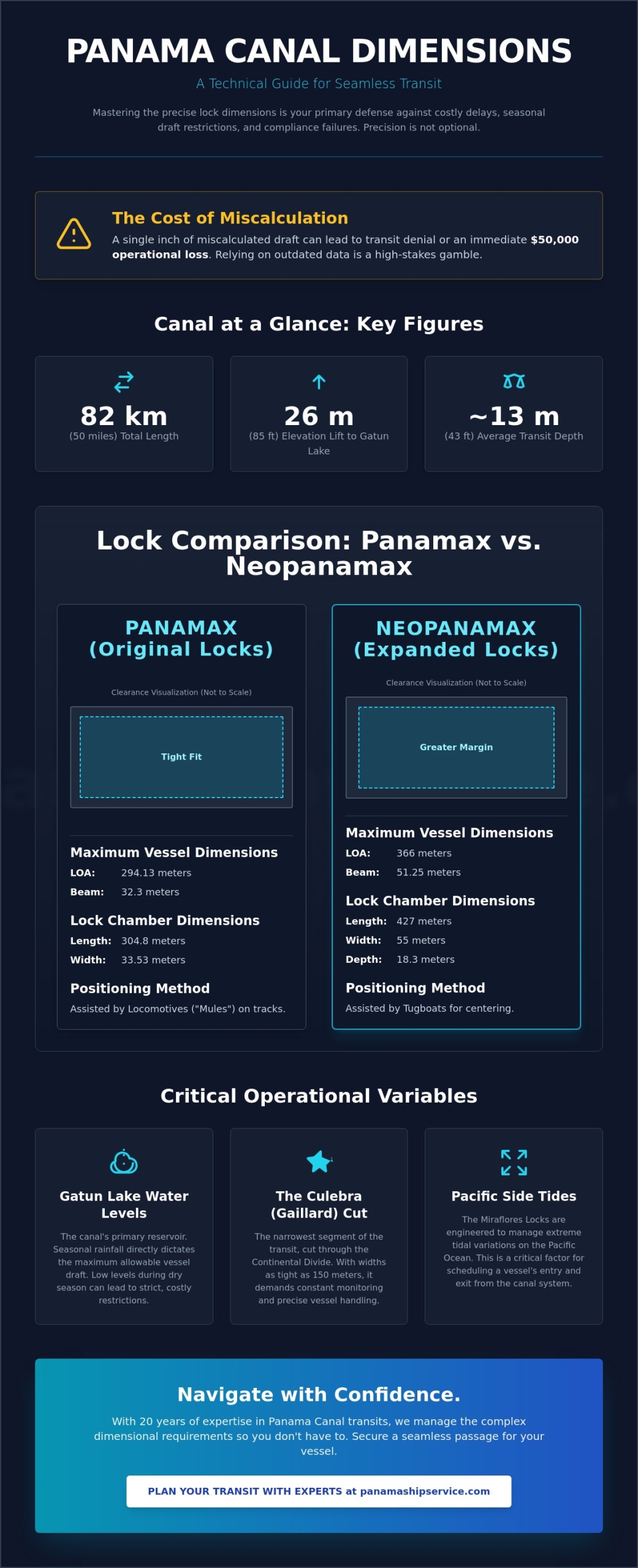
It’s frustrating when lock limits fluctuate based on Gatun Lake levels, but staying ahead of these shifts is essential for professional voyage planning. This guide gives you the precise, up-to-date technical dimensions for both Panamax and Neopanamax transits to ensure your vessel meets all current ACP requirements. We’ll provide the exact lock footprints, current vertical clearances, and a specific framework for technical preparation before your vessel arrives at the breakwater. You’ll have the data needed to secure a seamless transit without the risk of dimensional non-compliance.
Key Takeaways
- Master the precise dimensions of the Panama Canal to ensure your vessel meets all ACP requirements for both the Atlantic and Pacific passages.
- Identify the critical lock capacity differences between Panamax and Neopanamax standards to optimize your vessel’s route planning and cargo load.
- Learn how to navigate operational variables like Gatun Lake water levels to manage maximum allowable draft and avoid costly transit delays.
- Discover strategies for managing tight lock clearances to prevent mechanical wear and maintain peak fuel efficiency during narrow channel transits.
- Understand how to access 24/7 technical support and specialized repairs to mitigate the risks associated with navigating the canal’s technical limits.
Core Dimensions of the Panama Canal: Length, Width, and Depth
Precision is everything in maritime logistics. The dimensions of panama canal determine every aspect of a vessel’s voyage, from fuel consumption to cargo capacity. This 82-kilometer (50-mile) waterway connects the Atlantic and Pacific Oceans, acting as a critical bridge for global trade. Mariners must account for an average transit depth of 13 meters (43 feet). This depth is strictly maintained within the Culebra Cut, where maintenance dredging is a constant priority to prevent siltation from affecting draft limits. Widths vary across the channel, ranging from 150 meters in narrower segments to 300 meters at the widest points of Gatun Lake. The entire system relies on lifting ships 26 meters above sea level to reach the interior lake. We’re experts in these technicalities so you don’t have to be.
Physical Geography and the Isthmus of Panama
Gatun Lake isn’t a natural feature. It’s a massive artificial reservoir created by damming the Chagres River between 1907 and 1913. It serves as the canal’s central reservoir, providing the water volume needed to operate the gravity-fed locks. The path through the Isthmus isn’t straight; the Continental Divide forced engineers to create a winding route through difficult terrain. The Gaillard (Culebra) Cut remains the most dimensionally sensitive segment of the entire transit. This 12.6-kilometer stretch through the mountain range requires constant monitoring to ensure safe passage for deep-draft vessels. You can find detailed historical data on Panama Canal dimensions to understand how these constraints evolved over the last century. Misjudging your vessel’s fit in these tight corridors leads to costly delays.
The Three Original Lock Systems
The original lock system operates in three distinct stages to manage the 26-meter elevation change. These chambers act as water elevators, using gravity rather than pumps to move millions of gallons of water. The specific configurations include:
- Gatun Locks (Atlantic Side): A three-stage lift system that brings vessels from sea level up to the level of Gatun Lake in a continuous sequence.
- Pedro Miguel Locks: This single-stage lock initiates the first descent toward the Pacific, dropping vessels into Miraflores Lake.
- Miraflores Locks: The final two-stage descent that brings ships back to Pacific sea level, accounting for the extreme tidal variations found on the Pacific side.
Each original lock chamber measures 33.53 meters (110 feet) wide and 304.8 meters (1,000 feet) long. These fixed constraints define the “Panamax” standard that governed global shipbuilding for decades. Panama Ship Service is your trusted partner for managing these technical requirements. Put your transit in our hands to ensure your vessel meets every specification for a seamless crossing.
Panamax vs. Neopanamax: Comparing Lock Dimensions
The Panama Canal expansion, completed in June 2016, introduced a third lane of traffic that fundamentally changed the dimensions of panama canal for global trade. This project doubled the waterway’s capacity by allowing much larger vessels to bypass the original constraints. While the original locks still handle a significant volume of traffic, the Neopanamax locks provide the scale required for the modern global fleet. Understanding these specific technical differences is critical for masters and operators planning their 2026 transits.
Technical Limits for Panamax Vessels
The original Panamax locks consist of two lanes with chambers measuring 304.8 meters long and 33.53 meters wide. For safety, the maximum vessel length overall (LOA) is restricted to 294.13 meters, with a maximum beam of 32.3 meters. These dimensions leave very little margin for error. Within these narrow 33.53-meter-wide chambers, vessels rely on “mules,” which are specialized locomotives on tracks, to center the ship and maintain its position. Draft limitations in these original locks are highly sensitive to the fresh water levels of Gatun Lake. During periods of low rainfall, these limits can fluctuate, requiring precise calculations to avoid grounding or transit delays.
The Expanded Canal: Neopanamax Specifications
The Neopanamax locks represent a massive leap in maritime engineering. These chambers are 427 meters long, 55 meters wide, and 18.3 meters deep. These expanded dimensions of panama canal allow for vessels up to 366 meters in length and 51.25 meters in beam. A major operational shift in these new locks is the move from locomotives to tugboat-assisted centering. This method provides the high level of control needed for massive container ships carrying up to 14,000 TEUs. Navigating the Panama Canal requires a clear understanding of these operational shifts, especially as the 18.3-meter depth accommodates much deeper drafts than the original 12.8-meter depth of the Panamax locks.
Miscalculating these specifications can lead to costly delays, fines, or denied entry. We are experts so you don’t have to be. If you need assistance with technical readiness or draft surveys before your arrival, consult with our team to ensure a smooth, efficient transit. We prioritize your schedule and your bottom line by providing reliable, on-the-ground support for every vessel class.
Operational Realities: Draft, Clearances, and Seasonal Variations
The physical Panama Canal Dimensions are only half the story for a successful transit. Practical navigation depends almost entirely on water levels. Draft is the most critical variable for mariners. It changes daily based on Gatun Lake water levels. The ACP issues “Notices to Shipping” to define the maximum allowable draft for specific dates. You must monitor these notices to avoid being turned away at the entrance. Tropical seasonality creates a predictable but difficult cycle. The dry season runs from January to May. During these months, the available depth often decreases. This forces Neo-Panamax vessels to carry less cargo to stay afloat. Air draft is equally vital. The Bridge of the Americas has a fixed clearance of approximately 61 meters at high tide. If your vessel’s height exceeds this limit, you won’t pass. Timing your arrival with the tides is a standard operational requirement for high-profile ships. Understanding the dimensions of panama canal operations means looking beyond the concrete walls and focusing on the water column.
Gatun Lake Water Levels and Draft Restrictions
Rainfall patterns in the Panama Canal watershed dictate the 2026 transit schedule. If the previous year was dry, expect stricter limits on vessel size. Mariners must distinguish between salt water draft and Tropical Fresh Water (TFW) draft. Because fresh water is less dense, ships sit lower in Gatun Lake than in the Pacific or Caribbean. This difference can be several inches. It’s enough to cause a grounding if miscalculated. Accurate marine surveys in Panama are vital for draft verification. Our experts provide the precise data needed to satisfy ACP inspectors and ensure a safe passage. We are experts so you don’t have to be.
Under-Keel Clearance (UKC) Requirements
The ACP mandates a specific Under-Keel Clearance (UKC) for every transit. This is the minimum gap between your ship’s bottom and the canal floor. The risk of the “squat effect” is high in narrow channels like the Culebra Cut. When a ship moves through these tight spaces, the water flow speeds up and the pressure drops. This causes the vessel to sink deeper into the water than it would in the open sea. You must monitor vessel trim to ensure even weight distribution. A ship that is too heavy in the bow or stern risks hitting the bottom during lockage. We help operators calculate these variables to maintain safety and efficiency. Misjudging the dimensions of panama canal clearances leads to costly delays. Put your transit in our hands to ensure every technical requirement is met.
Maintenance Implications of Tight Canal Dimensions
The margins for error when navigating the dimensions of panama canal locks are razor-thin. In the Neopanamax locks, vessels measuring up to 51.25 meters in beam often operate with less than 60 centimeters of total lateral clearance. This tight fit means that any hull protrusions, structural irregularities, or significant marine growth can lead to physical contact with lock walls or increased hydraulic resistance. Technical compliance surveys conducted by the Panama Canal Authority (ACP) prior to transit ensure that vessel specifications match actual physical measurements. If your ship’s hull is distorted or fouled, you risk delays or restricted transit status.
Fuel efficiency drops sharply in these narrow channels. When a vessel occupies nearly the entire cross-section of the lock, the “piston effect” forces water to move rapidly around the hull. Any roughness on the steel surface increases this drag exponentially. Precise maneuvering isn’t just about safety; it’s about maintaining the schedule and avoiding the heavy surcharges associated with transit delays. We manage these technical risks so you can focus on your cargo.
The Role of Underwater Hull Cleaning
Biofouling adds weight and alters the effective draft of a vessel. Even a layer of slime can increase drag by 10%, while hard growth like barnacles can increase it by 40%. Utilizing professional underwater hull services ensures that your ship maintains its calculated displacement and stays within the strict draft limits set by the ACP. Expert cleaning removes these dimensional variables before they cause a non-compliance report. Hull cleaning is a mandatory prerequisite for any fuel-efficient transit through the canal system.
Propeller Polishing for Precision Maneuvering
Neopanamax transits rely on a combination of ship propulsion and tugboat assistance. Responsive propulsion is critical during lock entry where high-torque, low-speed maneuvers are the norm. A fouled propeller loses its “bite” on the water, forcing the engine to work harder and increasing the risk of over-torque alarms. Polishing the propeller to a Rubert Grade A finish reduces engine load and provides the instantaneous thrust response pilots require.
The economic benefits of polishing before entering the dimensions of panama canal structures are clear. It prevents the costly mechanical strain that occurs when fighting the hydraulic pressures of the locks. We are experts so you don’t have to be. Our team provides the rapid response needed to ensure your propulsion system is ready for the high-stakes environment of the canal.
Don’t let maintenance oversights jeopardize your schedule. Ensure your vessel meets all technical requirements by contacting our team for a professional technical survey and maintenance quote today.
Navigating the Canal with Panama Ship Service
Managing the tight tolerances required by the dimensions of panama canal demands more than just skilled navigation; it requires a dedicated technical partner on the ground. Panama Ship Service has spent over 20 years acting as that partner for ship owners and charterers. We provide 24/7 technical support to ensure your transit remains on schedule and within budget. Timing is everything in this waterway. A single delay or a failed inspection can lead to thousands of dollars in lost revenue and missed windows. We consolidate our services to eliminate downtime and keep your vessel moving through the locks safely.
The Panama Canal is a difficult and frustrating environment for those unprepared for its strict regulations. Our goal is to alleviate customer anxiety by providing a one-stop-shop for all technical needs. We are experts so you don’t have to be. By putting your transit in our hands, you gain access to a team that understands the specific pressures of the 2026 shipping landscape. We focus on minimizing vessel expenses through efficient, cost-conscious solutions that never compromise on quality or safety.
Mechanical Support for Large Vessels
Neopanamax vessels often operate with minimal clearance, which increases the risk of transit-related wear on propulsion and steering systems. We specialize in mechanical ship repairs specifically for rudder and propeller systems. Our technicians provide high-grade steel fabrication and welding for vessels that experience structural stress during the passage. If an emergency occurs, our rapid response teams are stationed at both Balboa and Cristobal ports. This strategic positioning allows us to perform critical repairs without forcing the vessel to leave the canal zone, saving you days of potential downtime.
Ensuring Compliance and Efficiency
Compliance is the second pillar of a successful transit. We handle MARPOL disposal panama to ensure your ship meets all environmental standards set by the ACP and international maritime law. Our experts also conduct detailed marine surveys, including bunker and draft surveys, to verify that your vessel’s technical readiness aligns with the current dimensions of panama canal. These surveys are essential for preventing costly fines or transit denials at the locks.
- 24/7 Availability: Constant communication from arrival to departure.
- Technical Expertise: Qualified divers and engineers for underwater inspections.
- Waste Management: Full compliance with Annex I, IV, and V MARPOL standards.
- Strategic Locations: Full service coverage in Balboa and Cristobal.
Don’t let technical oversights or maintenance issues jeopardize your schedule. Contact Panama Ship Service today to secure your transit’s technical success and ensure your vessel is fully prepared for the challenges of the Panama Canal.
Optimize Your Vessel Performance for the 2026 Transit Season
Navigating the specific dimensions of panama canal locks requires technical precision and proactive maintenance. With Neopanamax chambers reaching 366 meters in length and 51 meters in width, even minor miscalculations in draft or clearance lead to expensive bottlenecks. Success in these waters depends on meeting rigorous MARPOL standards and maintaining mechanical integrity under tight operational windows. We’ve served the maritime industry for 20 years; providing a reliable one-stop-shop for surveys, mechanical repairs, and hull cleaning. Our Class-approved underwater teams and technical experts handle the complex details, ensuring your ship meets every local requirement without delay. We’re experts so you don’t have to be. Put your transit in experienced hands and keep your cargo moving on schedule. Whether you need a bunker survey or emergency mechanical support, we’re ready to respond 24/7. Don’t let technical oversights disrupt your passage through this critical waterway.
Secure your vessel’s transit with expert technical services from Panama Ship Service
Your journey through the Isthmus is safer and more efficient with a partner who knows every inch of the canal’s requirements.
Frequently Asked Questions
What is the maximum length for a ship in the Panama Canal?
The maximum length for a vessel in the Neopanamax locks is 366 meters, while the Panamax locks accommodate ships up to 294.13 meters. These limits ensure safe maneuverability through the lock chambers and navigation channels. If your vessel’s length exceeds these specifications, you must obtain specific authorization from the Panama Canal Authority (ACP) prior to arrival. Our team coordinates with the ACP to verify your ship’s eligibility.
How deep is the water in the Panama Canal locks?
Water depth in the Panamax locks remains constant at 12.8 meters during normal operations. The Neopanamax locks provide a greater depth of 15.24 meters to support larger hull structures. These depths are measured at Tropical Fresh Water (TFW) levels. We monitor these technical dimensions of panama canal infrastructure daily to ensure your vessel meets all safety requirements before entering the system. Our proactive approach prevents draft-related delays.
What is the difference between Panamax and Neopanamax dimensions?
Panamax dimensions are limited to a beam of 32.31 meters and a length of 294.13 meters for the original locks. Neopanamax vessels utilize the expanded locks with a maximum beam of 51.25 meters and a length of 366 meters. The expanded locks allow for ships with nearly three times the TEU capacity of older vessels. Understanding these differences is vital for accurate route planning and slot reservations in 2026.
Can a ship be too wide for the Panama Canal?
A ship is considered too wide if its beam exceeds 51.25 meters for the Neopanamax locks or 32.31 meters for the Panamax locks. Vessels exceeding these limits cannot transit the canal and must seek alternative routes like the Cape of Good Hope. We recommend conducting a professional draft survey and beam verification before finalizing your transit schedule to avoid costly delays or rejections at the terminal. Our experts handle these technical assessments.
How do Gatun Lake water levels affect vessel draft in 2026?
Projections for 2026 indicate that Gatun Lake water levels will support a maximum draft of 13.41 meters for Neopanamax vessels. This figure fluctuates based on the 2025 rainy season and ACP water management strategies. If levels drop below 24.38 meters above sea level, the ACP implements draft restrictions in 15 centimeter increments. We provide real-time updates to help you adjust cargo loads and minimize vessel expenses during dry periods.
What is the maximum air draft for the Panama Canal?
The maximum air draft for any vessel transiting the canal is 57.91 meters measured from the waterline to the highest point. This limit is dictated by the Bridge of the Americas at mean high water. You can request an increase to 60.35 meters under specific conditions with ACP approval. Miscalculating these dimensions of panama canal clearances can lead to structural damage or immediate transit suspension. We verify your mast height before you arrive.
Does the Panama Canal Authority charge based on vessel dimensions?
The Panama Canal Authority calculates tolls based on the Panama Canal Universal Measurement System (PC/UMS), which utilizes a vessel’s total volume and dimensions. Specific categories like TEU capacity for containerships or displacement tons for other vessels also factor into the final cost. We are experts so you don’t have to be. Our team provides detailed cost simulations based on your ship’s specific certificates to ensure you have a competitive advantage.
What happens if a vessel exceeds the maximum dimensions during arrival?
If a vessel exceeds the declared dimensions upon arrival, the ACP will likely deny transit or demand immediate cargo lightering. You may also face administrative fines and the loss of your reserved slot. Put your transit in our hands to prevent these scenarios. We verify all technical data against current ACP regulations to ensure your ship meets every requirement before it reaches the breakwater. This ensures a smooth, cost-effective transit.