
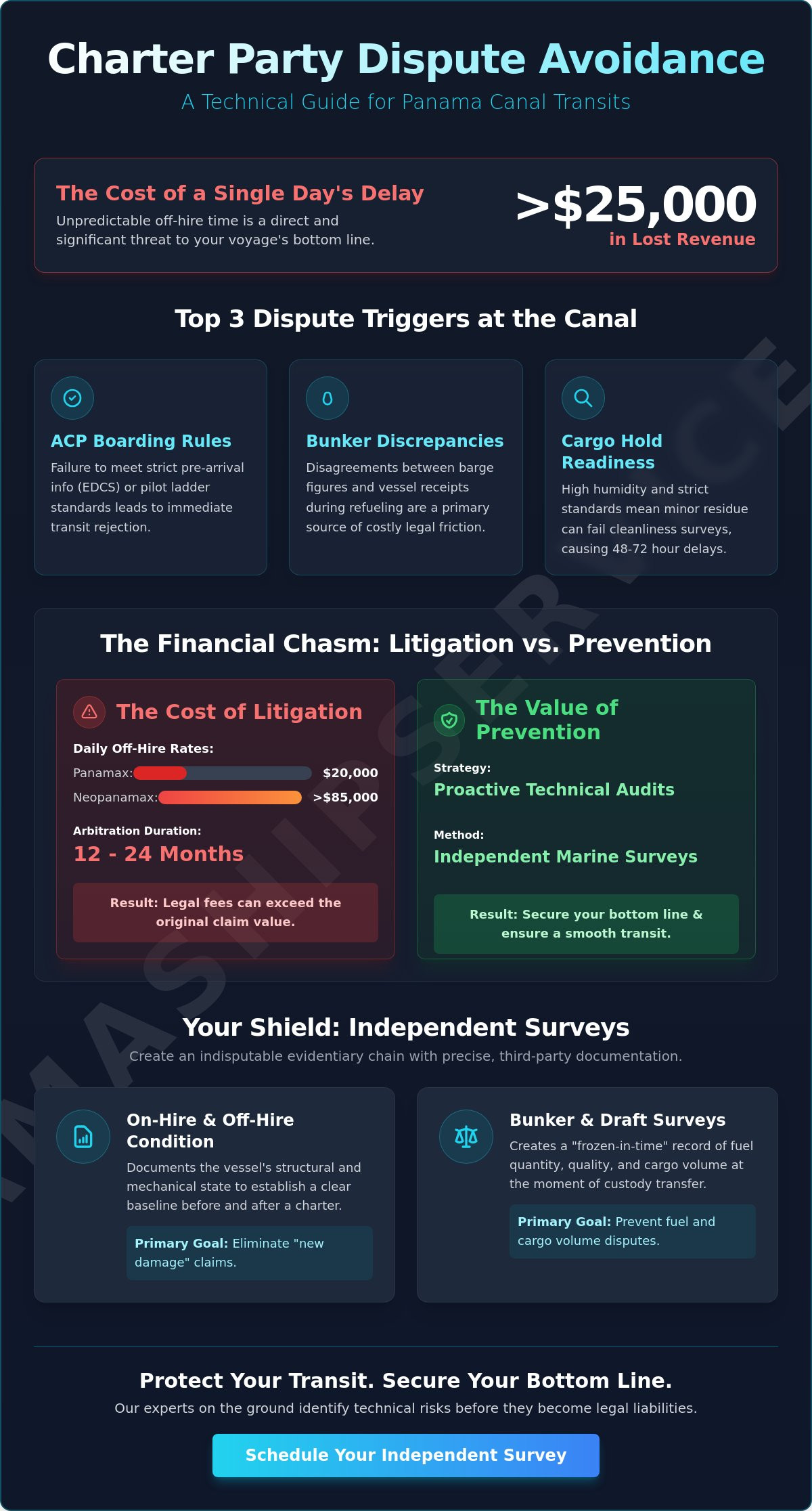
A single day of unpredictable off-hire time during a Panama Canal transit can cost an operator over $25,000 in lost revenue, yet many vessels still arrive without independent verification of their condition. You already know that disagreements over bunker quality or cargo tank readiness aren’t just inconveniences; they’re direct threats to your bottom line. When the stakes are this high, relying on luck is a strategy for failure. Professional charter party dispute avoidance is the only way to safeguard your voyage against the technical discrepancies that trigger expensive legal battles.
We are experts at the Canal so you don’t have to be. This technical guide will teach you how to mitigate financial risks and avoid maritime legal disputes through precise technical inspections and independent evidence. We’ll show you exactly how to use bunker surveys, draft measurements, and hold inspections to minimize your liability for speed and consumption claims. By the end of this article, you’ll have a clear roadmap for achieving a dispute-free transit through one of the world’s most demanding maritime passages. Our focus is on providing the technical precision you need to protect your interests and ensure a smooth journey from sea to sea.
Key Takeaways
- Identify the high-stakes financial risks of transit delays and learn how to mitigate the threat of costly off-hire claims.
- Utilize independent marine surveys as critical third-party evidence to strengthen your position in charter party dispute avoidance.
- Prevent performance warranty breaches by understanding the direct link between hull cleanliness and mechanical reliability during canal passage.
- Navigate the intersection of Panamanian law and international contracts by mastering the importance of the Statement of Facts (SoF).
- Discover how a unified vessel condition record from a trusted technical partner can protect owners and charterers from operational disagreements.
The High Stakes of Charter Party Disputes at the Panama Canal
Timing is everything at the Panama Canal. A single day of delay doesn’t just disrupt a schedule; it triggers a cascade of financial claims. Most operational disagreements stem from the Canal’s unique regulatory environment. The Panama Canal Authority (ACP) enforces rigid protocols that differ from standard international ports. If your vessel doesn’t meet these specific technical requirements, it goes off-hire. This is where a charter party dispute often begins. Owners and charterers frequently clash over who bears the cost of these idle hours. Speed and consumption warranties also play a critical role. Transit delays can force a Master to increase speed to meet the next window, leading to fuel consumption that exceeds agreed limits. Effective charter party dispute avoidance requires a technical strategy that anticipates these bottlenecks before the vessel reaches the locks.
Common Triggers for Panama Canal Disputes
- ACP Boarding Requirements: Misunderstanding the ACP’s Pre-Arrival Information (EDCS) or failing to provide proper pilot ladders and boarding facilities leads to immediate transit rejection.
- Bunker Discrepancies: Refueling in Panama often involves quantity disputes. Discrepancies between barge figures and vessel receipts are a primary source of legal friction.
- Cargo Hold Readiness: Panama’s high humidity and strict inspection standards mean even minor residue can cause a vessel to fail a cleanliness survey, delaying loading for 48 to 72 hours.
The Cost of Litigation vs. The Cost of Prevention
The financial gap between prevention and litigation is massive. Daily off-hire rates for a Panamax vessel currently average $20,000, while Neopanamax rates can surge past $85,000 during periods of high demand. A small technical oversight, such as a faulty mooring winch or an outdated navigation chart, can escalate into an arbitration case lasting 12 to 24 months. These cases often cost more in legal fees than the original claim value. Dispute avoidance is a proactive technical audit of vessel readiness. We act as your expert eyes on the ground to identify technical risks before they become legal liabilities. We are experts so you don’t have to be. Our role is to ensure your vessel meets every ACP standard, protecting you from the high costs of maritime litigation. By prioritizing charter party dispute avoidance through rigorous pre-transit inspections, you secure your bottom line against the unpredictable nature of global shipping.
Strengthening Your Position with Independent Marine Surveys
Independent third-party evidence isn’t just a precaution; it’s a legal requirement for effective charter party dispute avoidance. In maritime arbitration, oral testimony rarely holds up against documented, technical proof. Panama Ship Service provides that proof. We act as your eyes and ears on the ground, ensuring that every vessel state is recorded with forensic precision. This objective data serves as a shield against the “difficult and frustrating” legal battles that often arise during transit.
On-Hire and Off-Hire Condition Surveys
These surveys represent the most critical documents in your charter party dispute avoidance strategy. By documenting existing structural conditions and mechanical states before a charter begins, you eliminate the risk of “new damage” claims during redelivery. Our surveyors use class-approved reporting methods and high-resolution photographic evidence to create an indisputable baseline. For a deeper look at the technical requirements, see our guide on marine surveys panama. This level of detail is vital because even minor hull indentations or winch malfunctions can lead to massive repair bills if not noted at the outset. We ensure every finding is cross-referenced with the vessel’s log to provide a seamless evidentiary chain.
Bunker and Draft Surveys
Financial friction often stems from fuel and cargo volume discrepancies. Precise draft measurements prevent “short-delivery” claims that can cost thousands of dollars in cargo deductions. A bunker survey at the canal provides a “frozen-in-time” record of fuel state, capturing quantity and quality at the exact moment of custody transfer. This record is essential for MARPOL compliance and ensuring the fuel meets specific charter party specs. Beyond fuel, technical readiness is paramount. The Canal Authority often levies heavy Panama Canal Disruption Charges for vessel deficiencies that cause transit delays. These charges often trigger disputes between owners and charterers regarding who is liable for the operational failure. Having a surveyor verify equipment status before the Pilot boards can save you from these unexpected fines.
Local presence at Balboa and Cristobal ports is non-negotiable. Our team understands the specific environmental factors, like water density and swell, that affect draft readings in Panama. We’ve been in business for 20 years. We know how to navigate the local bureaucracy to get your survey done quickly. If you want to protect your interests, request a professional survey before your next transit. We are experts so you don’t have to be.
Proactive Maintenance: Avoiding Performance and Off-Hire Claims
Operational delays at the Panama Canal often trigger complex legal battles. When a vessel fails to meet its speed or consumption warranties, the financial fallout falls on the owner. Effective charter party dispute avoidance starts with technical readiness long before the vessel reaches the breakwater. Ship owners must recognize that the Panama Canal Authority (ACP) maintains strict standards for maneuverability. Any mechanical failure during transit doesn’t just delay the ship; it leads to immediate off-hire status and potential claims for consequential losses from charterers. We are experts in these requirements so you don’t have to be.
Hull and Propeller Integrity
Tropical waters accelerate biofouling. A vessel waiting in the high-temperature waters of the Pacific or Atlantic anchorages can see a 10% increase in fuel consumption within just 48 hours of idle time. This directly threatens performance warranty compliance. Utilizing underwater hull services ensures that the hull remains clean and the propeller stays polished. Propeller polishing alone can improve fuel efficiency by 3% to 5% based on standard industry data, providing a technical defense against under-performance claims. We recommend inspections every time a vessel stays at anchorage for more than 72 hours to maintain the condition required by most time charters.
Mechanical Reliability and Transit Readiness
The Hague-Visby Rules require owners to exercise due diligence to make the ship seaworthy. For a canal transit, this includes ensuring the main engine, steering gear, and bow thrusters are in peak condition. A steering failure in the Culebra Cut is a catastrophic event that triggers “failure to proceed with utmost despatch” claims. Owners should schedule mechanical ship repairs in Panama during the inevitable wait times for a transit slot. This strategy turns idle time into productive maintenance windows. Key checks before ACP boarding include:
- Testing the emergency steering gear 24 hours before arrival.
- Verifying the integrity of mooring winches and bitts for locomotive towing.
- Checking main engine astern power capabilities for lock entry.
- Confirming all bridge equipment meets ACP Navigation Regulations.
Proactive maintenance is the most reliable method for charter party dispute avoidance. It shifts the narrative from reactive crisis management to demonstrated technical excellence. Don’t wait for a breakdown to prove your vessel’s seaworthiness. Our team provides the rapid response and technical support needed to keep your vessel on-hire and moving through the canal without interruption. Efficiency is our priority because we know that in the shipping industry, timing is everything.
Navigating the Legal and Operational Landscape of Panama
Managing the intersection of Panamanian maritime law and international maritime contracts requires a technical approach to documentation. While your charter party might be governed by English or New York law, the operational reality is dictated by the Panama Canal Authority (ACP). This jurisdictional overlap is where most friction occurs. Effective charter party dispute avoidance relies on aligning these two worlds through meticulous record-keeping.
The Statement of Facts (SoF) serves as the primary evidentiary record for calculating laytime and demurrage, making it the most contested document in Panamanian waters. Every delay, whether caused by tug availability, pilot scheduling, or mechanical failure, must be recorded with precision. If a dispute arises, the SoF is the first document legal counsel will scrutinize. When the ACP’s timeline contradicts the master’s log, the financial consequences are immediate. We recommend a proactive approach where ship agents and technical surveyors verify every entry in real-time. If a discrepancy exists, a Letter of Protest (LoP) must be issued immediately at the port of Balboa or Cristobal to preserve the owner’s legal position.
ACP Regulations and Compliance
Compliance with the ‘Panama Canal Vessel Requirements’ (OP Notice to Shipping N-1-2024) is a contractual necessity. Any deviation from these technical standards can be interpreted as a breach of contract if it leads to transit delays or fines. Draft restrictions are a frequent source of cargo disputes. During the 2023 drought, Gatun Lake levels forced the ACP to reduce maximum drafts to 44 feet. These fluctuating limits directly impact cargo intake. Owners and charterers must coordinate closely to ensure the vessel’s arrival draft meets the daily requirements. Failure to do so often results in ‘off-hire’ claims that are difficult to defend without documented proof of the ACP’s specific daily directives.
Environmental Compliance as a Safe Guard
Environmental regulations in the Canal Zone are strictly enforced and play a critical role in an effective charter party dispute avoidance strategy. Authorities frequently inspect the Oil Record Book and garbage logs during transit. Utilizing a certified MARPOL disposal panama service ensures that all waste offloaded is documented with the correct regulatory receipts. This paper trail is your best defense against claims of negligence or operational delay.
Environmental non-compliance, such as failing to maintain an updated Oil Record Book or illegal discharge, can immediately trigger ‘unseaworthiness’ clauses, allowing charterers to void contracts or claim damages. Proper coordination between technical surveyors and legal teams ensures that disposal records are dispute-proof. Don’t leave your vessel’s reputation to chance when navigating these complex requirements.
For expert assistance with technical documentation and operational compliance, Contact Panama Ship Service to secure your transit.
Panama Ship Service: Your Partner in Dispute Prevention
Effective charter party dispute avoidance requires more than just careful contract drafting; it demands boots on the ground and technical precision. Panama Ship Service brings 20 years of local expertise to the Panama Canal. We act as a technical shield for both owners and charterers. By consolidating services like bunker surveys, draft surveys, and hull inspections under a single provider, we create a unified vessel condition record. This eliminates the conflicting data points that often trigger costly legal battles between parties.
Operating a vessel through the Canal involves tight windows and high stakes. We provide real-time communication and rapid response for emergency technical needs. Our one-stop-shop approach reduces the margin for error because every piece of data is cross-referenced by the same expert team. You don’t have to manage multiple contractors or reconcile disparate reports when time is of the essence. We handle the technical complexities so you can maintain your schedule and minimize vessel expenses. Our team understands that timing is everything in this corridor.
Technical Expertise You Can Trust
Our team consists of qualified surveyors and mechanical engineers available 24/7 at both Balboa and Cristobal terminals. We understand that a survey is only as good as its ability to withstand professional scrutiny. Our reports are specifically designed to stand up in international arbitration. We capture high-resolution evidence and provide clear, objective data that leaves no room for ambiguity. We are experts so you don’t have to be. We focus on the technical details while you focus on the voyage. Our presence at both canal entrances ensures constant daily communication and immediate support for any mechanical or operational challenge.
Getting Started with a Risk Mitigation Plan
A proactive approach is the only way to ensure charter party dispute avoidance remains a reality. We help clients by developing pre-transit checklists for owners and charterers that align with specific vessel requirements. These are not generic forms. We customize survey packages based on your specific charter party terms. Whether you’re concerned about fuel quality, cargo quantity, or engine performance, our packages provide the necessary evidence to prevent claims. Our goal is to be your trusted partner at the Panama Canal, providing cost-conscious solutions that protect your bottom line. Don’t leave your vessel’s reputation to chance in a high-pressure environment. Contact Panama Ship Service for a technical consultation to secure your next transit.
Protect Your Assets and Minimize Transit Delays
Navigating the Panama Canal requires more than just a schedule; it demands technical precision and proactive oversight. Effective charter party dispute avoidance relies on two critical pillars: objective data from independent surveys and verified mechanical readiness. By deploying Class-approved surveyors to document vessel conditions and certified mechanical engineers for preemptive repairs, you remove the ambiguity that often triggers expensive off-hire claims. Panama Ship Service delivers over 20 years of maritime expertise directly to your vessel’s side. We provide 24/7 rapid response for every ship type transiting the waterway, ensuring that minor technical glitches don’t escalate into major legal liabilities. We’re the experts on the ground so you don’t have to be. Our team manages the complex technical requirements of the Canal, protecting your bottom line from unexpected costs and operational friction. Trust a partner who understands the local landscape and the high stakes of international shipping. Secure Your Transit with Expert Technical Surveys and Repairs. Your successful crossing is our priority, and we’re ready to support your fleet around the clock.
Frequently Asked Questions
What is the most common cause of charter party disputes in Panama?
Off-hire claims stemming from transit delays and bunker delivery discrepancies are the most frequent causes of conflict. Data from maritime insurers suggests that nearly 35% of disputes in the region involve time-loss calculations during the canal queue. You can reduce these risks through proactive charter party dispute avoidance strategies. We provide the technical documentation needed to prove the vessel’s performance remained within the agreed parameters.
How can an independent bunker survey prevent fuel quality disputes?
An independent bunker survey provides a certified record of the fuel’s quantity and quality delivered in Balboa or Cristobal. This prevents “short-delivery” claims that often involve differences of 10 to 30 metric tons. Our surveyors follow ISO 8217:2017 standards to ensure the fuel meets the specifications in your contract. It’s a small investment that protects you from six-figure claims later.
Does the Panama Canal Authority (ACP) provide evidence for charter disputes?
The Panama Canal Authority maintains internal logs but doesn’t typically provide evidence for private commercial litigation. While they record transit times, they don’t document the specific details required for a technical charter dispute. You must hire an independent surveyor to capture the data points the ACP ignores. We act as your eyes on the ground to ensure every technical detail is recorded accurately.
What is the difference between an on-hire survey and a P&I inspection?
An on-hire survey establishes the vessel’s condition and fuel ROB at the start of a charter, while a P&I inspection evaluates safety risks for insurance coverage. On-hire surveys are essential for charter party dispute avoidance because they prevent arguments over pre-existing damage. We’ve conducted over 500 surveys in the last two years, providing the clear evidence owners need to protect their interests during redelivery.
Can hull cleaning in Panama help me meet speed and consumption warranties?
Professional hull cleaning in Panama significantly improves performance by removing marine growth that causes drag. The IMO’s GloFouling reports indicate that medium biofouling can increase fuel consumption by 30% or more. By cleaning the hull before or after transit, you ensure the vessel hits the speed and consumption targets defined in the charter party. This prevents costly performance claims from charterers.
How do I handle a dispute over ‘waiting time’ at the Panama Canal?
Handle waiting time disputes by ensuring your Notice of Readiness (NOR) is tendered correctly according to the charter party terms. If a vessel waits more than 24 hours at the anchorage, the financial impact is substantial. Our team provides real-time updates and documentation to prove the vessel was ready for transit. Clear communication prevents “who is at fault” arguments when the canal experiences seasonal congestion.
Is a Statement of Facts (SoF) legally binding in a charter dispute?
A Statement of Facts isn’t a binding contract, but it’s the most influential document in a maritime arbitration. It records the chronological events of the transit, including any 5 or 6 hour delays caused by the port. If your Master signs an inaccurate SoF, your legal position weakens significantly. We review these documents to ensure every minute of the vessel’s time is accounted for correctly.
What should I do if a mechanical failure occurs during canal transit?
If a mechanical failure occurs, you must report the incident to the ACP and your charterers within 30 minutes to minimize liability. ACP Regulation Article 62 requires vessels to be in good working order. A failure can result in the vessel being moved to a “not ready” list, potentially adding 72 hours to your transit time. We provide rapid-response repair teams to fix issues and get you back on schedule.