
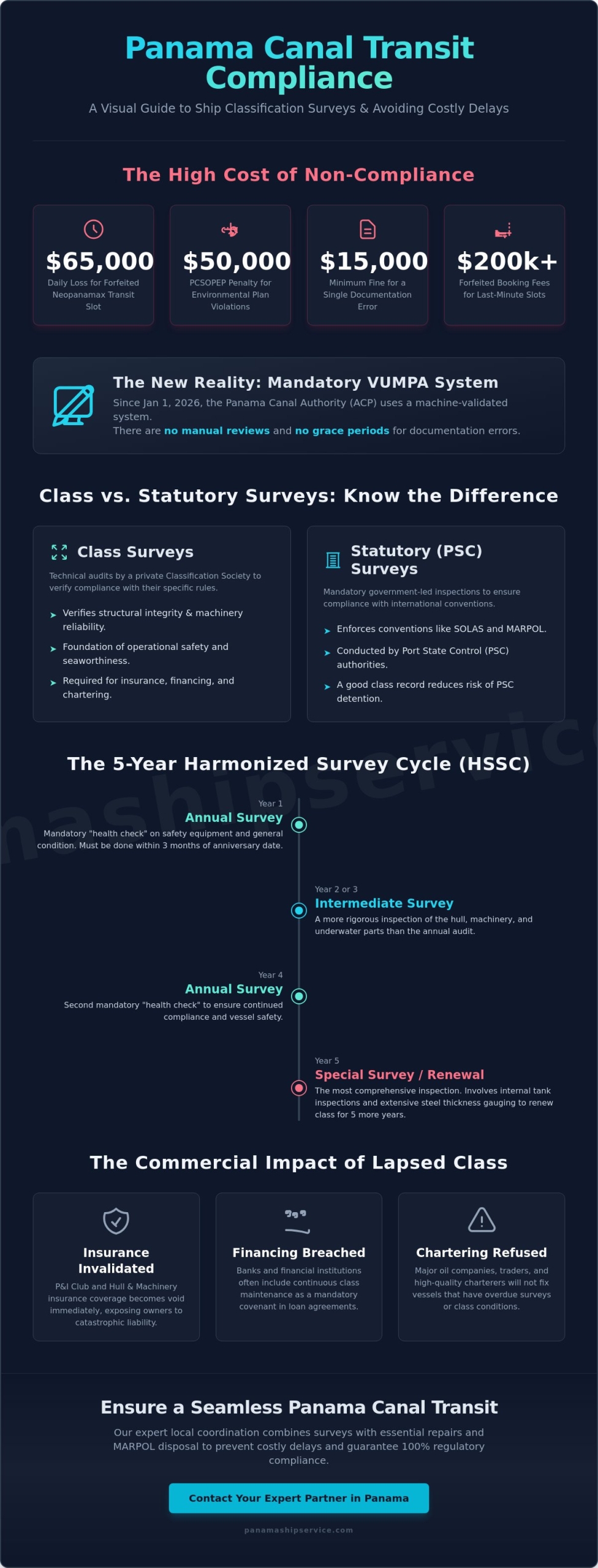
A $65,000 daily loss is the reality for Neopanamax operators who forfeit a transit slot because of a documentation error or a failed inspection. Since the Panama Canal Authority (ACP) transitioned to the mandatory machine-validated VUMPA system on January 1, 2026, there’s no room for manual review or grace periods. Understanding the specific ship classification survey requirements is no longer just about staying in class; it’s about protecting your schedule from a $15,000 fine or a $50,000 PCSOPEP penalty.
We understand that managing technical compliance while meeting the strict 96-hour pre-arrival deadline is a high-stakes balancing act. Misjudging your timing often leads to vessel detention or expensive last-minute repairs. This guide provides the expert clarity you need to master ACP regulations and the new risk-based vessel inspection model effective since October 1, 2025. We are experts so you don’t have to be; you’ll gain a clear checklist to minimize downtime and ensure your vessel maintains 100% regulatory compliance for a seamless transit.
Key Takeaways
- Distinguish between technical class standards and statutory international conventions to ensure your vessel meets all specific port-state requirements.
- Master the ship classification survey requirements within the HSSC framework to synchronize mandatory annual “health checks” with your operational timeline.
- Use our practical pre-audit checklist to identify structural deficiencies and organize logbooks before the physical inspection begins.
- Learn how expert local coordination in Panama can combine surveys with essential repairs and MARPOL disposal to prevent costly transit delays.
- Understand why maintaining “in class” status is only the first step toward meeting the Panama Canal’s unique, machine-validated compliance standards.
Understanding Ship Classification Survey Requirements and Their Importance
A classification survey is a comprehensive technical audit that verifies a vessel’s structural integrity and the reliability of its essential machinery, including propulsion, steering, and electrical systems. These standards are maintained by a Ship classification society, which develops and applies technical rules based on principles set by the International Association of Classification Societies (IACS). For shipowners, meeting ship classification survey requirements is the absolute foundation of operational safety. It provides an independent, third-party verification that the ship is fit for its intended service and environment. At the Panama Canal, this status is non-negotiable. The Panama Canal Authority (ACP) relies on these certificates to ensure that every vessel entering the locks won’t suffer a mechanical failure that could block the waterway, damage the infrastructure, or cause an environmental disaster. Without a valid certificate of class, your transit ends before it begins.
The Legal and Commercial Necessity of Classification
Maintaining “In Class” status is a strict prerequisite for securing P&I Club coverage and hull insurance validity. If a vessel’s class is suspended or withdrawn, insurance policies typically become void immediately, leaving the owner exposed to catastrophic liability. This creates a massive financial risk that no serious operator can afford. Beyond insurance, valid survey records are vital for maintaining the vessel’s resale value and its attractiveness to high-quality charterers who demand proof of structural reliability. Failing to meet ship classification survey requirements can lead to port state control detention or total transit refusal at the Canal. For Neopanamax operators, this results in the forfeiture of booking fees that can reach $200,000 for last-minute slots, plus documentation violation fines that start at $15,000.
Commercial impacts include:
- Insurance Validity: Most P&I Clubs require continuous class maintenance for coverage to remain active.
- Financing: Banks and financial institutions often use class status as a mandatory covenant in loan agreements.
- Chartering: Major oil companies and traders won’t fix vessels that have overdue surveys or class conditions.
Class Surveys vs. Port State Control (PSC)
It’s vital to distinguish between class surveys and Port State Control (PSC) inspections. Class surveys are technical audits conducted by private organizations to verify compliance with the society’s specific rules. In contrast, PSC inspections are mandatory government-led checks to ensure compliance with international conventions like SOLAS and MARPOL. A proactive approach to class surveys acts as a shield. When your technical standards are high and documented through a reputable class society, you significantly reduce the risk of PSC deficiencies or vessel detentions. The chain of responsibility creates a vital link between the shipowner’s maintenance duties, the classification society’s technical oversight, and the flag state’s ultimate legal authority.
The Mandatory Survey Cycle: Annual, Intermediate, and Special Requirements
Managing ship classification survey requirements efficiently relies on the Harmonized System of Survey and Certification (HSSC). This system aligns the anniversary dates and expiration windows for various certificates, including SOLAS and MARPOL, to reduce the number of times a surveyor must board the vessel. For operators at the Panama Canal, where timing is everything, this coordination prevents overlapping inspections that can disrupt a tight transit schedule. The cycle follows a strict five-year timeline. Annual surveys are the mandatory “health check” performed within three months of the vessel’s anniversary date. They focus on the general condition of the ship and its safety equipment. If a vessel misses this window, its certificates become invalid, leading to immediate detention by port state authorities.
Intermediate surveys occur during the second or third year of the cycle and involve a more rigorous inspection of the hull and machinery than the annual audit. The cycle culminates in the Special Survey at the five-year mark. This is a comprehensive renewal process where surveyors require internal inspections of all tanks and extensive thickness gauging of the steel structure. Because these societies often hold U.S. Coast Guard authorization to act on behalf of flag states, their findings carry significant legal weight. We are experts so you don’t have to be; we ensure your vessel is prepared for these critical milestones to avoid the $65,000 daily loss associated with transit slot forfeiture.
Key Technical Focus Areas During the Cycle
Surveyors prioritize three technical pillars to verify that the vessel meets all ship classification survey requirements for a safe Panama Canal transit:
- Structural Integrity: Detailed examination of deck plating, bulkheads, and framing for signs of corrosion, wastage, or stress fractures.
- Machinery and Systems: Operational testing of the main propulsion, steering gear, and the emergency electrical plant to ensure total reliability in the locks.
- Watertight Integrity: Inspection of hatch covers, air pipes, and hull openings to prevent water ingress and maintain stability.
The Role of Underwater Inspections (UWILD)
Drydocking is a massive expense that can take a vessel out of service for weeks. To minimize vessel expenses, many owners utilize an Underwater Inspection in Lieu of Drydocking (UWILD). This is generally permitted for vessels less than 15 years old, provided the hull is cleaned and inspected by class-approved divers using high-definition CCTV. We provide specialized underwater hull services that satisfy these requirements while your ship is at anchor. This proactive approach allows you to address fouling or minor damage without the need for a costly shipyard stay. If you’re preparing for an upcoming intermediate survey, contact our team to coordinate a class-approved dive inspection that keeps your transit on track.
Class Surveys vs. Statutory Surveys: What Shipowners Must Distinguish
Navigating technical compliance requires a clear understanding of two distinct regulatory tracks. Class surveys focus on the private technical standards of ship construction and machinery, ensuring the vessel remains structurally sound and mechanically reliable. Statutory surveys, however, are mandatory government requirements based on international conventions like SOLAS, MARPOL, and the International Load Line Convention. While class rules are developed by the societies themselves, statutory requirements are legal mandates from the vessel’s flag state. Meeting ship classification survey requirements is essential for technical integrity, but your ship cannot legally leave port without valid statutory certificates.
Most flag states don’t have the global network of inspectors needed to board vessels in every port. To bridge this gap, they authorize classification societies to act as Recognized Organizations (RO). This dual role allows a single surveyor to verify both class rules and international laws during the same attendance. This arrangement is highly efficient for shipowners. It reduces the number of boarding fees and minimizes the logistical burden of hosting multiple inspectors. We’ve seen how expert coordination here at the Panama Canal prevents these two regulatory tracks from clashing and causing unnecessary delays.
Mandatory Statutory Certificates to Monitor
Shipowners must track several key statutory documents to avoid detention during a Panama Canal transit. Safety Construction and Safety Equipment certificates under SOLAS are critical for proving the ship is equipped to handle emergencies. Pollution prevention is equally vital. Vessels must meet strict MARPOL disposal panama standards to ensure all oily waste and garbage are handled according to international law. Additionally, International Load Line certificates define the ship’s maximum draft and minimum freeboard, which directly impacts your cargo capacity and transit tolls.
Coordinating Surveys for Maximum Efficiency
The most effective way to manage these requirements is through “Harmonization.” By aligning the windows for class and statutory surveys, you can clear multiple certificate requirements during a single surveyor attendance. This strategy significantly reduces vessel downtime and travel costs for the surveyor. The standard window of opportunity for most annual surveys opens three months before the anniversary date and remains open until three months after that date. Missing this six-month window results in the automatic suspension of certificates. We help you capitalize on these windows by providing a “one-stop-shop” for technical services while your ship is at anchor in Panama.
Preparing for a Class Survey in Panama: A Practical Checklist
Preparation is the difference between a routine inspection and a transit-canceling disaster. When you approach the Canal, you must align your internal maintenance with ship classification survey requirements to ensure the surveyor finds no grounds for a condition of class. We recommend conducting an internal pre-audit at least seven days before your arrival at the anchorage. This proactive step allows your crew to identify and fix minor deficiencies that often trigger deeper inspections. Managing the “Panama Factor” means you’re not just satisfying a surveyor; you’re racing against a strict 96-hour VUMPA pre-arrival deadline and a fixed transit slot. If your documentation is disorganized or your equipment fails, you risk forfeiting a Neopanamax booking that could cost $100,000 or more.
Organizing your paperwork is just as critical as the physical state of the hull. Ensure all technical documentation, logbooks, and previous survey reports are laid out and ready for review. A surveyor who sees a well-organized bridge and engine room office is more likely to trust the vessel’s overall management. We are experts so you don’t have to be; we coordinate with local agents to manage launch services, equipment delivery, and technician access so your crew can focus on the technical inspection itself.
The Pre-Survey Readiness Checklist
Testing emergency systems is your first priority. You must verify the operational status of fire pumps, emergency generators, and steering gear under load. If these fail during a surveyor’s visit, your transit will be suspended immediately. Hull and tank preparation requires meticulous cleaning and ventilation; you must have a certified “safe for entry” document ready for any enclosed space inspection. Additionally, ensure all essential gauges and monitoring equipment have current calibration certificates from a recognized laboratory. Don’t wait for the surveyor to find a seized valve or an expired certificate; test everything before you reach the anchorage.
Local Logistics at Balboa and Cristobal
Choosing the right port for your survey depends on your transit direction and current congestion. Balboa offers extensive anchorage space on the Pacific side, while Cristobal serves as the primary hub for Atlantic-bound vessels. If the surveyor identifies a critical fault, you need immediate access to mechanical ship repairs panama to resolve the issue before your slot is forfeited. We facilitate rapid response for spare parts and specialized technical labor, ensuring that repairs are completed to class standards without missing your window. Put your transit in our hands and contact us to coordinate your next class survey in Panama.
Panama Ship Service: Your Expert Partner for Class-Approved Surveys
For 20 years, Panama Ship Service has acted as the trusted partner at the Panama Canal for global shipowners and charterers. We understand that meeting ship classification survey requirements is only half the battle; the other half is navigating the intense logistical pressure of the locks. Our “One-Stop-Shop” approach eliminates the need for multiple vendors by combining technical surveys with MARPOL disposal, bunkering, and essential repairs. We are experts so you don’t have to be. By centralizing these services under one technical management team, we minimize the vessel expenses and ensure that no single deficiency turns into a transit-stopping obstacle. Our class-approved underwater inspection capabilities also allow for UWILD surveys at anchor, preventing the need for costly deviations to drydock for vessels approaching their five-year special survey window.
Comprehensive Technical Support in Panama
We provide the technical backbone for vessels facing rigorous class and statutory inspections. Our team assists in every phase of preparation, from initial pre-audit checks of safety systems to the final surveyor walkthrough. If a surveyor identifies a fault, our network of qualified technicians is ready to perform immediate mechanical ship repairs. We maintain constant daily communication with owners and charterers throughout the process. You’ll never be left wondering about the status of an inspection or a critical repair. We provide rapid responses and clear documentation to keep your technical files in 100% compliance with both class societies and the Panama Canal Authority.
Streamlining Your Canal Transit
Local expertise is vital in a maritime environment that can often feel difficult and frustrating. In May 2026, our pre-survey coordination saved a Neopanamax vessel from a catastrophic 48-hour delay. An internal audit identified a faulty steering gear sensor just 12 hours before the official survey was scheduled. Because we had the qualified technician and the class-approved part ready at the Balboa anchorage, the repair was finished before the surveyor even boarded. The ship cleared its ship classification survey requirements without missing its slot. This intervention prevented the owner from facing a $65,000 daily operational loss and the $200,000 forfeiture of their last-minute booking fee.
Timing is everything in the shipping industry. Costs continually increase, and the ACP’s new digital VUMPA system leaves no room for documentation errors or technical failures. Put your transit in our hands and let us manage the complexities of your next survey. We’re the indispensable partner that gets the job done without fuss. Contact Panama Ship Service today to secure your seamless, delay-free transit through the Panama Canal.
Secure Your Transit with Expert Technical Coordination
Mastering ship classification survey requirements is the only way to protect your vessel from the strict automated enforcement now standard at the Canal. You’ve seen how harmonizing survey windows and distinguishing between technical and statutory tracks prevents redundant inspections. With the VUMPA machine-validation system in full effect since January 1, 2026, any documentation error or technical failure results in immediate slot forfeiture. Don’t let a failed inspection turn into a $65,000 daily operational loss.
We provide 20 years of maritime expertise to ensure your vessel is prepared for every rigorous check. Our team offers 24/7 rapid response at both Balboa and Cristobal anchorages, including class-approved underwater surveys that allow you to avoid the massive expense of drydocking. We are experts so you don’t have to be. Put your transit in our hands and maintain your schedule with total confidence. It is time to eliminate the frustration of regulatory delays.
Get a Quote for Your Next Marine Survey in Panama and secure a seamless passage through the locks.
Frequently Asked Questions
What is the main purpose of a ship classification survey?
The main purpose of a ship classification survey is to provide an independent technical audit of a vessel’s structural integrity and essential systems. These surveys verify that the ship meets the specific rules established by its classification society for safety and reliability. They ensure that hulls, propulsion units, and electrical plants are fit for sea service, which is a mandatory prerequisite for securing insurance and financing.
How often are mandatory class surveys required for commercial vessels?
Mandatory class surveys follow a strict five-year cycle under the Harmonized System of Survey and Certification (HSSC). This includes annual surveys conducted within three months of the anniversary date, an intermediate survey during the second or third year, and a comprehensive special survey every five years. Adhering to these ship classification survey requirements prevents the automatic suspension of certificates and subsequent port state control detentions.
Can a ship transit the Panama Canal if its class certificates are expired?
No, a vessel cannot transit the Panama Canal with expired class certificates. The Panama Canal Authority (ACP) requires valid documentation for all transits, and the mandatory VUMPA system, effective since January 1, 2026, automatically rejects incomplete or invalid pre-arrival packages. Expired certificates lead to immediate transit slot forfeiture, which can cost Neopanamax operators $65,000 per day in operational losses.
What is the difference between an Annual Survey and a Special Survey?
An annual survey is a general “health check” focused on the overall condition of the ship and its safety equipment. In contrast, a special survey is a comprehensive renewal process occurring every five years that requires intensive inspections. This includes internal examinations of all tanks, thickness gauging of steel structures, and detailed testing of all major machinery to ensure the vessel remains fit for another five-year term.
What happens if a surveyor finds a major deficiency during an inspection?
If a surveyor identifies a major deficiency, they’ll issue a “Condition of Class” (CoC) or a recommendation that must be rectified within a specific timeframe. For vessels at the Panama Canal, a major deficiency can lead to an immediate transit suspension until repairs are verified. We coordinate rapid mechanical repairs to address these findings on the spot, preventing the $15,000 fines associated with documentation and safety violations.
Is it possible to perform a class survey while the ship is at anchor in Panama?
Yes, many ship classification survey requirements can be satisfied while the vessel is at anchor in Balboa or Cristobal. We facilitate these attendances by providing launch services, technical support, and class-approved underwater inspections (UWILD). Performing surveys at the anchorage allows owners to maximize their time while waiting for a transit slot, effectively minimizing vessel downtime and avoiding unnecessary deviations to shipyards.
How long does a typical intermediate class survey take to complete?
A typical intermediate class survey usually takes between 2 to 4 days to complete, depending on the vessel’s age, type, and general condition. This timeframe includes the physical inspection of the hull, machinery testing, and the review of all mandatory logbooks and certificates. Efficient coordination with a local partner in Panama ensures that these inspections are synchronized with your transit schedule to prevent any operational delays.
Do classification societies also handle MARPOL and SOLAS inspections?
Yes, most classification societies act as Recognized Organizations (RO) authorized by flag states to conduct statutory inspections under MARPOL and SOLAS conventions. This allows a single surveyor to verify both class rules and international legal requirements during one attendance. Synchronizing these checks is a strategic way to reduce boarding fees and ensure your vessel meets all environmental and safety standards before entering the locks.