
A single documentation oversight during an ACP inspection in 2026 can trigger fines exceeding $15,000, yet that is minor compared to the $65,000 daily detention fee for a vessel held at anchorage. You understand that timing is everything when transiting the Panama Canal, and any confusion regarding vessel fumigation regulations can lead to costly, multi-day delays. Whether it is an expired Ship Sanitation Control Certificate or a missed 96-hour VUMPA submission, the margin for error has disappeared under the latest 2026 biosecurity standards.
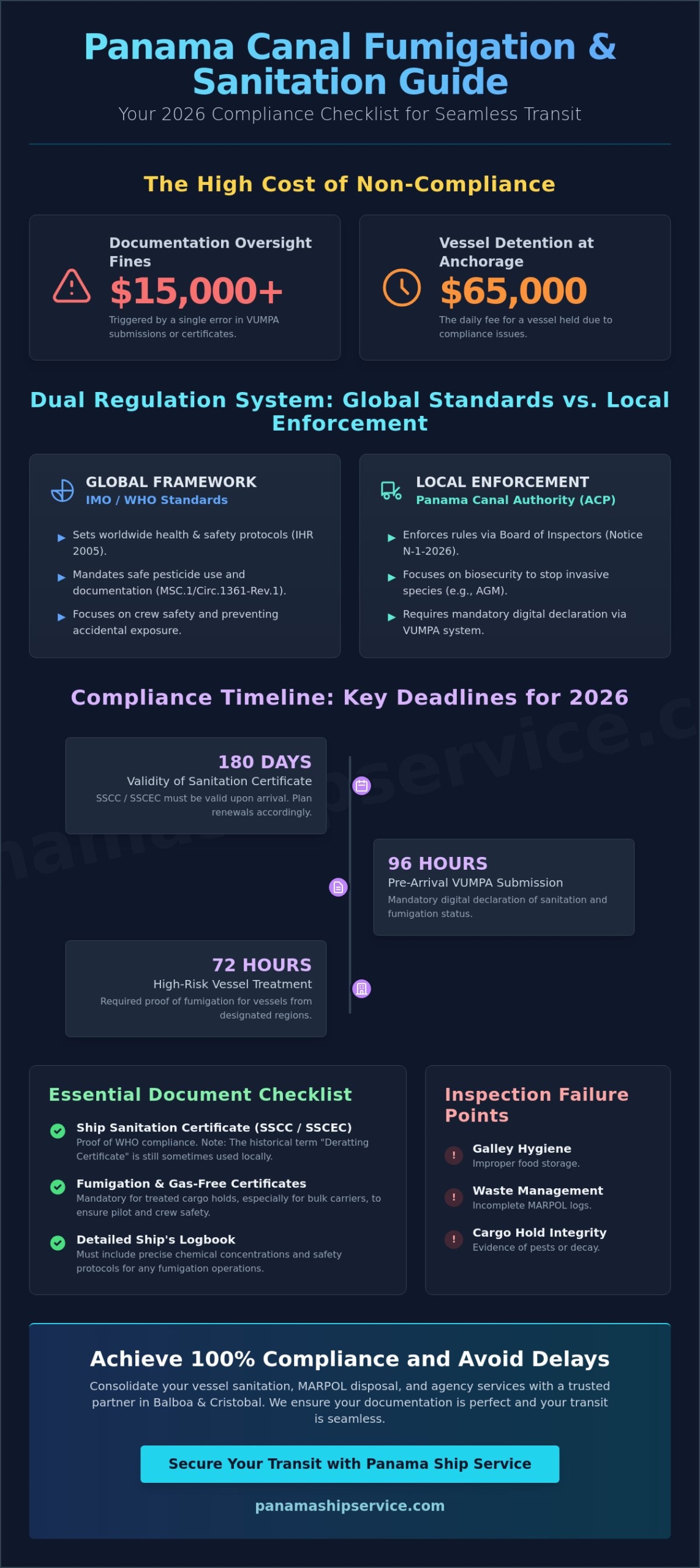
We know the frustration of balancing global IMO standards against local Panama Canal Authority (ACP) Notice to Shipping N-1-2026 rules. This guide provides the clarity you need to maintain compliance and protect your profit margins. We will show you exactly how to manage the 180-day validity window for sanitation certificates, meet the 72-hour fumigation deadline for high-risk vessels, and secure certified service providers in Balboa or Cristobal. We’re experts so you don’t have to be, ensuring your vessel moves through the locks without a second of wasted time.
Key Takeaways
- Understand the intersection of IMO IHR 2005 and the specific 2026 ACP Notice to Shipping requirements to avoid expensive transit fines.
- Learn the critical differences between SSCC and SSCEC documents and why maintaining a valid sanitation certificate remains a priority for the Panama Maritime Authority.
- Identify the mandatory “Gas-Free” certificate protocols for bulk carriers to ensure pilots board your vessel without delay.
- Master the latest vessel fumigation regulations to mitigate operational risks like gas leakage and ensure 100% compliance before reaching the Canal anchorage.
- Discover how consolidating your sanitation requirements with MARPOL disposal and agency services minimizes port time and administrative overhead.
Core Vessel Fumigation Regulations: IMO and ACP Standards for 2026
Compliance with vessel fumigation regulations in 2026 is a strategic operational move to prevent bottlenecks at the Panama Canal. The global framework for these rules starts with the World Health Organization’s International Health Regulations (IHR 2005). The International Maritime Organization (IMO) integrates these standards into its safety protocols to ensure ships don’t become mobile breeding grounds for disease or invasive pests. In the maritime sector, Fumigation serves two distinct purposes. It either addresses cargo sanitation to protect agricultural commodities or focuses on ship sanitation to maintain pest-free environments in crew quarters and storage lockers.
The 2026 regulatory updates focus heavily on biosecurity to stop the cross-continental spread of invasive species. Pests like the Asian Gypsy Moth (AGM) have caused significant ecological damage, leading the Panama Maritime Authority (PMA) to enforce stricter verification of sanitation history. If your vessel arrives from a designated high-risk region, the ACP requires proof of treatment within 72 hours of arrival. Mismanaging this timeline doesn’t just risk a fine; it can lead to a 48-hour transit delay and daily detention fees reaching $65,000.
IMO MSC.1/Circ.1361-Rev.1: The 2026 Standard
This circular provides the technical requirements for the safe use of pesticides on ships. Safety is the priority here. Under IMO 2026 standards, all fumigation operations must be documented in the ship’s logbook with precise chemical concentrations. You can’t simply state that a hold was treated; you must provide the data to prove it. The regulations also mandate strict safety perimeters and crew notification protocols to prevent accidental exposure during the voyage. Mastering these vessel fumigation regulations ensures you stay on schedule while protecting your crew.
Local Panama Canal Authority (ACP) Requirements
While the IMO sets the global stage, the ACP Board of Inspectors acts as the local enforcer at the Canal. They don’t take your documentation at face value. Inspectors verify sanitary conditions before any transit begins through the Neopanamax or Panamax locks. You must declare your vessel’s fumigation status through the Vessel Universal Measurement and Pre-Arrival (VUMPA) package at least 96 hours before arrival.
The 2026 transition to a fully digital VUMPA system means machine-validation of your documents happens instantly. This technology has increased first-submission rejection rates for vessels with incomplete histories. Failing to disclose a pest infestation or providing inaccurate chemical logs can result in fines exceeding $15,000. We recommend coordinating with a trusted partner in Balboa or Cristobal to ensure your declarations align with current ACP Notice to Shipping N-1-2026 standards.
Mandatory Ship Sanitation Certificates: SSCC and SSCEx
Every vessel entering the Panama Canal must present either a Ship Sanitation Control Certificate (SSCC) or a Ship Sanitation Control Exemption Certificate (SSCEC). These documents prove your vessel complies with the World Health Organization’s International Health Regulations. While the official names changed years ago, many local agents and authorities still use the term “Deratting Certificate.” It is a historical nod to the Canal’s roots in pest control. Don’t let the old terminology confuse you; the legal requirement for 2026 remains the modern SSCC or SSCEC.
These certificates are valid for exactly six months (180 days). If your certificate expires while you are at sea, you face an immediate transit hold and potential fines. Panama Ship Service coordinates directly with the Ministry of Health (MINSA) to schedule inspections upon your arrival at Balboa or Cristobal. We ensure the process is efficient so you don’t lose your transit slot. Understanding the nuances of vessel fumigation regulations is the only way to prevent these administrative bottlenecks.
The Inspection Process in Panama Ports
Inspectors focus on three critical areas: galley hygiene, waste management protocols, and cargo hold integrity. Common failures in Balboa often stem from improper food storage or incomplete MARPOL logs. If your vessel cannot be inspected at its current port of call before reaching Panama, authorities may grant a 30-day extension. This is not guaranteed. It requires a formal application through the Panama Maritime Authority (PMA) and proof that an inspection was not possible at previous ports.
Documentation and Record Keeping
Your VUMPA submission must include digital copies of your current sanitation documents. In 2026, the ACP’s digital transition means any discrepancy between your digital upload and the physical copy presented to the Board of Inspectors will trigger a red flag. Many operators choose to conduct marine surveys in Panama before the official inspection. This proactive step identifies potential hygiene or structural issues that could lead to a failed sanitation audit.
Maintain clear records of all previous pest control treatments and chemical concentrations used. To avoid the $15,000 fines associated with documentation errors, consult with our transit experts to review your certificates 96 hours before arrival. This ensures your vessel fumigation regulations data is machine-validated by the ACP system without issue.
Cargo Hold Fumigation: Procedures for Bulk and Container Vessels
Bulk carriers transiting the Canal with agricultural commodities face the most rigorous application of vessel fumigation regulations. These vessels often carry pests that threaten local ecosystems, making the cargo hold a primary target for ACP inspectors. For container vessels, the focus shifts to individual units that may have been treated at the port of origin. In both cases, the goal is to eliminate biological threats without compromising the safety of the crew or Canal personnel. Timing your treatment and subsequent aeration is the difference between a smooth transit and a costly stay at the anchorage.
Fumigant Selection and Regulatory Compliance
In 2026, Phosphine (AlP/Mg3P2) remains the industry standard for in-transit treatment of grains and bulk solids due to its effectiveness and relatively clean aeration profile. Conversely, Methyl Bromide is strictly restricted under updated environmental protocols; it often requires specialized permits that can delay your arrival. Dosage requirements aren’t static. They must be calculated based on the specific cargo volume and the ambient temperature of the holds during the voyage. A ‘Gas-Free’ status is achieved when toxic fumigant concentrations in all working areas, including the bridge and decks, are verified at zero or below the Threshold Limit Value (TLV) by a certified professional. Without this certification, the Panama Canal pilot won’t board your vessel, leading to an immediate loss of your transit slot.
Venting and Aeration Protocols
Venting is a technical process that requires precise timing. You must begin aeration well before reaching Canal waters to ensure all residual gases are cleared. Current safety standards mandate specific distances for crew members during the initial aeration phase to prevent accidental inhalation. Using specialized, calibrated sensors is the only reliable way to verify zero gas concentration before the Board of Inspectors arrives.
Improperly vented holds are a leading cause for ‘refusal of transit’ by the ACP. If a pilot detects even a faint odor or if sensors trigger an alarm upon boarding, the vessel is ordered to move to a designated waiting zone. This results in unplanned costs, including additional tugboat fees that range from $5,000 to $15,000 per movement. Our team monitors these vessel fumigation regulations to ensure your hold conditions meet the strict 2026 requirements before you reach the locks.
Managing In-Transit Fumigation Risks and Safety
In-transit fumigation is a legal and efficient way to manage pests during long voyages, but it introduces specific safety vulnerabilities. Both IMO standards and Panamanian law permit this practice as long as the master ensures no gas escapes into living spaces. The 2026 updates to vessel fumigation regulations place the burden of proof on the ship’s officers. You must demonstrate that the vessel is safe for third parties, specifically the Panama Canal pilots and ACP inspectors, to board without risk of exposure.
Gas leakage is the primary concern. Even a small breach in hold seals can allow toxic concentrations to accumulate in crew cabins or the engine room. If a critical system fails while the vessel is under gas, you face a double crisis. Performing mechanical ship repairs during an active fumigation cycle requires specialized breathing apparatus and strict ventilation monitoring to keep technical teams safe. You can’t simply send a technician into a space where gas levels haven’t been verified as zero. Furthermore, you must post mandatory “Fumigation in Progress” signage at every access point. These zones are strictly off-limits to anyone without specific authorization and the proper safety gear.
Safety Equipment and Crew Training
Every vessel must carry self-contained breathing apparatus (SCBA) and multi-gas detectors that are calibrated to the specific fumigant being used. A “Qualified Person” must be appointed to monitor gas levels every 8 hours throughout the voyage. This isn’t just a safety tip; it’s a regulatory requirement to prove the vessel is safe for the Panama Canal pilot. If a leak is detected during the transit of the locks, the ACP will trigger emergency evacuation protocols. This often results in the vessel being towed to a safe anchorage at your expense, adding thousands to your transit costs.
Liability and Insurance Considerations
P&I Clubs often require detailed documentation of the fumigation plan before they confirm coverage for a voyage. If an incident occurs and you can’t prove “Due Diligence” through proper logs, your insurance coverage may be compromised. Using a certified partner like Panama Ship Service ensures that every step follows the 2026 vessel fumigation regulations. We provide the machine-validated logs and safety certificates needed to satisfy both insurers and the ACP Board of Inspectors. Put your transit in our hands to avoid the legal and financial fallout of a safety breach. Contact our team for a risk assessment before your next transit to ensure your paperwork and safety protocols are airtight.
Achieving 100% Compliance with Panama Ship Service
Panama Ship Service acts as your one-stop-shop for navigating the strict vessel fumigation regulations enforced by the ACP. With over 20 years of experience, we understand that timing is everything in this industry. A single documentation error or a failed sanitation inspection can derail your entire transit schedule. We’re experts so you don’t have to be. Our team coordinates directly with the Panama Maritime Authority and the Ministry of Health to ensure your vessel meets every 2026 requirement before it reaches the locks.
Efficiency is the core of our value proposition. We minimize vessel expenses by consolidating essential services into a single, managed workflow. Instead of coordinating with multiple vendors, you can bundle your mandatory sanitation audits with MARPOL disposal in Panama. This integrated approach reduces time spent in port and ensures all your environmental and sanitary paperwork is machine-validated by the ACP portal simultaneously. We provide rapid response for emergency inspections, ensuring that even last-minute certificate renewals don’t cause you to lose your transit slot.
Expert Sanitary Inspections and Pest Control
Our methodology for deratting and cockroach infestation control is designed to meet the highest international biosecurity standards. We don’t just apply treatments; we provide the verified chemical logs and safety documentation required by the ACP Board of Inspectors. Whether your vessel is anchored in Balboa or Cristobal, our technicians are available for immediate deployment. We issue ACP-recognized certificates that guarantee zero transit delays due to sanitary non-compliance. Our proactive approach identifies potential risks 96 hours before arrival, giving you the window needed to rectify issues without facing the $15,000 fines common in 2026.
Integrated Technical Solutions
We maximize your operational window by performing multiple services concurrently. Our team can execute underwater hull services while fumigation or sanitation inspections are underway. This eliminates redundant downtime and keeps your vessel moving through the Canal without unnecessary pauses. We maintain constant daily communication with owners and charterers, providing real-time updates on inspection progress and certificate status. Put your transit in our hands to ensure a cost-conscious, compliant, and efficient passage. Contact our experts today for a compliance audit or quote to secure your 2026 transit schedule.
Secure Your 2026 Transit Slots with Expert Compliance
The 2026 transit environment leaves no room for documentation errors or expired sanitation certificates. Adhering to vessel fumigation regulations is your primary defense against the $65,000 daily detention fees and $15,000 fines that occur when biosecurity standards aren’t met. You’ve seen how critical the 180-day validity window and proper hold aeration are for a successful passage. Now is the time to verify your paperwork and ensure your vessel is ready for the Board of Inspectors before you reach the locks.
With 20 years of expertise at the Panama Canal, Panama Ship Service is your certified MARPOL and sanitary service provider. We offer rapid response in Balboa and Cristobal ports to manage everything from deratting certificates to emergency inspections. We’re experts so you don’t have to be. Put your transit in our hands and eliminate the stress of regulatory bottlenecks. Secure your vessel’s compliance and avoid transit delays; contact Panama Ship Service today. We look forward to being your trusted partner on the water and ensuring your next transit is a success.
Frequently Asked Questions
What is the difference between a Ship Sanitation Control Certificate and an Exemption Certificate?
An SSCC is issued after an inspector finds evidence of pests and oversees a treatment process. An SSCEC is issued when a vessel is found to be clean and is therefore exempt from control measures. Both certificates fall under the 2026 vessel fumigation regulations based on WHO standards. You must present one of these documents to the ACP Board of Inspectors to prove your ship isn’t a biological hazard.
Can a vessel transit the Panama Canal while under fumigation?
Vessels can transit under active fumigation only if the crew and pilot remain entirely protected from toxic exposure. The master must provide a written declaration that all working spaces, including the bridge and decks, are gas-free. If ACP sensors detect fumigants upon boarding, the vessel is removed from the queue. This results in unplanned costs for tugboat assistance and lost transit slots.
How long is a Deratting Certificate valid for in Panama?
A Deratting Certificate, now officially an SSCC or SSCEC, remains valid for exactly 180 days from the date of issuance. If your certificate expires while you’re approaching the Canal, you must apply for a 30-day extension through the Panamanian Ministry of Health (MINSA). Without a valid document or an approved extension, the ACP won’t allow the vessel to enter the locks.
What happens if my vessel fails a sanitary inspection at the Panama Canal?
Failure results in an immediate denial of transit and the vessel is sent to a designated anchorage for remediation. You must hire an authorized service provider to rectify the hygiene or pest issues before a follow-up inspection is scheduled. This process often causes delays of 48 hours or more. Beyond the lost time, you face administrative fines that often exceed $15,000.
Are there specific pesticides prohibited for use in the Panama Canal?
Methyl Bromide is strictly restricted in 2026 due to updated environmental biosecurity standards. Most operators have transitioned to Phosphine (AlP/Mg3P2) for cargo hold treatments. Using unapproved chemicals or failing to document chemical concentrations in the ship’s logbook leads to immediate rejection of your VUMPA submission. Always verify that your chosen pesticide aligns with current ACP Notice to Shipping N-1-2026 requirements.
How many hours before Canal transit must fumigation venting be completed?
Venting must be finished and the vessel certified gas-free before the pilot boards for transit. While the ACP doesn’t mandate a specific number of hours, the 96-hour pre-arrival notification requires you to declare your status. Most successful transits involve completing the aeration process at least 24 hours before reaching the anchorage to ensure sensors show zero concentration.
Do I need a new fumigation certificate for every transit?
You don’t need a new certificate for every transit if your existing document is within its 180-day validity window. However, you must upload the valid digital certificate to the Maritime Service Portal for every single transit. If the certificate is set to expire within 30 days of your arrival, we recommend renewing it in Balboa or Cristobal to avoid complications.
Who is authorized to issue a valid Ship Sanitation Certificate in Panama?
The Panamanian Ministry of Health (MINSA) is the sole authority permitted to issue or renew these certificates within Panama. They coordinate with the Panama Maritime Authority (PMA) to enforce vessel fumigation regulations. Panama Ship Service acts as your liaison, scheduling the inspectors and ensuring all shipboard conditions meet the necessary criteria for a successful, rapid issuance of the certificate.