
A single mechanical failure in the Neopanamax locks can now trigger an immediate $250,000 high-impact disruption charge before a single repair technician even steps on board. You’re likely already aware that the cost of delay has reached unprecedented levels, with transit slot auction premiums recently surging to an average of $385,000. When your vessel loses propulsion or steering in these waters, the pressure to act isn’t just operational; it’s a matter of protecting your bottom line from staggering ACP penalties and dead ship surcharges that can quickly spiral out of control.
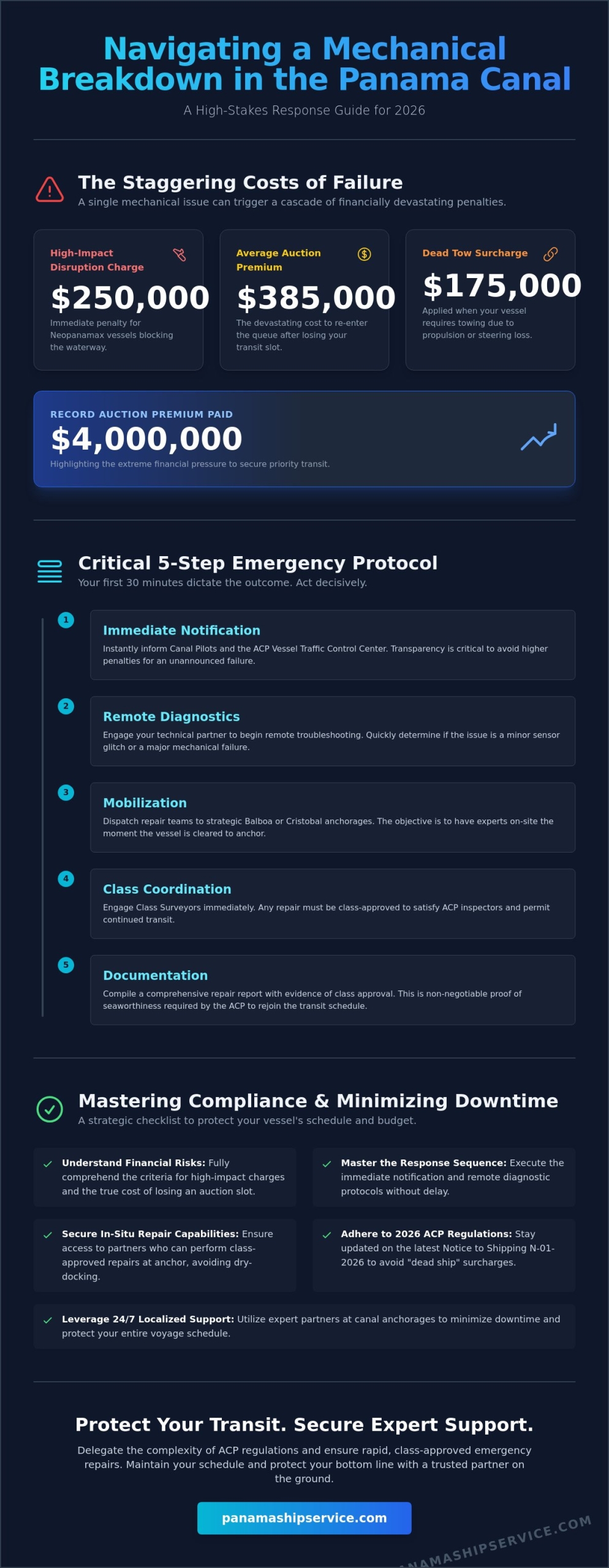
This guide delivers a comprehensive mechanical breakdown response panama canal strategy designed for the high-stakes environment of 2026. You’ll learn how to navigate the latest Notice to Shipping N-01-2026 requirements and deploy rapid technical solutions that satisfy both the Panama Canal Authority and your classification society. We’ll outline the exact protocols for immediate intervention and clear communication, ensuring you avoid the $175,000 dead tow surcharge and maintain your schedule through this critical global hub. By mastering these emergency strategies, you can delegate the complexity of local regulations to expert partners and focus on a safe, cost-effective transit.
Key Takeaways
- Understand the severe financial repercussions of transit delays, including the specific criteria for high-impact disruption charges and auction slot losses.
- Master the essential sequence of a mechanical breakdown response panama canal, starting with immediate ACP notification and remote technical diagnostics.
- Identify critical in-situ repair capabilities for propulsion and engine systems that facilitate class-approved restoration without the need for dry-docking.
- Decipher the latest 2026 ACP regulations to ensure full compliance and avoid costly “dead ship” or “dead tow” surcharges during an emergency.
- Learn how to leverage 24/7 localized support at strategic canal anchorages to minimize downtime and protect your vessel’s operational schedule.
The High Stakes of Mechanical Failure During Panama Canal Transit
The Panama Canal isn’t just a waterway; it’s a meticulously synchronized engine of global trade. With an average of 37 daily transits recorded in March 2026, there’s zero margin for equipment failure. A single engine stall or steering malfunction doesn’t just halt one vessel. It creates a logistical bottleneck that ripples across the entire maritime schedule. The Panama Canal Authority (ACP) operates with an efficiency-first mandate, meaning a disabled vessel is viewed as a threat to the canal’s throughput. If your ship cannot maintain the required speed or maneuverability, the ACP will intervene aggressively to clear the channel, often at the owner’s extreme expense.
Chokepoint Dynamics: Why Timing is Everything
The Neo-Panamax locks operate on a rigid, pre-booked scheduling system. When a vessel enters the approach channel, every minute is accounted for by tugboat assignments and pilot rotations. A technical glitch that causes a 2-hour delay can result in a total loss of the transit window, often forcing a 48-hour rescheduling penalty. This isn’t just an administrative hurdle; it’s an operational crisis. The pressure on the crew is intense as they must execute a mechanical breakdown response panama canal protocol while under the direct supervision of Canal Pilots. Failure to resolve issues within the ACP’s allotted time frame leads to immediate expulsion from the transit queue to keep traffic moving.
The Financial Anatomy of a Breakdown
The costs associated with a breakdown in 2026 are higher than ever before. Beyond direct towage and pilotage fees, the ACP now applies a High Impact Disruption Charge of $250,000 for Neopanamax vessels that block the waterway. If you lose your slot, re-entering the queue is financially devastating. Average auction premiums for transit slots hit $385,000 in early 2026, with some fuel vessels paying a record $4 million to secure a priority spot. To mitigate these losses, operators need immediate access to mechanical ship repairs that meet class-approval standards. Every hour spent idling at anchor consumes fuel and risks missing subsequent port calls. This creates a cascading delay effect that can cost millions in lost revenue and supply chain penalties across your entire voyage.
Emergency Protocol: Immediate Steps for a Mechanical Breakdown Response
When a vessel suffers a power loss or steering failure in the approach channel, the clock starts instantly. Your first thirty minutes dictate whether you face a standard repair delay or a $250,000 high-impact disruption charge. A successful mechanical breakdown response panama canal requires a dual-track approach: satisfying the regulatory demands of the ACP while simultaneously executing a technical recovery. You don’t have time for trial and error. Following a structured protocol is the only way to protect your transit slot and your budget.
- Step 1: Immediate Notification: Inform the Canal Pilots and the ACP Vessel Traffic Control Center immediately. Transparency is better than an unannounced mid-lock failure.
- Step 2: Remote Diagnostics: Contact your technical partner to begin remote troubleshooting. Identifying if the issue is a sensor glitch or a major mechanical failure determines your next move.
- Step 3: Mobilization: Dispatch repair teams to the Balboa or Cristobal anchorages. The goal is to meet the vessel as soon as it’s cleared to anchor.
- Step 4: Class Coordination: Engage Class Surveyors early. Any repair intended to allow continued transit must be class-approved to satisfy ACP inspectors.
- Step 5: Documentation: Compile a detailed repair report. You’ll need this to prove the vessel’s seaworthiness before the ACP allows you back into the transit schedule.
Reporting and Communication with the ACP
How you phrase your deficiency report matters. The ACP evaluates risk based on your initial communication. Vague descriptions lead to conservative, high-cost decisions by traffic controllers. You need a representative who understands the Panama Canal Authority’s official maritime regulations and can speak their technical language. Accurate reporting that aligns with Notice to Shipping N-01-2026 requirements can often prevent a vessel from being classified as a “dead ship,” saving you from the mandatory $250,000 surcharge.
Rapid Mobilization: Balboa vs. Cristobal
Logistics vary significantly depending on your location. At the Pacific entrance (Balboa), technicians and parts can often be mobilized from local workshops within two hours. On the Atlantic side (Cristobal), coordination requires managing launch services for mid-transit boarding if the vessel is already in the Gatun Lake. Launch services are the lifeblood of emergency repairs; they allow teams to board and begin work while the vessel is still being moved to a safe anchorage. To ensure the fastest possible intervention, it’s vital to coordinate with an expert local technical partner who maintains 24/7 readiness at both canal entrances. This proactive stance is the difference between a minor delay and a multi-day operational shutdown.
Critical Repair Capabilities: From Main Engines to Propulsion Systems
Restoring operational status while at anchor is the primary goal of any mechanical breakdown response panama canal. The ACP requires vessels to be fully self-propelled and maneuverable before entering the locks. In-situ repairs are the only viable solution to avoid the logistical nightmare of unloading cargo or the extreme costs of an emergency dry-docking. Technical teams must be prepared to troubleshoot complex mechanical systems under tight deadlines to meet the next available transit window.
Main Engine and Auxiliary Power Recovery
Main engine failures often stem from fuel system irregularities or governor malfunctions. A faulty fuel injection pump or a seized turbocharger can immediately disqualify a vessel from transit. Because the canal’s waters are tropical and often congested, auxiliary power systems must remain “live” to support ventilation, cooling, and navigation equipment. Reliable mechanical ship repairs panama depend on a partner’s ability to source critical spare parts locally. The Colon Free Zone serves as a strategic hub for this, allowing for the rapid delivery of specialized components like liners, pistons, or electronic control modules that would otherwise take days to arrive via international air freight.
Propulsion and Steering Gear Emergency Work
Maneuverability is non-negotiable, especially when navigating the narrow confines of the Culebra Cut. Steering gear hydraulic failures are frequent, often requiring immediate seal replacements or valve bypasses to restore redundancy. If the issue is external, such as a fouled propeller or a damaged shaft seal, specialized underwater hull services are required. Divers must execute these repairs at the Balboa or Cristobal anchorages to ensure the vessel meets the ACP’s stringent safety inspections. Any perceived lag in steering response or propulsion power will result in a pilot refusing to proceed, triggering the disruption charges discussed in earlier sections. Technical proficiency in these areas ensures your vessel remains compliant and avoids being reclassified as a dead tow.
Understanding ACP Disruption Charges and Regulatory Compliance
The Panama Canal Authority (ACP) maintains a zero-tolerance policy regarding vessel deficiencies that impede the flow of traffic. The Disruption Charge is a regulatory tool designed to penalize any vessel that causes a delay or requires extra resources due to mechanical failure. This isn’t a negotiable fee; it’s a mandatory tariff applied when a vessel’s “non-operational equipment” creates a bottleneck. A strategic mechanical breakdown response panama canal plan focuses on technical restoration and regulatory mitigation to prevent these costs from compounding.
The ACP categorizes these charges based on the severity of the incident and the vessel’s dimensions. For Neopanamax and Panamax-plus vessels, a High Impact Disruption Charge is set at $250,000.00. This applies to major incidents that significantly obstruct the waterway or lock operations. For less severe disruptions, a Low Impact Disruption Charge of $65,000.00 is levied. If your vessel is deemed a “dead ship” because it cannot move under its own power, you face an additional mandatory surcharge of $250,000.00 for the towage through the canal. These figures represent the baseline before adding the costs of tugs, pilots, and rescheduling fees.
The Financial Impact of Disruption Fines
The ACP does not accept “waiting for parts” as a valid reason for remaining at a transit anchorage. Their priority is the 37 daily transits that must proceed without interruption. If your technical partner cannot source components or execute repairs immediately, the ACP will order the vessel to be towed out of the canal’s waters, often to a distant anchorage, which triggers the $175,000.00 Dead Tow Surcharge. Engaging in proactive marine surveys panama before your arrival can identify potential failure points in fuel systems or steering gear, allowing you to address them before they become a $250,000 liability.
Satisfying the Canal Safety Inspectors
Once a repair is complete, the vessel must pass a rigorous inspection by ACP safety officials. These inspectors follow the Notice to Shipping N-01-2026, which outlines the technical requirements for all transiting vessels. They look for more than just a functioning engine; they require proof of redundancy and reliability. You must provide detailed documentation of the repair, often including class-approved certificates for any major component replacements. Before re-entering the locks, the pilot will typically require trial maneuvers, such as a “crash astern” test and full-range steering checks, to ensure the vessel can handle the narrow confines of the canal. To navigate these high-stakes inspections and minimize your downtime, you should contact a specialized local technical partner who can manage both the repairs and the regulatory paperwork on your behalf.
Why Panama Ship Service is the Preferred Choice for Emergency Repairs
In a high-stakes environment where a $250,000 disruption charge is a single mechanical failure away, having a dependable partner isn’t a luxury. It’s a necessity. Panama Ship Service provides the specialized expertise required to execute a rapid mechanical breakdown response panama canal at both the Pacific and Atlantic entrances. We don’t just fix engines; we manage the entire recovery process, from technical diagnostics to regulatory clearance. Our approach is built on efficiency and a deep understanding of the maritime industry’s operational pressures.
Our teams are stationed strategically near Balboa and Cristobal ports. This proximity allows us to board vessels at anchor within hours of an incident report. We maintain a “flying squad” of technicians who specialize in emergency repairs. They understand that every hour at anchor is an hour of lost revenue. By acting as a single point of contact, we eliminate the friction between repair teams, logistics providers, and the ACP. This one-stop-shop model ensures that technical, regulatory, and logistical hurdles are cleared simultaneously.
Local Expertise and Strategic Hub Positioning
Success in the Panama Canal depends as much on relationships as it does on mechanical skill. We’ve spent decades building a reputation for reliability with ACP inspectors and international Class societies. This trust facilitates smoother inspections and faster approval of temporary repairs. To further optimize your time at anchor, we offer a consolidated service model. You can manage your MARPOL disposal panama requirements simultaneously with your mechanical repairs. This integrated approach ensures your vessel is compliant with both environmental and safety regulations before you re-enter the transit queue. We handle the complexity so you can simplify your operations.
Minimizing Downtime and Protecting Your Bottom Line
Throughout 2025 and into early 2026, we’ve successfully intervened in numerous high-pressure scenarios where vessels faced immediate expulsion from the canal. In one recent case, a Neopanamax container ship with a steering gear failure was restored to operational status within 12 hours. This rapid intervention avoided both the disruption charge and the loss of a multi-million dollar auction slot. We understand the urgency of the Canal schedule. Our 24/7 availability across all anchorages means we’re ready to deploy the moment you encounter a deficiency. We take the burden of technical troubleshooting off your hands, allowing you to focus on your voyage. When the stakes are this high, don’t leave your recovery to chance. Contact Panama Ship Service for 24/7 Emergency Support to secure your transit and protect your budget.
Protecting Your Transit Schedule and Bottom Line
Navigating the 2026 maritime landscape requires more than just technical skill; it demands a strategic alignment with ACP regulations and rapid mobilization. By implementing a structured mechanical breakdown response panama canal, you can mitigate the risk of high-impact disruption charges and maintain your voyage continuity. Success hinges on immediate technical intervention and class-approved repairs that satisfy canal safety inspectors before your transit window expires. Proactive management of these emergencies ensures that a technical failure remains a manageable delay rather than a financial catastrophe.
Delegate the complexity of emergency repairs to a partner with the localized expertise to handle high-pressure scenarios. We provide 24/7 Emergency Response Units and Class-Approved Mechanical Technicians from our strategic hubs in Balboa and Cristobal. This proximity ensures your vessel receives the proficiency required to resolve propulsion or steering issues without unnecessary delays. Secure Immediate Mechanical Support for Your Panama Canal Transit and ensure your vessel remains an efficient part of the global supply chain. We’re ready to protect your operations at a moment’s notice.
Frequently Asked Questions
What is the very first thing I should do if my vessel has a mechanical breakdown in the Panama Canal?
Notify the Canal Pilot and ACP Vessel Traffic Control immediately. This transparency is the first step in an effective mechanical breakdown response panama canal strategy to ensure waterway safety. Once you’ve reported the deficiency, you must activate your local technical partner to begin diagnostics and repair mobilization to avoid the vessel being classified as a major disruption risk.
How much are the Panama Canal disruption charges for a disabled vessel?
High Impact Disruption Charges for Neopanamax vessels are $250,000.00 as of the February 2026 tariff update. Low impact disruptions carry a $65,000.00 fine. If the vessel is non-operational and requires a tow, a Dead Ship Surcharge of $250,000.00 is applied, making immediate technical intervention a financial necessity.
Can repairs be carried out while the vessel is waiting for its transit slot?
Yes, performing repairs at the Balboa or Cristobal anchorages while awaiting your transit window is standard practice and highly recommended. It ensures the vessel meets all ACP requirements before the pilot boards for the actual transit. This proactive approach prevents the loss of expensive auction slots and avoids the application of disruption penalties.
Does the ACP provide its own repair services for broken-down ships?
No, the Panama Canal Authority doesn’t provide ship repair services. They act strictly as the regulatory and governing body for the waterway. Ship owners must contract independent, licensed technical providers to perform mechanical repairs, underwater services, or marine surveys to satisfy the ACP’s safety requirements.
How long does it take for a repair team to board a vessel at the Balboa anchorage?
Technical teams can typically board a vessel at the Balboa anchorage within two hours of a request. This timeline depends on the speed of local launch services and the completion of required security documentation. Strategic positioning near the port entrances is vital for minimizing this response time during an emergency.
Are the technicians at Panama Ship Service certified by major Class societies?
Yes, all technicians are trained to perform repairs that meet the standards of major Class societies like ABS, Lloyd’s, and DNV. This is a requirement for a successful mechanical breakdown response panama canal. ACP inspectors will only clear a vessel for transit if the repairs are documented and certified as seaworthy by a recognized authority.
What happens if my vessel cannot be repaired in time for its scheduled transit?
The vessel loses its transit slot and must re-enter the auction queue, where average premiums reached $385,000 in early 2026. The ACP may also order a mandatory tow to a safe anchorage outside the main channel. This results in significant operational delays and the potential for a $175,000.00 Dead Tow Surcharge.
Can you assist with sourcing rare engine spare parts in Panama?
Yes, parts can be sourced rapidly through the Colon Free Zone and established local logistics networks. This allows for the acquisition of critical engine components without the multi-day delays associated with international air freight. Local inventory management is key to resolving mechanical failures before they cause a total schedule collapse.