
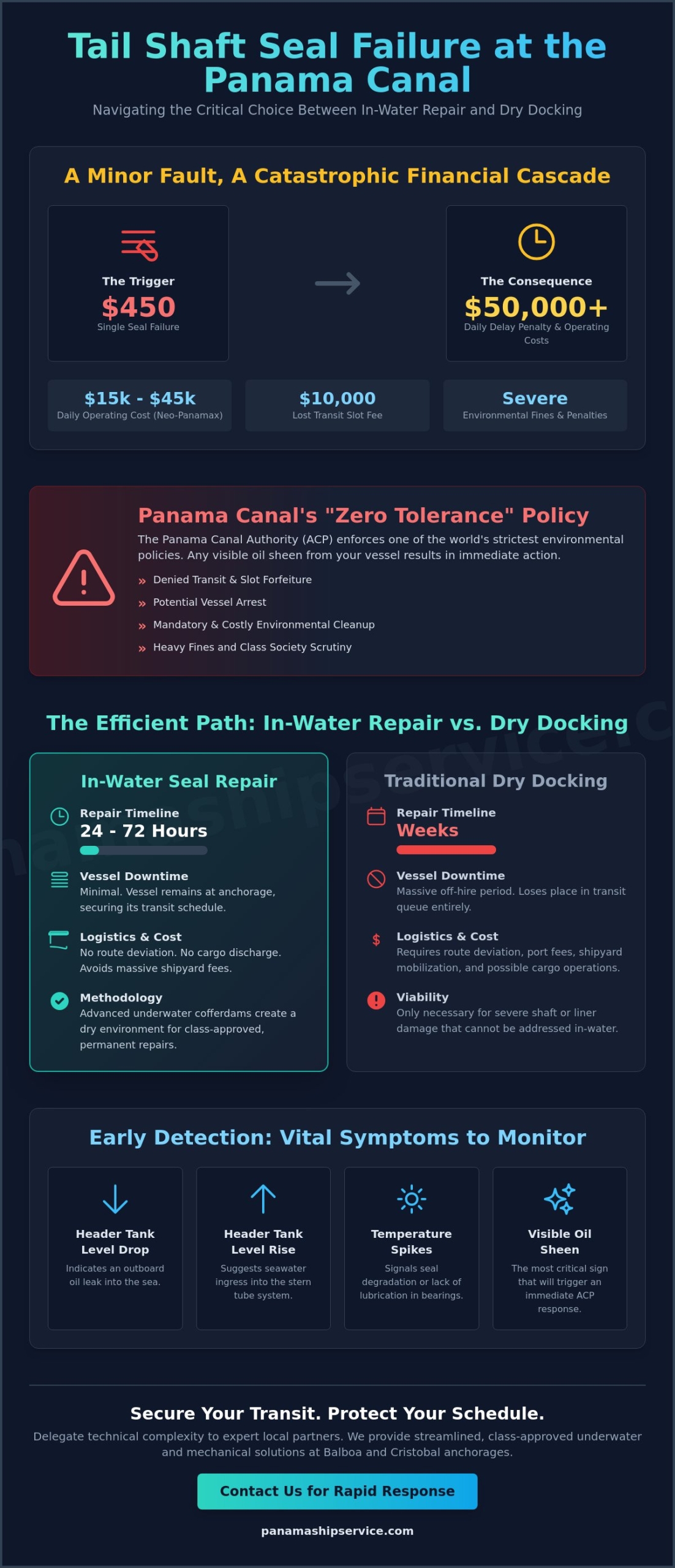
Did you know that a single $450 seal failure can trigger a $50,000 daily delay penalty if your vessel misses its scheduled Panama Canal transit? For a Neo-Panamax container ship, where daily operating costs range from $15,000 to $45,000, every hour spent waiting for a solution is a massive financial drain. It’s an incredibly high-pressure situation when a tail shaft seal begins to leak just as you’re approaching the isthmus. You’re balancing the threat of environmental fines and potential cargo seizure against the risk of losing a $10,000 transit slot due to mechanical failure.
We understand that the complexity of coordinating underwater divers and mechanical engineers can feel overwhelming when your schedule is on the line. You’ll learn how to resolve these leaks through a specialized tail shaft seal repair panama without the need for emergency dry docking, ensuring you maintain both environmental compliance and your transit window. This article previews how to integrate underwater hull services with expert mechanical ship repairs to achieve a class-approved restoration and zero oil discharge with minimal vessel downtime. By delegating this technical complexity to experienced local partners, you can focus on a successful transit and optimized operations.
Key Takeaways
- Understand the operational impact of the Panama Canal’s Zero Tolerance oil discharge policy and how to avoid severe environmental fines.
- Compare the efficiency of in-water solutions against traditional dry docking to reduce your repair timeline from weeks to just 24 to 72 hours.
- Discover the technical requirements for a professional tail shaft seal repair panama using advanced underwater cofferdam techniques.
- Navigate the logistical complexities of coordinating mechanical repairs and AMP permits at either Balboa or Cristobal anchorages.
- Secure your vessel’s schedule by integrating underwater hull services and mechanical repairs into a single, streamlined operation.
Tail Shaft Seal Leakage: Critical Risks During Panama Canal Transit
The tail shaft seal, also known as the stern tube seal, acts as the primary barrier between the ocean and your vessel’s internal machinery. It serves a dual purpose: keeping seawater out of the engine room and containing lubricating oil within the stern tube. Understanding the technical details of radial shaft seals highlights their vulnerability. These components operate under constant pressure and friction; even a small piece of fishing line or sediment can compromise the sealing surface. When a failure occurs near the isthmus, the operational stakes escalate instantly.
The Panama Canal Authority (ACP) enforces a strict “Zero Tolerance” policy for oil discharge. Any visible sheen trailing from your vessel is a red flag for inspectors. If a leak is detected during the pre-transit inspection or while at anchorage, the ACP can deny your transit slot immediately. This isn’t just a minor delay. A denied transit often leads to vessel arrest and mandatory environmental cleanup orders. Securing a tail shaft seal repair panama is the only way to satisfy inspectors and protect your schedule.
The financial difference between an in-water repair and emergency dry docking is immense. Emergency dry docking requires you to deviate from your route, wait for an open dock, and pay massive mobilization fees. It can take weeks to complete. In-water repairs allow your vessel to stay afloat at the Balboa or Cristobal anchorage. This method resolves the leak in a fraction of the time, keeping your Neo-Panamax operating costs under control and avoiding the $10,000 slot cancellation fees that follow a missed transit.
Symptoms of Tail Shaft Seal Failure
Early detection is vital for avoiding a total operational shutdown. Monitor your stern tube header tank levels for any unexplained drops, which indicate an outboard oil leak. Conversely, an increase in tank levels or the presence of emulsified oil suggests seawater ingress. You should also track temperature readings from the stern tube bearings. Sudden temperature spikes often signal seal degradation or a lack of lubrication. If you notice an oil sheen while at the Pacific or Atlantic entrance, you must act before the Canal Authority intervenes.
Regulatory Consequences in Panama
The ACP environmental compliance requirements are among the strictest in the world. Fines for oil spills are heavy, and the vessel owner is responsible for all remediation costs. Beyond the canal officials, you must satisfy Class society requirements from organizations like ABS, DNV, or Lloyd’s. While Class may occasionally allow a temporary “voyage repair,” they typically demand a permanent, class-approved solution before the vessel can continue its journey. A professional tail shaft seal repair panama ensures that your ship meets these rigorous standards without the need for a shipyard visit.
Underwater vs. Dry Dock Repair: Choosing the Efficient Path
Deciding between an underwater intervention and a shipyard visit is a critical choice for any technical superintendent. While traditional thinking suggests dry docking for stern tube issues, modern technology has shifted the advantage toward in-water solutions. A tail shaft seal repair panama can typically be completed within 24 to 72 hours. Compare this to the weeks required for a dry dock stay; that includes time spent waiting for an available berth and the logistical nightmare of diverting a fully laden vessel. Staying afloat preserves your schedule and avoids the massive off-hire costs associated with deviation.
The cost-benefit analysis favors underwater repair because it eliminates the need to discharge cargo or gas-free the vessel. You avoid mobilization fees and the daily rates of a shipyard, which often exceed the cost of the repair itself. However, technical feasibility depends on the condition of the shaft. If the liner is severely scored or the shaft is bent, in-water methods cannot provide a permanent fix. For standard seal wear or minor debris damage, the underwater path is almost always superior for maintaining your position in the transit queue.
In-Water Repair Methodologies
Technicians achieve a dry working environment underwater using hyperbaric habitats or specialized cofferdams. These structures are fitted around the propeller hub and stern tube, allowing divers to perform mechanical work in a dry space. A key technical distinction involves the choice between bonded and non-bonded seals. In-situ bonding allows technicians to join the new seal around the shaft without removing the propeller. This process is highly reliable when performed by experienced teams; it ensures a seamless, vulcanized join that meets class standards. Coordinating these underwater hull services with mechanical precision is the hallmark of a successful repair.
The Dry Dock Alternative in the Region
Relying on dry dock availability in Central America is a risky strategy. Shipyards in the Caribbean are often booked months in advance, leaving vessels with emergency leaks in a vulnerable position. Diverting a vessel means violating the Panama Canal Authority maritime regulations regarding vessel readiness; this can result in the immediate loss of your transit slot. As mentioned previously, a 24-hour delay can trigger a slot cancellation fee of $10,000 or more. When you factor in the daily OPEX of a Neo-Panamax ship, the financial argument for an in-water solution becomes undeniable.
Technical Requirements for In-Water Seal Replacement
Executing a successful tail shaft seal repair panama requires a rigorous adherence to technical standards and mechanical precision. Whether your vessel utilizes lip-type or face-type seals, the repair process must be standardized to meet original equipment manufacturer (OEM) specifications. The reliability of the repair depends on the environment created underwater. While lip seals are often bonded in-situ, face seals might require different handling. Technical teams must be proficient in both to ensure the vessel’s integrity isn’t compromised during the transition back to operational status.
Logistics play a decisive role in the technical success of the repair. Panama’s “Spares in Transit” (SIT) legal framework is a significant advantage for ship owners. This regime allows for the tax-free importation of OEM spare parts, exempting them from the 7% ITBMS sales tax and other duties. Having the correct seals waiting at the port of Balboa or Cristobal is essential. Without these specific components, even the most skilled divers cannot complete a permanent restoration. Meticulous planning ensures that parts arrive before the vessel, avoiding the $50 per day storage fees typically charged by bonded warehouses for delayed cargo.
Pre-repair inspections are the most critical technical step. Before any bonding occurs, technicians must measure shaft wear and the condition of the chrome liner. If the liner is heavily pitted or scored beyond a certain tolerance, a simple seal replacement won’t suffice. Throughout this process, class surveyor attendance from organizations like ABS or DNV is mandatory. The surveyor’s role is to verify that the repair meets permanent certification standards, allowing the vessel to maintain its insurance coverage and regulatory standing.
Preparing the Vessel for Repair
Preparation begins with stabilizing the vessel’s position and environment. If the cargo configuration allows, the crew can trim the vessel by the head. This action raises the stern tube closer to the waterline, reducing the external water pressure on the repair area. Divers then perform a detailed cleaning of the hull and propeller hub to ensure a debris-free workspace. Crucially, the engine room team must isolate the stern tube oil system. This prevents any accidental oil discharge into the canal waters during the seal’s removal, maintaining compliance with the ACP’s strict environmental mandates.
The Bonded Seal Repair Process
The core of the tail shaft seal repair panama is the in-situ bonding process. Once the old seal is removed, the chrome liner is cleaned and inspected for any imperfections that could cause future leaks. Technicians then join the new seal around the shaft using specialized vulcanizing adhesives. This bonding requires a controlled, dry environment provided by the cofferdam. After the adhesive has cured, the system undergoes a series of pressure trials. These tests simulate operational conditions to confirm a leak-free seal before the mechanical team signs off on the repair.
Coordinating Repairs in Balboa and Cristobal Ports
Choosing the correct terminal for a tail shaft seal repair panama is a strategic decision that impacts both your budget and your timeline. Panama offers two primary hubs for technical intervention: Balboa on the Pacific side and Cristobal on the Atlantic side. Misidentifying the delivery port for your spare parts can result in $300 to $500 in unnecessary cross-isthmus trucking fees. To avoid these logistical friction points, you must align your repair location with your vessel’s transit direction and the current availability of anchorage space.
Navigating the permit process is the next critical hurdle. Every underwater mechanical intervention requires formal authorization from the Panama Maritime Authority (AMP). A licensed local ship agent is legally required to facilitate these permits and manage the customs release of “Spares in Transit.” We handle the administrative burden by coordinating directly with the AMP and the Panama Canal Authority (ACP) to ensure all diving and mechanical work is fully compliant. This proactive management prevents administrative delays that could otherwise jeopardize your scheduled transit slot.
Timing is the most volatile factor in this operation. You must synchronize the arrival of specialized diving teams and mechanical tools with your vessel’s arrival at the anchorage. A 24-hour delay in a part’s arrival can force a vessel to lose its position, resulting in a slot cancellation fee of $10,000 or more. Our teams prioritize rapid mobilization to ensure the repair window fits within your pre-booked transit schedule, minimizing the risk of costly penalties.
Balboa (Pacific Side) Logistics
The Balboa anchorage is the preferred choice for northbound vessels. While the Pacific side can experience more significant swell than the Atlantic, it offers immediate proximity to major workshops and heavy mechanical support in Panama City. This proximity is vital if the repair requires additional machining or specialized tool fabrication. Coordination is key here, as the anchorage is often crowded with vessels waiting for bunkers. We manage the logistics to ensure that diving operations aren’t interrupted by simultaneous operations like refueling or crew changes.
Cristobal and Colon (Atlantic Side) Logistics
Cristobal provides distinct advantages for southbound transits, particularly due to its more sheltered waters. The breakwater at Colon offers a stable environment for delicate underwater mechanical work, which is essential for the precision required in seal bonding. Performing a tail shaft seal repair panama in these sheltered waters ensures higher precision during the curing phase. The proximity to the Colon Free Trade Zone allows for the rapid sourcing of auxiliary supplies. Integrating these repairs with comprehensive underwater hull services during the same window maximizes your vessel’s efficiency. To secure your transit and resolve technical issues, contact us for expert mechanical ship repairs.
Panama Ship Service: Expert Mechanical and Underwater Solutions
Managing a critical mechanical failure while approaching the isthmus requires more than just technical skill; it demands a partner who understands the intersection of engineering and Canal logistics. We provide a comprehensive “One-Stop-Shop” model that eliminates the friction of coordinating multiple vendors. By integrating specialized underwater hull services with mechanical ship repairs panama, we ensure that every aspect of your stern tube system restoration is handled under a single, accountable management team. This unified approach is the most efficient way to execute a tail shaft seal repair panama without risking your transit window.
Our rapid response teams are available 24/7 to address emergency seal issues as they arise at the Balboa or Cristobal anchorages. We maintain a deep expertise in stern tube systems, specifically focusing on the nuances of lip-type and face-type seals used in modern commercial tonnage. Our technical procedures have a proven track record of approval from major class societies, including ABS, DNV, and Lloyd’s Register. We work in close alignment with the Panama Canal Authority (ACP) to ensure that every repair meets the stringent environmental standards required for a successful transit.
Why Choose Our Technical Teams?
The success of an in-water seal replacement depends on the combined proficiency of certified divers and specialized mechanical engineers. Our divers provide the underwater precision needed to install hyperbaric habitats and cofferdams, while our engineers oversee the mechanical bonding and pressure testing to OEM standards. This dual expertise is focused entirely on minimizing your vessel’s downtime. We provide transparent, detailed reporting and high-definition photo documentation. These records are vital for satisfying class surveyors and insurance underwriters that the repair is permanent and compliant.
Integrated Logistics and Agency Support
Technical repairs in Panama cannot succeed in a vacuum. They require seamless coordination with local authorities and customs. As a licensed canal transit agency, we handle all necessary AMP permits and port clearances as part of the repair package. We manage the entire lifecycle of your “Spares in Transit,” from the moment they arrive at the airport to their delivery by launch boat to your vessel. This level of integration ensures there are no administrative bottlenecks to delay your mechanical restoration. To protect your schedule and secure a technical assessment, request your ship repair quote panama today for immediate assistance with your vessel’s requirements.
Securing Your Transit with Professional Mechanical Support
Resolving a stern tube leak doesn’t have to mean losing your position in the Panama Canal queue. By choosing an in-water tail shaft seal repair panama, you bypass the massive overhead of dry docking and maintain your vessel’s operational momentum. This approach ensures you meet the strict environmental standards of the Panama Canal Authority while avoiding the $10,000 slot cancellation fees associated with mechanical delays. Success in these high-stakes scenarios depends on the seamless integration of technical precision and local logistical knowledge.
Our class-approved technical teams provide a reliable path to restoration at strategic Balboa and Cristobal locations. With 24/7 emergency response capabilities, we handle the complexity of permits and mechanical execution so you can focus on your cargo and schedule. We’re committed to delivering results that satisfy both class surveyors and your commercial requirements without unnecessary complication.
Don’t let a seal failure disrupt your commercial commitments. Contact Panama Ship Service for Emergency Tail Shaft Seal Repairs to secure a fast, compliant, and cost-effective solution. We’re ready to protect your vessel’s integrity and your bottom line.
Frequently Asked Questions
Can a tail shaft seal be replaced while the ship is in the water?
Yes, technical teams can replace these seals while the vessel remains afloat by using specialized underwater cofferdams or hyperbaric habitats. These tools create a dry environment around the propeller hub and stern tube. This method allows divers to perform mechanical work that meets the same standards as a shipyard visit. It’s a standard procedure for resolving leaks without the need for emergency dry docking.
How long does a typical tail shaft seal repair take in Panama?
A standard tail shaft seal repair panama generally requires between 24 and 72 hours to complete once the team is mobilized. This timeline includes the installation of the cofferdam, the mechanical replacement or bonding of the seals, and final pressure testing. The exact duration depends on the specific seal type and the vessel’s trim. This rapid turnaround is essential for maintaining your pre-booked Panama Canal transit slot.
Is an underwater seal repair considered a permanent fix by class societies?
Yes, class societies like ABS, DNV, and Lloyd’s Register recognize underwater seal replacements as permanent repairs when they’re performed by certified technicians. A class surveyor must attend the repair to verify the process and witness the final pressure trials. Once the surveyor issues the certificate, the repair is officially class-approved. This ensures your vessel remains compliant with international maritime regulations and insurance requirements.
What information do I need to provide for a repair quote?
To provide an accurate quote, we require the vessel’s name, current location, and the specific make and model of the stern tube seal. You should also provide the shaft diameter and confirm if OEM spare parts are already on board or in transit. Details regarding the vessel’s current draft and the possibility of trimming by the head are also necessary for our technical teams to plan the dive operation.
Can the Panama Canal Authority deny transit for a minor oil leak?
The Panama Canal Authority (ACP) enforces a strict zero-tolerance policy regarding oil discharge and will deny transit for even a minor leak. If an inspector identifies a visible oil sheen at the anchorage or during pre-transit checks, the vessel is typically ordered to resolve the issue before proceeding. This can lead to significant delays and slot cancellation fees. Immediate intervention is required to avoid these regulatory penalties.
Do you provide the spare seals or must the vessel supply them?
Vessels typically supply their own OEM spare seals to ensure compatibility and maintain manufacturer warranties. However, we provide the critical logistics and agency support needed to clear these “Spares in Transit” through Panama Customs without tax. We manage the delivery of these parts from the airport directly to the vessel at the anchorage. This ensures the repair team has the correct components ready upon arrival.
What is the difference between bonding and vulcanizing a seal in-situ?
Bonding involves joining the ends of a new seal around the shaft using specialized cold-adhesive kits provided by the manufacturer. Vulcanizing is a more intensive process that uses heat and pressure to create a seamless chemical bond. Both methods are effective for in-water repairs, though the choice often depends on the seal manufacturer’s specific technical requirements and the tools available to the diving team.
Which port is better for a tail shaft repair: Balboa or Cristobal?
The choice between Balboa and Cristobal depends on your vessel’s transit direction and the current sea conditions. Balboa, on the Pacific side, offers closer proximity to the city’s major mechanical workshops. Cristobal, on the Atlantic side, provides more sheltered waters within the breakwater, which can be advantageous for delicate underwater work. We evaluate both locations to determine which anchorage offers the most efficient environment for your specific repair.