
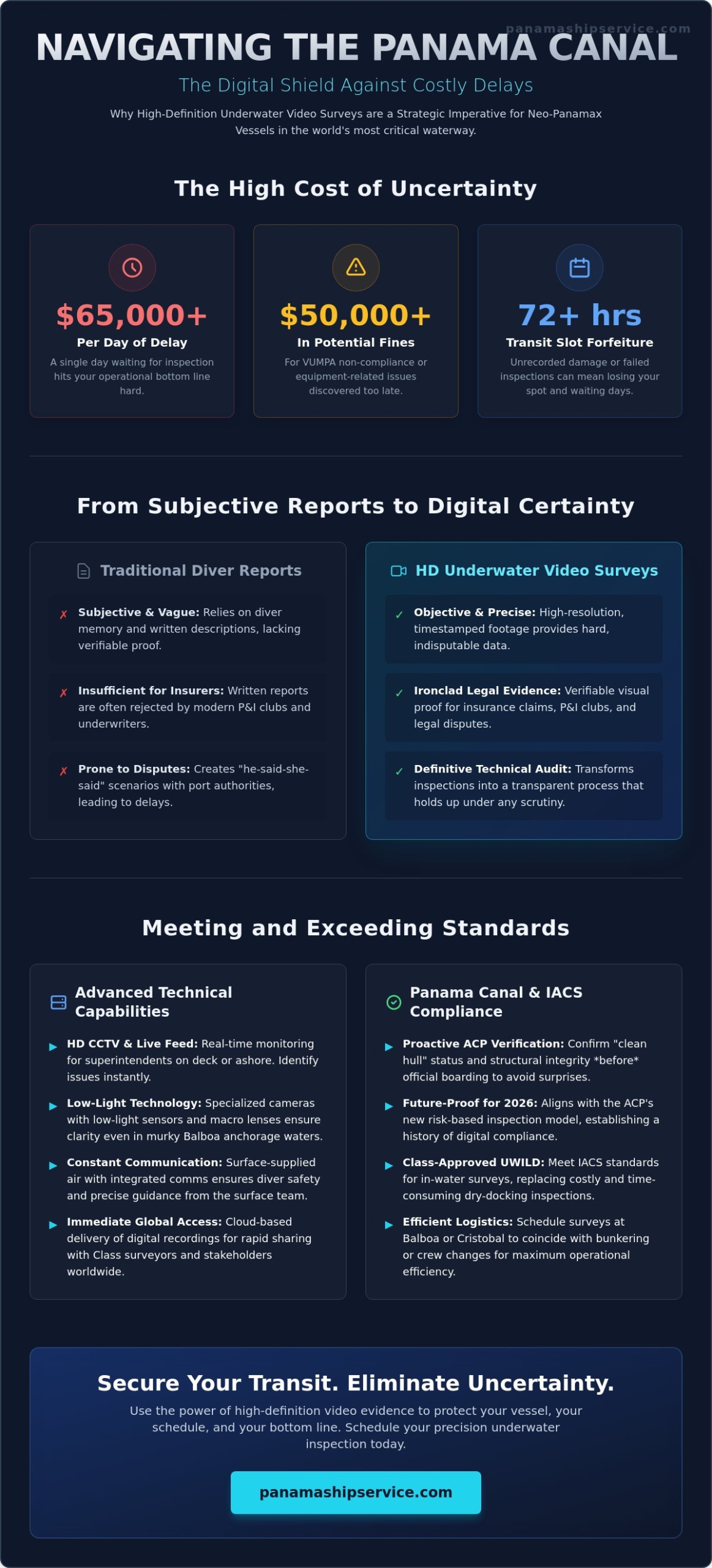
For a Neo-Panamax vessel, a single day of delay in the Panama Canal can cost over $65,000. You recognize that every hour spent waiting for an inspection or managing an undetected hull issue is a direct hit to your operational bottom line. With the Panama Canal Authority’s risk-based inspection model in effect as of January 1, 2026, the margin for error has narrowed. Utilizing a professional underwater video survey panama is no longer just a maintenance routine; it’s your primary digital defense against transit delays and insurance disputes.
We understand the pressure to maintain your schedule while ensuring full compliance with IACS standards and VUMPA requirements. You’ll discover how high-definition underwater video surveys protect your vessel’s operational integrity and legal compliance during transit. This guide details how real-time communication with dive teams and Class-approved reporting can replace the high costs of dry-docking with efficient, transparent inspections at the ports of Balboa or Cristobal.
Key Takeaways
- Learn how a professional underwater video survey panama serves as a critical risk-management tool to prevent transit delays and equipment-related fines.
- Understand the technical requirements for HD CCTV and live-feed inspections that provide real-time visibility for ship superintendents and surveyors.
- Discover the criteria for Class-approved UWILD surveys to meet IACS standards and maintain vessel compliance without the high costs of dry-docking.
- Identify the optimal logistics for scheduling inspections at Balboa or Cristobal to align with bunkering or crew changes for maximum efficiency.
- Explore how high-definition video evidence protects your vessel’s operational integrity and provides a clear record for insurance and legal purposes.
The Strategic Role of Underwater Video Surveys in Panama
An in-water survey utilizing high-definition CCTV or ROV technology is a specialized visual inspection of a vessel’s hull, propeller, and sea chests. In the high-pressure environment of the Panama Canal, where approximately 14,000 transits occur annually, these surveys are a critical risk-management tool. The Canal’s rigid scheduling leaves no room for error. A single equipment-related delay can result in fines exceeding $15,000 and a 72-hour wait. An underwater video survey panama provides the technical clarity needed to identify issues before they trigger a transit denial or costly operational setbacks.
The maritime industry has moved beyond traditional diver reports that rely on subjective descriptions. Modern fleet management demands digital video documentation. High-resolution footage allows for precise damage assessment and biofouling monitoring. This shift ensures that decisions regarding maintenance or repairs are based on hard data rather than memory. By documenting the condition of the hull before arrival, operators can address regulatory compliance issues proactively. It’s a fundamental change from reactive diving to proactive digital oversight.
Visual Evidence vs. Diver Reports
Written reports are no longer sufficient for modern P&I clubs and insurance underwriters. They demand timestamped, high-resolution footage to validate claims and assess risks. Video evidence provides a transparent record that eliminates the “he-said-she-said” scenarios often encountered with port authorities. If a dispute arises regarding hull damage or fouled components, the ability to produce clear, verifiable visual data is your best defense. It transforms a subjective inspection into a definitive technical audit that holds up under scrutiny.
Meeting Panama Canal Authority (ACP) Expectations
The ACP maintains strict standards for hull cleanliness and structural integrity. Under the new risk-based inspection model effective January 1, 2026, qualifying vessels may move toward digital inspections, but this relies on a history of compliance. A proactive video survey verifies that your vessel meets these expectations before the official ACP boarding. It’s an effective way to confirm “clean hull” status for biosecurity regulations and ensure that no structural defects will cause a forfeiture of your transit slot. Failure to meet the mandatory 96-hour VUMPA submission deadline or arriving with unrecorded damage can lead to immediate slot forfeiture. Avoiding a $50,000 fine for non-compliance starts with seeing exactly what lies beneath the waterline.
Technical Standards: HD CCTV and Live-Feed Inspection Capabilities
Precision in maritime inspections isn’t a luxury; it’s a requirement for maintaining vessel schedules. Modern maritime inspections rely on high-definition (HD) CCTV systems that capture every weld seam and propeller niche with absolute clarity. An underwater video survey panama utilizes specialized cameras designed for the high-pressure, low-visibility conditions often found at major anchorages. These systems provide a level of detail that standard diver observations simply can’t match. By using surface-supplied air systems with integrated communication lines, divers remain in constant contact with the surface team. This setup ensures both diver safety and the surgical precision required for complex structural assessments.
Live-feed monitoring has transformed how technical managers oversee their assets. Instead of waiting for a post-dive debriefing, managers view the hull in real-time from the safety of the deck or a shore-based office. This immediate visual access allows for instant identification of anomalies. Once the inspection is complete, digital recording and cloud-based delivery provide immediate global access to the data. This speed is vital when you’re coordinating with classification societies or insurance adjusters across different time zones. To ensure your vessel meets these rigorous technical benchmarks, consider professional underwater hull services tailored for the Panama Canal environment.
CCTV Systems for Underwater Clarity
Visibility at the Balboa anchorage can be notoriously unpredictable. To combat murky waters, technical teams employ low-light sensor technology that enhances contrast and detail in dark environments. Wide-angle lenses are used for broad hull sweeps to identify large-scale issues like impact damage or extensive biofouling. Conversely, macro lenses allow for tight, detailed inspections of specific components like rudders or zinc anodes. Every survey utilizes redundant recording systems. This prevents data loss during critical inspections, ensuring that every second of footage is captured and archived for your records.
Real-Time Collaboration with Technical Managers
The ability to make on-the-spot decisions is the greatest advantage of live-feed technology. Technical managers can direct the diver to specific areas of concern, such as a suspected crack or a fouled sea chest, without the delay of a second dive. This real-time collaboration reduces the need for repeat inspections and allows for the immediate planning of mechanical ship repairs if damage is found. It’s an efficient process that eliminates guesswork. By verifying findings instantly, you ensure that the survey is comprehensive and that no detail is overlooked before the vessel is cleared for its transit slot.
Class-Approved Surveys: UWILD and IACS Requirements
Maintaining a vessel’s class status is a non-negotiable aspect of global maritime operations. An underwater video survey panama performed for an IACS member (International Association of Classification Societies) ensures that your ship remains compliant without the immediate need for a shipyard visit. These surveys serve as a vital bridge between mandatory dry-docking periods. Class surveyors from bodies like ABS, DNV, or Lloyd’s Register don’t just look for general footage; they require specific, high-resolution evidence of structural soundness. This includes clear views of the sea chests, rudders, propeller blades, and the Impressed Current Cathodic Protection (ICCP) systems. Without certified divers who hold recognized class society endorsements, the resulting footage may be rejected, leading to wasted time and additional expenses.
The technical precision required for these surveys is immense. Surveyors expect a systematic approach where every component is documented from multiple angles. For example, propeller inspections must show the leading and trailing edges of every blade to check for cavitation or impact damage. Sea chests must be inspected for both structural integrity and the presence of invasive species, which is a growing concern for biosecurity compliance. Using a professional dive team that understands these specific IACS requirements is the only way to ensure the survey is accepted on the first attempt. This level of expertise prevents the frustration of rejected reports and the logistical nightmare of rescheduling dives during a tight Canal transit window.
UWILD: Avoiding the Cost of Dry-Docking
Underwater Inspection in Lieu of Dry-docking (UWILD) is perhaps the most significant application of this technology. By conducting a comprehensive video survey, operators can extend the interval between expensive dry-dockings, often by up to five years depending on the vessel’s age and condition. In the 2026 shipping market, the ability to keep a vessel on-hire is a massive financial advantage. For a successful UWILD, the video must meet strict clarity and coverage requirements. Every weld, pintle, and sea-chest grating must be clearly visible and narrated in real-time to satisfy the attending surveyor’s checklist. This process effectively moves the inspection from the dry-dock to the water, saving millions in potential shipyard fees over the life of the vessel.
Pre-Purchase and Charterer Inspections
Beyond mandatory class surveys, video inspections are essential during ownership transitions. When a vessel changes hands in Panama, a detailed underwater video survey panama provides an objective record of the hull’s condition. This protects both buyers and sellers from future liability disputes. Similarly, charterers use these surveys for “on-hire” and “off-hire” documentation to ensure they aren’t held responsible for pre-existing damage. High-definition video evidence serves as a definitive digital baseline for hull fouling and structural integrity at the start of a contract.
Operational Logistics: Scheduling Surveys at Balboa and Cristobal
Efficiently managing an underwater video survey panama requires precise coordination between the vessel’s arrival time and the available transit window. You must decide whether to conduct the inspection at the Pacific entrance (Balboa) or the Atlantic side (Cristobal). This choice often depends on your vessel’s direction of travel and the specific anchorage assignments provided by the Panama Canal Authority (ACP). To minimize downtime, we recommend scheduling surveys to coincide with other critical operations such as bunkering, ship supplies delivery, or crew change services. This integrated approach ensures that your vessel remains productive while meeting all necessary inspection criteria.
Weather conditions in Panama play a significant role in survey quality. During the wet season, which typically runs from May through December, increased rainfall can lead to higher turbidity and reduced underwater visibility. Technical teams account for these environmental factors by utilizing advanced lighting and low-light camera sensors to maintain HD clarity. Coordination with the ACP for anchorage permits is also mandatory. All vessels must adhere to the 96-hour VUMPA data package submission deadline to secure their transit slots. Any delay in securing a dive permit or completing an inspection can jeopardize this schedule, making proactive planning essential.
Balboa Anchorage (Pacific Side) Procedures
The Balboa anchorage serves as the primary staging area for Northbound transits. Water conditions here can vary, but visibility is generally sufficient for high-quality video documentation if scheduled during optimal tidal windows. Getting a dive team and technical equipment to the outer anchorage requires reliable launch services and clear communication with the Port Captain’s office. Most operators aim to complete their survey within the 24-48 hour pre-transit window. This provides enough time to review the footage and address any minor mechanical ship repairs before the official Canal pilot boards the vessel.
Cristobal and Colon (Atlantic Side) Logistics
On the Atlantic side, the proximity of the Cristobal and Colon terminals offers different logistical advantages. The water depth and current patterns at these anchorages may differ from the Pacific side, requiring specific diving profiles for safety and precision. Compliance with local port authority regulations is strictly enforced. Dive teams must be fully vetted and authorized to operate within these restricted zones. Because the Atlantic side is a major hub for cargo handling and MARPOL disposal, scheduling your survey alongside these services can significantly reduce your vessel’s overall time in port. Efficiency in these zones is the difference between a seamless transit and a costly delay.
Panama Ship Service: Precision Underwater Inspections
Operational efficiency in the Panama Canal requires a partner who understands that time is your most valuable asset. Panama Ship Service delivers high-definition video documentation and real-time reporting designed to satisfy the most stringent IACS requirements. We don’t just provide a visual record; we provide a definitive technical audit of your vessel’s submerged condition. By integrating high-definition video documentation with our comprehensive suite of underwater hull services, we eliminate the need for multiple vendors and fragmented reporting. This one-stop-shop approach ensures that your vessel moves through the inspection process without unnecessary complications.
Our dive teams are IACS-certified and possess extensive experience navigating the unique environmental challenges of the Panama Canal. We prioritize rapid deployment and efficient reporting to minimize your overhead. Every underwater video survey panama we conduct is backed by professional-grade equipment and a deep understanding of classification society standards. We provide the technical clarity needed to make immediate maintenance decisions, helping you avoid the astronomical costs associated with transit delays or unexpected dry-docking. When you work with us, you’re choosing a partner committed to your vessel’s operational integrity and fiscal responsibility.
Why Experience in Panama Matters
Navigating the local currents and unpredictable visibility of Panamanian anchorages requires more than just technical skill; it requires local knowledge. Our deep understanding of ACP protocols and biosecurity regulations allows us to assist vessels in meeting even the tightest transit windows. We know exactly what port captains and surveyors look for during an inspection. If the camera reveals structural issues or fouling, you have the immediate advantage of a local partner capable of performing mechanical ship repairs on-site. This proactive capability prevents minor findings from escalating into transit denials.
Requesting Your Video Survey Quote
Securing a precise quote for your inspection is a straightforward process. To ensure accuracy and a rapid response, please provide your vessel’s specifications, current location, and the specific scope of the required survey. Whether you need a standard hull sweep or a comprehensive UWILD inspection, our team is ready to respond. We maintain 24/7 availability for emergency inspections and assessments, recognizing that maritime issues don’t follow a standard schedule. Our goal is to provide the data you need to keep your fleet moving safely and efficiently. Contact Panama Ship Service for a Class-approved underwater video survey today.
Secure Your Transit with Digital Precision
The Panama Canal’s transition to a risk-based inspection model means your vessel’s digital history is now a critical asset. By prioritizing a professional underwater video survey panama, you replace operational uncertainty with high-definition evidence. You’ve seen how HD live-feeds and IACS-certified reporting allow for immediate decision-making, effectively protecting your schedule from preventable equipment-related delays. Whether you’re entering the Pacific at Balboa or the Atlantic at Cristobal, having a verified record of your hull’s integrity is your best defense against transit denials and unforeseen dry-docking costs.
Panama Ship Service stands ready to support your fleet with technical expertise and rapid response. Our IACS-certified dive teams utilize the latest HD technology to ensure your vessel meets every regulatory and classification standard. Don’t leave your Canal transit to chance. Request a Technical Quote for Underwater Video Survey in Panama and leverage our 24/7 rapid deployment capabilities in Balboa and Cristobal to keep your operations moving. We’re here to ensure your next transit is efficient, compliant, and cost-effective.
Frequently Asked Questions
Can an underwater video survey replace a dry-dock inspection in Panama?
Yes, an underwater video survey panama can effectively replace a scheduled dry-dock inspection through the UWILD program. This process allows vessel owners to extend their dry-docking intervals by providing high-definition visual evidence of the hull’s integrity to a Class surveyor. It’s a cost-effective alternative that keeps your vessel on-hire. However, the survey must be conducted by IACS-approved divers using certified video equipment to ensure the data is accepted by the classification society.
How long does a typical underwater video survey take at the Balboa anchorage?
A standard underwater video survey at the Balboa anchorage typically takes between 4 to 8 hours to complete. The exact duration depends on the vessel’s size, the complexity of the submerged structures, and the specific requirements of the inspection scope. Factors like water turbidity and current strength at the Pacific entrance can also influence the timeline. We prioritize efficiency to ensure the survey is finished well within your pre-transit window, minimizing any impact on your schedule.
What happens if the video survey reveals hull damage or heavy fouling?
If the survey reveals structural damage or significant biofouling, the findings are reported immediately through the live-feed system. This real-time visibility allows technical managers to assess the severity of the issue instantly. Based on the footage, we can coordinate necessary mechanical ship repairs or specialized underwater hull services before your scheduled Canal transit. Addressing these issues proactively prevents the Panama Canal Authority from denying transit or issuing fines for non-compliance with biosecurity standards.
Is the video footage provided to the ship owner immediately after the survey?
Yes, digital video files and a preliminary report are typically provided to the ship owner or technical manager immediately following the dive operation. We utilize cloud-based delivery systems to ensure global access to the high-definition footage as soon as the survey concludes. This rapid data turnaround is essential for vessels with tight schedules. A formal, Class-approved report follows shortly after, providing the documented evidence required for regulatory compliance and internal maintenance records.
Do you provide live-feed capabilities for remote technical managers?
We provide integrated live-feed capabilities as a standard feature of our underwater video survey panama. This technology allows technical managers and Class surveyors to view the inspection in real-time from the surface or a remote location. High-resolution cameras transmit clear visuals, enabling the surface team to direct the diver toward specific areas of interest. This collaborative approach ensures that every critical component is inspected thoroughly and reduces the need for time-consuming repeat dives.
What Class societies are your underwater surveys approved by?
Our underwater surveys are designed to meet the rigorous standards of all major IACS member societies. This includes approvals from the American Bureau of Shipping (ABS), DNV, Lloyd’s Register (LR), and Bureau Veritas (BV). Our dive teams are trained specifically in the documentation protocols required by these organizations. By adhering to these global standards, we ensure that your survey data is recognized and accepted for UWILD requirements and other mandatory class renewals.
How does the Panama Canal Authority (ACP) use underwater survey data?
The Panama Canal Authority (ACP) uses underwater survey data to verify that a vessel meets mandatory safety and environmental standards. Specifically, they look for evidence of structural integrity and hull cleanliness to prevent the introduction of invasive species into the local ecosystem. Under the risk-based inspection model, accurate digital documentation can help a vessel maintain a clean compliance record. This reduces the likelihood of physical boardings and prevents delays caused by suspected equipment deficiencies or biofouling.
What is the difference between a CCTV survey and an ROV inspection?
A CCTV survey involves a diver carrying a camera and light system while maintaining direct communication with the surface. This method is ideal for detailed inspections of complex areas like sea chests or rudders where tactile feedback is helpful. An ROV (Remotely Operated Vehicle) inspection uses a tethered underwater robot. ROVs are often preferred for long hull sweeps or in conditions where diver safety might be a concern. Both methods provide high-definition video evidence for technical review.