
What if a minor surface irregularity on a single propeller blade is actually the catalyst for a 5% increase in your fuel consumption or a catastrophic bearing failure during your next Panama Canal transit? For vessel operators, the line between a routine voyage and an unscheduled dry-docking often comes down to the accuracy of your propeller damage assessment. You already know that even slight cavitation or hidden edge deformations can compromise the mechanical integrity of your entire propulsion system, leading to expensive downtime and missed schedules.
This guide provides a professional framework to help you identify, categorize, and evaluate propeller damage effectively. By applying the latest ISO 19030 standards for performance measurement and understanding the updated 2026 ABS requirements, you’ll learn to make informed decisions about pursuing in-water repairs versus immediate docking. We will examine how to distinguish between superficial wear and critical structural defects, ensuring your vessel maintains peak fuel efficiency and operational safety throughout its journey. We start by looking at the most common types of damage encountered in high-traffic corridors and how to document them for Class-approved reporting.
Key Takeaways
- Understand why a systematic propeller damage assessment is the critical first step to preventing propulsion failure and fuel inefficiency.
- Learn to categorize damage severity, from minor cavitation to structural blade loss, to make data-driven maintenance decisions.
- Discover how high-definition CCTV and certified diver inspections deliver the technical documentation required for Class-approved shore-side reviews.
- Evaluate the operational criteria for choosing in-water repairs like cold straightening or cropping over an immediate, unscheduled dry-docking.
- Optimize your Panama Canal transit by coordinating professional mechanical ship repairs and underwater hull services to maximize vessel uptime.
What is Marine Propeller Damage Assessment?
A marine propeller damage assessment is a systematic technical evaluation of a vessel’s propulsion blades and hub assembly. Unlike a casual visual check, this process involves precise measurements and high-resolution documentation to identify deviations from original manufacturing tolerances. To understand the mechanics involved, one should first consider What is a Marine Propeller? and how its hydrodynamic design converts rotational power into thrust. Any deviation from this design, whether caused by erosion or impact, compromises the entire propulsion train’s health.
The propeller acts as the final link in the mechanical chain. If it’s damaged, the engine and shafting bearings bear the brunt of the inefficiency. In the specific context of the Panama Canal, the high volume of traffic and the presence of submerged debris near the locks increase the risk of hidden damage. Operators must distinguish between cosmetic surface wear, which might only require polishing, and structural threats like trailing edge bends or root cracks that risk catastrophic failure. A professional propeller damage assessment provides the data necessary to make this distinction before a minor issue turns into a total propulsion loss.
The Stakes of Propeller Integrity
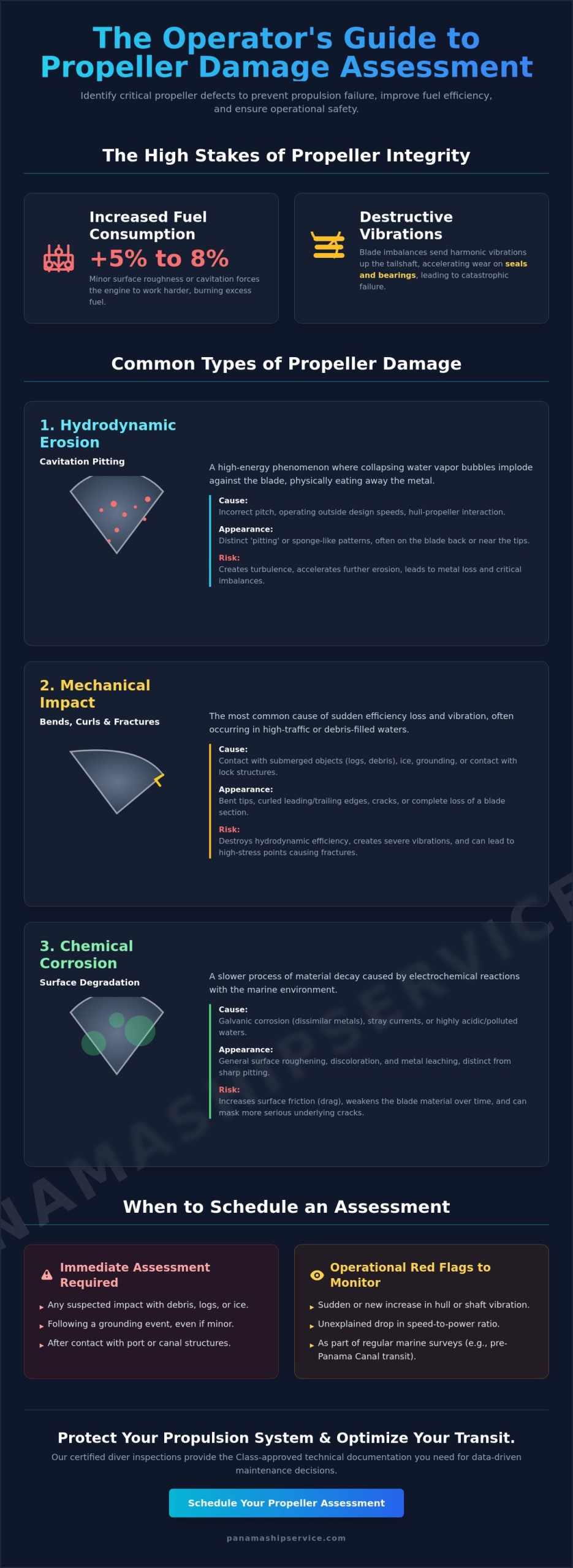
Even minor imbalances create destructive harmonic vibrations. These vibrations travel up the tailshaft, accelerating wear on stern tube seals and bearings. A propeller with significant surface roughness or minor cavitation can increase fuel consumption by 5% to 8% depending on vessel type. In the restricted waters of the Panama Canal, where precise maneuvering is mandatory, a compromised propeller reduces response times. It increases the risk of contact with lock walls or other vessels, making mechanical reliability a matter of safety as much as economy.
When to Schedule an Assessment
Immediate assessments are critical following any suspected impact event. If your vessel encounters logs, heavy debris, or experiences a grounding near the ports of Balboa or Cristobal, an underwater inspection is non-negotiable. You should also watch for operational red flags. Increased hull vibration or a sudden drop in speed-to-power ratios often indicates blade deformation. Beyond emergency events, these evaluations are standard components of marine surveys in Panama, ensuring compliance with updated 2026 ABS and IMO regulations before entering the transit queue. Proactive propeller damage assessment allows you to schedule repairs during scheduled stops rather than facing an emergency dry-docking.
Common Types of Propeller Damage and Their Causes
Propeller degradation occurs across a broad spectrum of severity. While aviation maintenance often focuses on simple nicks from runway gravel, marine operators face a more complex set of hydrodynamic and chemical challenges. A professional propeller damage assessment must distinguish between surface-level roughness and deep-seated structural defects that threaten the vessel’s mechanical integrity. We categorize these issues into three primary groups: hydrodynamic erosion, mechanical impact, and chemical corrosion.
Cavitation and Erosion
Cavitation is often misunderstood as simple wear. It is actually a high-energy phenomenon where water vapor bubbles implode against the blade surface with enough force to eat through solid bronze. This process creates distinct ‘pitting’ patterns, typically found on the back of the blade or near the tips. These pits are not just a cosmetic concern; they create localized turbulence that further accelerates erosion. Incorrect pitch or operating at speeds outside the design envelope can exacerbate this. Following the IACS Unified Requirements for Propellers, inspectors must identify which ‘zone’ the pitting occupies to determine if the blade’s structural integrity is at risk. Ignoring minor pitting today leads to significant metal loss and balance issues tomorrow.
Mechanical and Impact Damage
Impact damage is a constant threat in busy maritime transit hubs like the Panama Canal. With 5-blade propellers accounting for 45.15% of the market share in 2026, the complexity of assessing these multi-blade systems has increased. Submerged objects, ice, or contact with lock structures cause bent tips and leading-edge curling. Even a slight deviation in the blade’s geometry ruins hydrodynamic efficiency, leading to the destructive vibrations mentioned earlier. Edge curling often creates high-stress points where fractures can develop during normal operation. Unlike small aircraft props where nicks are easily filed, large marine propellers require specialized mechanical ship repairs to perform cold straightening or precision cropping without removing the vessel from the water.
Chemical threats like electrolysis and galvanic corrosion target the alloy itself. If sacrificial anodes are depleted or there’s an electrical leak in the hull, the propeller becomes the anode in a massive battery. This results in a brittle surface texture or a ‘wasp-waisted’ appearance at the hub. Identifying these chemical signatures early is a core part of any professional propeller damage assessment, as they often indicate systemic issues with the vessel’s cathodic protection systems.
The Professional Assessment Process: Step-by-Step
A professional propeller damage assessment begins long before a vessel enters a dry dock. Unlike smaller aircraft components that require total teardown, large-scale marine propulsion systems are evaluated in-situ by certified commercial divers. This process is systematic and data-driven, ensuring that every nick, crack, or deformation is documented against original design specifications. This level of detail is vital because, as noted in this Marine Engineering Guide to Propeller Damage, undetected fatigue cracks can lead to sudden blade failure under the immense torque of a modern engine.
The assessment follows a rigorous four-stage protocol:
- Visual Survey: Divers conduct a 360-degree inspection of all blades, the hub assembly, and the fairwater cone.
- Digital Documentation: High-definition CCTV and still photography provide shore-side engineers and Class surveyors with a clear view of the damage.
- Non-Destructive Testing (NDT): Inspectors use specialized underwater tools to identify subsurface fractures that aren’t visible to the naked eye.
- Precision Measurement: Technicians measure pitch and balance deviations using calipers and templates to determine the exact degree of hydrodynamic loss.
Underwater Inspection Techniques
Success in this field relies on specialized underwater hull services to prepare the site. Divers often find that biofouling hides the very defects they need to measure. We use hydraulic polishing tools to clean the propeller surface to a Rubert Grade A finish. This reveals hidden stress fractures and allows for more accurate tactile cues in low-visibility environments like the ports of Balboa or Cristobal. High-resolution imaging then captures these details, creating a permanent record for the vessel’s maintenance history.
Class-Approved Reporting
A technical report is only useful if it meets the stringent requirements of classification societies like ABS, Lloyd’s Register, or DNV. Following the updated 2026 ABS Rules for Building and Classing Marine Vessels, your propeller damage assessment must now reflect the removal of the 70% astern RPM requirement to avoid unnecessary plant risk. Our reports contain detailed mapping of damage zones, metallurgical analysis of any corrosion, and a clear set of recommendations. This documentation is essential for insurance claims and for securing necessary transit clearances from the Panama Canal Authority (ACP) when emergency repairs are required. We handle the technical complexity so you can focus on your operational schedule.
Decision Matrix: Repair vs. Replace vs. Monitor
Once the propeller damage assessment is complete, the operator faces a critical choice: can the vessel safely continue its transit, or is an immediate intervention required? The goal is to avoid the high costs of unscheduled dry-docking while ensuring the mechanical integrity of the propulsion system. For many operators arriving at the Panama Canal, the most efficient path involves combining the assessment with immediate propeller polishing. This not only clarifies the extent of surface defects but provides an immediate return on investment by reducing hydrodynamic drag and improving fuel economy before the next leg of the voyage.
The decision to repair or replace hinges on the severity and location of the damage. If defects are located in high-stress areas near the hub, Class rules generally mandate more aggressive action. Conversely, damage near the blade tips can often be managed through in-water techniques. The cost of downtime for a large container vessel or bulk carrier is immense. Therefore, a technical framework that prioritizes in-water solutions is essential for maintaining operational schedules and fiscal responsibility.
In-Water Repair Capabilities
Modern underwater technology allows for significant remediation without removing the vessel from service. If the assessment identifies minor nicks or cavitation pits, these can be ground out and polished to restore a smooth hydrodynamic profile. For more significant deformations, the following procedures are often viable:
- Cold Straightening: Using hydraulic jacks to return bent blade tips to their original geometry.
- Precision Cropping: Removing a damaged blade section and its opposite counterpart to restore rotational balance.
- Underwater Welding: Applying Class-approved wet welding techniques to arrest the growth of minor cracks in non-critical zones.
The Financial Impact of Neglect
Ignoring the results of a propeller damage assessment is a high-stakes gamble. According to ISO 19030 standards, even moderate surface roughness can result in a significant increase in fuel consumption. A damaged propeller doesn’t just waste fuel; it creates unbalanced forces that accelerate wear on stern tube seals and tailshaft bearings. This cumulative damage can lead to a total propulsion loss during a critical maneuver in the Canal locks. Proactive management is always more cost-effective than reactive crisis handling. If your vessel requires a technical evaluation, contact our team for expert underwater hull services and repairs in Panama.
Panama Ship Service: Expert Propeller Solutions
When a vessel triggers an alarm for high vibration or reduced RPM, a professional propeller damage assessment cannot wait. Panama Ship Service provides an immediate emergency response for vessels arriving at both the Pacific and Atlantic entrances of the Panama Canal. We understand that in the maritime industry, time is the most expensive commodity. Our team bridges the gap between diagnostic evaluation and execution by combining mechanical ship repairs with specialized underwater expertise. This integrated approach ensures that once a defect is identified, the remediation plan is already in motion.
Our role extends beyond simple technical labor. We act as a critical liaison between vessel operators, Class surveyors, and the Panama Canal Authority (ACP). We manage the technical documentation and reporting required to secure transit permissions or to justify emergency repair stops. By centralizing your technical requirements with a single provider, you eliminate the communication gaps that often lead to costly transit delays or missed windows. We focus on delivering a clear path to operational readiness with the efficiency required by modern shipping schedules.
Strategic Location in Panama
Our operational footprint covers the entire Canal corridor, including Balboa, Cristobal, and all major anchorages. We maintain the capability to mobilize dive teams and mechanical engineers rapidly, ensuring your propeller damage assessment is completed during your scheduled stay or bunkering. For maximum efficiency, we offer the consolidation of multiple technical needs. While our divers evaluate your propulsion system, we can simultaneously coordinate underwater hull services, marine surveys, or MARPOL disposal. This comprehensive service model reduces the administrative burden on the master and shore-side management, allowing for a smoother turnaround in one of the world’s busiest strategic hubs.
Request Your Assessment Today
To receive a rapid quote for a technical evaluation, contact our team with your vessel’s current position and specific operational symptoms. Providing data such as recent fuel consumption spikes, vibration patterns, or the details of a suspected impact event allows our engineers to perform an accurate preliminary review. We prioritize clear communication and fiscal responsibility in every engagement. Don’t let hidden propeller defects compromise your propulsion integrity or fuel efficiency during your next voyage. Ensure your vessel is transit-ready with Panama Ship Service and secure the professional support you need for a successful Canal transit.
Securing Your Vessel’s Propulsion Future
Effective management of your vessel’s propulsion system requires more than just reacting to failures. It demands a proactive technical strategy that prioritizes early detection and high-resolution data. A professional propeller damage assessment ensures you can distinguish between manageable surface wear and critical structural defects before they lead to catastrophic engine damage or transit delays. By leveraging in-water repair techniques and precise hydrodynamic evaluations, you maintain peak fuel efficiency and mechanical reliability throughout your voyage.
Panama Ship Service stands as your reliable partner in this strategic geographical hub. We provide Class-approved underwater surveyors and emergency mechanical support to keep your operations moving without complication. Our team’s deep knowledge of updated 2026 maritime regulations ensures your vessel remains compliant and safe during its Canal transit. Delegate the technical complexity of your propulsion train to our seasoned experts and focus on your core business outcomes.
Don’t let hidden defects escalate into unscheduled dry-docking costs. Contact our technical team now to Request an Emergency Propeller Assessment in Panama. We look forward to ensuring your vessel is fully optimized for its next transit.
Frequently Asked Questions
Can a propeller be repaired while the ship is in the water?
Yes, many critical repairs like cold straightening, precision grinding, and blade cropping are performed while the vessel is afloat. Specialized underwater hull services allow technicians to restore blade geometry at anchorages or ports without the need for dry-docking. These in-water solutions are designed to address mechanical defects quickly, ensuring the vessel stays on its operational schedule.
What are the signs of a bent propeller blade on a large vessel?
The most immediate signs include unusual hull vibrations, a sudden drop in speed-to-power ratios, and a noticeable increase in fuel consumption. You might also detect rhythmic mechanical noise or thumping from the stern area. Any sudden change in the propulsion train’s performance, especially after transiting debris-heavy waters, should trigger an immediate propeller damage assessment to identify the root cause.
How much fuel can a damaged propeller actually waste?
A damaged or fouled propeller can increase fuel consumption by 5% to 8% depending on the severity of the deformation and surface roughness. Even minor “pitting” or edge curling disrupts the laminar flow of water, forcing the engine to work harder to maintain the same speed. Regular assessments and polishing are essential for maintaining the fiscal responsibility of your voyage and reducing overhead.
What is the difference between propeller cavitation and corrosion?
Cavitation is a mechanical process where vapor bubbles implode against the metal surface, while corrosion is a chemical or electrochemical reaction. Cavitation typically leaves deep, localized “pitting” patterns on the blade’s back or near the tips. Corrosion results in a more uniform thinning of the blade or a brittle, discolored surface texture, often indicating a failure in the vessel’s cathodic protection system.
Is an underwater inspection mandatory after a suspected prop strike?
While the term “mandatory” depends on your specific Class society and insurance policy, failing to inspect after a strike is a significant operational risk. ABS and DNV guidelines emphasize the necessity of maintaining propulsion integrity. An underwater inspection provides the data required for a professional propeller damage assessment, satisfying surveyors and preventing hidden damage from causing a total power loss during transit.
How long does a professional propeller damage assessment typically take?
A standard assessment typically takes between four to eight hours to complete. This timeframe includes the necessary surface cleaning to reveal hidden defects and the high-definition CCTV documentation required for shore-side review. Total duration can vary based on water visibility and the extent of biofouling on the propeller blades at the time of the dive.
Does the Panama Canal Authority require specific propeller certifications?
The Panama Canal Authority (ACP) requires all transiting vessels to be in a seaworthy condition with fully functional propulsion and maneuvering systems. While the ACP focuses on operational safety, they rely on Class-approved surveys and repair certifications. We coordinate directly with Canal authorities to ensure all technical documentation meets the required standards for a safe and efficient transit.
What is ‘blade cropping’ and is it a permanent fix?
Blade cropping involves the removal of a damaged section of a propeller blade to restore rotational balance and stop crack propagation. It’s often a permanent, Class-approved solution if the cropped area remains within specific design tolerances. Technicians must also crop the opposite blade to maintain the hydrodynamic balance of the entire assembly, preventing destructive vibrations during operation.