
Did you know that hard biofouling is estimated to cost the global commercial fleet an additional $15 billion in fuel annually? This isn’t just a maintenance oversight; it’s a massive drain on your operational budget and a direct threat to your transit schedule. Effective in-water hull cleaning for biofouling control is no longer optional if you want to remain competitive. You likely feel the pressure of rising fuel costs and the increasingly strict enforcement of international standards like the IMO’s Resolution MEPC.412(82) and the new ISO 6319 documentation requirements. We understand that the risk of spreading invasive species or damaging expensive coatings makes this a high-stakes technical challenge.
Effective in-water hull cleaning for biofouling control requires a sophisticated understanding of coating chemistry. You aren’t just removing marine growth; you’re managing a high-value chemical system. Self-Polishing Copolymer (SPC) coatings function through the controlled erosion of the paint layer, which releases biocides as the ship moves through the water. If your cleaning protocol is too aggressive, you’ll strip away the active layer and leave the vessel vulnerable to rapid re-colonization. On the other hand, Foul-Release Coatings (FRC) rely on a low-friction silicone surface that prevents organisms from sticking. A single scratch from an improper brush can compromise the entire system, creating anchor points for new growth. In such cases, professional Fiberglass Hull Repair is essential to restore the gelcoat’s integrity and maintain the vessel’s hydrodynamic profile.
This guide will help you master the technical and regulatory requirements of in-water cleaning to maximize fuel efficiency and ensure seamless Panama Canal transits. You’ll learn how to navigate the latest robotic cleaning advancements and regional enforcement trends, such as Brazil’s NORMAM-401/DPC, without risking operational delays. We provide a clear roadmap to reducing drag, extending coating life, and maintaining full compliance with global biofouling guidelines to protect your bottom line.
Key Takeaways
- Identify the direct correlation between hull roughness and hydrodynamic drag to effectively reduce fuel-related overhead.
- Assess the shift toward ROV-based “clean-and-capture” systems to meet increasingly strict environmental standards at major ports.
- Learn how to balance in-water hull cleaning for biofouling control with the preservation of specialized Self-Polishing Copolymer and Foul-Release coatings.
- Navigate the complex regulatory landscape of IMO biofouling management plans and stringent regional biosecurity requirements.
- Streamline operations by coordinating underwater hull services with mechanical ship repairs during your next Panama Canal passage.
The Financial and Environmental Cost of Vessel Biofouling
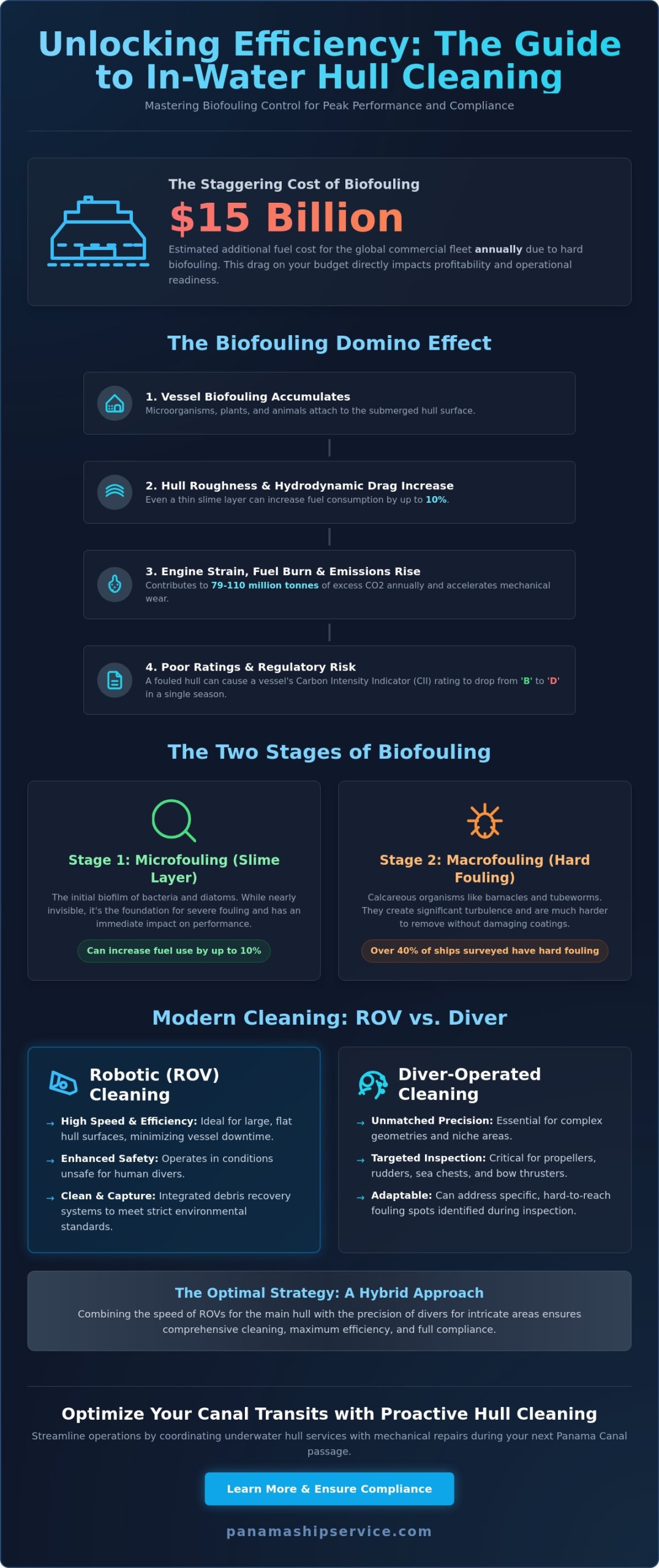
Biofouling or biological fouling is the undesirable accumulation of microorganisms, plants, and animals on submerged surfaces. For a ship operator, it’s a direct tax on performance. Even a seemingly minor slime layer increases hull roughness, leading to immediate hydrodynamic drag. Research suggests that a thin layer of microfouling can increase fuel consumption by up to 10%. When left unmanaged, this drag creates a compounding financial penalty that erodes profit margins and compromises engine health.
The physics are simple: a rough hull requires more power to maintain speed. This increased resistance forces engines to work harder, burning more fuel and accelerating mechanical wear. Hard biofouling alone is estimated to cost the global shipping industry approximately $15 billion in additional fuel expenses every year. Implementing proactive in-water hull cleaning for biofouling control isn’t just a maintenance task; it’s a critical financial strategy to mitigate these avoidable overheads. You can’t afford to ignore the hidden costs of a fouled hull when fuel prices remain volatile.
Microfouling vs. Macrofouling: Identifying the Risk
Fouling begins almost immediately once a vessel is in the water. The initial “slime layer” or microfouling consists of bacteria and diatoms. While invisible from a distance, this layer is the foundation for macrofouling. If you don’t intervene early, this biofilm attracts calcareous organisms like barnacles, tubeworms, and bryozoans. These hard structures create significant turbulence and are much more difficult to remove without damaging the underlying coating. Early intervention via underwater hull services is significantly more cost-effective than reactive cleaning once hard fouling has taken hold. A study conducted between 2015 and 2019 found that over 40% of ships surveyed already had at least 10% of their hull covered in hard fouling. This demonstrates that many operators wait too long to act, leading to unnecessary drag and higher cleaning costs.
Impact on Carbon Intensity Indicator (CII) Ratings
Biofouling isn’t just a cost issue; it’s a compliance hurdle. Increased fuel burn translates directly into higher greenhouse gas (GHG) emissions. Current estimates suggest biofouling-related inefficiencies contribute between 79 and 110 million tonnes of excess CO2 annually. Under the IMO’s Carbon Intensity Indicator (CII) framework, these emissions directly impact your vessel’s annual efficiency ratio. A fouled hull can drop a ship’s rating from a ‘B’ to a ‘D’ in a single season. Utilizing in-water hull cleaning for biofouling control serves as a tactical tool to maintain high CII ratings. This proactive approach avoids the operational restrictions and potential commercial disadvantages associated with low-rated vessels. Maintaining a smooth hull profile ensures you stay compliant while optimizing your schedule and reducing your environmental footprint.
Modern Methods for In-Water Hull Cleaning and Debris Capture
The maritime industry is undergoing a technical shift. Traditional diver-operated brushes are giving way to sophisticated robotic systems for Vessel biofouling management. These Remotely Operated Vehicles (ROVs) provide a safer and more systematic approach to in-water hull cleaning for biofouling control. While human divers remain essential for inspecting niche areas like sea chests and rudders, robots now handle the expansive flat surfaces of the hull with far greater speed. This transition is driven by the need for operational efficiency and the requirement to collect all removed biological material before it enters the local ecosystem.
Diver-Operated vs. Robotic (ROV) Cleaning
Safety and speed are the primary drivers for ROV adoption. In high-traffic zones like the Panama Canal, deploying divers can lead to complex scheduling conflicts and safety risks. Robots can operate in conditions where human divers cannot, maximizing the cleaning area per hour. This minimizes vessel downtime. However, complex geometries still require the precision of underwater hull services performed by experienced technicians. A hybrid approach often yields the best results: robots for the main hull and specialized divers for the intricate areas. This ensures no part of the vessel is left untreated, protecting both performance and compliance.
The Mechanics of Debris Recovery
Environmental compliance is now a non-negotiable part of hull maintenance. The “cleaning-with-capture” method utilizes high-powered suction technology to ensure no biological material escapes. This process is essential for meeting the standards set by IMO Resolution MEPC.412(82), adopted in May 2026. The recovered slurry goes through a rigorous containment process to prevent the release of invasive species. A typical recovery system includes several critical stages:
- Suction: High-volume pumps create a vacuum at the cleaning head to capture debris instantly.
- Centrifugal Separation: Heavy calcareous material and large organisms are separated from the water stream.
- Multi-stage Filtration: Fine mesh filters trap micro-particulates and coating flakes down to specific micron levels.
Operators must choose between hydraulic brush systems and high-pressure water jetting. Brushes are highly effective for aggressive macrofouling but carry a higher risk of coating depletion if not calibrated correctly. High-pressure water jets offer a non-contact alternative that’s gentler on specialized coatings. The choice depends on the fouling type and the age of the anti-fouling system. With the hull cleaning robot market projected to reach $2.68 billion by 2035, these technologies are becoming more accessible and refined. Utilizing in-water hull cleaning for biofouling control with debris capture allows you to maintain performance while adhering to the ISO 6319 standard for documentation and environmental responsibility.
Balancing Biofouling Removal with Coating Integrity
Effective in-water hull cleaning for biofouling control requires a sophisticated understanding of coating chemistry. You aren’t just removing marine growth; you’re managing a high-value chemical system. Self-Polishing Copolymer (SPC) coatings function through the controlled erosion of the paint layer, which releases biocides as the ship moves through the water. If your cleaning protocol is too aggressive, you’ll strip away the active layer and leave the vessel vulnerable to rapid re-colonization. On the other hand, Foul-Release Coatings (FRC) rely on a low-friction silicone surface that prevents organisms from sticking. A single scratch from an improper brush can compromise the entire system, creating anchor points for new growth.
Responsible vessel biofouling management involves matching the cleaning force to the specific fouling stage and coating type. Many operators inadvertently shorten their dry-docking intervals by “over-cleaning.” Using heavy-duty hydraulic brushes on a light slime layer is counterproductive because it removes the very biocides designed to protect the hull. A “soft-cleaning” or grooming approach is often the superior strategy. By performing frequent, gentle cleanings, you prevent the transition from microfouling to macrofouling without depleting the paint. This tactical balance preserves the hull’s hydrodynamic profile while maximizing the service life of the coating.
Selecting the Right Cleaning Tool for the Coating
Precision is mandatory when selecting equipment. Silicone-based foul-release coatings require non-abrasive tools, often utilizing soft sponges or specialized water-jetting systems to avoid tearing the delicate surface. For SPC coatings, technicians must calibrate brush pressure to ensure they remove only the fouling, not the paint. Sensitive areas like propellers and transducers require even higher levels of care. Propellers, often made of bronze or stainless steel, need polishing rather than aggressive scrubbing to maintain efficiency. Transducers and sensors can be permanently damaged by mechanical contact, so these require hand-cleaning by skilled divers using non-metallic scrapers.
Post-Cleaning Inspections and Reporting
The job isn’t finished until you have verifiable proof of the hull’s condition. Professional underwater hull services provide the documentation necessary to satisfy Class requirements and internal audits. Standardized reporting, now increasingly governed by the ISO 6319 standard published in March 2026, ensures that both the owner and the port authorities have a clear record of the cleaning’s impact. High-definition photo and video documentation are essential. These records prove that the coating remains intact and that the cleaning didn’t cause premature depletion. Detailed reports also allow you to track fouling patterns over time, helping you optimize your future maintenance schedules and predict when the next intervention will be necessary.
Regulatory Compliance: IMO Guidelines and Regional Standards
The global regulatory landscape for biofouling is shifting from voluntary recommendations to mandatory enforcement. On May 13, 2026, the IMO’s Marine Environment Protection Committee adopted Resolution MEPC.412(82), establishing binding environmental compliance standards for autonomous cleaning systems. This makes in-water hull cleaning for biofouling control a legal prerequisite for international trade. Port State Control inspectors now look for standardized data retention and sonar-based monitoring to verify that cleaning events don’t release invasive species into local waters. You can’t rely on outdated maintenance logs; you need a rigorous, data-backed compliance strategy.
Regional biosecurity enforcement is often more stringent than international baselines. Australia, New Zealand, and California have set the bar for years, but new players are entering the field. As of February 1, 2026, Brazil’s maritime authority began full enforcement of NORMAM-401/DPC. This regulation includes specific penalties and sanctions for vessels that arrive without proper permits or proof of biofouling management. When your vessel is scheduled for a Panama Canal transit, ensuring your documentation is in order is critical to avoiding costly delays or denied entry at your next port of call.
Biofouling Management Plans (BFMP)
A compliant Biofouling Management Plan is no longer a static document kept in a drawer. It must be a living operational guide that details the vessel’s anti-fouling system, hull design, and niche area protection. Your plan should integrate regular in-water inspections into the operational schedule to catch fouling before it reaches the macro stage. Linking these actions to your Ship Energy Efficiency Management Plan (SEEMP) demonstrates a proactive approach to both carbon reduction and biosecurity. This integrated strategy satisfies both environmental auditors and technical managers focused on fuel savings.
Documentation and Evidence of Compliance
The Biofouling Record Book (BFRB) serves as your primary evidence during a port state inspection. Every cleaning event, inspection, and maintenance task must be recorded with precision. Inspectors focus heavily on “niche areas” like sea chests, rudders, and bow thrusters because these are primary vectors for invasive species. Utilizing professional marine surveys in Panama provides the third-party validation necessary to satisfy international authorities. These surveys ensure that your records align with the ISO 6319 standard for documentation, providing a clear audit trail of your maintenance activities.
To secure your vessel’s compliance and optimize your transit schedule, schedule your next inspection with our expert team for comprehensive underwater hull services and regulatory validation.
Optimizing Canal Transits with Panama Ship Service
The Panama Canal is the most strategic operational hub for performing in-water hull cleaning for biofouling control. Vessels often face waiting periods before their transit window, which provides a critical opportunity to address hull performance without adding extra days to the voyage. By performing these services at the canal’s entrances in Balboa or Cristobal, you ensure your vessel enters its next leg at peak efficiency. This proactive approach directly mitigates the massive fuel penalties discussed earlier in this guide. Coordinating these tasks at this specific geographical hub minimizes mobilization costs and leverages specialized local equipment designed for the unique conditions of the waterway.
Consolidating your technical requirements is the most effective way to reduce vessel overhead. Instead of managing multiple vendors across different ports, you can combine hull maintenance with mechanical ship repairs. This integrated model ensures that all underwater and topside work is synchronized with your canal schedule. Efficiency is paramount in this high-stakes environment. You need a partner who understands the tight timelines of canal operators and can respond with the precision required to avoid transit delays. Delegating these complexities to an experienced local provider simplifies your operations and protects your bottom line.
The One-Stop-Shop Advantage at the Canal
Coordinating multiple service categories at a single stop simplifies your logistics chain and reduces administrative burden. You can align your underwater cleaning with MARPOL disposal to handle waste management and hull efficiency simultaneously. Our deep expertise in both Balboa and Cristobal ports allows for seamless service delivery regardless of your transit direction. Proactive communication is our standard. We ensure all technical requirements and permits are secured before your arrival, preventing the logistical complications that often arise with non-specialized providers. This systematic approach ensures your vessel remains compliant with all local and international environmental standards.
Expertise in Complex Underwater Repairs
Technical needs frequently extend beyond simple cleaning. Maintaining a fouled hull is only one part of the efficiency equation; your propulsion system also requires expert attention. We provide comprehensive mechanical ship repairs in Panama, including underwater welding and propeller polishing. Propeller polishing alone can improve fuel efficiency by an additional 3% to 5% when performed alongside in-water hull cleaning for biofouling control. Our team handles Class-approved repairs and technical assessments with the urgency your schedule demands. By choosing a seasoned veteran in the Panama hub, you eliminate the risk of substandard work and ensure your vessel remains a high-performing asset in the global fleet. Contact Panama Ship Service today for a comprehensive technical assessment.
Secure Your Operational Efficiency at the Panama Canal
Maintaining a clean hull is a strategic necessity for your bottom line and regulatory standing. Minor fouling creates significant fuel penalties; meanwhile, new IMO and regional standards make compliance mandatory. By prioritizing in-water hull cleaning for biofouling control, you protect coating integrity and meet strict biosecurity requirements. This proactive approach ensures you avoid the delays or fines associated with non-compliance.
Panama Ship Service offers the specialized debris capture technology and technical expertise required to manage these complexities during your canal transit. We provide Class-approved underwater surveys and 24/7 technical support at the Panama Canal to keep your fleet moving efficiently. Don’t let biofouling compromise your schedule or your fuel budget. Delegate the technical details to a reliable partner and focus on your core operations.
Optimize your vessel performance. Request an underwater service quote today. We’re ready to help you achieve zero delays and maximum efficiency for your next passage.
Frequently Asked Questions
What is the primary goal of in-water hull cleaning for biofouling control?
The primary goal of in-water hull cleaning for biofouling control is to restore a vessel’s hydrodynamic efficiency by removing biological growth. This process directly reduces fuel consumption and greenhouse gas emissions while preventing the spread of invasive aquatic species. By maintaining a smooth hull profile, operators ensure their vessels meet international biosecurity standards and maintain peak performance during transits.
Does in-water cleaning damage anti-fouling paint?
In-water cleaning doesn’t damage anti-fouling paint when performed with calibrated equipment and the correct brush materials. Modern robotic systems and specialized divers adjust pressure settings based on the specific coating chemistry, whether it’s a Self-Polishing Copolymer or a Foul-Release system. Utilizing a grooming or “soft-cleaning” approach ensures that only the fouling is removed while the protective biocide layer remains intact.
How often should a vessel undergo in-water hull inspection?
Vessels should undergo in-water hull inspections at least every six months or before entering strictly regulated biosecurity zones. Ships operating in tropical waters or those with long idle periods may require more frequent monitoring due to accelerated fouling growth. Regular inspections allow for early intervention, which is significantly more cost-effective than reactive cleaning after hard calcareous fouling has established itself on the hull.
Is in-water cleaning allowed in the Panama Canal?
In-water cleaning is permitted in the Panama Canal’s designated anchorage areas, such as Balboa and Cristobal, provided the service provider holds the required local permits. It’s a strategic location for maintenance because operators can utilize the waiting period for a transit window to optimize hull performance. You must ensure your service partner uses compliant debris capture technology to adhere to local environmental regulations.
What is cleaning-with-capture and why is it necessary?
Cleaning-with-capture is a technical method that uses suction and multi-stage filtration to collect all biological debris and coating particulates during the cleaning process. This technology is necessary to comply with the IMO’s Resolution MEPC.412(82) and regional standards like Brazil’s NORMAM-401/DPC. It ensures that invasive species and harmful biocides aren’t released into the local marine ecosystem, protecting the environment and your vessel’s legal standing.
How much fuel can be saved by removing biofouling?
Removing even a light slime layer through in-water hull cleaning for biofouling control can save up to 10% in fuel consumption. For vessels with hard fouling, the savings are even more significant. Maintaining a clean hull is one of the most effective ways to improve your Carbon Intensity Indicator (CII) rating and reduce the annual $15 billion fuel penalty currently faced by the global fleet.
What documents are required to prove biofouling compliance?
Compliance is documented through a Biofouling Management Plan (BFMP) and a meticulously maintained Biofouling Record Book (BFRB). You’ll also need detailed service reports from your underwater hull services provider, including high-definition photo and video evidence. These records must align with the ISO 6319 standard to satisfy Port State Control and Class inspectors during biosecurity audits.
Can propeller polishing be done at the same time as hull cleaning?
Propeller polishing can and should be performed alongside hull cleaning to maximize propulsion efficiency. This integrated approach reduces mobilization costs and ensures the entire submerged surface is optimized during a single service window. Polishing the propeller to a high finish can provide an additional 3% to 5% improvement in fuel efficiency, complementing the gains achieved by a clean hull.