
With VLSFO prices climbing past $910 per metric tonne in April 2026, a single 2% discrepancy in your fuel delivery can result in immediate losses exceeding $15,000 before your vessel even clears the locks. Industry data indicates that over 39% of global bunker deliveries contain significant quantity variances, making a potential bunker quantity survey dispute one of the most common threats to your operating margins. You understand that “cappuccino bunkers” and aerated fuel are not just technical nuisances. They’re direct hits to your bottom line that lead to costly operational delays at high-traffic hubs like the Panama Canal.
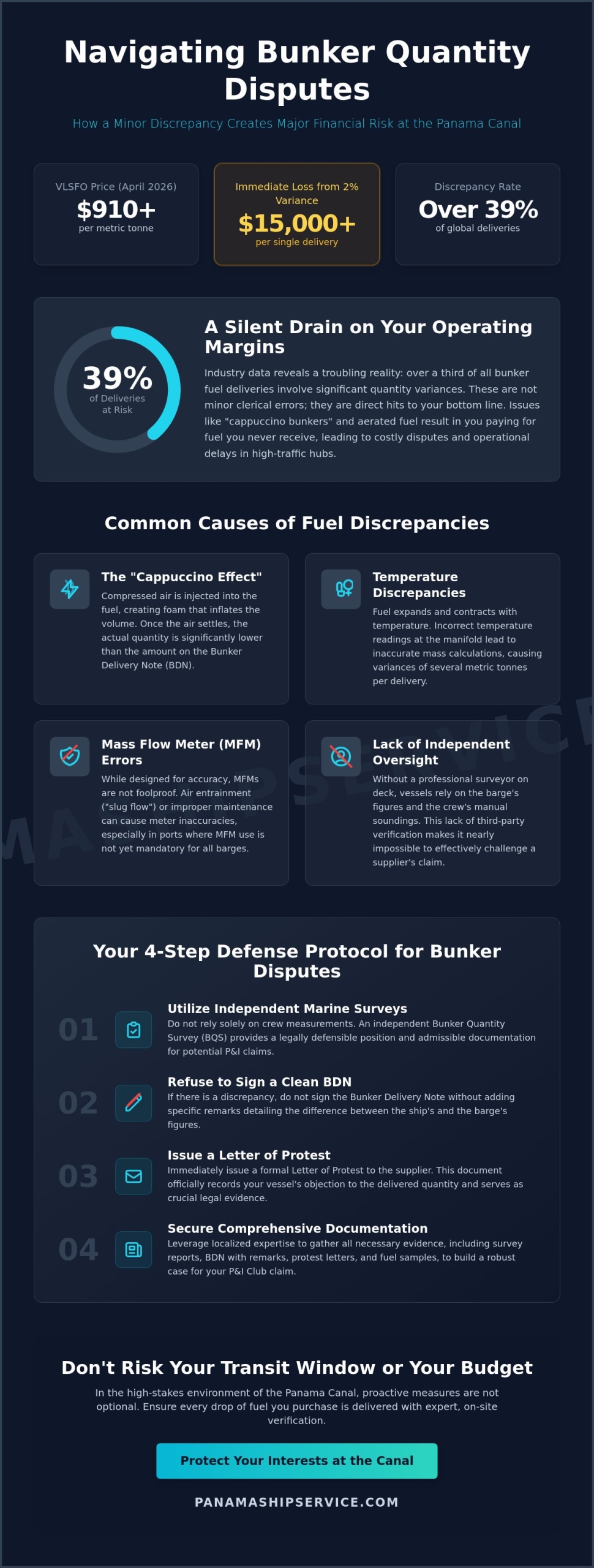
This guide provides the framework to mitigate these financial losses and resolve fuel discrepancies using expert survey protocols. You’ll learn how to secure admissible documentation for P&I claims and ensure full delivery of purchased fuel without risking your transit window. We’ll cover the impact of the ISO 8217:2024 standards, the importance of independent verification, and the specific steps required to maintain your schedule while protecting your legal rights in a volatile market.
Key Takeaways
- Identify how technical anomalies like the “cappuccino effect” and Mass Flow Meter errors create discrepancies between supplier and receiver figures.
- Establish a legally defensible position in a bunker quantity survey dispute by utilizing independent marine surveys instead of relying solely on crew measurements.
- Execute the correct immediate response protocol, including the refusal to sign a Bunker Delivery Note without specific remarks and the issuance of a formal Letter of Protest.
- Leverage localized expertise at the Panama Canal to manage tight transit windows and ensure comprehensive documentation for P&I club claims.
The Financial Stakes of Bunker Quantity Survey Disputes in 2026
A bunker quantity survey dispute arises the moment the supplier’s figures on the Bunker Delivery Note (BDN) fail to align with the receiving vessel’s measurements. In the 2026 maritime market, these discrepancies have become increasingly expensive. With Very Low Sulphur Fuel Oil (VLSFO) prices climbing above $910 per metric tonne in April 2026, even a minor variance represents a significant loss of capital. The recent introduction of ISO 8217:2024 has added further complexity to fuel handling, as the industry integrates biofuels and new distillates into standard operations.
The Panama Canal remains a high-pressure environment for these transactions. The sheer volume of traffic and the rigid scheduling of the Panama Canal Authority (ACP) create a high-risk zone for quantity errors. When a barge rushes to meet multiple vessel appointments, measurement accuracy often suffers. Data from FuelTrust indicates that over 39% of global bunker deliveries involve a discrepancy of 2% or more. For a standard fuel delivery, this “minor” leakage results in tens of thousands of dollars in lost value per bunkering operation, creating a massive annual financial drain for fleet operators.
Why Bunker Disputes Occur Thousands of Miles from HQ
Most ship owners and charterers manage their fleets from central hubs like London, Singapore, or Athens. This distance creates a lack of physical oversight during the critical moments of fuel transfer. Without a professional representative on the deck, the vessel relies entirely on the barge’s figures and the chief engineer’s manual soundings. The bunker barge is the primary point of conflict. Discrepancies often stem from differences in tank calibration, temperature adjustments, or the presence of entrained air. Because the vessel is constantly moving to meet its next transit window, there is rarely enough time for the crew to perform the exhaustive cross-checks required to challenge a supplier’s claim effectively.
Operational Consequences of Unresolved Discrepancies
The impact of a bunker quantity survey dispute extends far beyond the initial fuel invoice. In Panama, an unresolved dispute can lead to the loss of a scheduled transit slot. The ACP requires precise documentation; any delay caused by measurement disagreements can trigger fines starting at $2,500, while more serious documentation violations can exceed $15,000. Unresolved claims also strain the relationship between owners and charterers, leading to months of administrative friction. Legal fees and demurrage costs quickly accumulate when disputes remain inconclusive due to a lack of independent evidence. Relying on good faith in a high-stakes hub like the Panama Canal is a strategy that leads to predictable financial leakage.
Common Causes of Discrepancies: From Aeration to MFM Errors
The most notorious cause of a bunker quantity survey dispute is the “cappuccino effect.” This occurs when suppliers inject compressed air into the fuel during delivery. The resulting foam inflates the physical volume of the oil in the tanks, leading to a higher reading on the sounding tape. Once the air settles, the actual quantity is revealed to be significantly lower than the Bunker Delivery Note (BDN) suggests. This manipulation is difficult to detect without immediate, professional oversight during the entire pumping process to monitor for unusual frothing or bubbles in the sampling line.
Temperature variations also play a critical role in measurement disagreements. Fuel oil expands and contracts based on its thermal state. If a supplier provides a density reading based on a temperature significantly different from the actual delivery temperature, the calculated mass will be incorrect. Adhering to best practices to avoid bunker quantity disputes requires precise temperature monitoring at the manifold throughout the transfer. Even a few degrees of variance can translate into several tonnes of missing fuel, especially with the high-viscosity fuels often used in deep-sea transits.
While Mass Flow Meters (MFM) were designed to eliminate these issues, they aren’t a universal solution. As of January 1, 2026, all bunker vessels in Rotterdam and Antwerp-Bruges must use certified MFMs, but these systems remain vulnerable to specific types of interference. Air entrainment or “slug flow” can still cause meter inaccuracies if the system isn’t properly maintained or if the air-eliminator fails. In hubs like Panama where MFMs aren’t yet mandatory for all barges, “short-changing” through tank stripping remains a constant threat. This involves the barge claiming tanks are empty when unpumpable remains (ROB) are still hidden in the lines or sumps.
Technical Factors Influencing Fuel Volume
The relationship between temperature, density, and mass is the foundation of every fuel transfer. Under the ISO 8217:2024 standards, verifying these parameters is more complex due to the inclusion of biofuels with different expansion characteristics. Manual sounding remains a vital cross-check because it provides a physical verification that electronic sensors might miss. Relying solely on the barge’s computer is a risk most operators can’t afford when margins are thin.
Human Error vs. Intentional Manipulation
Discrepancies aren’t always malicious, but they are often preventable. Common mistakes include incorrect trim and heel corrections or using outdated tank calibration tables. However, intentional manipulation like “magic pipes” or hidden bypasses still occurs in high-traffic hubs. Crew members under pressure to meet tight Panama Canal transit slots often rush these measurements, missing critical signs of foul play. For those navigating these high-stakes transfers, engaging a professional marine survey team ensures that every drop of fuel is accounted for before the vessel departs.
Independent BQS vs. Crew Measurements: A Legal Necessity
A bunker quantity survey dispute often hinges on the quality of the evidence presented during arbitration. Relying on supplier-provided figures is a fundamental risk; these figures represent an inherent conflict of interest. While a barge crew might present a Mass Flow Meter printout as absolute truth, these documents lack the impartiality required for legal protection. P&I clubs and insurers prioritize independent surveyor reports because they provide a third-party, forensic account of the transfer. In the event of a significant short-delivery, an independent surveyor serves as a vital expert witness, offering a professional log that carries far more weight in court than internal crew soundings.
The financial return on investing in professional Marine Surveys is clear when compared to the average cost of a quantity discrepancy. A 2022 report indicated that the average fuel oil quantity dispute costs approximately $27,790. When Very Low Sulphur Fuel Oil prices exceed $910 per metric tonne, a survey that prevents even a 30-tonne discrepancy pays for itself many times over. This proactive approach transforms a potential loss into a manageable operational expense, providing the “evidentiary trail” that organizations like Skuld emphasize for successful claims.
The Limitations of Ship’s Crew Measurements
In the high-pressure environment of the Panama Canal, the ship’s crew is frequently overwhelmed. Preparing for a transit involves complex ballast adjustments, engine room readiness, and administrative compliance. Fatigue and operational distractions make it difficult for a Chief Engineer to dedicate the necessary hours to monitor a barge’s pumping behavior. Crew members often lack specialized training in forensic bunker auditing, which leaves them vulnerable to sophisticated manipulation. Most importantly, a Bunker Delivery Note (BDN) signed by the crew without specific, technical remarks is often viewed as a legally binding acceptance of the quantity, making it nearly impossible to contest the invoice later.
What an Independent Surveyor Brings to the Barge
Independent surveyors operate with total impartiality, adhering to strict international sampling and measurement standards. They perform comprehensive full-tank soundings of both the vessel and the supply barge, including all non-nominated tanks where fuel might be concealed. Beyond simple measurements, they calculate the Vessel Experience Factor (VEF). This historical data identifies patterns of discrepancy specific to a particular vessel or barge over time. By documenting every variable from trim corrections to temperature fluctuations, the surveyor ensures that the final figures are accurate and defensible against any supplier challenge.
Step-by-Step Protocol for Handling a Bunker Dispute in Panama
When the Chief Engineer identifies a variance between the barge figures and the vessel’s soundings, the first 60 minutes are critical. You must never sign a Bunker Delivery Note (BDN) without clearly stating your objections in the remarks section. A clean signature on the BDN is often interpreted as a legal acceptance of the quantity delivered, which effectively voids your ability to initiate a bunker quantity survey dispute later. If the barge master refuses to allow remarks on the BDN, the vessel must immediately issue a formal Letter of Protest (LOP) before the barge unmoors.
The documentation trail must be exhaustive to survive the scrutiny of a P&I club audit. Ensure that all fuel samples are taken at the vessel’s manifold, sealed in the presence of both parties, and logged with unique seal numbers. You should also request the Mass Flow Meter (MFM) profile data and the barge’s own sounding logs. In the Panama Canal, where transit windows are tight, these records must be organized and ready for inspection. For vessels currently facing a discrepancy, immediate intervention via professional Marine Surveys is the only way to secure the evidence needed for a successful claim.
Drafting an Effective Letter of Protest
An effective LOP must include the vessel’s name, the barge’s name, the exact time and location of the bunkering, and the specific amount of the discrepancy. Clearly state the reason for the protest, whether it is due to air entrainment, temperature differences, or physical short-delivery. A Letter of Protest serves as a formal reservation of rights that preserves the vessel’s ability to pursue a claim against the supplier at a later date. If the supplier refuses to sign the LOP, the ship’s agent should be notified immediately to witness the refusal and distribute the document to all relevant stakeholders.
Engaging local authorities is a necessary step if the dispute threatens your transit schedule. The Panama Canal Authority (ACP) maintains strict regulations regarding documentation. Failure to resolve or properly document a dispute can lead to fines ranging from $2,500 to over $15,000 for documentation violations. If the discrepancy is significant enough to affect the vessel’s safety or compliance with the Panama Canal Shipboard Oil Pollution Emergency Plan (PCSOPEP), the ACP may require a formal investigation before the transit can proceed.
The Role of Witnesses and Digital Evidence
Digital evidence provides an indisputable layer of protection. Take high-resolution photographs of all seals, meter readings, and sounding tapes used during the operation. Ensure these photos are timestamped and geotagged. The surveyor acts as a critical third-party witness, and their independent statement often carries more weight than the crew’s testimony in arbitration. Every interaction with the barge master, including the time the protest was issued and any verbal disagreements, must be recorded in the vessel’s Bell Book. This chronological record proves that the crew followed standard industry protocols throughout the delivery process.
Panama Ship Service: Protecting Your Interests at the Canal
A bunker quantity survey dispute at the Panama Canal isn’t just a financial disagreement; it’s a direct threat to your transit schedule. Panama Ship Service leverages decades of local experience to navigate these high-stakes scenarios. We maintain a detailed history of the local barge fleet, identifying patterns of discrepancy before the first hose is connected. This proactive intelligence allows us to position your vessel for a successful transfer, even in a market where VLSFO prices surpassed $910 per metric tonne in April 2026.
Our team provides comprehensive marine surveys in Panama designed to satisfy the evidentiary requirements of P&I clubs and legal counsel. By integrating these surveys with our capacity for mechanical ship repairs, we provide a single point of accountability. This minimizes the need for multiple contractors and reduces the likelihood of operational friction during your stay. We focus on business outcomes, ensuring that your fuel delivery is accurate and your equipment is ready for the locks.
Our Approach to Loss Control and Dispute Resolution
We utilize rigorous pre-delivery and post-delivery sounding protocols that leave no room for ambiguity. Our surveyors don’t just record numbers; they perform forensic audits of barge tank calibrations and monitor for air entrainment throughout the pumping process. We coordinate directly with vessel agents and P&I representatives to ensure that every Letter of Protest is backed by admissible data. This systematic approach allows us to identify high-risk barges and alert your crew to potential issues before they escalate into a formal claim. You can delegate the complexity of fuel verification to our experts and focus on the safety of your transit.
Why Strategic Location Matters for Your Bottom Line
The Panama Canal Authority (ACP) operates on a precise schedule that allows little room for error. A delay in resolving a quantity discrepancy can lead to fines starting at $2,500, while documentation violations can attract penalties of $15,000 or more. Our strategic presence at both ends of the Canal ensures that survey response teams are available for emergency surveys during tight transit windows. We understand the ACP’s digital transformation and pre-arrival requirements, including the Panama Canal Shipboard Oil Pollution Emergency Plan (PCSOPEP).
This localized knowledge ensures that your vessel moves through the locks without the risk of a bunker quantity survey dispute or unnecessary financial leakage. We provide the technical precision and legal protection required to maintain your schedule in a high-pressure environment. Contact Panama Ship Service today to secure your next bunkering operation and protect your fleet from the risks of short-delivery.
Securing Your Fleet’s Financial Integrity at the Panama Canal
Protecting your vessel from financial leakage requires more than just careful crew soundings. It demands a rigorous, independent protocol that stands up to legal scrutiny. By implementing the correct Letter of Protest (LOP) sequence and prioritizing independent verification, you eliminate the ambiguity that often fuels a bunker quantity survey dispute. Technical precision is the only defense against the sophisticated “short-changing” tactics found in high-traffic hubs. You don’t have to face these high-stakes transfers alone.
Panama Ship Service provides the specialized oversight needed to navigate these complexities. With over 20 years of maritime expertise in Panama and membership in leading international maritime survey associations, we bridge the gap between physical measurement and legal protection. You can delegate the technical burden of fuel verification to our experts; we understand the specific barge dynamics and ACP operational requirements that affect your bottom line. Our 24/7 rapid response ensures that your vessel maintains its Panama Canal transit window while securing every drop of purchased fuel. Secure your fuel investment with expert Bunker Surveys in Panama and transition through the locks with total operational confidence. Your fleet’s efficiency is our priority.
Frequently Asked Questions
What is the most common cause of a bunker quantity dispute?
The “cappuccino effect,” or air entrainment, remains the leading cause of delivery discrepancies. Suppliers may inject compressed air into the fuel to inflate its physical volume during measurement. Other common causes include incorrect density declarations and temperature variances that lead to inaccurate mass calculations.
Can I resolve a bunker dispute after the vessel has sailed?
Resolving a dispute after departure is extremely difficult if the Bunker Delivery Note was signed without technical remarks. Without a formal Letter of Protest issued at the time of delivery, suppliers and insurers typically consider the transaction finalized. Success after sailing depends entirely on having witnessed samples and independent survey reports.
Is a Mass Flow Meter (MFM) reading legally binding in Panama?
Mass Flow Meter readings aren’t yet the sole legal authority for bunkering in Panama, unlike the mandates in Singapore or Rotterdam. While MFM data is strong evidence, the Panama Maritime Authority and local courts still place significant weight on independent manual soundings and witnessed meter profiles during a bunker quantity survey dispute.
What should the Chief Engineer do if the barge figures don’t match the ship’s?
The Chief Engineer must immediately refuse to sign a clean Bunker Delivery Note and instead insert specific remarks regarding the discrepancy. They should then issue a formal Letter of Protest and contact the vessel’s agent to arrange for an independent marine survey before the barge departs.
How does temperature affect the final bunker quantity calculation?
Fuel oil expands as temperature increases, which increases volume while decreasing density. Since fuel is purchased by mass, failing to adjust for the actual delivery temperature can lead to a significant bunker quantity survey dispute. Accurate mass calculation requires using the density at the actual manifold temperature.
What is a ‘Letter of Protest’ and why is it critical for bunker claims?
A Letter of Protest is a formal document that serves as a reservation of rights for the ship owner or charterer. It preserves the legal ability to pursue a claim by documenting that a discrepancy was identified and contested during the bunkering operation. It’s the primary evidence required by P&I clubs.
How long does a standard Bunker Quantity Survey take at the Panama Canal?
A standard survey typically adds 2 to 4 hours to the bunkering operation. This timeframe includes the initial pre-delivery soundings, monitoring the entire transfer process, and performing the final measurements on both the barge and the vessel to ensure all fuel is accounted for properly.
Are independent BQS surveys recognized by all P&I clubs?
Yes, independent surveys are recognized and highly prioritized by all major P&I clubs. These organizations rely on the impartial, third-party data provided by professional surveyors to validate claims. This documentation is often the only admissible evidence during arbitration or litigation involving fuel discrepancies.