
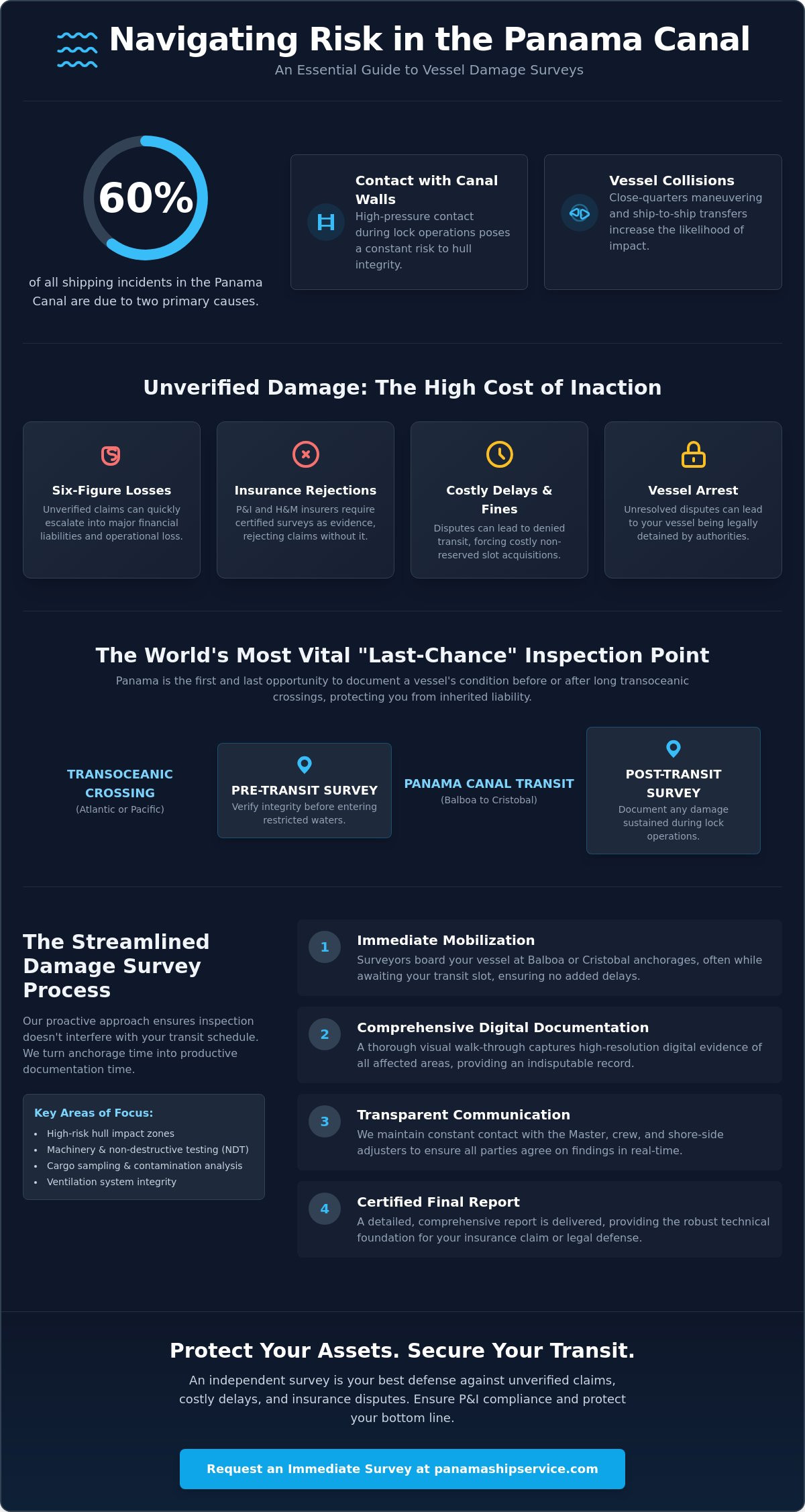
Did you know that contact with canal walls and vessel collisions account for nearly 60% of all shipping incidents in the Panama Canal? With 6,288 transits recorded in the first half of fiscal year 2026, the pressure to maintain a strict schedule is higher than ever. When an incident occurs, securing an immediate vessel damage survey panama is the only way to prevent unverified damage from turning into a six-figure operational loss. You need a partner who understands that unverified claims and inaccurate assessments lead directly to insurance rejections and costly delays.
We recognize that every hour your ship spends idle at Balboa or Cristobal erodes your profit margins and complicates your logistics. This guide explains how professional vessel and cargo damage surveys protect your interests by providing certified evidence and accurate repair cost estimates. We’ll examine how to maintain P&I compliance, navigate the new risk-based inspection models, and minimize downtime during your Canal transit to keep your operations on track.
Key Takeaways
- Understand why Panama serves as a critical “last-chance” inspection hub to verify hull and machinery integrity before or after transoceanic crossings.
- Learn how to secure a professional vessel damage survey panama that utilizes high-resolution digital evidence to satisfy P&I and H&M insurance requirements.
- Discover the “neutral party” advantage of independent surveyors and why avoiding captive providers is essential for successful maritime dispute resolution.
- Identify the specific documentation and coordination steps required with your Canal agent to minimize anchorage time and avoid transit delays.
- See how integrating survey results with mechanical ship repairs reduces communication lag and optimizes your vessel’s maintenance schedule.
What is a Vessel Damage Survey and Why is it Critical in Panama?
A vessel damage survey is an independent, expert assessment designed to document the exact extent of degradation or physical harm to a ship’s hull, machinery, or cargo. In the maritime industry, an objective third party must verify these findings to ensure the report holds legal and financial weight. A professional Marine surveyor acts as a neutral observer, providing a technical bridge between ship operators, insurers, and the Panama Canal Authority (ACP).
Panama occupies a unique strategic position as the world’s most vital maritime “last-chance” inspection point. For vessels arriving from long transoceanic crossings, Panama is the first opportunity to evaluate structural integrity before entering the restricted waters of the Canal. Conversely, for ships exiting the Canal, it’s the final chance to document any damage sustained during lock operations before heading into the open sea. Without a vessel damage survey panama, a shipowner risks inheriting liabilities for damage that occurred under a previous charterer’s watch or during a specific transit segment.
This survey is essential for protecting the “Master’s signature” on the Bill of Lading. When a Master signs for cargo or accepts a vessel’s condition without a formal survey, they effectively accept legal responsibility for any pre-existing defects. In the high-stakes environment of the Canal, unresolved disputes aren’t just paperwork headaches; they frequently lead to vessel arrest or the ACP denying transit until safety is verified. This can result in astronomical costs for non-reserved transit slots, which have seen auction prices exceed $1 million in peak periods.
The Financial Impact of Unverified Damage
The gap between a supplier’s claim and the actual condition of a vessel can reach tens of thousands of dollars. One of the most common financial risks involves “bad bunkers” or contaminated fuel. If poor-quality fuel causes machinery failure during a transit, the shipowner faces both repair costs and potential fines for blocking the waterway. P&I Clubs and international insurers demand certified surveys in the Panama region because they require evidence that meets global evidentiary standards. These reports serve as the primary defense against inflated repair invoices and fraudulent cargo claims.
Panama Canal Specific Risks
The local environment introduces specific variables that many general surveys overlook. Panama’s intense tropical humidity and heat can rapidly accelerate the degradation of sensitive agricultural or chemical cargoes if ventilation systems are compromised. Furthermore, the physical process of Canal lock operations involves high-pressure contact with lock walls and ship-to-ship transfers that pose a constant risk to the hull. Whether your vessel is calling at Balboa on the Pacific side or Cristobal on the Atlantic side, securing an urgent inspection is a logistical necessity. We coordinate these surveys to ensure your ship remains compliant with ACP safety regulations while minimizing any impact on your scheduled transit time.
The Damage Survey Process: Step-by-Step
Time is the most expensive commodity at the Panama Canal. When you request a vessel damage survey panama, the process begins with immediate mobilization. Our surveyors board your vessel at the Balboa or Cristobal anchorages, often while the ship is awaiting its transit slot; this proactive approach ensures the inspection doesn’t interfere with your scheduled movement. By utilizing the time spent in the queue, we provide the necessary documentation without adding to your port stay.
The inspection follows a rigid protocol. First, the surveyor conducts a comprehensive visual walk-through, capturing high-resolution digital documentation of all affected areas. Given that contact with canal walls and collisions account for nearly 60% of all incidents in the waterway, our visual inspections focus heavily on these high-risk impact zones. If the damage involves mechanical systems, we perform technical testing such as non-destructive testing (NDT) to identify hairline fractures in the hull or machinery. For cargo disputes, we implement strict sampling protocols to verify degradation levels and potential contamination.
Throughout the process, the surveyor maintains constant communication with the Master, the crew, and shore-side insurance adjusters. This transparency ensures all parties agree on the findings in real-time, which speeds up the final report issuance. Once the data is compiled, we deliver a comprehensive report that provides the technical foundation for your insurance claim or legal defense. Our goal is to provide a clear, indisputable record that allows you to move forward with confidence.
On-Site Inspection Techniques
In Panama’s high-traffic environment, we use specialized tools to detect hidden issues. Thermal imaging and moisture sensors are vital for bulk grain or coal surveys to identify hot spots caused by the region’s intense humidity. If structural damage is suspected below the waterline, we deploy divers or ROVs to perform hull inspections. These assessments allow us to evaluate integrity without the need for immediate dry-docking, keeping your transit schedule intact. We also conduct draft surveys and tallying to ensure cargo quantity matches the manifest exactly. If these inspections reveal critical issues, securing mechanical ship repairs immediately is the best way to satisfy ACP requirements.
Evidence and Documentation Standards
The strength of a survey lies in its ability to withstand scrutiny in international arbitration. We maintain a rigorous chain of custody for all physical samples, whether it’s contaminated fuel or damaged cargo. Every photograph is time-stamped and geo-located to prove exactly where and when the damage was recorded. The resulting Statement of Fact (SOF) serves as an indisputable record of events. This level of detail is what P&I Clubs require when reviewing a vessel damage survey panama to process claims efficiently and protect your financial interests.
Evaluating Survey Providers: Independent vs. Captive Surveyors
Relying on a surveyor provided by a charterer or a fuel supplier is a significant operational risk. Their primary objective often aligns with minimizing their own liability rather than providing an objective assessment of your vessel’s condition. An independent vessel damage survey panama removes this conflict of interest, providing the “neutral party” advantage that P&I and Hull & Machinery (H&M) insurers require for claim approval. Without an unbiased report, your evidence may be dismissed during arbitration, leaving you to absorb the full cost of repairs or cargo loss.
Expertise matters more than just a presence on the dock. You need a team comprised of Naval Architects and Marine Engineers who can interpret complex structural data. While a generalist might identify a dent in the hull, a specialized engineer understands how that impact affects the vessel’s longitudinal strength or its ability to safely navigate the Canal’s lock systems. Proficiency in these technical fields ensures that your survey is not just a collection of photos, but a professional diagnostic tool that stands up to technical scrutiny.
Response time is a critical differentiator in this high-stakes environment. In the fast-paced logistics of the Panama Canal, a surveyor who takes 24 hours to mobilize is an operational liability. We prioritize a 2-hour mobilization window to meet vessels at Balboa or Cristobal. This speed is essential when a vessel faces a narrow transit window or needs to clear an inspection before a scheduled departure. Prompt action prevents the compounding costs of missed slots and port congestion, ensuring your schedule remains as intact as possible.
Certifications and International Standards
Validity in the maritime world is defined by Class Approval. Ensure your provider holds recognition from major societies such as ABS, Lloyd’s, or DNV. For 2026 operations, compliance with IFIA/TIC Council standards is increasingly critical for cargo and quality inspections. We also maintain all necessary local licenses to operate within Panamanian ports. This ensures our surveyors have immediate, legal access to your vessel without the bureaucratic delays that often plague uncertified providers.
Report Quality and Dispute Resolution
A poorly drafted report can undermine your legal standing. A mere “visual summary” often lacks the technical depth required to prove liability in a court of law or an insurance board. Instead, we focus on root cause analysis, which identifies exactly how and why damage occurred. This level of detail is a powerful tool when negotiating repair costs at Balboa shipyards or resolving disputes with charterers. Accurate data allows you to challenge inflated invoices and ensures that the final settlement reflects the actual technical reality of the incident.
Preparing for a Damage Survey at the Panama Canal
Efficient preparation is the only way to ensure a vessel damage survey panama doesn’t derail your transit schedule. Coordination with your Panama Canal agent is the first critical step; they must secure the necessary anchorage time and ensure the Panama Canal Authority (ACP) is aware of the inspection requirements. Given that all vessels must provide a 96-hour advance notification of their estimated time of arrival, this window should be used to finalize the surveyor’s boarding logistics. Failure to align the agent, the Master, and the surveyor often results in missed transit slots and mounting port fees.
Before the surveyor steps onto the gangway, the Master must have all essential documentation ready for review. This includes the Bill of Lading, the Stowage Plan, and detailed Logbooks. These records provide the historical context needed to determine if damage was pre-existing or occurred during the current voyage. Additionally, the Master should manage the Notice of Protest (NOP) process concurrently. An NOP serves as a formal declaration that an incident occurred; however, it is the survey report that provides the technical evidence required to quantify that declaration. Having the survey data to back up your protest creates an airtight case for your insurers.
Safety protocols for surveyors boarding during transit or bunkering are non-negotiable. The crew must ensure clear access and safe ladder deployment, particularly during ship-to-ship transfers which are high-risk zones for hull contact. Maintaining a clear deck and organized workspace allows the technical expert to work efficiently, reducing the time they need to be on board and allowing your crew to focus on operational readiness.
Logistical Coordination in Balboa and Cristobal
Surveying at the Pacific entrance (Balboa) involves different anchorage dynamics than the Atlantic side (Cristobal). While Balboa often sees higher traffic for bunker stops, Cristobal can present more challenging weather conditions that affect small boat transfers. We handle the complexities of port security, including securing boarding passes and gate access for our technical teams. This allows for a seamless “bunker and survey” stop where multiple operations occur simultaneously to minimize your vessel’s idle time and reduce overhead.
Immediate Post-Survey Actions
The process doesn’t end when the surveyor finishes their walk-through. The Master should review preliminary findings immediately to identify “Critical to Transit” damages. These are structural or mechanical issues that could cause the ACP to deny lock entry. If such problems are identified, we immediately link the survey findings to mechanical ship repairs panama to address the faults before your transit window closes. This proactive transition from assessment to resolution is what keeps your operation moving.
To protect your schedule and your bottom line, you need a partner who can handle the logistics from start to finish. Contact us today to secure your vessel damage survey in Panama and ensure a smooth transit through the Canal.
Integrated Maritime Solutions: The Panama Ship Service Advantage
The “One-Stop-Shop” approach is the most effective way to reduce vessel overhead and eliminate the communication lag that typically occurs between disparate service providers. When you commission a vessel damage survey panama, the value lies not just in the technical report, but in the speed of the subsequent response. Most surveying firms provide a document and exit the vessel; we provide a direct bridge to resolution. By integrating our survey department with our on-site technical teams, we facilitate a seamless transition to mechanical ship repairs. This ensures that the moment a deficiency is identified, the specialized resources required to fix it are already being mobilized.
Consolidating multiple maritime requirements during a single port call is a matter of fiscal responsibility. While our surveyors conduct their assessment, we can simultaneously manage MARPOL disposal panama and the delivery of essential provisions. This holistic management style reduces the number of vendors your crew must coordinate with, lowering the risk of logistical errors and port stay extensions. We maintain a constant presence at both the Balboa and Cristobal terminals, providing the operational continuity required for high-stakes Canal transits. Our 24/7 availability across both ends of the Canal means your vessel is never left without expert support, regardless of your arrival time.
Beyond Damage: Comprehensive Technical Support
A thorough vessel assessment often requires looking below the waterline. We frequently combine our damage surveys with underwater hull services to provide a 360-degree view of structural health. This is particularly vital for Neopanamax vessels where hull clearances are minimal and the risk of lock contact is a constant reality. Our local expertise allows us to navigate the specific Panama Canal Authority (ACP) requirements for 2026, ensuring that all technical documentation meets their stringent safety standards. While the technical teams work, our agency department can manage crew changes and the delivery of ship supplies panama canal, ensuring your vessel is fully prepared for the next leg of its voyage.
Contacting Panama Ship Service for 2026 Operations
Operational efficiency at the Canal requires a partner who is proactive rather than reactive. To request an urgent survey quote for Balboa or Cristobal, your team only needs to provide the vessel’s ETA and the nature of the suspected damage. We’re committed to total transparency and a rapid report turnaround, providing the data you need to resolve insurance claims or ACP inquiries without delay. Don’t let unverified damage compromise your transit schedule or your legal standing. Contact Panama Ship Service for expert vessel damage surveys and experience the advantage of a truly integrated maritime partner.
Secure Your Maritime Interests in Panama
Protecting your vessel’s operational integrity requires technical precision and a partner who understands the high-stakes environment of the Panama Canal. Securing an independent vessel damage survey panama ensures that every claim is backed by certified evidence, shielding your business from unverified liabilities and insurance rejections. This technical clarity is essential for resolving disputes and satisfying P&I requirements while your ship is at anchor.
Panama Ship Service provides the reliability you need with Class-approved surveyors from ABS, Lloyd’s, and DNV. We offer 24/7 emergency response from our strategic locations in Balboa and Cristobal, ensuring our technical teams are ready whenever your vessel arrives. We don’t just provide data; we offer the technical expertise required to maintain your transit schedule. Request an Independent Vessel Damage Survey Quote today and safeguard your interests at the Canal. We look forward to supporting your fleet’s success.
Frequently Asked Questions
What is the typical cost of a vessel damage survey in Panama?
The cost of a professional assessment depends on the technical scope, the size of the vessel, and whether specialized testing like NDT or underwater inspections are required. We provide tailored quotes based on your specific operational needs at the Canal rather than using a flat rate. Factors such as whether the survey occurs at the Balboa or Cristobal anchorage also influence the final logistical expenses associated with the inspection.
How quickly can a surveyor board my vessel at the Panama Canal?
Our surveyors typically board vessels within a two-hour window once the request is finalized and port access is granted. This rapid mobilization is critical for ships with tight transit slots or those awaiting bunkering operations. We coordinate directly with your Panama Canal agent to ensure the boarding process is synchronized with your vessel’s arrival, preventing any additional delays to your scheduled movement through the locks.
Can a damage survey be conducted while the ship is in transit through the locks?
Most comprehensive inspections occur at anchor for safety and technical accuracy. Conducting a vessel damage survey panama while a ship is moving through the locks is generally discouraged due to restricted access to the hull and machinery. Performing the survey at a stable anchorage allows for the use of specialized equipment like drones or moisture sensors to capture high-resolution evidence that stands up to insurance scrutiny.
What types of cargo do you specialize in surveying at Balboa and Cristobal?
We specialize in a wide range of cargo types, including bulk minerals, liquid chemicals, and temperature-sensitive agricultural products. Our technical experts understand the specific risks associated with each commodity, such as moisture-induced heating in coal or contamination in refined oil tankers. This specialization ensures that your cargo damage report is technically sound and provides a clear basis for any legal or insurance claims.
Are your survey reports accepted by all P&I Clubs and international insurers?
Yes, our survey reports are recognized by major P&I Clubs and international hull insurers. We maintain high standards of documentation and evidence gathering that align with global maritime legal requirements and evidentiary standards. Using Class-approved surveyors ensures that the findings from your vessel damage survey panama are accepted during international arbitration or when processing complex insurance claims for hull and machinery damage.
What happens if the survey reveals damage that prevents Panama Canal transit?
If a survey identifies damage that violates ACP safety regulations, the vessel must be repaired before transit is permitted. In these scenarios, we facilitate a direct transition to our mechanical ship repair teams to address the deficiencies immediately. This integrated approach allows you to resolve structural or mechanical issues without searching for a separate contractor, helping you secure a new transit slot as quickly as possible.
Do you provide surveys for containerized cargo as well as bulk and tankers?
We provide technical survey services for containerized vessels, bulk carriers, and tankers alike. For container ships, we focus on lashing integrity and structural damage to the cells or the containers themselves. For tankers and bulkers, the focus shifts to hull integrity and cargo contamination. This ensures that every vessel type receives a specialized assessment tailored to its specific structural and cargo-handling characteristics.
How long does it take to receive the final survey report after the inspection?
You’ll receive a preliminary summary of findings immediately after the surveyor leaves the vessel. This allows the Master and shore-side management to make urgent operational decisions regarding repairs or transit. The final, comprehensive report, including all time-stamped digital evidence and technical analysis, is typically delivered within 24 to 48 hours. This fast turnaround is designed to meet the high-pressure demands of the Panama Canal’s logistics schedule.