
Did you know that a single failed inspection or a missing form during a Panama Canal transit can lead to a penalty of up to $10,000? For ship operators, the pressure of a transit goes far beyond the standard $670 vessel inspection fee. You recognize that the true risk lies in cargo damage claims and the operational paralysis caused by a failed water-tightness check. Professional hatch cover inspection services are no longer just a recommendation. They’re a critical operational gatekeeper for the 22% of the world’s total tonnage currently registered under the Panamanian flag.
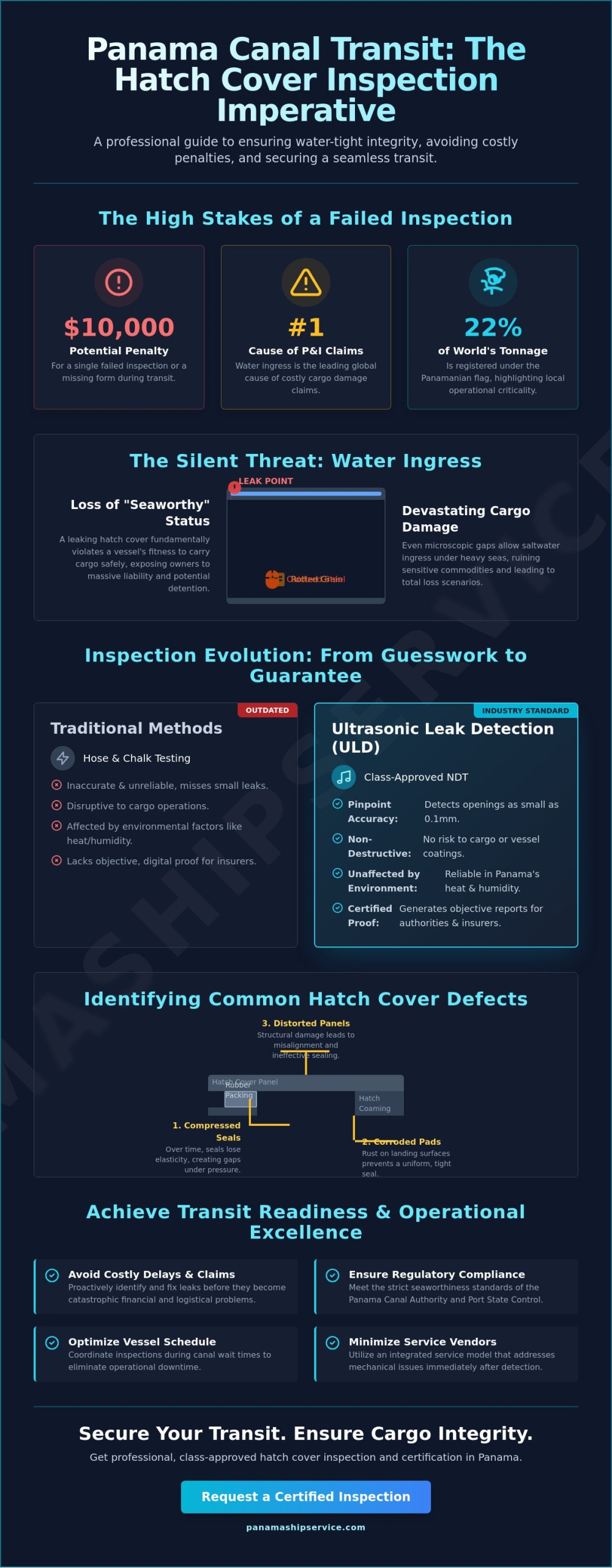
We understand that maintaining cargo integrity is your top priority when moving through this strategic hub. This guide provides a professional roadmap for ensuring your vessel meets strict seaworthiness standards through advanced leak detection and compliance strategies. We’ll examine the industry shift toward ultrasonic testing, the specific requirements of the Panama Maritime Authority, and how to prevent technical hold-ups that threaten your schedule. By the end, you’ll have the knowledge to secure certified proof of water-tightness and ensure a smooth, delay-free transit.
Key Takeaways
- Understand why water-tight integrity acts as a mandatory operational gatekeeper to avoid costly transit delays and cargo damage claims.
- Learn how modern hatch cover inspection services utilize non-destructive ultrasonic testing to provide accurate leak detection without disrupting cargo operations.
- Identify the common structural and mechanical defects that compromise seal alignment and vessel seaworthiness during heavy weather.
- Discover how to optimize your schedule by coordinating technical inspections with essential tasks like MARPOL disposal during canal wait times.
- Explore the benefits of an integrated model that addresses mechanical issues immediately to minimize the need for multiple service vendors.
The Critical Role of Hatch Cover Inspections for Panama Canal Transits
A vessel’s seaworthiness isn’t merely defined by its propulsion or hull integrity; it’s equally dependent on its ability to protect cargo from the elements. For ship operators, hatch cover inspection services represent a mandatory safeguard against the harsh realities of maritime logistics. In the high-stakes environment of the Panama Canal, where operational delays can cost thousands of dollars per hour, ensuring your hatches are watertight is a baseline requirement for a successful transit. If a vessel is found to have defective sealing arrangements, the consequences extend far beyond a simple repair bill.
Water ingress remains the leading cause of Protection and Indemnity (P&I) cargo claims globally. When sea water enters a hold, it doesn’t just wet the cargo; it often destroys it entirely. From a legal standpoint, a ship is only considered “seaworthy” if it’s fit to encounter the ordinary perils of the sea and carry its specific cargo safely. A leaking hatch cover fundamentally violates this status, exposing owners to massive liability and potential detention by port state control authorities.
Preventing Cargo Damage and Contamination
Saltwater ingress is particularly devastating for sensitive commodities like grain, which can rot rapidly, or steel products, which suffer immediate oxidation and surface rust. The point of failure is often the interface where the cover meets the hatch coaming. Even a microscopic gap in the rubber packing can allow significant volumes of water to enter under the pressure of heavy seas. Professional hatch cover inspection services look beyond the surface, identifying compressed seals, corroded landing pads, or distorted panels that visual checks alone often miss. Modern insurance requirements now demand more rigorous proof of tightness than a simple chalk test can provide.
Regulatory Compliance and Canal Readiness
The Panama Canal Authority (ACP) maintains strict expectations for vessel condition to ensure the safety of the waterway. Technical hold-ups during a scheduled transit slot are a nightmare for any fleet manager. Having a comprehensive record of recent maintenance, including an underwater hull service and a certified hatch inspection report, streamlines the vetting process. Charterers and insurers view these documents as proof of proactive management. By verifying your vessel’s integrity before reaching the locks, you eliminate the risk of emergency repairs that could derail your schedule and damage your commercial reputation.
Advanced Inspection Methodologies: Ensuring Water-Tight Integrity
The maritime industry’s approach to verifying water-tightness has evolved significantly. Traditional methods like hose testing and chalk testing are increasingly viewed as insufficient for modern risk management. Today, hatch cover inspection services prioritize Non-Destructive Testing (NDT) to provide a higher level of certainty. This shift is driven by the need for extreme accuracy and the demand from insurers for objective, digital proof of integrity. Following the hatch cover survey guidelines established by international classification societies ensures that these inspections meet global safety standards. Using class-approved equipment isn’t just about compliance; it’s about utilizing tools that can withstand the rigors of a commercial vessel environment.
Environmental factors in Panama, specifically the high humidity and intense heat, can affect how different testing methods perform. In such conditions, water from a traditional hose test might evaporate too quickly or be trapped by surface tension, masking small leaks. Ultrasonic methods remain unaffected by these atmospheric variables, making them the most reliable choice for vessels transiting the Isthmus. Reliable data is the only way to satisfy the rigorous vetting processes of both the Panama Canal Authority and discerning charterers.
Ultrasonic Leak Detection (ULD)
Ultrasonic testing has become the preferred standard for professional hatch cover inspection services. The process involves placing an ultrasonic transmitter inside the cargo hold and using a receiver to scan the hatch joints from the outside. If there’s a gap in the seal, sound waves leak through. This technology can identify openings as small as 0.1mm, providing a level of precision that visual checks can’t match. One of the primary advantages of ULD is its operational efficiency. You don’t need to empty the holds, meaning inspections can occur while cargo is in place. This makes it a cornerstone of comprehensive marine surveys in Panama, where time is always a critical factor.
Visual Inspections and Hose Testing
While technology leads the way, a thorough visual “look-see” remains a vital first step. Inspectors must physically examine the bearing pads, rubber gaskets, and drainage channels for signs of wear or deformation. Hose testing, though traditional, has clear limitations. It requires empty holds to avoid cargo damage and creates a messy, often unsafe working environment. If you’re concerned about the physical condition of your hardware, scheduling a detailed marine survey can help identify mechanical vulnerabilities before they lead to a failed transit inspection. A visual check often reveals the “why” behind a leak that ultrasonic testing has already identified.
Identifying and Mitigating Common Hatch Cover Defects
Professional hatch cover inspection services provide a systematic breakdown of vessel vulnerabilities by categorizing defects into structural, mechanical, and sealing issues. During long transoceanic voyages, heavy weather often subjects the ship’s hull to intense racking stresses. These forces can push hatch panels out of alignment, putting immense pressure on the sealing interface and compromising water-tightness. When these misalignments occur, some operators resort to temporary “quick fixes” like expanding foam or heavy-duty adhesive tape. These materials are not recognized as legitimate sealing methods by P&I clubs or canal authorities. They often serve as a red flag to inspectors, suggesting that the vessel’s primary sealing arrangements have failed.
When an inspection identifies these critical vulnerabilities, immediate intervention is necessary to maintain the vessel’s schedule. Specialized mechanical ship repairs can rectify structural distortions or component failures while the vessel is in the Panama region. Addressing these problems proactively prevents the cascading costs associated with cargo damage or a failed Panama Canal Authority (ACP) inspection. A systematic repair approach ensures that the vessel remains compliant and operational without needing to deviate from its planned route.
Rubber Gasket and Compression Bar Failure
Rubber gaskets are the primary defense against water ingress, but they have a limited operational lifespan. Over time, they suffer from “permanent set,” a condition where the rubber loses its elasticity and hardens, preventing it from creating a tight seal against the compression bar. The compression bar itself must be straight, smooth, and free of corrosion. If the bar is rusted or notched, it will damage the rubber gasket and allow water to seep through. Inspectors look for physical signs of hardening, deep imprints, and “bridging” where the gasket has been poorly spliced during previous maintenance.
Mechanical and Structural Wear
Mechanical wear often centers on the bearing pads, which are designed to maintain the hatch cover’s correct vertical position. When these pads wear down, the cover sits too low on the coaming, leading to over-compression and rapid destruction of the rubber seals. Securing arrangements, such as cleats and wedges, are equally vital. Seized or missing cleats are common findings during hatch cover inspection services and represent a significant safety risk. Additionally, any leaks in the hydraulic system must be addressed immediately. Hydraulic failure can prevent the hatches from operating during cargo handling, leading to expensive port delays and potential safety hazards for the crew.
Strategic Timing: Scheduling Inspections to Minimize Vessel Downtime
Efficiency is the primary currency of the Panama Canal. Vessels often face significant wait times at the Pacific or Atlantic entrances, providing a strategic window to conduct critical maintenance without impacting the voyage schedule. This “Panama Advantage” allows ship operators to utilize idle time for professional hatch cover inspection services. By performing these checks at the anchorage, you ensure that any identified defects can be addressed before the vessel receives its transit slot. This proactive approach eliminates the risk of the Panama Canal Authority (ACP) identifying issues during their own inspections, which could lead to immediate delays or costly fines.
Bundling technical services is another way to optimize your operational budget. While the inspection team is on board, operators can simultaneously coordinate other essential requirements like MARPOL disposal or the delivery of ship supplies. Using a single agency to manage both the survey and any necessary mechanical ship repairs simplifies logistics and reduces the administrative burden on the crew. It’s about maximizing the utility of every hour spent at the Isthmus.
Inspections at Balboa and Cristobal Ports
The choice between the Pacific (Balboa) and Atlantic (Cristobal) anchorages often depends on the vessel’s direction of travel and its assigned schedule. Inspectors board the vessel via launch at these anchorages, allowing the crew to maintain their routine operations. Because canal transit slots are time-sensitive, it’s vital to coordinate with a service provider that understands the urgency of the waterway’s schedule. You should verify that your service partner can align their boarding times with your vessel’s arrival to ensure no interference with the narrow transit windows provided by the ACP.
The Pre-Transit Checklist
A successful transit begins long before the vessel reaches Panamanian waters. Fleet managers should implement a rigorous pre-transit checklist that includes a review of previous survey reports and maintenance logs. We recommend that the on-board crew conducts a visual check of all sealing arrangements at least 48 hours before arrival. This internal audit helps identify obvious issues like seized cleats or damaged rubber gaskets that might require immediate attention. Booking a certified third-party inspector to validate these findings provides the necessary documentation for P&I clubs and charterers, ensuring your vessel’s technical status is beyond reproach. To secure your transit window and ensure compliance, schedule your technical survey today.
Panama Ship Service: Professional Hatch Inspection and Certification
Panama Ship Service provides specialized technical teams stationed at the Canal to deliver precise hatch cover inspection services. We understand that a vessel’s schedule is its most valuable asset. Our approach combines technical proficiency with a deep understanding of the high-pressure environment surrounding the locks. By providing Class-approved reporting, we ensure that your vessel meets the rigorous standards required by insurers and the Panama Canal Authority. You can delegate the technical complexity of water-tightness verification to us, allowing you to focus on the broader logistics of your voyage. This level of professional documentation is often the deciding factor in a charterer’s vetting process.
Our “Inspect & Repair” model sets us apart from standard surveying firms. If an inspection reveals a leaking seal or a structural misalignment, you don’t need to waste time vetting and hiring a second contractor. We provide an integrated solution where the same partner identifying the problem can execute the resolution. This reduces overhead and eliminates the communication gaps that often lead to project delays. Fleet managers benefit from a single point of accountability, which is essential when a transit slot is on the line. We focus on tangible business outcomes like cost reduction and schedule optimization.
Comprehensive Technical Solutions
Our services integrate seamlessly with our broader portfolio of marine surveys. If our ultrasonic testing identifies a breach, we can immediately mobilize our steel and mechanical repair teams. Whether the issue is a corroded compression bar or a seized cleat, our technicians arrive equipped to handle the task. We maintain a proactive posture to match the non-stop pace of the Panama Canal. This responsiveness ensures that minor technical findings don’t escalate into major operational hold-ups. We handle the complexity so your crew can stay focused on safe navigation.
Why Experience in the Panama Hub Matters
Operating in this strategic corridor requires more than just technical skill; it requires a deep familiarity with local regulations and the history of the Panama Canal operational standards. We’ve spent years refining our processes to reduce vessel off-hire time for global operators. Our team knows exactly what the ACP inspectors are looking for and how to document repairs to satisfy their requirements. This localized expertise is why seasoned fleet managers trust us to secure their cargo integrity and seaworthiness. Contact our Panama office today for an immediate quote on our professional hatch cover inspection services and take the first step toward a worry-free transit.
Securing Your Cargo and Schedule in the Panama Corridor
Maintaining water-tight integrity is a constant operational challenge that requires more than just visual checks. You’ve seen how ultrasonic leak detection provides the precision needed to satisfy insurers and the Panama Canal Authority. By identifying defects early and utilizing wait times for professional hatch cover inspection services, you protect your vessel from the massive liability of cargo damage and regulatory fines.
Panama Ship Service brings decades of expertise to the Panama Canal maritime hub. We utilize Class-approved inspection technology and offer 24/7 emergency repair support at Balboa and Cristobal to ensure your vessel stays on schedule. Our integrated model handles everything from the initial survey to mechanical repair, which eliminates the need for multiple vendors and simplifies your logistics. This systematic approach ensures that your vessel remains compliant without unnecessary complications.
Secure your vessel’s transit with a professional hatch cover inspection from Panama Ship Service today. We’re ready to help you maintain seaworthiness and cargo integrity through every lock.
Frequently Asked Questions
Why are hatch cover inspections mandatory for most cargo vessels?
Hatch inspections are mandatory because they verify a vessel’s seaworthiness and its ability to protect cargo from water ingress. International regulations, including the Load Line Convention and SOLAS, require these checks to ensure ship stability and safety at sea. Without proof of water-tight integrity, a vessel is legally unfit to carry cargo, exposing ship owners to massive liability and potential detention by port state authorities.
What is the difference between ultrasonic testing and a hose test for hatch covers?
Ultrasonic testing uses high-frequency sound waves to identify gaps as small as 0.1mm without using water. It provides digital, objective proof of tightness and can be performed while holds are full. In contrast, hose testing involves spraying high-pressure water at the seals. This method is often messy, requires empty holds to avoid cargo damage, and cannot pinpoint small leaks with the same precision as electronic methods.
How often should a vessel perform a professional hatch cover inspection?
Professional inspections are typically required annually as part of statutory safety surveys. However, it’s a best practice to schedule a technical check before major transits through hubs like the Panama Canal or after the vessel encounters heavy weather. Regular weekly checks by the crew help maintain the hardware, but a certified third-party survey provides the necessary documentation for insurers and charterers to validate the vessel’s condition.
Can a hatch cover inspection be performed while the ship is loaded with cargo?
Yes, modern hatch cover inspection services utilize ultrasonic leak detection, which is completely non-destructive and safe for all cargo types. Since no water is used during the process, there is zero risk of moisture damage to sensitive goods like grain or steel. This allows operators to verify water-tightness at the anchorage while waiting for a transit slot, maximizing operational efficiency without disrupting cargo operations.
What happens if my hatch covers fail an inspection at the Panama Canal?
Failure leads to immediate operational delays and the potential for a penalty of up to $10,000 from the Panama Canal Authority. The vessel may be barred from transiting until the defects are rectified and a follow-up inspection confirms the repairs meet safety standards. This often results in missed transit slots and significant off-hire costs, which is why pre-arrival inspections at the Balboa or Cristobal anchorages are highly recommended.
How long does a typical professional hatch cover inspection take?
A standard inspection usually takes between 3 to 6 hours to complete. The exact duration depends on the size of the vessel and the number of hatch panels that require testing. Because ultrasonic equipment is portable and fast to set up, technicians can move quickly between holds. This speed ensures that the survey doesn’t interfere with the ship’s tight schedule or its assigned window for canal transit.
Are hatch cover inspection certificates recognized by P&I Clubs and insurance?
Yes, certificates issued by professional hatch cover inspection services using Class-approved equipment are essential for insurance purposes. P&I Clubs rely on these reports to settle cargo damage claims and to verify that the ship owner has exercised due diligence in maintaining the vessel. Having a valid, recent certificate significantly strengthens your position during commercial disputes or when negotiating insurance premiums for high-value voyages.
What are the most common reasons for hatch cover leakage?
Leakage is most often caused by hardened or “set” rubber gaskets that have lost their elasticity over time. Other common issues include corroded compression bars, worn bearing pads that cause the cover to sit too low, and seized securing cleats. Structural damage from heavy weather or improper maintenance of the drainage channels also allows water to bypass the primary seals, leading to cargo contamination and potential safety risks.