
With auction prices for transit slots reaching $385,000 and daily transits averaging 37 vessels, a single oversight during a port state control inspection in Panama is an expensive risk you can’t afford. Fines for equipment failures now exceed $15,000. Administrative errors in your PCSOPEP can trigger penalties up to that same amount. You’re likely feeling the pressure of the Panama Maritime Authority’s increased oversight, especially with the 2026 requirements mandating stricter reporting of seaworthiness deficiencies. It’s a high-stakes environment where technical precision is the only way to avoid detentions and protect your bottom line.
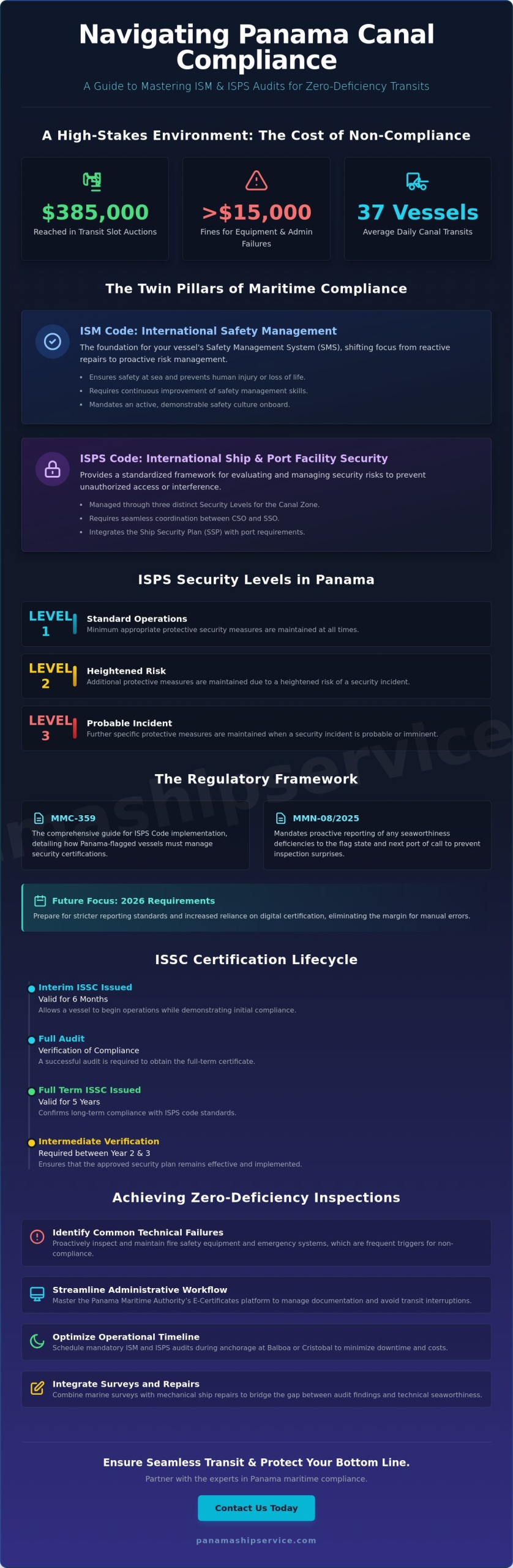
We understand that managing the complexity of the AMP E-platform while coordinating audits with tight transit schedules feels like a constant battle against the clock. This guide will help you master the administrative and technical requirements for mandatory ISM and ISPS audits at the Panama Canal. You’ll learn how to achieve zero-deficiency inspections and maintain valid ISSC and SMC certifications. We’ll preview the essential updates from ACP Notice N-1-2026 and Regulation MMC-359 to ensure your vessel moves through the canal without costly delays or compliance failures.
Key Takeaways
- Understand the requirements of MMC-359 and MMN-08/2025 to ensure your vessel meets the current standards for Panama-flagged ISPS certification.
- Prepare for a successful port state control inspection panama by identifying common technical failures in fire safety and emergency systems that trigger audit non-compliance.
- Streamline your administrative workflow by mastering the Panama Maritime Authority’s E-Certificates platform to manage mandatory documentation without transit interruptions.
- Optimize your operational timeline by scheduling mandatory ISM and ISPS audits during anchorage at Balboa or Cristobal to minimize downtime.
- Learn how integrating marine surveys with mechanical ship repairs can bridge the gap between audit findings and technical seaworthiness.
Understanding ISM and ISPS Compliance for Panama-Flagged Vessels
Compliance isn’t just a regulatory hurdle; it’s the foundation of your vessel’s operational license within the Panama Canal. As the world’s largest ship registry, the Panama Maritime Authority (AMP) maintains rigorous oversight to uphold international safety and security standards. For any operator, a successful port state control inspection panama depends on a deep understanding of the twin pillars of maritime safety: the ISM and ISPS Codes. These frameworks ensure that every vessel transiting the Isthmus operates with a verified safety management system and a robust security protocol.
The International Safety Management (ISM) Code, mandated by SOLAS Chapter IX, establishes the framework for a vessel’s Safety Management System (SMS). It shifts the focus from reactive repairs to proactive management. Parallel to this, the International Ship and Port Facility Security (ISPS) Code, under SOLAS Chapter XI-2, provides a standardized framework for evaluating and managing security risks. By 2026, these standards have evolved to prioritize real-time reporting and digital certification. This shift eliminates the margin for manual errors or delayed documentation that often leads to detention.
The AMP has modernized its oversight to reflect the high-stakes nature of the canal’s 2026 traffic levels. Digitalization is now the standard. Operators who rely on paper-based systems risk significant delays. Efficient compliance requires an integrated approach where administrative accuracy meets technical readiness. If your documentation doesn’t match the physical state of your vessel, you’ll face immediate scrutiny during your next inspection.
The Core Objectives of the ISM Code
The ISM Code aims to ensure safety at sea and prevent human injury or loss of life. It requires operators to establish safeguards against all identified operational and environmental risks. This isn’t a static requirement; it demands the continuous improvement of safety management skills for both personnel ashore and aboard. When an inspector boards for a port state control inspection panama, they look for evidence that your safety culture is active. They verify that your crew can effectively execute emergency procedures and that your maintenance logs accurately reflect the condition of your machinery.
The ISPS Code and Security Levels in Panama
Security within the Panama Canal Zone is managed through three distinct Security Levels. Level 1 represents the minimum appropriate protective security measures. Level 2 applies when there is a heightened risk of a security incident. Level 3 is reserved for periods where a security incident is probable. Compliance requires seamless coordination between the Company Security Officer (CSO) and the Ship Security Officer (SSO). Their roles are vital in integrating the Ship Security Plan (SSP) with local port facility requirements to prevent unauthorized access or interference during transit.
The Regulatory Framework: MMC-359 and MMN-08/2025
The Panama Maritime Authority (PMA) maintains a rigorous regulatory environment. To ensure your vessel remains compliant, you must strictly follow Merchant Marine Circular MMC-359 and the newer Merchant Marine Notice MMN-08/2025. These documents form the legal backbone of your security and safety reporting obligations. Failure to comply with these specifics often results in immediate detention during a port state control inspection panama.
MMC-359 serves as the comprehensive guide for ISPS Code implementation. It details how Panama-flagged vessels must manage their security certifications. Meanwhile, MMN-08/2025, issued in August 2025, introduces a critical mandate: you must report any deficiency that affects seaworthiness to the flag state and the next port of call. This proactive reporting is designed to prevent surprises during inspections and ensures the registry’s reputation remains intact.
Types of ISPS Verifications and ISSC Validity
Understanding the lifecycle of your International Ship Security Certificate (ISSC) is essential for planning. An Interim ISSC is valid for only six months. This allows a vessel to demonstrate compliance during initial operations. Once a full audit is successful, a Full Term ISSC is issued with a five-year validity. However, this is not a permanent pass. You must complete an Intermediate Verification between the second and third anniversary of the certificate. During these Recognized Security Organization (RSO) audits, non-conformities are categorized. Major non-conformities require immediate resolution before the vessel can sail, while minor issues are given a specific timeframe for correction.
Mandatory Notifications under MMN-08/2025
The introduction of MMN-08/2025 has created a more demanding reporting schedule. You must notify the Segumar offices immediately of any onboard damage or machinery malfunctions. This reporting requirement ensures the PMA is aware of your vessel’s status before an inspector boards. Additionally, you must notify the authorities at your next port of call at least 24 hours before arrival if any deficiencies exist.
Proper record-keeping is your best defense. You’re required to maintain an onboard file that documents the closure of all previous PSC deficiencies. If a marine survey reveals a technical issue, documenting the repair process is vital. Inspectors will check this file to verify that you’ve addressed past findings. This transparency builds trust with the authorities and significantly reduces the likelihood of a prolonged port state control inspection panama.
Bridging the Gap: From Audit Findings to Technical Readiness
Paperwork only gets you so far. An ISM audit fails the moment a fire damper doesn’t close or an emergency generator fails to start. In 2026, the Panama Maritime Authority has shifted toward stricter physical verification, meaning your safety management system must be backed by a vessel in prime mechanical condition. A failed port state control inspection panama can result in fines exceeding $15,000. However, the hidden costs are often much higher. With transit slot auctions reaching $385,000, a detention doesn’t just mean a fine; it means losing a high-value passage window and facing massive rescheduling fees. You need to integrate your compliance strategy with immediate access to mechanical ship repairs to ensure audit findings don’t turn into operational standstills.
The gap between a theoretical safety plan and technical reality is where most detentions happen. Inspectors aren’t just looking for signed logs; they’re testing the physical integrity of your ship. If your crew can’t demonstrate that emergency systems are functional, the paperwork becomes irrelevant. Efficient operators treat technical maintenance as a prerequisite for certification, not an afterthought. This integrated approach minimizes the risk of a port state control inspection panama revealing critical flaws that should’ve been caught during routine maintenance.
Common Physical Deficiencies in PSC Inspections
Inspectors prioritize life-safety and environmental systems above all else. We often see detentions caused by mechanical failures in emergency power, steering gear, or primary propulsion systems. These aren’t just minor observations; they’re grounds for immediate “no-sail” orders. Structural integrity issues, such as wasted deck plating or compromised watertight doors, require specialized mechanical ship repairs in Panama to resolve before transit. Additionally, hull fouling and propeller damage can lead to efficiency losses and environmental red flags that catch an inspector’s eye during a routine boarding.
Proactive Compliance Strategies
Don’t wait for an inspector to find your vessel’s flaws. Use underwater hull services to conduct class-approved CCTV inspections before you reach the locks. This allows you to identify fouling or structural damage below the waterline that could trigger a detention. Scheduling pre-audit marine surveys in Panama helps identify red flags in your safety management system before they become official deficiencies. You should also verify that your MARPOL disposal panama records are fully updated and match your oil record book. An organized disposal log is often the first thing an inspector checks to gauge your overall compliance posture.
Efficient Compliance Management during Canal Transit
Success in the Panama Canal depends on precision timing. With an average of 37 daily transits in early 2026, the window for administrative tasks is narrow. You must synchronize your mandatory audits with your vessel’s anchorage time to avoid disrupting your transit slot. A failed port state control inspection panama or a delayed ISPS verification during this period can trigger a cascade of rescheduling fees. Effective management requires a dual track approach: mastering the digital tools provided by the Panama Maritime Authority and coordinating physical logistics through a seasoned local agent.
The transition to digital certification has streamlined the process, but it demands technical accuracy. You can’t afford to wait until you’re at the locks to discover a documentation mismatch. Your digital ISPS verification must be completed before the Full Term ISSC can be issued. This process involves a meticulous review of your Ship Security Plan and recent audit findings. We recommend finalizing these uploads well in advance of your arrival at the Balboa or Cristobal anchorages to ensure your digital file is ready for inspector review.
Navigating the AMP E-Platform
The AMP E-Certificates platform is the mandatory hub for all Panama-flagged vessel documentation. You must first register your operating company and manage user access for your DPA and CSO. Once an RSO completes an audit, their verification report must be uploaded directly to the platform. This triggers the issuance of the Full Term ISSC, replacing the 6-month Interim certificate. Managing this transition digitally requires consistent oversight to ensure no expiration dates are missed, as an expired certificate is a primary trigger for a port state control inspection panama detention.
Maximizing Efficiency at Canal Anchorages
Anchorages at Balboa and Cristobal offer the best opportunity to conduct surveys without impacting your transit schedule. Timing is everything. Coordinate your audits to occur simultaneously with your intake of ship supplies panama canal. This consolidation reduces the number of boat transfers and minimizes crew fatigue. Ensure your CSO is available for real-time communication during the audit to resolve any administrative queries immediately. To protect your high-value transit slot and ensure all regulatory requirements are met, contact our canal transit agency for expert logistical support.
Your Strategic Partner for Panama Maritime Compliance
Panama Ship Service provides an integrated solution for vessel operators facing the complexities of 2026 maritime regulations. We eliminate the friction between administrative auditing and technical readiness by consolidating mechanical repairs with regulatory compliance. When your vessel faces a port state control inspection panama, you need more than just a consultant; you need a partner who can physically rectify deficiencies on the spot. Our team ensures that every safety management objective is met through verified action, not just paperwork.
Scheduling multiple services through a single provider significantly reduces mobilization fees and operational overhead. By coordinating underwater hull services, MARPOL disposal, and mechanical repairs in a single window, we optimize your port stay. This efficiency is critical in an era where transit slots are at a premium and every hour at anchorage counts. Our commitment to international safety and environmental standards ensures your fleet remains in high standing with both the Panama Maritime Authority and international MOUs.
Why Consolidate with Panama Ship Service?
Communication is the most common point of failure in maritime compliance. We bridge this gap by ensuring our technical repair teams and marine surveyors work in total alignment. This synergy allows us to identify and fix structural or mechanical issues before they’re flagged during a port state control inspection panama. Our deep local expertise is rooted in a thorough understanding of the panama canal history and its evolving operational nuances. This long-standing tenure in the region allows us to provide a proactive response that minimizes vessel downtime and secures your passage through the waterway.
Contact Us for a Compliance Readiness Assessment
Operators and fleet managers can delegate the complexity of Panama Canal compliance to our experienced team. We offer customized compliance packages that integrate audit support with essential technical services. Whether you require a detailed marine survey or immediate ship supplies, we provide a single point of accountability for your vessel’s needs. We maintain availability for emergency repairs and surveyor support to handle the unpredictable nature of maritime operations. Request a quote today to secure integrated support for your next transit. Optimize your vessel operations in Panama today by partnering with a service provider that understands the critical nature of timing and technical proficiency.
Secure Your Transit and Compliance Future in Panama
Mastering maritime compliance in 2026 requires more than organized paperwork. It demands a vessel that’s mechanically sound and fully aligned with the latest Panama Maritime Authority mandates like MMN-08/2025. You’ve seen how integrating digital certification with physical readiness is the only way to protect your high-value transit slots. Proactive reporting and technical maintenance are no longer optional; they’re essential for a successful port state control inspection panama.
Panama Ship Service provides authorized technical support at both Balboa and Cristobal. We offer 24/7 emergency mechanical and underwater repair capabilities alongside comprehensive MARPOL and marine survey expertise. By consolidating your regulatory audits with technical repairs, you reduce mobilization fees and eliminate the risk of detention. Don’t let a minor deficiency jeopardize your canal passage. Secure your vessel compliance and schedule your technical inspection now. We’re ready to ensure your fleet remains efficient and compliant in one of the world’s most critical maritime hubs.
Frequently Asked Questions
What is the main difference between ISM and ISPS compliance in Panama?
ISM compliance focuses on safety management and pollution prevention under SOLAS Chapter IX. It requires a functional Safety Management System (SMS) to prevent human injury and environmental damage. ISPS compliance, governed by SOLAS Chapter XI-2, focuses strictly on maritime security. While both require rigorous auditing by the Panama Maritime Authority, ISM manages operational safety while ISPS manages security threats to the ship and port facilities.
How does MMN-08/2025 change my reporting obligations as a Ship Master?
MMN-08/2025 mandates that Ship Masters notify the Panama Maritime Authority and the next port of call of any deficiencies affecting seaworthiness. You must report these issues at least 24 hours before arrival. It also requires you to maintain a dedicated onboard file of all closed deficiencies. This transparency is vital for a smooth port state control inspection panama and prevents unexpected detentions at the canal locks.
Can an ISPS audit be conducted while the vessel is at the Panama Canal anchorage?
Yes, conducting audits at the Balboa or Cristobal anchorages is a standard industry practice. This allows vessel operators to satisfy regulatory requirements without disrupting their scheduled transit slots. Scheduling these verifications during anchorage time is highly efficient. It provides the crew with a stable window to coordinate with Recognized Security Organizations while waiting for their turn to enter the canal system.
What documentation is required for the Panama AMP E-Platform application?
You must provide the approved Ship Security Plan (SSP), the verification report from your Recognized Security Organization (RSO), and the operating company’s registration details. The platform also requires evidence that any previous non-conformities have been addressed. Accurate digital copies of these documents are essential for the issuance of a Full Term International Ship Security Certificate (ISSC) and the successful management of your vessel’s registry status.
How long is an Interim International Ship Security Certificate (ISSC) valid?
An Interim ISSC is valid for a maximum period of six months. This certificate is issued to new vessels or those changing management to allow for initial operations. It cannot be extended under Panamanian regulations. You must complete a full initial audit and submit the required documentation through the AMP E-Platform before this six-month window expires to receive your Full Term certificate.
What are the consequences of a Port State Control (PSC) detention in Panama?
A detention triggers immediate financial and operational penalties. You will face a standard inspection fee of $670, but fines for equipment oversights can exceed $15,000. The most critical consequence is the potential loss of your transit slot. With auction prices for slots reaching $385,000 in early 2026, the cost of a delay far outweighs the price of proactive compliance and technical readiness.
Does Panama Ship Service assist with both technical repairs and audit readiness?
Yes, we provide an integrated service model that combines mechanical ship repairs with marine surveys. This approach ensures that any physical deficiencies found during an internal audit are corrected before an official port state control inspection panama. By consolidating technical support and regulatory preparation, we help operators minimize downtime and ensure their vessels meet all international safety and environmental standards during transit.
Who are the Recognized Security Organizations (RSOs) authorized by the AMP?
The Panama Maritime Authority authorizes several major classification societies to act as RSOs. These include organizations such as the American Bureau of Shipping (ABS), Lloyd’s Register (LR), Bureau Veritas (BV), and DNV. You should consult the most recent Merchant Marine Circulars to verify the current list of authorized entities. Using an approved RSO is mandatory for the validation of your Ship Security Plan and ISSC certification.