
Every dollar you save by deferring maintenance today will likely cost you four dollars in capital renewal expenses tomorrow. For fleet managers weighing in-house vs outsourced ship maintenance in 2026, the decision is no longer just about payroll. It’s about operational survival in a landscape of shifting MARPOL regulations and volatile Panama Canal transit fees. You understand the pressure of escalating labor costs for chief engineers, which can now reach $14,000 per month, and the constant burden of maintaining specialized equipment for underwater hull cleaning or steel fabrication.
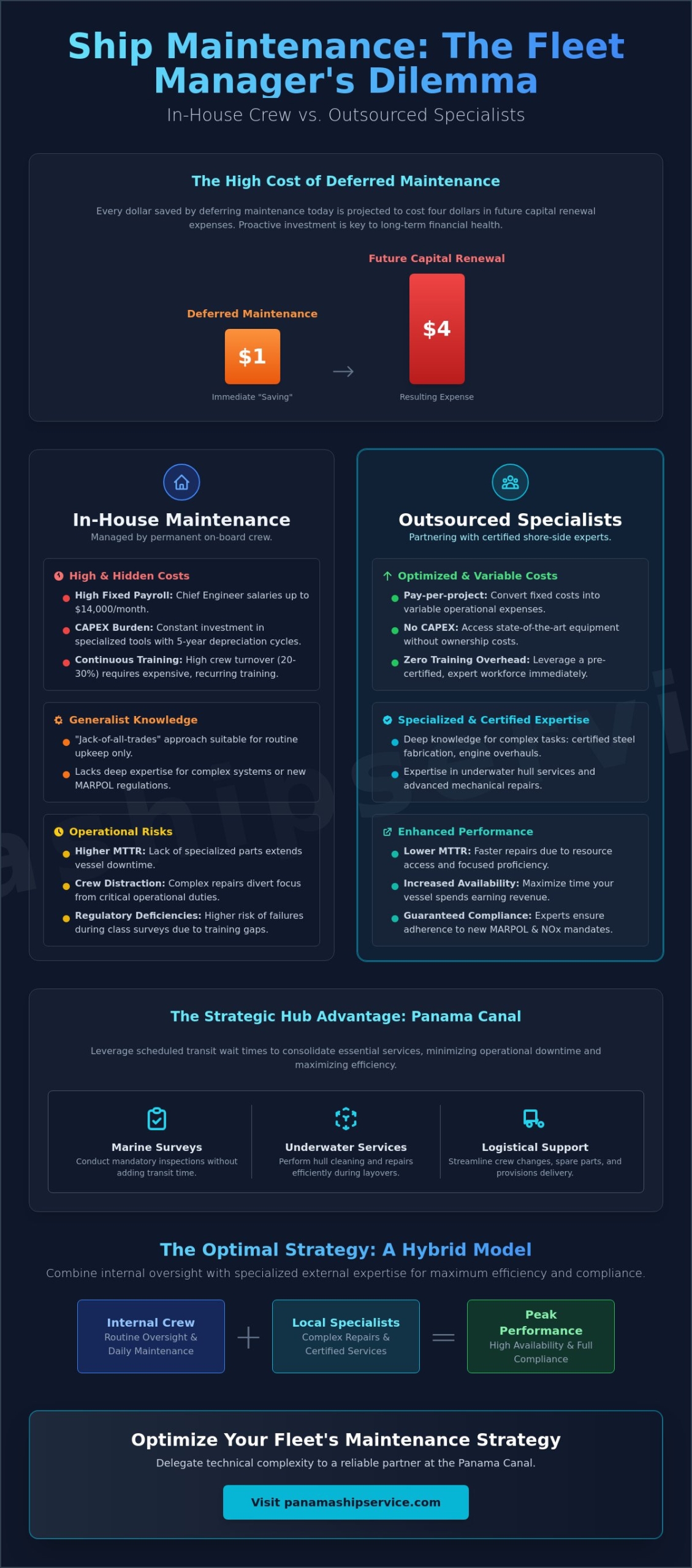
This guide evaluates the financial, technical, and operational trade-offs between internal teams and third-party specialists to help you optimize vessel performance. We’ll explore how to reduce operational overhead while guaranteeing compliance with new MARPOL data collection mandates and NOx Emission Control Areas. You will also learn how to minimize transit delays through efficient, local maintenance strategies that keep your fleet moving. We provide the clarity needed to decide when to keep tasks internal and when to delegate complexity to a reliable partner.
Key Takeaways
- Identify the hidden fiscal impact of internal teams, including crew training overhead, equipment depreciation, and the high cost of specialized tool maintenance.
- Optimize vessel performance by utilizing specialized shore-side technical expertise for complex mechanical repairs and certified structural steel fabrication.
- Leverage strategic geographical hubs like the Panama Canal to consolidate marine surveys and underwater services during scheduled transit wait times.
- Evaluate the core trade-offs of in-house vs outsourced ship maintenance to determine which model best scales with your fleet size and technical requirements.
- Implement a high-efficiency hybrid strategy that delegates specialized technical tasks to a local service provider while maintaining routine internal oversight.
Defining the Scope: In-House vs. Outsourced Ship Maintenance
Fleet managers generally view maintenance through two distinct lenses. In-house maintenance relies on the permanent technical staff and on-board crew to handle day-to-day repairs. This model offers high immediate control but often hits a ceiling when specialized tooling or deep technical knowledge is required. Conversely, outsourced maintenance involves partnering with shore-side specialists for technical interventions like Mechanical Ship Repairs and Underwater Hull Services. The decision regarding in-house vs outsourced ship maintenance has become more critical as vessel systems grow increasingly complex and regulatory requirements tighten.
Outsourcing allows managers to tap into deep technical expertise without the overhead of permanent payroll for every specialty. By Defining Maintenance, Repair, and Operations (MRO) within a strategic framework, companies can distinguish between routine upkeep and critical technical overhauls. While in-house teams provide a baseline of readiness, shore-side firms offer the scalability needed for major steel fabrication or complex engine work that exceeds standard crew certifications. This technical depth is often the difference between a successful transit and a costly deficiency report.
The Evolution of Maritime Maintenance
Maritime technology has advanced rapidly. Modern vessels are no longer just hulls and engines; they’re sophisticated digital ecosystems. Standard crews often lack the training for the newest MARPOL Annex VI equipment or the enhanced data collection systems mandatory as of January 1, 2026. This gap creates a significant regulatory risk. A “jack-of-all-trades” approach often leads to deficiencies during class surveys. Generalist knowledge simply cannot replace the precision of a certified technician who handles specialized repairs daily. Relying on outdated training models leads to errors that delay operations and increase long-term costs.
Key Performance Indicators (KPIs) for Evaluation
Effective evaluation requires hard data. Fleet managers should track Mean Time To Repair (MTTR) as a primary metric. While an on-board crew might start a repair instantly, their lack of specialized parts or tools often extends the total downtime. In contrast, specialized firms often achieve a lower MTTR through better resource access and focused proficiency. Other critical KPIs include vessel availability for charter and compliance success rates for mandatory underwater inspections. High-performing fleets prioritize these outcomes over the perceived simplicity of keeping everything internal. It’s about maximizing the time your vessel spends earning revenue, not just looking at the immediate labor bill.
Analyzing the Economic Reality: The Hidden Costs of In-House Teams
Many fleet managers focus strictly on direct payroll when debating in-house vs outsourced ship maintenance. However, the true cost of an internal technical team extends far beyond the base salary of a Chief Engineer. You must account for the continuous cycle of training and certifications required to keep pace with evolving maritime technology. The industry currently faces an average attrition rate of 20 to 30 percent for shipyard and technical workers. This high turnover forces companies into a constant state of expensive reinvestment just to maintain baseline proficiency.
Capital expenditure (CAPEX) presents another significant hurdle. Maintaining an internal capability for specialized tasks requires a massive investment in diagnostic equipment and heavy tooling. These assets often carry a five-year depreciation cycle, adding a permanent burden to your balance sheet regardless of how often they’re used. Relying on local specialists for Mechanical Ship Repairs allows you to convert these fixed burdens into variable, project-based expenses that only occur when necessary.
Total Cost of Ownership (TCO) Framework
A true TCO analysis must include the opportunity cost of your crew’s time. When on-board staff are bogged down with complex repairs, they’re distracted from critical operational duties and safety oversight. This distraction can lead to technical failures that carry heavy insurance and liability implications. Research into the strategic use of outsourcing in shipbuilding suggests that using specialized subcontractors is often the most efficient way to manage workforce quality and improve overall project outcomes. Outsourcing eliminates the need for a global parts inventory, as local partners source components on-demand.
Scalability and Resource Allocation
Scaling an internal team is difficult during rapid fleet expansion or emergency situations. If a vessel breaks down in a remote location, the logistical cost of flying internal technicians, housing them, and transporting specialized tools can be astronomical. These mobilization costs often exceed the actual repair bill. Strategic hubs like the Panama Canal offer a different path. By utilizing local experts, you eliminate travel expenses and benefit from established supply chains. This localized approach ensures that your maintenance budget goes toward actual repairs rather than logistics. It’s a more responsive model that protects your bottom line during peak transit seasons.
Technical Expertise: Specialized Repairs vs. Generalist Maintenance
Relying on a generalist crew for complex technical overhauls often creates a false sense of security. While on-board teams are essential for routine upkeep, they frequently lack the high-precision tooling and specific certifications required for modern vessel systems. The debate over in-house vs outsourced ship maintenance hinges on technical depth. Specialized shore-side firms invest millions in diagnostic equipment that a single vessel cannot justify carrying. When your vessel faces critical engine failures or structural damage, the difference between a temporary patch and a class-approved repair determines your long-term seaworthiness.
Choosing a Class-approved provider isn’t just a preference; it’s a requirement for maintaining vessel insurance and regulatory standing. A RAND Corporation analysis on shipbuilding highlights that accessing specialized skills through outsourcing is a primary driver for quality and technical reliability in the maritime industry. Generalist maintenance often results in “temporary fixes” that eventually become permanent liabilities, leading to detention by port state control or catastrophic failure during transit.
Mechanical and Structural Integrity
Modern diesel engines require extreme precision during mechanical ship repairs. Tolerance levels for crankshaft alignments and cylinder liner honing are measured in microns. Internal crews, despite their best efforts, don’t have the calibrated tools to meet these standards. Similarly, steel fabrication for marine vessels involves specific alloys and stress-test protocols. Using non-certified welders for structural repairs introduces weak points into the hull. These deficiencies might not be visible immediately, but they’ll fail under the extreme pressures of the open sea or during a heavy cargo load.
Efficiency Gains through Underwater Services
The efficiency gap between a standard crew inspection and professional underwater hull services is vast. Professional divers use high-definition imaging and specialized hydraulic tools to perform class-approved propeller polishing and hull cleaning. These services directly impact your bottom line by reducing drag and lowering fuel consumption. A basic scrub by the crew can actually damage the hull coating, leading to faster biofouling. Utilizing professional underwater inspections allows fleet managers to identify minor corrosion or propeller cavitation before these issues necessitate an expensive, unscheduled dry-docking. It’s a proactive approach that ensures your vessel remains compliant with MARPOL standards while optimizing operational costs.
The Strategic Hub Advantage: Why Geography Dictates Maintenance Strategy
Geography is the silent arbiter of fleet efficiency. While in-house teams handle routine tasks during transits, they’re often unable to manage complex interventions without disrupting tight schedules. A strategic hub like the Panama Canal provides a unique maintenance window. By outsourcing at this location, fleet managers can turn mandatory wait times into productive repair periods. This approach is central to the in-house vs outsourced ship maintenance strategy, as it allows for the consolidation of multiple services in a single, high-traffic location. It moves the technical burden from a moving vessel to a controlled, resource-rich environment.
Maximizing the Panama Canal Transit
Performing mechanical ship repairs in Panama allows vessels to address engine or rudder issues while awaiting their transit slot. This eliminates the need for additional deviations, which can cost thousands in extra agency fees and fuel. Local specialists provide the technical depth required for emergency repairs that on-board crews cannot safely execute. Coordinating marine surveys and ship supplies alongside technical work ensures the vessel is fully optimized before entering the Canal’s lock system. This proactive coordination prevents mechanical failures that could lead to transit delays or expensive fines from the Panama Canal Authority (ACP).
Regulatory and Environmental Compliance
Compliance with MARPOL Annex VI is a critical priority in 2026. Ships of 5,000 GT and above must now comply with enhanced data collection for the IMO Ship Fuel Oil Consumption Database. Local providers ensure that MARPOL disposal in Panama meets both international standards and the specific, stringent regulations of the ACP. Handling sludge, slops, and ship garbage requires established local infrastructure that internal crews cannot access while at sea. Expert local partners also navigate sanitary inspections and fumigation requirements, ensuring international health standards are met without delaying the transit. Given that unreserved Neopanamax slots can hit six figures in last-minute auctions, avoiding administrative delays is a financial imperative. To streamline your next transit and minimize downtime, partner with Panama Ship Service for integrated technical and logistical coordination.
Conclusion: Building a Hybrid Maintenance Model with Panama Ship Service
The maritime industry in 2026 demands a sophisticated approach to fleet readiness. The most successful managers have moved beyond the binary debate of in-house vs outsourced ship maintenance, instead adopting a strategic hybrid model. This approach keeps routine preventive tasks with the on-board crew while delegating high-stakes technical interventions to specialized shore-side partners. By focusing internal resources on daily operations and external experts on complex repairs, you ensure both technical proficiency and fiscal responsibility.
Partnering with a localized technical expert in a strategic hub like Panama provides a sustainable return on investment. It eliminates the need for expensive internal specialized crews and the CAPEX burden of heavy tooling. Instead of reacting to failures, you leverage planned transit windows to maintain peak vessel performance. This transition from a reactive internal model to a proactive outsourced partnership is the most effective way to protect your charter rates and ensure long-term fleet longevity.
The Panama Ship Service Solution
Panama Ship Service acts as a comprehensive one-stop-shop designed to simplify your most complex vessel operations. We integrate mechanical repairs, underwater surveys, and MARPOL disposal into a single, coordinated workflow. Our commitment to 24/7 emergency response ensures that your fleet receives immediate attention, minimizing transit delays and avoiding the high costs of unreserved slot auctions. By consolidating these services, you remove the administrative burden of managing multiple vendors and ensure that every technical intervention meets strict class standards.
Final Decision Checklist for Ship Owners
To determine if your current maintenance strategy is optimized for 2026, perform a quick audit of your operations. If you answer “yes” to more than two of these points, your current model may be bleeding revenue:
- Are your internal technical labor costs and overtime payments increasing year-over-year?
- Does your crew lack the specialized certifications required for modern MARPOL or class-approved surveys?
- Is specialized maintenance equipment on your vessels underutilized or frequently requiring its own repair?
- Have you experienced transit delays or port state control deficiencies due to “temporary” internal fixes?
- Are the mobilization costs for flying in internal technicians exceeding the cost of local specialized labor?
Evaluating provider certifications and class approvals is the final step in securing your fleet’s future. When you’re ready to optimize your maintenance schedule and reduce operational overhead, Request a comprehensive ship repair quote in Panama today.
Optimize Your Fleet Strategy for the 2026 Maritime Landscape
Optimizing your fleet’s maintenance strategy is no longer just about cutting immediate costs; it’s about securing operational longevity in a high-stakes environment. You’ve seen how the debate over in-house vs outsourced ship maintenance requires a careful analysis of hidden CAPEX burdens and the technical precision only shore-side specialists can provide. By shifting complex repairs to strategic hubs, you eliminate the logistical friction that drains your revenue during critical transits. This transition from generalist oversight to specialized intervention ensures your vessels meet the most stringent regulatory demands without compromise.
Panama Ship Service provides the authoritative expertise required to handle these complexities with total reliability. We deliver class-approved underwater surveys, 24/7 mechanical repair support, and comprehensive MARPOL compliance services at the Panama Canal. Our team ensures that your vessel remains a high-performing asset without the overhead of maintaining a permanent technical payroll for every specialty. Partner with Panama Ship Service for expert vessel maintenance and repair to streamline your operations and maximize your transit efficiency. Your fleet is built for the open sea; let us handle the technical details that keep it there with confidence.
Frequently Asked Questions
Is outsourced ship maintenance more expensive than in-house?
Outsourcing is often more cost-effective when evaluating in-house vs outsourced ship maintenance over the long term. While specialist hourly rates may be higher, you avoid the fixed overhead of permanent technical salaries, continuous training, and equipment depreciation. It’s a shift that converts capital-heavy internal departments into variable, project-based expenses. This allows your budget to focus on actual repairs rather than maintaining an underutilized workforce during transit periods.
What are the main risks of relying solely on on-board crew for repairs?
Relying strictly on generalist crews introduces significant technical and regulatory risks. On-board staff often lack the high-precision tooling and specialized certifications required for modern engine overhauls or structural steel fabrication. This gap can lead to temporary fixes that fail under stress, potentially resulting in port state control detentions or catastrophic mechanical failure. Professional intervention ensures repairs meet strict class standards and maintain the validity of your vessel’s insurance.
How can I ensure quality control when outsourcing technical ship repairs?
Quality control is best managed by selecting providers with recognized class approvals and documented industry tenure. You should request detailed service reports and post-repair diagnostic data to verify that all work meets international standards. Establishing a long-term partnership with a localized provider allows for consistent oversight and accountability. This systematic approach ensures that every repair, from mechanical work to underwater services, aligns with your fleet’s specific operational requirements.
Can ship repairs be performed while waiting for Panama Canal transit?
The wait time for a transit slot provides an ideal window for performing essential repairs without disrupting your schedule. Local specialists can meet your vessel at the Balboa or Cristobal ports to execute mechanical repairs, underwater hull cleaning, or marine surveys. This strategy minimizes downtime by utilizing mandatory idle periods for technical improvements. It’s a proactive way to ensure your vessel is optimized and compliant before entering the lock system.
What certifications should I look for in an outsourced maintenance provider?
Prioritize providers that hold approvals from major classification societies such as ABS, Lloyd’s Register, or DNV. These certifications guarantee that the firm’s technical processes, equipment, and personnel meet rigorous safety and quality benchmarks. For specialized tasks like underwater services or steel fabrication, verify that technicians hold specific, up-to-date certifications for those disciplines. Choosing a class-approved partner is critical for maintaining your vessel’s regulatory standing and ensuring full insurance coverage.
Does outsourcing maintenance help with MARPOL compliance?
Professional outsourcing is vital for meeting the complex requirements of MARPOL Annex VI. Specialized firms possess the infrastructure and knowledge to handle enhanced data collection and proper waste management, such as sludge and ship garbage disposal. When considering in-house vs outsourced ship maintenance, remember that local providers are better equipped to navigate the stringent regulations of strategic hubs. This ensures your vessel remains compliant with both international and local environmental standards.
How does underwater hull cleaning affect vessel fuel efficiency?
Professional underwater hull cleaning significantly reduces hydrodynamic drag by removing biofouling and debris. This reduction in resistance allows the vessel to maintain speed with lower engine output, directly decreasing fuel consumption. Class-approved propeller polishing further optimizes propulsion efficiency. Regular underwater inspections and cleanings prevent the accumulation of marine growth that can lead to increased operational costs and higher carbon emissions, keeping your fleet both profitable and environmentally compliant.
What is the benefit of a one-stop-shop for maritime services in Panama?
Utilizing a single provider for multiple services simplifies complex logistics and reduces administrative overhead. A one-stop-shop allows you to coordinate mechanical repairs, underwater services, and MARPOL disposal through a single point of contact. This integration ensures that all tasks are completed within the same maintenance window, maximizing efficiency during a Panama Canal transit. It’s a streamlined approach that provides consistency in quality and a much faster turnaround for your vessel.