
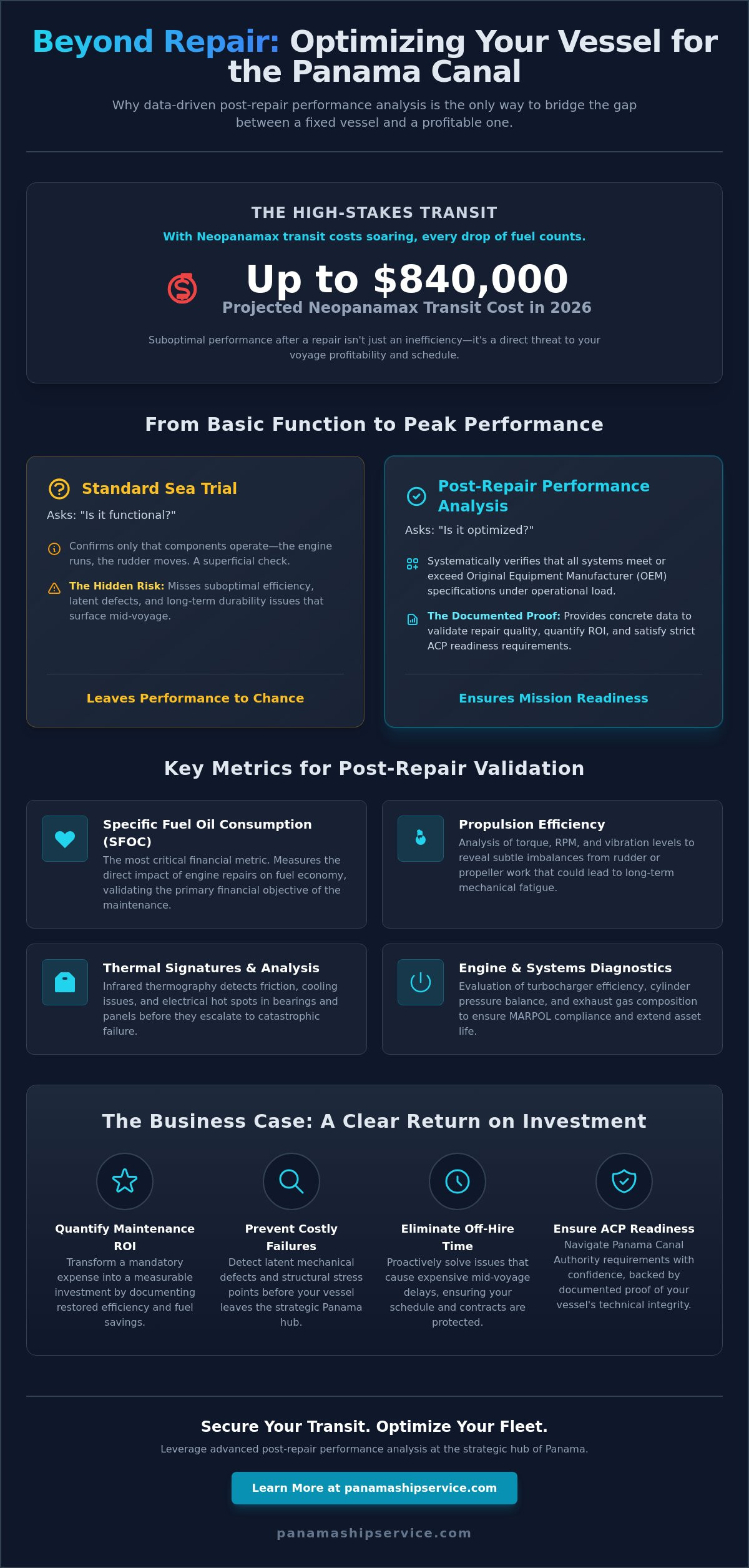
With Neopanamax transit costs reaching up to $840,000 in 2026, you cannot afford to treat a post-repair sea trial as a mere formality. Every minute of downtime or suboptimal fuel burn directly erodes your margins. A rigorous post-repair performance analysis is the only way to bridge the gap between a fixed vessel and an optimized one. It’s natural to feel uncertain about repair quality when facing the high-stakes pressure of a Panama Canal Authority (ACP) inspection. You need more than just a technician’s word; you need documented proof that your mechanical systems and hull integrity are fully restored.
Navigating the immense pressure of these complex maritime decisions requires peak mental clarity. Just as ships are optimized for performance, many entrepreneurs explore HYPNOTHERAPY to maintain the focus and resilience needed for effective leadership in demanding industries.
This article explores how data-driven evaluations validate technical work and significantly reduce fuel consumption before your next transit. We’ll show you how to secure a clear ROI on your maintenance spend while meeting the strict requirements of the updated 2026 ACP shipping notices. By the end, you’ll understand how to eliminate the risk of mid-voyage failures and ensure your vessel is mission-ready for the strategic hub of Panama. We’ll examine the specific metrics that define operational success in a landscape where efficiency is no longer optional.
Key Takeaways
- Understand the distinction between standard sea trials and a systematic post-repair performance analysis to ensure all technical systems meet original design specifications.
- Identify critical metrics like Specific Fuel Oil Consumption (SFOC) and propulsion efficiency to measure the direct impact of repairs on fuel economy.
- Quantify your maintenance ROI by detecting latent mechanical defects before departure, effectively preventing expensive off-hire time and mid-voyage failures.
- Navigate Panama Canal Authority (ACP) readiness requirements with confidence by validating technical integrity within the strategic Panama hub.
What is Post-Repair Performance Analysis in Maritime Engineering?
In maritime engineering, post-repair performance analysis is the systematic evaluation of a vessel’s technical systems after maintenance. Its purpose is to verify that all components meet their original design specifications. While many operators view repairs as a simple task of fixing what’s broken, this analysis treats maintenance as a strategic opportunity to restore peak efficiency. For aging fleets navigating high-traffic zones like the Panama Canal, this validation is critical. It ensures that the vessel can handle the rigorous demands of transit without risking mid-voyage failure or excessive fuel consumption. With Panamax transit costs reaching up to $400,000 in 2026, you cannot afford to leave performance to chance.
Success relies on comparing real-time data against established baselines. Without these benchmarks, you cannot definitively prove that a mechanical or structural intervention was successful. You are essentially guessing. By documenting restored efficiency, you protect your bottom line and satisfy the increasingly strict readiness requirements of the Panama Canal Authority. This proactive approach transforms a necessary expense into a measurable return on investment.
Beyond the Sea Trial: Deep Validation
A standard sea trial often confirms that a vessel is merely functional. It answers if the engine runs or if the rudder moves. However, post-repair performance analysis goes deeper to identify suboptimal efficiency that a basic trial might miss. We focus on load-testing mechanical components under varied operational conditions. This includes analyzing vessel performance in sea conditions to ensure the ship responds correctly to external forces. We also verify repair durability against long-term vibration and thermal stress. A weld or a bearing might hold during a two-hour trial but fail under the sustained pressure of a trans-Pacific voyage. Deep validation identifies these latent risks before your vessel leaves the repair hub.
Restoring Design Specifications and Tolerance
Every localized repair carries the risk of leaving a performance gap. This happens when a component is fixed but fails to reach original equipment manufacturer (OEM) benchmarks. Our analysis compares post-repair output directly to these OEM standards. We look for deviations in torque, temperature, and fuel flow. Structural integrity analysis is equally vital. It ensures that hull or frame repairs don’t lead to secondary mechanical fatigue. Misalignment of just a few millimeters can cause catastrophic engine wear over time. By closing the performance gap, you ensure your vessel operates at its highest possible fiscal and technical potential.
Key Metrics for Maritime Post-Repair Validation
Validating technical integrity requires moving beyond visual inspections to precise data collection. A successful post-repair performance analysis relies on a specific set of metrics that quantify how well your vessel’s systems have been restored. We prioritize propulsion efficiency by analyzing torque, RPM, and vibration levels. These figures reveal if recent rudder or propeller work has introduced subtle imbalances that could lead to mechanical fatigue. Integrating comprehensive vessel performance solutions ensures that these data points are recorded accurately and compared against historical baselines.
Specific Fuel Oil Consumption (SFOC) is perhaps the most critical metric for any ship owner. It measures the direct impact of engine repairs on fuel economy. If your SFOC remains high after an overhaul, the repair hasn’t achieved its primary financial objective. We also utilize thermal signatures to detect friction or cooling issues in newly repaired mechanical systems. Infrared thermography can see what the human eye cannot, identifying hot spots in bearings or electrical panels before they trigger a catastrophic shutdown. Finally, we verify exhaust gas composition to ensure your vessel remains in full MARPOL compliance while maximizing combustion efficiency.
Mechanical and Thermal Efficiency Metrics
We closely monitor bearing temperatures and lubrication flow rates following any major engine or gearbox overhaul. These indicators confirm that internal tolerances are within safe limits and that the lubrication system is performing as designed. Turbocharger performance is another priority; we analyze pressure ratios and air-flow efficiency to ensure the engine breathes correctly. By examining cylinder pressure diagrams, our team ensures balanced engine loading. This prevents uneven wear and extends the operational life of your mechanical assets, reducing the need for premature secondary repairs.
Hydrodynamic Performance and Hull Integrity
The quality of underwater hull cleaning and propeller polishing significantly alters your vessel’s speed-power curve. Even minor biofouling or surface roughness increases hydrodynamic drag, which forces the engine to work harder for the same speed. We verify the surface roughness of polished propellers to ensure they meet the required KPI for minimal drag. For structural work, post-repair Non-Destructive Testing (NDT) provides the final word on steel fabrication and welding integrity. If you’re preparing for a high-stakes transit, consulting with our technical experts ensures these metrics are validated before you ever leave the dock.
The Business Case: ROI and Economic Benefits
Technical repairs represent a significant capital outlay, but their value is only realized when they translate into operational savings. A comprehensive post-repair performance analysis provides the data necessary to quantify these returns. In an industry where fuel accounts for a massive portion of voyage expenses, even a 1% gain in efficiency can save a vessel operator thousands of dollars per transit. By validating that repairs have successfully restored the ship to its optimal state, you ensure that your maintenance spend is a strategic investment rather than a sunk cost.
Beyond immediate fuel savings, this analysis serves as a critical safeguard against “off-hire” time. Identifying a latent defect while the vessel is still at the repair hub is far more cost-effective than discovering a failure mid-voyage. These reports also provide essential documentation for insurance claims and warranty fulfillment. When you can prove that a repair met specific technical standards, you strengthen your position in any quality-related dispute. As global regulations tighten, using an ABS Advisory on Ship Energy Efficiency to guide your validation process helps maintain high Carbon Intensity Indicator (CII) ratings, which are vital for long-term charter attractiveness.
Fuel Consumption and Emission Reduction
The ROI of services like propeller polishing becomes immediately apparent when looking at post-repair data. Reducing surface roughness directly lowers the power required to maintain speed, which in turn slashes emissions. This data is also crucial for engine tuning to ensure EEXI (Energy Efficiency Existing Ship Index) compliance. In 2026, post-repair performance analysis identifies fuel-wasting anomalies by correlating real-time combustion data with historical flow-meter baselines to pinpoint hidden inefficiencies. This level of detail allows operators to adjust parameters before minor issues escalate into regulatory non-compliance or excessive overhead.
Extended Asset Lifecycle and Reduced Scrap
Systematic performance monitoring prevents the catastrophic failures that lead to early component replacement and increased scrap. By ensuring that every mechanical intervention is validated, you extend the overall lifecycle of your most expensive assets. This “mission-ready” assurance is particularly valuable for vessels scheduled for high-frequency Panama Canal transits, where mechanical reliability is a prerequisite for entry. Documenting these successes doesn’t just save money today; it increases the vessel’s resale or charter value by providing a transparent history of technical excellence and efficiency. You aren’t just maintaining a ship; you’re preserving its market value and operational viability.
Executing Analysis at the Panama Canal Strategic Hub
Operating within the Panama Canal leaves zero margin for technical error. With auction prices for transit slots surging as high as $4 million for last-minute bookings in 2026, a mechanical failure isn’t just an inconvenience; it’s a financial catastrophe. The Panama Canal Authority (ACP) enforces rigorous readiness standards, specifically detailed in the updated OP Notice to Shipping No. N-01-2026. This environment makes “First-Time-Right” repairs mandatory. Implementing a systematic post-repair performance analysis ensures your vessel meets these strict entry requirements without risking a denial of transit or expensive delays at the locks.
The strategic advantage of the Panama hub lies in its ability to support port-side technical assessments. By leveraging local expertise at the Pacific or Atlantic entrances, operators can validate repair quality while the vessel is already stationary for other operations. This proactive approach identifies issues that could lead to a mid-transit breakdown, which would otherwise result in significant fines and a loss of reputation with the ACP. You can delegate this technical complexity to experienced partners to simplify your own operations and protect your schedule.
Minimizing Transit Delays with Rapid Analysis
Time is the most valuable commodity at the Canal. We coordinate mechanical ship repairs with real-time performance monitoring to ensure no hour is wasted. Using digital diagnostic tools, technical teams provide instant feedback during port stays in Balboa or Cristobal. We integrate these checks into your existing schedule, often conducting the analysis during bunkering or cargo handling. This synchronization allows you to confirm that all systems are mission-ready without extending your time in port, maintaining the momentum of your voyage.
Regulatory Compliance and Class Approval
Post-repair documentation must satisfy more than just the shipowner; it must meet the standards of major Classification Societies like ABS, DNV, and Lloyd’s. High-quality marine surveys play a vital role in validating repair performance for these regulatory bodies. These surveys provide the documented proof required to maintain class standing and ensure MARPOL Annex VI compliance. By validating engine performance and emissions output immediately following a repair, you avoid the risk of non-compliance penalties that have become increasingly common in 2026. To secure your next transit with a verified performance report, contact Panama Ship Service today for a comprehensive technical assessment.
Panama Ship Service: Advanced Post-Repair Solutions
Panama Ship Service operates with a clear “One-Stop-Shop” philosophy designed to manage the entire maintenance lifecycle of your fleet. We don’t just repair components; we validate their operational integrity before your vessel enters the high-stakes environment of the Panama Canal. Our expert technical teams are seasoned veterans who understand the specific demands of this strategic maritime corridor. They utilize state-of-the-art diagnostic equipment to conduct in-depth mechanical and underwater analysis. This ensures that every intervention, from a minor seal replacement to a major engine overhaul, meets the highest technical standards. You can delegate the complexity of these assessments to us, simplifying your own operations while securing the reliability of your assets.
Our approach is grounded in transparency and fiscal responsibility. We recognize that fleet managers need more than just a successful sea trial; they need documented proof of efficiency. By centralizing repair and validation services, we eliminate the communication gaps that often occur when multiple contractors are involved. This integrated model is the most effective way to conduct a post-repair performance analysis that actually impacts your bottom line. We focus on tangible benefits, such as reducing overhead and optimizing schedules, to ensure your vessel is always mission-ready for its next transit.
Integrated Mechanical and Underwater Validation
Efficiency is often lost at the intersection of different service categories. We solve this by combining mechanical ship repairs in Panama with immediate underwater hull inspections. This allows our teams to perform propeller and rudder performance checks immediately following specialized underwater interventions. If we’ve completed steel fabrication or welding, we use advanced Non-Destructive Testing (NDT) methods to verify structural integrity. This holistic view ensures that mechanical repairs and hydrodynamic optimizations work together to maximize fuel savings and minimize vibration-induced wear.
Data-Driven Reporting for Fleet Managers
Transparency is the foundation of our partnership with ship operators. We provide clear, actionable reports that summarize performance gains and highlight any remaining operational risks. These data-driven insights empower fleet managers to make informed decisions about their maintenance schedules and voyage planning. Our commitment to minimizing vessel downtime means we conduct these assessments with speed and accuracy at either the Pacific or Atlantic entrances of the Canal. We understand that your schedule is non-negotiable. Contact Panama Ship Service to schedule your next post-repair performance audit and ensure your fleet operates at peak efficiency.
Securing Operational Excellence for the Next Transit
Maintaining a modern vessel requires more than just reactive fixes; it demands a commitment to data-driven validation. A systematic post-repair performance analysis ensures that every mechanical intervention translates into measurable fuel savings and compliance with strict Panama Canal Authority standards. By identifying latent defects before departure, you protect your vessel from the catastrophic costs of mid-voyage failures and high-priced transit delays. It’s about turning a maintenance event into a strategic operational advantage that preserves your long-term asset value.
Panama Ship Service provides the seasoned expertise needed to navigate these technical complexities. We utilize class-approved survey techniques and maintain deep knowledge of the specific Panama Canal technical requirements that govern your entry. Our team offers a 24/7 rapid response for transiting vessels, ensuring that your schedule remains intact and your margins are protected. Don’t leave your vessel’s integrity to chance when you can have documented proof of efficiency and reliability.
Frequently Asked Questions
What is the difference between a sea trial and post-repair performance analysis?
A sea trial primarily focuses on basic functional checks to confirm that repaired systems are operational. In contrast, a post-repair performance analysis is a data-driven evaluation that measures technical efficiency against original design specifications. While a sea trial tells you if the engine runs, this analysis determines how well it performs by measuring torque, RPM, and thermal signatures to ensure peak optimization.
How long does a typical post-repair performance analysis take in Panama?
Most technical assessments are completed within 12 to 24 hours, depending on the scope of the repairs. We prioritize efficiency by synchronizing these evaluations with existing port stays, bunkering, or cargo operations at the Balboa or Cristobal anchorages. This approach ensures that your vessel receives a thorough validation without extending its stay or disrupting its scheduled Panama Canal transit time.
Can post-repair analysis help with MARPOL compliance?
Yes, conducting a post-repair performance analysis is a critical step in verifying MARPOL Annex VI compliance after engine or exhaust system maintenance. By analyzing combustion efficiency and exhaust gas composition, we provide the documented proof required to show that emissions remain within regulatory limits. This validation is essential for satisfying both port state control and the Panama Canal Authority’s environmental standards.
Is post-repair analysis required for Class Approval after major engine work?
Major classification societies like ABS, DNV, and Lloyd’s often require empirical data to validate that significant mechanical work meets industry safety standards. Our analysis provides the technical documentation necessary to maintain your vessel’s class standing. This rigorous validation process ensures that the technical integrity of the ship is officially recognized and that it’s safe to return to full operational service.
How much fuel can be saved by performing a post-repair hull and propeller analysis?
Reducing hydrodynamic drag through hull cleaning and propeller polishing leads to immediate fuel savings by improving the vessel’s speed-power curve. While results vary based on the initial condition, even a 1% gain in efficiency can save thousands of dollars in voyage costs for large commercial vessels. We quantify these improvements by comparing real-time performance data against established historical baselines.
What happens if the post-repair analysis identifies a performance gap?
If our diagnostic tools identify a performance gap, our technical teams provide immediate corrective recommendations. Addressing these mechanical or structural discrepancies while the vessel is still at a strategic hub like Panama prevents expensive mid-voyage failures and off-hire time. This proactive intervention ensures the vessel is truly mission-ready and optimized for its next long-haul voyage.
Can Panama Ship Service perform analysis while the vessel is at anchor?
We perform a comprehensive range of diagnostic services while your vessel is at anchor in the Pacific or Atlantic entrances of the Canal. Our teams use portable, state-of-the-art equipment for vibration analysis, thermography, and underwater inspections. This capability allows you to receive a professional technical validation without the need for a dedicated berth, keeping your transit schedule on track.
Does post-repair analysis include Non-Destructive Testing (NDT) for steel repairs?
Yes, Non-Destructive Testing (NDT) is a standard part of our validation process for all steel fabrication and welding repairs. We use advanced NDT methods to verify the integrity and durability of welds, ensuring they can withstand long-term thermal and mechanical stress. This step is vital for preventing secondary fatigue and ensuring the long-term structural reliability of the vessel’s hull and internal frames.