
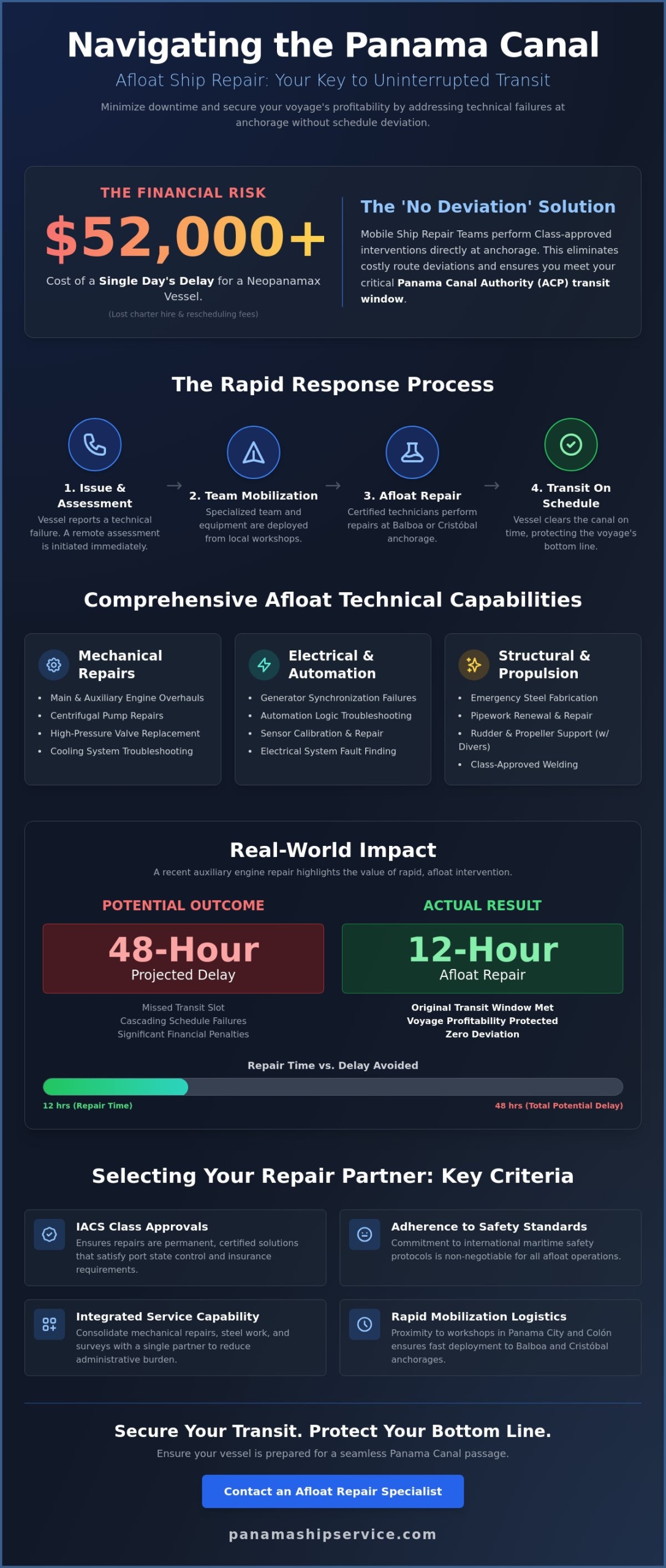
A single day of delay for a Neopanamax vessel at the Panama Canal can cost over $52,000 in lost charter hire and rescheduling fees. You know that in this high-pressure environment, technical failures don’t just threaten your schedule; they jeopardize your entire voyage’s profitability. It’s frustrating to coordinate multiple service providers while racing to meet a strict Panama Canal Authority (ACP) transit window. Deploying a specialized mobile ship repair team panama is the most effective way to address these mechanical or structural issues without deviating from your route.
We understand that efficiency is your primary metric for success. This article explores how expert afloat interventions minimize downtime through immediate technical assessments and consolidated services. You’ll learn how specialized teams handle mechanical repairs and steel work at anchor to keep your vessel in compliance with the latest 2026 ACP environmental standards. We provide a clear look at how to maximize your stop so you can clear the canal on time and protect your bottom line.
Key Takeaways
- Understand why afloat technical solutions are critical for maintaining your Panama Canal transit schedule without the high costs of vessel deviation.
- Discover how a specialized mobile ship repair team panama performs Class-approved mechanical overhauls and electrical troubleshooting directly at anchorage.
- Learn how rapid mobilization from local workshops, starting with remote technical assessments, ensures your vessel meets strict transit windows.
- Identify essential selection criteria for repair providers, focusing on IACS Class approvals and adherence to international maritime safety standards.
- Explore the operational efficiency of consolidating mechanical repairs and marine surveys through an integrated service partner to reduce administrative burden.
The Critical Role of Mobile Ship Repair Teams in Panama Canal Operations
Mobile ship repair teams function as rapid-response units specialized in performing Class-approved technical work while a vessel remains at anchorage. These teams are composed of certified technicians who bring specialized tooling and expertise directly to the ship, eliminating the need for dry-docking for many essential repairs. Utilizing a mobile ship repair team panama allows vessel operators to address critical failures without deviating from their planned route. This “no deviation” advantage is vital for maintaining the continuity of Panama Canal operations, where any change in schedule can trigger a cascade of logistical failures and financial penalties.
In 2026, the Panama hub remains a strategic focal point for both emergency and scheduled maintenance. The technical scope of these mobile units is extensive, covering everything from complex mechanical overhauls of main engines to emergency steel fabrication and pipework. Because these teams operate in a high-stakes environment, their work must meet the stringent standards of IACS member societies. This ensures that repairs are not just temporary fixes but permanent, certified solutions that satisfy both port state control and insurance requirements.
Minimizing Downtime During Transit Windows
The financial stakes of a technical failure in Panama are exceptionally high. Missing an ACP transit slot can be catastrophic for a voyage’s profitability. Current data indicates that a single day of delay for a Neopanamax vessel can exceed $52,000 in lost charter hire and rescheduling fees. A mobile ship repair team panama mitigates this risk by performing interventions concurrently with other vessel activities like bunkering or crew changes. In one recent instance, a mobile team completed a 12-hour auxiliary engine repair at anchor, preventing a projected 48-hour delay and allowing the vessel to meet its original transit window.
Strategic Anchorages: Balboa and Cristóbal
Logistical efficiency hinges on the specific anchorage where the vessel is positioned. The Pacific side (Balboa) and the Atlantic side (Cristóbal) present distinct deployment requirements. Balboa often serves as the primary staging area for vessels entering the canal from the south, while Cristóbal handles the northbound traffic. Mobile teams utilize outer holding areas for easier accessibility, boarding vessels via specialized launch boats. Proximity to local workshops in Panama City and Colón is a decisive advantage. This closeness allows for the rapid fabrication of specialized components, which technicians can then transport and install at sea, significantly reducing the time spent waiting for spare parts.
Specialized Mechanical and Technical Capabilities Afloat
The Panama Canal remains a critical cornerstone of global maritime transportation, requiring vessels to maintain peak mechanical performance for safe and timely transit. When technical deficiencies arise, engaging a mobile ship repair team panama ensures that complex failures are resolved at anchor. These specialized units possess the tooling and certifications necessary to perform high-level interventions that were previously restricted to shipyards. By bringing the workshop to the vessel, operators maintain their position in the transit queue while technical experts restore essential systems to operational status.
The scope of technical work performed afloat is diverse. Mechanical interventions often focus on critical fluid systems, including centrifugal pump overhauls and the replacement of high-pressure valves. On the electrical side, technicians address automation logic errors, generator synchronization failures, and sensor calibrations that are vital for the vessel’s safe maneuvering through the locks. Propulsion support is also a key capability. Mobile teams coordinate closely with technical divers to inspect rudder bushings or address propeller fouling, ensuring the ship’s steering and thrust meet ACP requirements. Consolidating these technical tasks with professional mechanical ship repairs ensures a streamlined service stop that protects the vessel’s schedule.
Engine and Propulsion System Troubleshooting
Tropical water temperatures in Panama, often exceeding 28°C, place immense strain on vessel cooling systems. Mobile teams frequently diagnose and repair heat exchanger inefficiencies and fouled sea chests that can lead to engine overheating during the slow-speed maneuvering required for canal transit. Additionally, technicians perform on-site fuel system repairs to ensure compliance with strict environmental standards. Addressing governor malfunctions or control system glitches before entering the canal prevents emergency tug assignments, which can significantly increase operational costs.
Marine Steel Fabrication and Precision Welding
Structural integrity is non-negotiable for canal passage. A mobile ship repair team panama provides certified welding services following approved Welding Procedure Specifications (WPS). This includes the on-site fabrication of ballast or cooling system pipework and emergency hull plating repairs. Mobile workshops equipped with specialized cutting and welding gear allow for the replacement of corroded sections or the installation of new sea chest gratings while the vessel is at anchorage. These repairs meet Class requirements, providing the Master with the necessary documentation to satisfy port state authorities and insurance surveyors without the need for a costly dry-docking deviation.
Operational Logistics: Deploying a Mobile Team to Your Vessel
Deploying a mobile ship repair team panama is a logistical operation that begins long before the technicians board the vessel. The process initiates with a detailed remote technical assessment. Vessel engineers provide photos, video footage, and engine logs via ship-to-shore communication, allowing the shore-based technical manager to diagnose the failure accurately. This step is vital for ensuring the team arrives with the correct spare parts and specialized tooling, preventing wasted time in the transit window. Once the scope of work is defined, personnel and equipment mobilize from local Panama workshops to the designated pier for launch boat transfer.
Transporting heavy equipment, such as welding machines or portable lathes, to a vessel at anchor requires precise coordination. The logistics team manages the transfer via specialized supply boats, ensuring all gear is safely hoisted aboard. Throughout this process, the team maintains strict compliance with the Panama Canal Authority’s official vessel requirements. This includes securing the necessary hot-work permits and ensuring that repair activities don’t interfere with the vessel’s readiness for its scheduled transit. By managing these administrative and logistical layers, the repair team allows the Master to focus on navigation and canal entry protocols.
24/7 Response Protocols and Coordination
In the maritime industry, every hour counts. Technical emergencies don’t follow a standard schedule, which is why immediate responsiveness through WhatsApp and email is a core requirement for a mobile ship repair team panama. Rapid communication allows for the immediate dispatch of technicians, often within hours of the initial notification. To maintain momentum on complex repairs, teams operate in shifts to provide continuous 24-hour labor. This tireless approach is facilitated by close liaison with port captains and ship agents, who streamline boarding procedures and immigration clearance for the technical staff.
Specialized Equipment and Tooling for Afloat Repairs
Afloat repairs require the team to be entirely self-sufficient. Since a vessel’s own power or air supply might be compromised during a failure, mobile teams deploy with independent generators and compressors to power their tools on deck. The toolkit often includes:
- Portable machining tools for on-site surfacing of shafts, flanges, and valve seats.
- Diagnostic equipment for non-destructive testing (NDT), including ultrasonic thickness gauging and dye penetrant testing.
- Vibration analysis tools to identify mechanical imbalances in rotating machinery before they lead to catastrophic failure.
This high-level equipment ensures that repairs performed at anchor meet the same precision standards as those conducted in a traditional shipyard environment.
Evaluating Mobile Repair Providers: Key Performance Indicators
Selecting the right mobile ship repair team panama is a critical decision that directly impacts a vessel’s operational safety and insurance validity. Owners and Managers must move beyond simple price comparisons and focus on specific Key Performance Indicators (KPIs) that ensure technical compliance. The most vital indicator is Class Approval. A reputable provider must hold certifications from International Association of Classification Societies (IACS) members such as ABS, DNV, or LR. Without these approvals, any repair performed afloat may be rejected by surveyors, potentially leading to a vessel being declared unseaworthy before its canal transit.
Resource depth is another essential metric. Providers with permanent, in-house workshops in Panama offer superior control over quality and lead times compared to those relying on sub-contracted labor. This infrastructure allows for the immediate fabrication of parts and ensures that technicians are familiar with local regulatory requirements. Transparency during the repair process is equally important. A professional team provides real-time technical documentation and photo reports, allowing the ship owner to monitor progress remotely. To protect your vessel’s schedule and safety, partner with an established technical service provider that maintains these high standards.
Certification and Class Approval Requirements
Afloat repairs are only as good as the documentation supporting them. Maintaining vessel insurance requires that all structural or high-pressure system repairs are Class-approved. In Panama, providers must also hold ‘Specialized Engineering and Maintenance’ (SEM) licenses to operate legally within the jurisdiction. Verifying a technician’s welding certifications (WPS) is mandatory for any steel work on ballast or fuel systems. These certifications prove that the repair meets international standards, protecting the owner from future liability and ensuring the vessel remains in compliance with global maritime regulations.
Response Time vs. Quality of Intervention
The urgency of a Panama Canal transit often tempts operators to choose the fastest or cheapest quote. However, the cheapest option frequently leads to the most expensive delays if the repair fails to pass an ACP inspection. Evaluating a provider’s track record with specific vessel types, such as Tankers, Bulkers, or LNGCs, is crucial because these ships have unique safety protocols. A provider with a permanent local presence is always preferable to fly-in teams. Local teams possess established relationships with port authorities and a deeper understanding of the local supply chain, which are both vital for a successful, zero-deviation intervention.
Panama Ship Service: Your Integrated Mobile Repair Partner
Panama Ship Service provides a centralized technical hub for vessels at anchor on both sides of the Isthmus. Managing multiple vendors during a short stop is a significant administrative burden for any Master or Owner. By deploying a single mobile ship repair team panama, you consolidate complex mechanical ship repairs with other essential husbandry services. This integrated approach ensures that communication remains clear and that all technical interventions align with the vessel’s strict transit schedule. Our goal is to simplify your operations by handling the technical complexity so your crew can focus on the transit itself.
Beyond Repairs: Consolidating Surveys and Disposal
Efficiency at the Panama Canal is often measured by how much can be achieved during a single anchorage period. We synchronize technical work with marine surveys in Panama to maximize your time. While our technicians address mechanical issues, surveyors can perform condition assessments or hold inspections. We also manage MARPOL disposal in Panama alongside technical work. Handling waste management and technical repairs through one partner ensures that all operations comply with local environmental laws without requiring separate logistical arrangements or additional launch boat fees.
Streamlining Your Canal Transit Experience
Our team leverages deep local expertise to navigate the evolving Panama Canal Authority (ACP) regulations. We act as a technical liaison between your vessel and the canal, ensuring that all repairs meet the specific material condition requirements for transit. This proactive coordination reduces the risk of last-minute deficiencies that could lead to fines or mandatory tug assignments. By using a single provider for repairs, supplies, and surveys, you significantly reduce overhead and simplify your accounting. We ensure that every intervention, from a pump overhaul to a hull survey, is documented and reported according to international standards.
We design customized maintenance plans around your vessel’s specific transit window. Whether you require an emergency intervention or a scheduled technical stop, our infrastructure is built to support your operational goals. A dedicated mobile ship repair team panama is ready to respond to your technical challenges with precision and speed. Contact our 24/7 technical team for an immediate assessment and quote to ensure your next Panama transit is successful, compliant, and cost-effective.
Protect Your Transit Schedule with Rapid Afloat Interventions
Maintaining a seamless schedule at the Panama Canal requires more than just careful planning; it requires immediate access to technical expertise when systems fail. You’ve learned that afloat repairs provide a critical “no-deviation” advantage, allowing your vessel to remain in the transit queue while certified technicians resolve mechanical or structural issues. By consolidating technical work with marine surveys and MARPOL compliance, you significantly reduce the administrative burden on your crew and shore-based management. This integrated approach is the most efficient way to protect your voyage’s profitability in a high-stakes environment.
Our mobile ship repair team panama stands ready to provide Class-approved technical solutions at a moment’s notice. As an expert afloat repair specialist strategically located in both Balboa and Cristóbal, we offer the local infrastructure and resource depth needed for complex interventions. Our 24/7 technical response team ensures that your vessel meets all Panama Canal Authority requirements without unnecessary delays. Don’t let a technical failure compromise your canal window.
Request an Emergency Mobile Ship Repair Quote in Panama to secure your vessel’s passage. We’re committed to keeping your operations efficient and your transit on track.
Frequently Asked Questions
What types of repairs can be performed by a mobile team at anchor in Panama?
Mobile teams perform a wide range of technical interventions including mechanical overhauls, electrical troubleshooting, and steel fabrication. Common tasks involve repairing centrifugal pumps, replacing high-pressure valves, and maintaining auxiliary engines. By deploying a mobile ship repair team panama, owners can address these issues at anchorages like Balboa or Cristóbal without the need for a dry dock. This ensures the vessel remains operational and compliant with international safety standards.
Do mobile ship repair teams in Panama operate 24/7?
Yes, specialized mobile teams in Panama operate 24 hours a day, 7 days a week. The high cost of vessel downtime and the strict nature of Panama Canal transit windows necessitate a constant state of readiness. Technicians work in shifts to provide continuous labor for complex repairs, ensuring that work doesn’t stop until the vessel is ready for its scheduled slot. This round-the-clock service is essential for managing unexpected technical failures.
Can mobile teams perform Class-approved welding afloat?
Certified mobile teams perform Class-approved welding afloat by adhering to strict Welding Procedure Specifications (WPS). These procedures are monitored by IACS member societies such as ABS, DNV, or Lloyd’s Register to ensure structural integrity. Using certified welders is a requirement for maintaining vessel insurance and satisfying port state control. This capability allows for permanent hull or pipework repairs to be completed while the ship remains at anchorage.
How quickly can a mobile repair team board a vessel in Balboa or Cristóbal?
Boarding times are typically rapid, often occurring within hours of a confirmed technical assessment. The exact timing depends on the vessel’s specific anchorage location and the availability of launch boat services in Balboa or Cristóbal. Because workshops are located near these strategic hubs, technicians can mobilize personnel and heavy equipment quickly. Early communication and remote diagnosis via ship-to-shore channels are the most effective ways to accelerate this mobilization process.
Is it necessary to deviate from the canal transit for minor mechanical repairs?
Deviation is not necessary for most mechanical or structural repairs when using an afloat service provider. The primary advantage of a mobile ship repair team panama is the ability to perform work while the vessel is at anchor or during cargo operations. This “no-deviation” model prevents the massive financial losses associated with missing a Panama Canal Authority (ACP) transit window or rescheduling a voyage’s port rotation.
How do I coordinate a mobile repair team with my Panama Canal transit slot?
Coordination requires close communication between the ship’s Master, the local agent, and the technical team. You must notify the Panama Canal Authority of any repair work to obtain the necessary hot-work or maintenance permits. The repair team manages these administrative requirements to ensure that technical interventions don’t interfere with the vessel’s readiness. Aligning these services with bunkering or crew changes is a proven way to maximize efficiency.
What certifications should I look for in a Panama mobile ship repair provider?
Look for providers that hold current IACS member certifications and local ‘Specialized Engineering and Maintenance’ (SEM) licenses. These credentials prove the team meets international technical standards and is legally authorized to operate within Panama’s jurisdiction. You should also evaluate their safety records and the depth of their in-house workshop resources. A provider with a permanent local presence offers more reliable support than temporary or fly-in teams.
Can mobile teams assist with emergency engine failures during transit?
Mobile teams primarily board vessels at designated anchorages before or after a transit to resolve technical deficiencies. If an engine failure occurs during transit, the Panama Canal Authority usually assigns tugs to move the vessel to a safe mooring area. Once the ship is secured, the mobile team can board to perform the necessary repairs. This rapid intervention helps return the vessel to service as quickly as possible following an emergency.