
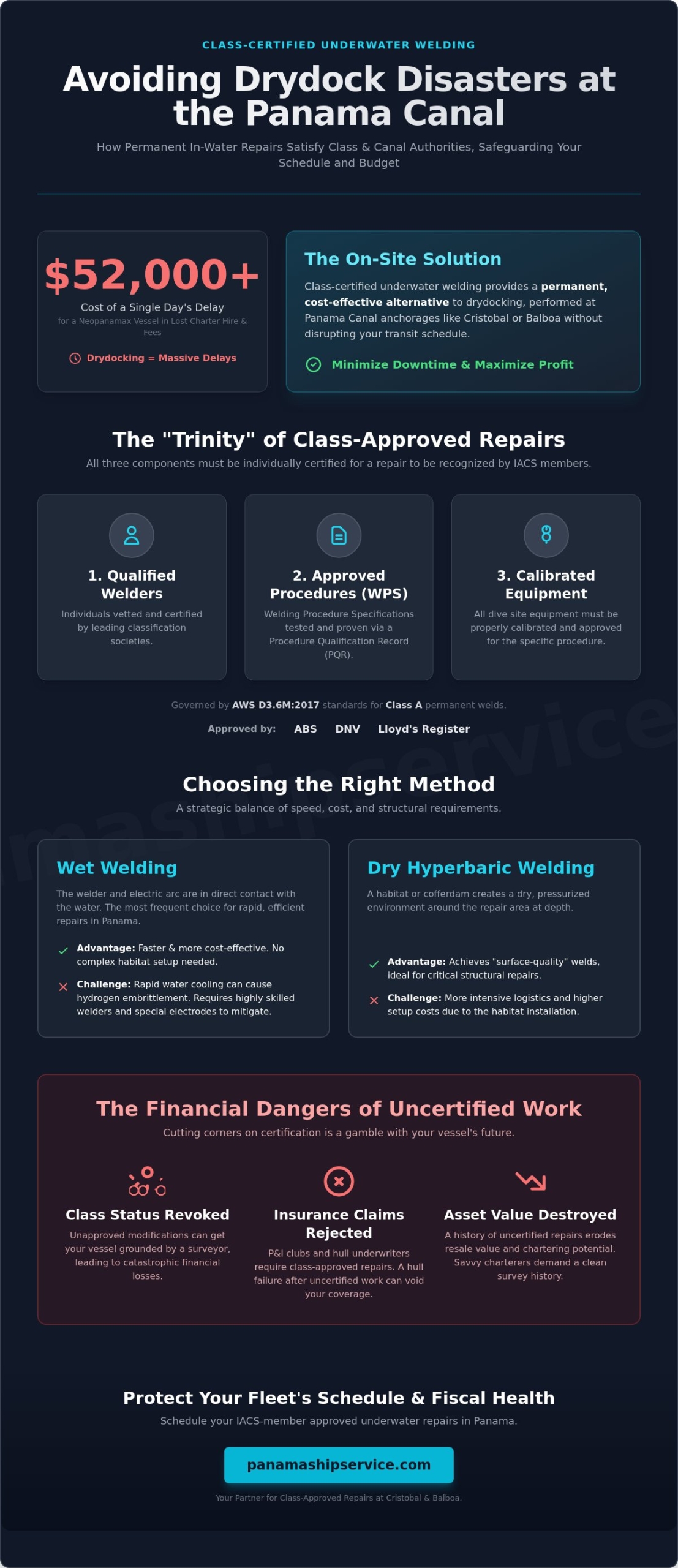
A single day of delay at the Panama Canal can cost a Neopanamax vessel over $52,000 in lost charter hire and rescheduling fees. When structural damage occurs, the immediate instinct is to look for a drydock, but the associated costs and transit delays can be devastating to your operational schedule. You need a solution that satisfies both your classification society and the Panama Canal Authority without forcing your ship out of the water. Finding class certified underwater welders who are qualified by ABS, DNV, or Lloyd’s Register is the critical first step in avoiding these massive overheads.
We understand that maintaining vessel integrity under pressure requires more than just a quick fix. This guide demonstrates how class-certified underwater welding provides a permanent, cost-effective alternative to drydocking for vessels transiting the Isthmus. You’ll learn about the latest AWS D3.6M standards for Class A welds, the impact of the 2026 ACP regulations, and how localized technical expertise ensures your vessel remains compliant while minimizing downtime. By the end, you’ll see why delegating these complex repairs to seasoned professionals is the most efficient way to protect your fleet’s schedule and fiscal health.
Key Takeaways
- Understand how IACS-member approval protects your vessel’s insurance and P&I club coverage during emergency hull repairs.
- Learn how class certified underwater welders apply AWS D3.6M Class A standards so you don’t have to settle for temporary fixes.
- Compare the technical advantages of wet versus dry hyperbaric welding to select the most cost-effective method for your specific damage.
- Master the logistics of coordinating with the Panama Canal Authority to perform repairs at Cristobal or Balboa without disrupting your transit schedule.
- Identify the specific criteria major classification societies like ABS and DNV require for underwater repairs to be deemed permanent.
Why Class Certification is Non-Negotiable for Underwater Welding
Class certification is the formal recognition that an underwater repair meets the stringent technical requirements of the International Association of Classification Societies (IACS). When you hire class certified underwater welders, you’re engaging professionals whose skills are vetted by leading organizations like the American Bureau of Shipping (ABS), DNV, or Lloyd’s Register. This isn’t just an administrative badge; it’s a verification of structural integrity. True certification covers a critical “trinity” of maritime repair: the individual welder’s qualification, the specific welding procedure specification (WPS), and the calibrated equipment used at the dive site. If any of these three elements lack approval, the repair cannot be officially recognized.
The global benchmark for these operations is the AWS D3.6M:2017 (Specification for Underwater Welding). This code dictates everything from the chemistry of the electrodes to the mechanical properties of the finished weld. Without adherence to these standards, a repair is considered a temporary patch at best and a structural liability at worst. Choosing between Wet Welding vs. Dry Hyperbaric Welding depends on the depth and the class of weld required, but both methods must be executed under the watchful eye of a class surveyor to be documented as permanent. In high-stakes environments like the Panama Canal, where vessel schedules are tight, having the right certification ensures that your ship doesn’t face unnecessary delays or re-work.
The Role of IACS in Underwater Repairs
IACS members set the bar for maritime safety by establishing uniform technical standards that govern how repairs are performed. For underwater welding, these societies require a Procedure Qualification Record (PQR). This document proves that a specific welding method has been tested in conditions that mimic the actual repair environment, including water depth and temperature. Maintaining your vessel “In Class” is mandatory for smooth operations. If a surveyor finds unapproved structural modifications during a routine inspection, they can revoke your class status. This effectively grounds the vessel until a certified repair is completed, leading to massive financial losses in lost charter hire.
Insurance and Liability Risks of Uncertified Work
Using uncertified labor is a gamble with your vessel’s financial future. Protection and Indemnity (P&I) clubs and hull underwriters typically require that all structural repairs carry a class stamp to maintain coverage. If you perform an uncertified repair and the hull fails later, your insurance claim will likely be rejected due to non-compliance with class rules. This negligence also destroys resale value and chartering potential, as savvy buyers and charterers demand a clean, class-approved survey history. Professional underwater hull services prioritize these certifications to ensure your ship stays compliant and fully insured while operating in strategic hubs like Cristobal or Balboa.
Wet Welding vs. Dry Hyperbaric Welding: Choosing the Right Method
Choosing the correct welding method is a strategic decision that balances speed, cost, and structural requirements. Wet welding is the most frequent choice for vessels in Panama because it eliminates the need for complex habitat setups. In this process, the welder and the arc are in direct contact with the water. While efficient, this environment creates metallurgical challenges. The surrounding water acts as a massive heat sink, causing the weld to cool at an accelerated rate. This rapid quenching can lead to hydrogen embrittlement and high porosity, which compromises the joint’s ductility. Class certified underwater welders mitigate these issues through precise electrode manipulation and pre-approved procedures, ensuring the repair meets the safety standards required for continued transit.
Dry hyperbaric welding utilizes a cofferdam or a bespoke habitat to create a dry environment at depth. By displacing the water, the welder can achieve “surface-quality” welds that are virtually indistinguishable from those performed in a drydock. This method is typically reserved for critical structural repairs where the highest level of mechanical properties is non-negotiable. While the logistics of installing a cofferdam are more intensive, the result is a permanent repair that satisfies even the most stringent surveyor requirements. Understanding the AWS D3.6M Underwater Welding Code is essential for determining which method applies to your specific hull damage.
Capabilities of Modern Wet Welding
Modern advancements in flux-coated electrodes have significantly improved the quality of wet welds. It’s now possible to achieve Class A or Class B results as defined by the American Welding Society. These welds are commonly used for attaching sacrificial anodes, securing non-structural plate patches, or repairing bilge keels. However, wet welding has limits. It is rarely approved for high-stress areas like the engine room foundation or primary structural members due to the risk of micro-cracking in high-carbon steels. For these applications, a dry environment is the only way to guarantee long-term integrity.
Hyperbaric and Cofferdam Solutions
When structural integrity is at stake, dry habitats are the gold standard. These solutions allow for controlled pre-heating and post-weld heat treatments, which are impossible in wet conditions. This is particularly vital when performing complex mechanical ship repairs involving rudders, propeller nozzles, or thruster tunnels. By creating a stable, dry workspace, class certified underwater welders can perform deep penetration welds that withstand the immense operational stresses of a transoceanic voyage. If you’re unsure which method your damage requires, you should consult with a class-approved technical superintendent to review your repair plan before arrival in Panama.
Understanding AWS D3.6M Standards and Procedure Qualifications
The AWS D3.6M standard provides the technical framework for every underwater weld performed on a commercial hull. It categorizes welds into three distinct classes based on their mechanical properties and intended application. Class A welds are the most rigorous; they must meet the same strength and ductility requirements as surface welds. When class certified underwater welders execute a Class A wet weld, it is frequently accepted by IACS surveyors as a permanent repair for hull plating. This classification effectively eliminates the need for an emergency drydocking, saving the owner significant capital and time.
Class B welds allow for slightly more surface discontinuities. These are typically reserved for less critical structural components or secondary attachments where the highest level of ductility isn’t required. Class O welds must meet the requirements of another specific code or standard, often used in specialized offshore applications. Understanding these distinctions is vital for ship superintendents. You must ensure your repair plan aligns with the correct class to avoid a “temporary repair” status that requires future drydocking. This clarity prevents the frustration of a repair that only lasts until your next scheduled maintenance window.
NDT Methods for Underwater Welds
Verification is as important as the weld itself. Non-Destructive Testing (NDT) is the only way to prove a weld’s integrity without damaging the vessel. Class certified underwater welders utilize specialized tools to ensure the repair is flawless. Key methods include:
- Magnetic Particle Inspection (MPI): Essential for detecting surface-breaking cracks that are invisible to the naked eye.
- Ultrasonic Testing (UT): Crucial for verifying weld penetration and checking for internal voids or slag inclusion.
- Video Documentation: High-definition live feeds allow class surveyors to witness the entire process and review the results from the surface in real-time.
Procedure Qualification: Matching Site Conditions
A Procedure Qualification Record (PQR) is not a universal permit. It’s a specific validation of a welder’s ability to perform under set environmental conditions. Hydrostatic pressure changes with depth, which directly affects the solubility of gases in the weld pool and the stability of the electric arc. A welder qualified for shallow work at 5 meters cannot legally perform a structural weld at 20 meters. The Welding Procedure Specification (WPS) must be pre-approved by the attending surveyor to ensure it matches the local conditions. In Panama’s tropical waters, the cooling rate is slightly slower than in frigid climates, but it still remains high enough to cause metallurgical issues if the procedure isn’t strictly followed. We manage these thermal dynamics to prevent brittle zones in the heat-affected area, ensuring the repair remains structurally sound for the long term.
Planning Underwater Repairs in Panama: Logistics and Timing
Panama’s strategic position as a global maritime crossroads demands a logistical approach that is both precise and proactive. When your vessel requires structural intervention, the window for action is often limited by your scheduled transit slot. Coordinating with the Panama Canal Authority (ACP) requires deep local knowledge and immediate responsiveness. Our teams manage the complex permitting process for underwater work at both major anchorages. Whether your ship is waiting in the Pacific or the Atlantic, class certified underwater welders must be mobilized quickly to prevent missed transit deadlines. We maintain a 24/7 operational posture to ensure that equipment, specialized electrodes, and dive teams are on-site exactly when needed. This eliminates the risk of costly idle time and ensures that repairs are completed before your pilot arrives.
Managing equipment mobilization to offshore anchorages is a significant logistical hurdle that requires dedicated support craft. We deploy fully equipped dive vessels capable of handling the high-power requirements of underwater welding and the heavy lift needs of cofferdam installation. This proactive mobilization strategy ensures that no time is wasted once the vessel is cleared for repair work. By delegating these logistical complexities to a seasoned local partner, you ensure your vessel remains on schedule while meeting all technical requirements. This approach transforms a potential crisis into a manageable operational task.
Balboa and Cristobal: Strategic Repair Hubs
The choice between Balboa and Cristobal often depends on your vessel’s direction of travel and its bunkering requirements. Balboa serves as the Pacific gateway, offering extensive anchorage space for vessels arriving from Asia or the West Coast of the Americas. Cristobal provides similar capabilities on the Atlantic side, serving as a vital hub for Caribbean and European routes. Efficient operators often schedule their underwater repairs to coincide with other essential services. By integrating welding work with the delivery of ship supplies, you can maximize your time at anchorage and reduce total port stay duration. Navigating the local port authority permits is a task we handle directly, allowing your crew to focus on their primary duties while we manage the underwater technicalities.
Minimizing Transit Delays
The primary goal of in-water repair is to avoid the massive expense of deviating to a distant shipyard. A well-planned underwater intervention can keep a vessel in service for months until its next scheduled drydock. To achieve this, we utilize comprehensive marine surveys in Panama to assess the damage before the welding team even enters the water. This pre-assessment ensures that the correct materials and class certified underwater welders are ready for the job from the moment the dive boat arrives. Consolidating your technical needs under a single provider simplifies communication and ensures that diving, welding, and mechanical teams work in perfect synchronization. If you are facing a critical repair deadline, you should contact our technical team to secure a repair slot immediately to protect your transit schedule.
Panama Ship Service: Your Partner for Class-Approved Repairs
Panama Ship Service maintains a specialized roster of class certified underwater welders ready for immediate deployment across the Isthmus. We have decades of experience working alongside surveyors from the world’s leading classification societies, including ABS, DNV, Lloyd’s Register, and Bureau Veritas (BV). This deep-rooted familiarity with class-specific requirements ensures that our repair procedures are approved without hesitation. We don’t just provide divers; we provide technical solutions that keep your vessel in class and in service. Our commitment to IACS compliance is absolute, meaning every weld we perform is backed by rigorous documentation and the highest metallurgical standards.
Urgency is a constant in the shipping industry, especially for vessels approaching the Panama Canal. We offer 24/7 emergency response for ships in distress or those facing urgent ACP requirements. When a vessel arrives with a structural deficiency that threatens its transit slot, our teams mobilize within hours. We handle everything from the initial damage assessment to the final NDT report. Our post-repair protocols include comprehensive Magnetic Particle Inspection and Ultrasonic Testing to verify that every joint is sound. This systematic approach alleviates the anxiety of the ship’s command and the technical management office by providing a clear path to compliance.
Our Welding Capabilities
Our technical scope covers the full range of underwater structural needs. We specialize in permanent hull repairs and bilge keel fixes that withstand the harshest oceanic conditions. Our teams are proficient in sea chest grating repairs and propeller crack arrests, which are vital for maintaining propulsion efficiency and preventing further structural degradation. When a wet weld isn’t sufficient for the required class of repair, we design and fabricate custom cofferdams. These habitats allow our class certified underwater welders to work in a dry, controlled environment to achieve surface-level quality without the vessel ever leaving the water.
Why Choose Panama Ship Service?
Choosing us means choosing a partner that understands the financial impact of every hour spent at anchorage. We have a proven track record of minimizing vessel downtime by synchronizing our diving operations with your existing schedule. Our services integrate seamlessly with mechanical ship repairs in Panama, allowing for simultaneous work on rudders, thrusters, and main hull structures. We act as a proactive liaison between the ship and the classification society, facilitating direct communication with surveyors to ensure immediate approval of the work. You can delegate the technical and logistical complexity of underwater repairs to us, knowing that your vessel is in the hands of seasoned maritime veterans who prioritize your schedule and fiscal responsibility.
Secure Your Vessel’s Future with Certified Technical Expertise
Maintaining vessel integrity while transiting the Panama Canal requires a balance of technical precision and logistical agility. By utilizing IACS-compliant procedures, you ensure that every repair meets the high standards required by ABS, DNV, and Lloyd’s Register. This approach doesn’t just fix a structural issue; it protects your ship’s insurance standing and long-term resale value without the need for an expensive drydocking deviation. Choosing the right method and standard today prevents costly rework tomorrow.
Our team provides 24/7 availability at both Balboa and Cristobal to meet the urgent needs of the global fleet. When you engage our class certified underwater welders, you’re choosing a partner dedicated to minimizing downtime and maximizing operational efficiency. We handle the technical complexities so your crew can focus on a safe and timely transit. Request an Emergency Underwater Repair Quote today to ensure your vessel remains compliant and on schedule. We’re ready to keep your fleet moving.
Frequently Asked Questions
Is underwater welding considered a permanent repair by classification societies?
Yes, classification societies consider underwater welding a permanent repair when it achieves Class A status according to AWS D3.6M standards. The repair must be performed by class certified underwater welders and pass all required non-destructive testing. If the surveyor is satisfied with the mechanical properties and fusion of the weld, the vessel’s record is updated to reflect a permanent fix. This eliminates the requirement for follow-up work during your next scheduled drydocking.
What certifications should I look for in an underwater welding company?
You should prioritize companies that hold “Approved Service Supplier” status from IACS members like ABS, DNV, or Lloyd’s Register. Individual divers must also possess valid welder qualification records for the specific procedures being used. It’s essential to verify that the contractor’s equipment and welding procedure specifications (WPS) are currently certified. This comprehensive level of documentation ensures that the work is legally recognized by your vessel’s underwriters and port authorities.
Can wet welding be performed on all types of marine steel?
Wet welding is generally limited to steels with a Carbon Equivalent (CE) of 0.40% or lower. High-carbon steels are highly susceptible to hydrogen-induced cracking due to the rapid cooling effect of the surrounding water. If your hull plating exceeds this CE limit, class certified underwater welders will likely recommend a dry hyperbaric habitat or a cofferdam. This creates a controlled environment that prevents brittle zones and ensures the long-term structural integrity of the repair.
How long does a typical underwater hull repair take in Panama?
Most minor underwater hull repairs in Panama are completed within 12 to 36 hours, depending on the extent of the damage and local sea conditions. Logistics and mobilization to anchorages like Balboa or Cristobal play a major role in the timeline. We focus on rapid deployment to ensure that your repair doesn’t interfere with your scheduled Panama Canal transit slot. A detailed pre-assessment survey is the most efficient way to get an accurate time estimate.
Do I need Panama Canal Authority (ACP) permission for underwater welding?
Yes, you must obtain formal authorization from the Panama Canal Authority (ACP) before starting any underwater work within their jurisdiction. This includes repairs at the Pacific or Atlantic anchorages. As your local partner, we handle the communication with the ACP and the Port Authority to secure the necessary permits. This ensures your vessel remains in full compliance with local regulations while avoiding any fines or administrative delays during your canal transit.
What is the difference between Class A and Class B underwater welds?
Class A welds are designed for critical structural applications and must exhibit properties comparable to surface welds. In contrast, Class B welds are intended for less critical areas where some surface discontinuities or lower ductility are acceptable. If your goal is a permanent repair that satisfies a class surveyor for hull integrity, a Class A weld is required. Class B is often sufficient for secondary attachments like sacrificial anodes or non-structural fairing plates.
How is the quality of an underwater weld verified?
Weld quality is verified through a combination of real-time monitoring and Non-Destructive Testing (NDT). Class surveyors typically observe the process via high-definition live video feeds from the diver’s helmet. Once the weld is complete, technicians perform Magnetic Particle Inspection (MPI) to check for surface cracks and Ultrasonic Testing (UT) to ensure proper internal fusion. These results are documented in a final report that serves as the official record of the repair’s integrity.
Can underwater welding fix a leaking hull plate permanently?
Underwater welding can permanently fix a leaking hull plate if the repair is executed as a Class A structural weld. This often involves the use of a doubler plate or a flush insert depending on the surveyor’s requirements and the location of the leak. When performed by expert teams using approved procedures, these repairs are considered permanent. This allows the vessel to continue its commercial operations without the immediate need for a costly emergency drydocking.