
Did you know that missing a single scheduled transit slot for a Neo-Panamax vessel can result in daily delay costs exceeding $65,000? You are likely already feeling the pressure of VLSFO prices hovering around $658 per metric ton while trying to improve your Carbon Intensity Indicator (CII) ratings. In this high-stakes environment, Rupert scale propeller polishing is not a cosmetic luxury but a critical mechanical intervention. Even light fouling can increase your fuel consumption by up to 10 percent; this makes the difference between a profitable voyage and a costly deficit.
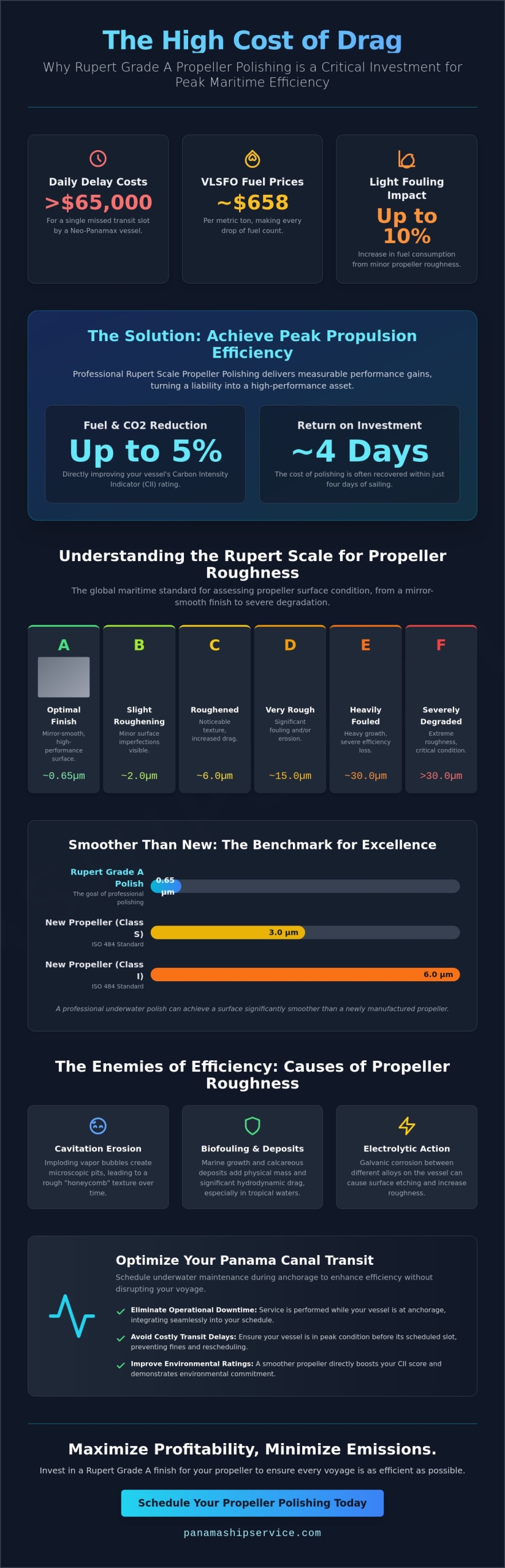
We understand that maintaining a strict schedule at the Panama Canal is your top priority. This guide demonstrates how achieving a Rupert Grade A finish, which represents a surface roughness of approximately 0.65 microns, can reduce your fuel consumption and CO2 emissions by up to 5 percent. You will learn why this specific standard is essential for maximizing RPM efficiency and how to complete this vital maintenance within the Panama Canal Authority’s regulatory framework. We will also show you why the cost of professional polishing often pays for itself within just four days of sailing.
Key Takeaways
- Understand the technical grading system from Grade A to F and why achieving a surface roughness of 0.65 microns is the maritime benchmark for propulsion efficiency.
- Discover how professional Rupert scale propeller polishing delivers a 5% reduction in fuel consumption, often paying for itself within a single long-haul voyage.
- Learn the critical difference between basic fouling removal and high-precision technical polishing to avoid the risks of blade scouring and permanent damage.
- Optimize your Panama Canal transit by scheduling underwater maintenance during anchorage to eliminate operational downtime and avoid transit delays.
- Align your vessel maintenance with modern environmental standards to improve your Carbon Intensity Indicator ratings and meet strict canal authority requirements.
What is the Rupert Scale for Propeller Roughness?
The Rubert & Co. Ships Propeller Roughness Comparator Scale is the definitive global standard for assessing the surface condition of marine propellers. In the shipping industry, we don’t rely on guesswork; we use this visual and tactile tool to determine exactly how much drag a vessel is fighting. Professional Rupert scale propeller polishing transforms a rough, inefficient blade into a high-performance asset by matching its surface to a specific, standardized grade. This scale allows ship owners and divers to communicate using a common technical language that translates directly into fuel savings.
The system consists of six specimens labeled A through F. Grade A represents the smoothest finish, while Grade F indicates a severely degraded surface. Each grade corresponds to a specific micron value (Ra). While a Grade A finish achieves approximately 0.65 microns, a Grade F surface can exceed 30 microns. This exponential increase in roughness creates significant turbulence, which forces the engine to work harder to maintain the same speed. It’s why achieving the highest possible grade is a priority for any operator focused on fiscal responsibility.
Why do we use a physical comparator rather than electronic gauges? Underwater environments are often dark, pressurized, and filled with suspended solids. Electronic surface profile gauges are sensitive and prone to failure under these conditions. A diver can feel the difference between the propeller and the Rupert scale specimen even in low visibility. This tactile verification ensures the polishing (metalworking) process meets the required specifications without the delays caused by equipment malfunction.
Major Class Societies, including ABS, Lloyd’s Register, and the US Navy, recognize the Rupert Scale as the benchmark for in-water inspections. These organizations require documented surface roughness readings during surveys to verify vessel efficiency and structural integrity. Using the Rupert scale propeller polishing methodology ensures your vessel remains compliant with international standards while optimizing its Carbon Intensity Indicator (CII) performance.
The Anatomy of the Rupert Comparator
The comparator plate features six distinct specimens that represent the progression of surface degradation. Specimen A is the target for all high-performance polishing jobs, equating to a surface roughness of roughly 0.65 microns. For context, new propellers are typically delivered from the foundry meeting ISO 484 standards. A Class S finish requires 3 microns, while a Class I finish requires 6 microns. This means a professional underwater polish can actually result in a surface that is smoother than the propeller was on the day it was installed.
Causes of Propeller Roughness Underwater
Propeller surfaces don’t stay smooth on their own. Cavitation erosion is a primary culprit; imploding vapor bubbles create microscopic pits in the metal that eventually lead to a “honeycomb” texture. Biofouling and calcareous deposits also accumulate quickly in tropical waters like those at the Panama Canal, adding significant physical mass and drag. Finally, electrolytic action between different alloys can cause surface etching. Without regular intervention, these factors quickly degrade a propeller from Grade A to Grade C or worse, costing thousands in extra fuel.
The Financial Impact: Why Rupert Grade A Matters
Efficiency isn’t just a technical metric; it’s the primary driver of your profit margin. When a propeller surface degrades from a Grade A finish to a Grade D or E, the resulting hydrodynamic drag forces the engine to burn more fuel just to maintain cruising speed. With VLSFO prices in major hubs like Houston reaching $658 per metric ton as of June 2026, even a minor drop in efficiency carries a heavy price tag. Implementing a consistent program for Rupert scale propeller polishing ensures that your vessel operates at peak performance, directly offsetting these rising overhead costs.
The “5% Rule” is a well-documented reality in maritime operations. A professionally polished propeller can improve propulsion efficiency and reduce fuel consumption by 3 to 5 percent. This isn’t a theoretical projection. Major classification societies like the American Bureau of Shipping (ABS) and Lloyd’s Register recognize the Rupert Scale as the mandatory benchmark for evaluating these gains, a fact supported by industry leaders such as Armada Systems, Inc. By reducing the micro-roughness on the blades, you lower the engine load and minimize mechanical wear on the entire propulsion train.
Beyond fuel costs, the environmental impact is now a regulatory priority. The International Maritime Organization’s (IMO) Carbon Intensity Indicator (CII) ratings now penalize inefficient vessels. A rough propeller doesn’t just waste money; it inflates your CO2 emissions profile. Maintaining a Grade A finish is one of the most cost-effective ways to improve your CII rating without expensive retrofits. If you’re preparing for a transit, securing underwater hull services before you enter the canal can prevent performance-related fines and ensure compliance with the Panama Canal Authority’s Green Vessel incentives.
Fuel Efficiency and ROI Calculations
Transitioning from a Grade D finish to Grade A significantly improves your power-to-speed ratio by reducing “added resistance” caused by surface friction. The return on investment for a professional propeller polish is exceptionally fast; the service costs are typically paid back within two to four days of sailing due to fuel savings alone. This makes proactive maintenance a strategic financial decision rather than a simple repair cost.
Environmental Compliance and Emissions
With the implementation of IMO 2026 standards, documenting your energy efficiency (EEXI) is mandatory. A Grade A polish reduces greenhouse gas emissions by 2 to 5 percent, providing a measurable data point for your environmental audits. Keeping detailed, Rupert scale propeller polishing reports from your dives ensures you’re ready for port state control inspections and class surveys without any unnecessary complications.
Propeller Cleaning vs. Rupert Scale Polishing
Many operators mistakenly assume that a propeller free of visible growth is an efficient one. This is a costly misconception. Propeller cleaning and Rupert scale propeller polishing are distinct technical interventions with vastly different outcomes. Cleaning is a basic maintenance task that removes macro-fouling like barnacles, tubeworms, and seagrass. While this is a necessary first step, it doesn’t address the microscopic surface profile of the metal. A propeller can be visually “clean” but still possess a surface roughness equivalent to Grade D or E, which continues to generate significant hydrodynamic drag and waste fuel.
Technical polishing is a reconditioning process. It goes beyond simple debris removal to restore the original smoothness of the blade. If your vessel hasn’t seen a dive team in over six months, the alloy has likely suffered from minor corrosion or “staining” that increases friction. Only a dedicated polishing protocol can bring that surface back to a Grade A finish. Choosing simple cleaning when your vessel requires a full polish is like washing a car that needs the engine tuned; it looks better, but the performance remains compromised. For vessels transiting the Panama Canal, where every minute of efficiency counts, the distinction is critical.
Technical Comparison of Methods
Cleaning focuses on the removal of physical mass. Divers use standard rotating brushes to clear the blades of calcareous growth. This restores the blade’s weight and balance but leaves the surface texture untouched. In contrast, Rupert scale propeller polishing is a multi-stage abrasive process. We use specialized equipment to grind down the “peaks” of the metal’s surface profile. The goal is to achieve a mirror-like finish that allows water to flow over the blade with minimal turbulence. We typically recommend a full polish if the vessel has been idle in tropical waters or if it’s been more than six months since the last technical reconditioning.
The Danger of Substandard Maintenance
Inexperienced service providers often cause more harm than good by using improper tools. The biggest risk is “scouring,” which occurs when aggressive wire brushes are used on soft bronze alloys. These brushes create micro-grooves that actually increase the surface area of the blade. This doesn’t just increase drag; it creates a perfect environment for new fouling to take hold. You’ll find that a scoured propeller requires cleaning twice as often as one that’s been properly polished. At Panama Ship Service, we prevent this by using only trained divers for underwater hull services. We use flexible abrasive discs that smooth the surface without digging into the metal, ensuring your maintenance investment lasts for the duration of your long-haul voyage.
The Multi-Stage Polishing Process: Achieving the Rupert A Standard
Achieving a Grade A finish requires more than a standard dive team; it demands a disciplined, multi-stage mechanical protocol. We begin every Rupert scale propeller polishing operation with a detailed pre-polishing inspection. Our divers document the “As Found” condition by comparing the blade surface directly against the Rupert comparator scale. This initial baseline is essential for quantifying the efficiency gains your vessel will achieve after the service is complete. We don’t believe in “black-boxed” processes; transparency is the foundation of our reliability.
Once the initial state is recorded, we move to Stage 1. This involves the systematic removal of all calcareous growth and biofouling using specialized hydrodynamic tools. We prioritize the preservation of the underlying metal, ensuring that no aggressive scraping damages the alloy. Stage 2 follows with the sequential use of specialized abrasive discs. We start with an 80-grit disc to level surface pitting and cavitation damage; we then transition to 150-grit and higher to refine the surface. The final stage is a high-speed polish that produces the required mirror finish, verified by a tactile match with Rupert Specimen A. This rigorous Rupert scale propeller polishing method ensures that every square centimeter of the blade contributes to propulsion rather than drag.
Underwater Equipment and Technology
Precision is impossible without the right hardware. We utilize hydraulic polishing heads that maintain consistent pressure across the entire surface of the blade. This is critical because manual pressure varies, which leads to uneven finishes and compromised hydrodynamics. We select abrasive grades based specifically on your propeller’s alloy, whether it’s Manganese Bronze or Nickel-Aluminum Bronze (NiAlBr). Our technicians are trained to polish the critical edges and tips with extreme care. We restore smoothness without altering the original blade geometry or hydrodynamic profile, protecting the long-term integrity of your propulsion system.
Documentation and Quality Assurance
A technical service is only as good as the data that supports it. We provide comprehensive before-and-after photographic evidence as part of our final technical report. This documentation serves as a signed certificate of roughness for your vessel’s permanent records, which is often required during class audits or port state inspections. For vessels undergoing more extensive maintenance, we seamlessly integrate this data into our broader mechanical ship repairs documentation. This unified approach ensures your technical superintendent has a clear, transparent view of the vessel’s operational status. If your vessel is approaching the canal, contact us today to schedule a high-precision polish that guarantees performance.
Strategic Maintenance: Propeller Polishing at the Panama Canal
The Panama Canal isn’t just a transit point; it’s a strategic window for critical maintenance. While your vessel awaits its scheduled slot at the Balboa or Cristobal anchorages, you have a unique opportunity to eliminate propulsion drag without adding a single hour to your voyage. Performing Rupert scale propeller polishing during this idle time transforms a mandatory wait into a productive maintenance session. We specialize in coordinating these services so they’re completed well before your pilot boards, ensuring you enter the canal with a Grade A finish and maximum RPM efficiency.
The geographical advantage of the canal’s anchorages cannot be overstated. Both the Pacific and Atlantic entrances provide sheltered environments ideal for underwater work. By consolidating your technical needs with a single, localized partner, you avoid the administrative burden and high agency fees associated with managing multiple contractors. We provide a one-stop-shop approach that handles everything from the dive team’s logistics to the final technical reporting. This allows your crew to focus on transit preparations while we handle the complexity of the underwater environment.
Minimizing Transit Delays
Timing is everything when you’re facing high daily delay costs for a Neo-Panamax vessel. We coordinate directly with the Panama Canal Authority (ACP) to secure the necessary permits and ensure all work complies with environmental regulations. Our rapid-response teams are stationed to deploy the moment your vessel reaches the anchorage. To maximize this window, many operators integrate polishing with marine surveys in Panama for a comprehensive health check. This proactive strategy identifies potential mechanical issues before they can cause a failed inspection or a transit delay.
The Panama Ship Service Advantage
Operating within the canal’s unique water conditions and strict regulatory framework requires specialized expertise. We understand the ACP’s requirements for debris capture and environmental safety; these are critical for maintaining your standing in the “Green Vessel” incentive program. To further streamline your port call, we offer the ability to consolidate Rupert scale propeller polishing with MARPOL disposal in Panama. This integrated service model reduces the number of barge movements and administrative touchpoints, saving you thousands in operational overhead. Don’t let your transit wait go to waste. Contact us to develop a tailored maintenance plan that fits your specific schedule and ensures your vessel transits at peak performance.
Maximize Your Vessel Efficiency for the Next Voyage
Your vessel’s performance depends on the precision of its propulsion system. Achieving a Grade A finish is a calculated financial decision that protects your profit margins against rising fuel costs and tightening environmental regulations. By utilizing the idle time during your Panama Canal transit, you can transform a logistical necessity into a high-yield maintenance window. This proactive approach ensures your propulsion system remains a financial asset rather than a liability.
Our team of certified underwater technicians uses class-approved reporting standards to document every stage of the Rupert scale propeller polishing process. This ensures you leave the anchorage with proven 5% fuel efficiency gains and a clear, documented path toward meeting your Carbon Intensity Indicator (CII) targets. Don’t let micro-roughness and biofouling compromise your schedule or your budget. Delegate the technical complexity to our experienced team so you can focus on a successful transit.
Request a Propeller Polishing Quote for Your Panama Transit to secure your service window. We are ready to help you optimize your propulsion efficiency and ensure a smooth, compliant voyage.
Frequently Asked Questions
What is the ideal frequency for Rupert scale propeller polishing?
The ideal frequency for propeller reconditioning is every 6 to 12 months, though this depends on your vessel’s trade route and idle time. Vessels operating in high-fouling tropical regions or those with a low activity profile should consider more frequent inspections. Proactive maintenance prevents the surface from degrading past a Grade B finish, making it faster and more cost-effective to restore the blades to Grade A during your next port call.
Can propeller polishing be performed while the vessel is loading or discharging cargo?
Propeller polishing is typically restricted during cargo loading or discharging for safety reasons. Diving operations are generally prohibited while the vessel is in a state of flux or when thrusters and sea suctions are active. We coordinate with the terminal and port authority to perform these services at designated anchorages like Balboa or Cristobal before or after cargo operations are finalized.
How long does a typical Rupert A propeller polish take to complete?
Achieving a Rupert Grade A finish usually takes between 3 and 5 hours for a standard commercial vessel. The exact duration depends on the propeller’s diameter and the “as found” condition of the blades. Our teams work efficiently to ensure the service is completed within your scheduled anchorage window, preventing any disruption to your Panama Canal transit slot.
Is a Rupert Grade A finish achievable on an older, heavily pitted propeller?
A Rupert Grade A finish is achievable on older propellers, provided the metal hasn’t suffered from structural thinning or extreme cavitation damage. While deep pitting can’t always be completely removed without compromising blade geometry, our multi-stage Rupert scale propeller polishing process can smooth the surface significantly. This reduces the turbulent flow and improves efficiency even on seasoned equipment.
Does propeller polishing help in reducing underwater radiated noise (URN)?
Professional polishing significantly reduces underwater radiated noise (URN) by minimizing blade-tip cavitation. A rough propeller creates vapor bubbles that implode with high intensity, generating both noise and vibration. By restoring a mirror finish, you ensure a more laminar flow of water over the blades, which lowers the vessel’s acoustic signature and improves crew comfort by reducing hull vibration.
What is the expected fuel saving percentage after a professional polish?
You can expect a fuel saving of 3% to 5% following a professional polish to Grade A standards. This improvement in propulsion efficiency is a result of reduced hydrodynamic drag. For a large container ship or tanker, these savings translate into thousands of dollars in reduced bunker costs during a single long-haul voyage, often providing a return on investment within the first four days of sailing.
Will propeller polishing affect the propeller’s balance or pitch?
Technical polishing does not affect the propeller’s balance or pitch when performed by trained specialists. The process involves removing only microns of surface oxidation and calcareous growth, which is far too little material to alter the mechanical properties of the blades. In fact, removing uneven fouling helps restore the propeller’s original hydrodynamic balance and reduces stress on the shaft bearings.
Are there specific environmental regulations for propeller polishing in Panama?
The Panama Canal Authority (ACP) enforces strict environmental regulations regarding in-water maintenance. You must obtain a specific permit and provide a 48-hour advance notice before starting any underwater work at Balboa or Cristobal anchorages. Our teams are fully compliant with these local standards, ensuring that all Rupert scale propeller polishing operations meet the requirements for debris management and environmental safety to avoid fines.