
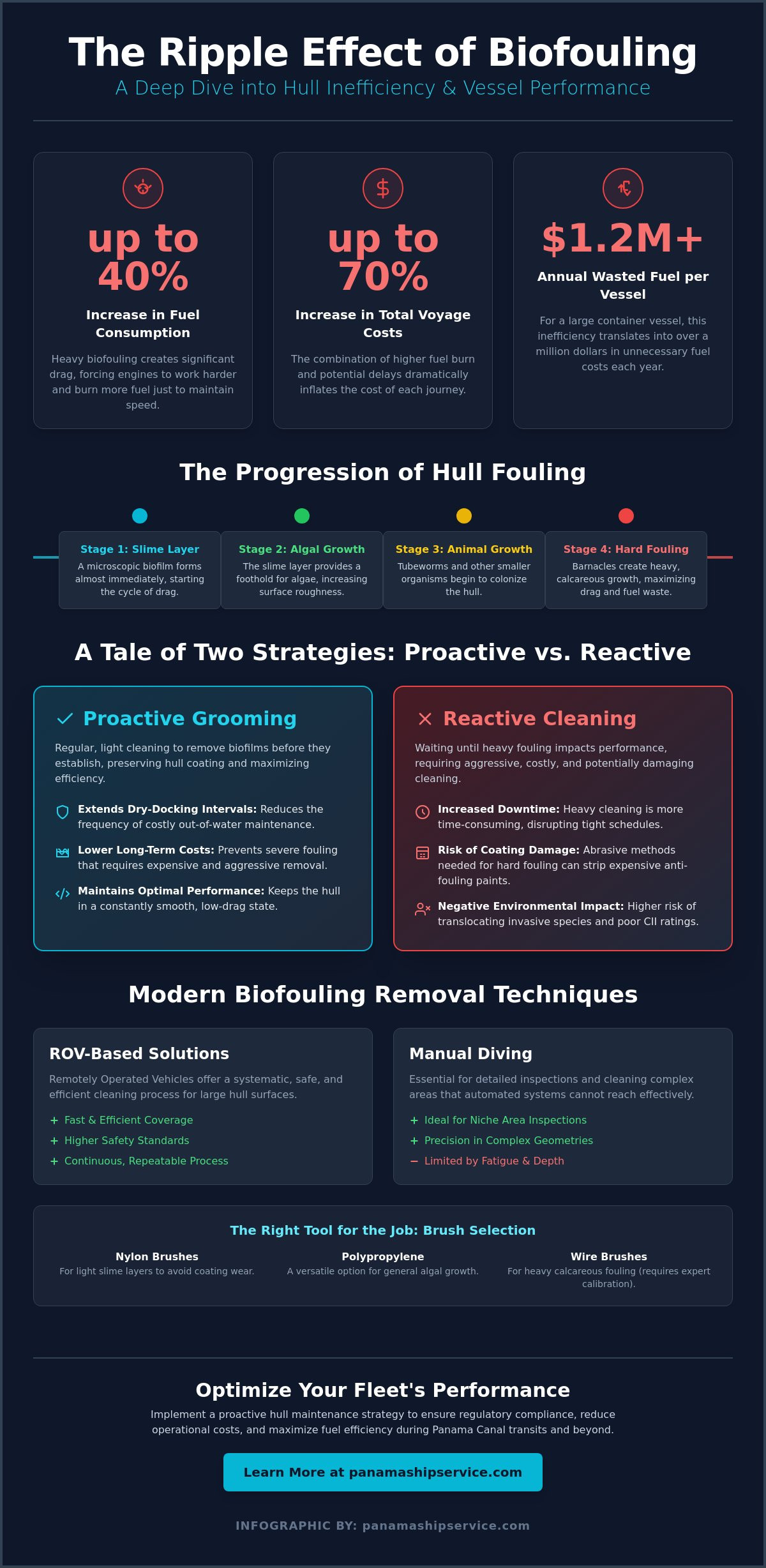
Did you know that biofouling on a vessel’s hull can increase fuel consumption by approximately 40%, potentially driving total voyage costs up by a staggering 70%? For a large container vessel, this inefficiency translates to over $1.2 million in wasted fuel annually. You’re likely already feeling the impact of these rising overheads alongside the pressure to meet strict IMO guidelines while evaluating the most effective biofouling removal techniques. It’s a difficult balance to maintain, especially when the risk of damaging specialized hull coatings during cleaning remains a constant concern for technical superintendents.
This guide helps you master the technical and operational strategies for biofouling removal to optimize vessel performance and fuel efficiency during Panama Canal transits. We’ll explore how high-precision mechanical interventions eliminate the trade-off between maintenance and uptime. You will learn about the industry shift toward proactive cleaning programs, the latest regulatory requirements like the 2023 IMO guidelines, and strategies to extend your dry-docking intervals. By the end, you’ll have a clear roadmap for maintaining a clean hull that satisfies both international environmental standards and your bottom line.
Key Takeaways
- Identify the financial risks of biofouling progression, from initial slime layers to heavy calcareous growth, to mitigate voyage cost spikes.
- Master the selection of biofouling removal techniques, comparing manual diving and ROV solutions to find the right balance for your fleet’s specific hull coatings.
- Adopt a proactive grooming strategy to remove biofilms before they establish, extending dry-docking intervals and reducing long-term maintenance costs.
- Ensure full compliance with international standards and Panama Canal regulations by implementing MARPOL-compliant waste capture during all cleaning operations.
- Streamline your port stay by coordinating underwater technical solutions with mechanical repairs to eliminate unnecessary downtime during transit.
Understanding Biofouling: The Financial and Operational Impact
To manage a modern fleet efficiently, you must first understand the biological adversary affecting your hull. What is Biofouling? In the maritime context, it is the unwanted accumulation of microorganisms, plants, and animals on submerged structures. This process begins almost immediately after a vessel enters the water, starting with a microscopic biofilm or “slime layer.” If you don’t address this early, it quickly progresses into heavy calcareous fouling, where barnacles and tubeworms create a rigid, abrasive surface. This growth fundamentally alters the vessel’s hydrodynamics. Surface roughness disrupts the smooth, laminar flow of water around the hull, creating turbulence that forces the propulsion system to work harder to maintain speed.
The hidden costs of a fouled hull extend beyond the fuel pump. Engines running at higher loads to overcome drag suffer from accelerated wear and tear, leading to more frequent mechanical ship repairs. Additionally, biofouling significantly reduces a vessel’s maximum attainable speed. This loss of performance can be critical when you’re trying to meet tight delivery windows or recover time lost during transit delays. Integrating professional biofouling removal techniques into your routine maintenance is the only way to prevent these operational bottlenecks.
The Economics of Hull Drag
Research shows that even light slime can increase fuel consumption significantly. Heavy biofouling can increase fuel consumption by approximately 40%, often leading to a total voyage cost increase of up to 70%. Frictional resistance is the primary driver of excess fuel consumption as the engine struggles to overcome the drag created by a fouled hull. For a 20,000+ TEU container vessel, heavy growth can result in 3,000 to 5,000 tons of additional fuel burned annually. Beyond direct costs, this inefficiency negatively impacts your Carbon Intensity Indicator (CII) ratings. Low ratings restrict operational flexibility and can decrease the market value of your assets.
Environmental Risks and Invasive Species
Ships act as primary vectors for the translocation of Invasive Aquatic Species (IAS). When organisms from one biogeographic region are introduced to another via a fouled hull, they can devastate local ecosystems. This risk has led to intense global regulatory pressure, specifically through the 2023 IMO Biofouling Guidelines. Regional laws, such as the Vessel Incidental Discharge Act (VIDA) in the United States, are becoming increasingly strict. Maintaining a clean hull through effective biofouling removal techniques allows operators to qualify for “Green Flag” incentives and environmental discounts in major ports, further reducing overhead.
Advanced Mechanical and Technical Removal Techniques
Modern maritime operations require more than just brute force to maintain hull efficiency. The transition from manual diving to Remotely Operated Vehicles (ROVs) has revolutionized how we approach biofouling removal techniques. While manual divers remain essential for complex niche area inspections, ROV-based solutions offer faster coverage and higher safety standards for large flat-bottom surfaces. These systems allow for continuous operation without the fatigue or depth limitations associated with human divers. They provide a systematic, repeatable cleaning process that ensures no section of the hull is overlooked.
Selecting the correct brush material is a technical decision that depends on the fouling type and the specific coating system applied to the vessel. Nylon brushes are typically reserved for micro-fouling or slime layers to avoid unnecessary coating wear. Polypropylene brushes provide a versatile middle ground for general growth. For heavy calcareous fouling, such as barnacles or tubeworms, specialized wire brushes are necessary. However, these require expert calibration. The goal is always to remove the growth without compromising the underlying anti-fouling paint. If you need to assess your fleet’s current condition, our team provides comprehensive underwater hull services tailored to the specific needs of vessels transiting the Panama Canal.
Brush-Based Mechanical Cleaning
Multi-brush units are the industry standard for large-scale cleaning. These systems use several rotating heads that maintain consistent pressure across the hull’s curvature. Adjustable torque is a critical feature here, especially when working with fragile silicone-based foul-release coatings. Whether using diver-operated carts or remote-controlled units, the operator must balance cleaning speed with coating preservation. Precision is vital to ensure you don’t inadvertently shorten the vessel’s dry-docking cycle by stripping away the protective layers along with the biofouling.
Cavitation and Water-Jetting Technologies
Contactless cleaning represents the next step in hull maintenance. Cavitation technology uses high-speed water flow to create microscopic vapor bubbles. When these bubbles implode near the hull surface, the resulting shockwaves strip away fouling. This method is exceptionally gentle on anti-fouling systems because no physical bristles touch the paint. High-pressure water-jetting is also highly effective for reaching niche areas like sea chests, rudder hinges, and thruster tunnels that traditional brushes often miss. These technologies ensure a thorough clean while maintaining the integrity of the original paint system.
Beyond active removal, ultrasonic anti-fouling is gaining traction as a preventative measure. This technology uses high-frequency sound waves to inhibit larval attachment, keeping the hull cleaner for longer between interventions. Adhering to these advanced standards is no longer optional for global operators. As part of maintaining Regulatory Compliance for Biofouling, fleet managers must document their cleaning methodologies and waste management protocols to satisfy port authorities and international environmental bodies.
Proactive vs. Reactive Maintenance: A Strategic Comparison
Choosing between proactive and reactive maintenance is a decision that dictates your fleet’s long-term fiscal health. The “Wait-and-Clean” model involves waiting until heavy growth is visible before deploying biofouling removal techniques. While this might seem cost-effective in the short term, it frequently results in significant coating damage. When hard calcareous organisms like barnacles attach, they cement themselves to the hull. Removing them often strips the anti-fouling paint down to the primer, necessitating expensive spot repairs or premature dry-docking. You’re effectively trading a small upfront saving for a massive downstream liability.
Proactive maintenance shifts the focus to preventing macro-fouling altogether. This strategy relies on regular underwater inspections to monitor the hull’s condition before problems become visible from the surface. By identifying the exact moment a slime layer begins to thicken, operators can intervene with light cleaning methods that don’t compromise the coating’s integrity. The Return on Investment (ROI) for frequent grooming is clear. The cost of several light cleanings is significantly lower than the combined fuel penalty and repair costs associated with a single major dry-dock intervention. It’s about maintaining the asset’s value rather than just reacting to its degradation.
The Slime-Grooming Advantage
Regular biofilm removal ensures the hull retains its “as-new” hydrodynamic profile by preventing the transition to macro-fouling. This technique requires low-force tools, such as soft nylon brushes or low-pressure water jets, used at high-frequency intervals. For biocidal coatings, grooming helps by removing the “spent” layer of paint and exposing fresh active ingredients. For foul-release coatings, it prevents the biological “anchoring” that leads to permanent surface degradation. Keeping the surface smooth from day one is the most efficient way to manage long-term performance.
When to Choose Intensive Mechanical Removal
There is a clear tipping point where micro-fouling evolves into a macro-fouling crisis. Once barnacles and tubeworms establish a foothold, light grooming is no longer effective. At this stage, you must employ more aggressive biofouling removal techniques involving specialized wire brushes or high-powered ROVs. The primary risk here is shell base-plate retention. If the base of a barnacle remains on the hull, it creates residual roughness that continues to cause drag. Rigorous post-cleaning inspection protocols are essential to verify hull smoothness and assess whether the coating requires immediate mechanical ship repairs. If the damage is extensive, a full survey is necessary to plan the next dry-docking phase.
Regulatory Compliance and Operational Logistics in Panama
Panama serves as a critical operational hub where timing and regulatory adherence are paramount. The Panama Canal Authority (ACP) maintains high standards for vessel safety and environmental protection, making it essential to choose biofouling removal techniques that align with local and international mandates. Operating within this strategic corridor allows fleet managers to address hull performance issues without deviating from their primary trade routes. Success depends on meticulous logistical planning and the use of class-approved service providers who understand the specific requirements of the region. You must ensure that every intervention is documented to satisfy the growing demand for verifiable biofouling management records.
Environmental Safeguards and Capture Systems
“Clean and Capture” technology is no longer just a preference; it is becoming the global standard for in-water hull cleaning. This system ensures that all removed biomass and paint debris are vacuumed from the hull surface and filtered before the effluent water is discharged back into the sea. This process is vital for MARPOL compliance and prevents the release of invasive species into the local ecosystem. Proper processing and disposal of the captured biomass must be documented to satisfy port authority audits and demonstrate your commitment to environmental stewardship. Maintaining high effluent water quality during operations is a core requirement for any reputable underwater service provider in the region.
Integrating Cleaning with Canal Transit
Efficiency is the cornerstone of Panama Canal operations. You can schedule hull cleaning during the waiting periods at Balboa or Cristobal anchorages to maximize your vessel’s uptime. Coordinating these services with marine surveys panama provides a comprehensive condition report that satisfies both technical requirements and insurance needs. This integrated approach ensures that cleaning doesn’t interfere with bunkering or cargo handling schedules, allowing your vessel to proceed with its transit in peak condition. Speed of mobilization is critical here to ensure the cleaning window doesn’t delay your scheduled canal entry.
Working with class-approved providers ensures that your survey documentation is valid for global authorities. These records serve as verifiable proof of maintenance, which is increasingly required by regulators in the US and Europe. Delegating these complexities to a trusted local partner simplifies your operations and guarantees that all biofouling removal techniques are executed with precision. If you are preparing for a transit, contact Panama Ship Service to secure your maintenance window and ensure full regulatory compliance.
The Panama Ship Service Approach to Hull Optimization
Panama Ship Service is the authoritative partner for technical maritime solutions in the Central American corridor. We understand that vessel performance depends on more than just surface-level maintenance. Our approach integrates advanced biofouling removal techniques with a comprehensive suite of maritime services to ensure your fleet operates at peak efficiency. By leveraging our strategic location at the entrance of the Panama Canal, we serve vessels immediately before or after transit, eliminating the need for costly deviations. Our teams deliver results that align with the high-stakes, time-sensitive nature of global shipping, providing a calm and expert presence in a complex environment.
Reliability is our hallmark. We deploy professional dive teams and high-specification equipment, including advanced ROVs and multi-brush systems, to handle the most demanding hull conditions. Our responsiveness ensures that your vessel’s schedule remains the priority. We don’t just clean hulls; we optimize the entire underwater profile of the ship to restore the laminar flow necessary for fuel-efficient steaming. This focus on tangible business outcomes, such as the reduction of overhead and the optimization of schedules, makes us a dependable partner for modern fleet managers.
One-Stop Technical Solutions
Efficiency increases when you delegate technical complexity to a single, experienced provider. We provide a unique synergy by combining underwater hull services with mechanical ship repairs. This allows technical superintendents to address hull fouling and mechanical issues during a single port stay, reducing the administrative burden and total downtime. We develop customized maintenance plans based on your vessel type, existing coating systems, and specific trade routes. For instance, Post-Panamax container vessels have reported significant fuel savings after our coordinated cleaning operations, effectively reversing the fuel consumption spikes typically caused by heavy biofouling.
Booking Your Hull Maintenance
Time management is critical in the maritime industry. We prioritize quick mobilization and responsive communication to provide quotes and technical assessments without delay. You get direct access to expert advice for complex biofouling challenges, from heavy calcareous growth to niche area obstructions. Our professional teams use high-specification equipment to ensure that every application of biofouling removal techniques preserves your hull’s integrity while restoring hydrodynamic performance. Don’t let hull drag compromise your schedule or your budget. Optimize your vessel performance with Panama Ship Service today and ensure your fleet remains compliant and efficient for its next voyage.
Secure Your Fleet’s Operational Efficiency in the Panama Canal
Maintaining a clean hull is a financial and regulatory necessity. The shift from reactive cleaning to proactive grooming saves significant capital in fuel costs and carbon allowances while extending dry-docking intervals. By implementing advanced biofouling removal techniques during your transit window, you eliminate the conflict between maintenance requirements and tight operational schedules. Adhering to the 2023 IMO guidelines and regional biosecurity laws ensures your vessel maintains global mobility without the risk of penalties.
Panama Ship Service provides the technical expertise required to manage these high-stakes operations. With class-approved survey and repair teams stationed at both the Pacific and Atlantic entrances, we offer localized support for vessels navigating the canal. Our expertise in Panama Canal logistics allows us to execute complex underwater tasks with precision. You can delegate technical complexity to a partner that prioritizes your bottom line and operational uptime. Contact Panama Ship Service for an Underwater Hull Maintenance Quote to restore your vessel’s hydrodynamic performance. We’re ready to support your fleet’s success during your next transit.
Frequently Asked Questions
How often should a vessel undergo biofouling removal?
A vessel should undergo biofouling removal based on the results of regular underwater inspections, typically every 6 to 12 months. The specific frequency depends on your trade route, the age of your anti-fouling coating, and your vessel’s idle time. Ships operating in warm, tropical waters or those with extended port stays require more frequent monitoring to prevent biofilm from transitioning into heavy macro-fouling.
Does in-water hull cleaning damage the ship’s anti-fouling paint?
In-water hull cleaning doesn’t damage the paint system when technicians use the correct biofouling removal techniques for your specific coating. Professional teams use adjustable torque brush units and select bristle materials, such as soft nylon for slime layers, to preserve the paint’s integrity. Damage typically only occurs during reactive cleaning of hard calcareous growth, which requires much higher mechanical force to remove.
What is the difference between grooming and cleaning?
Grooming is a proactive maintenance strategy that involves the frequent removal of light biofilm or slime layers using low-force tools. Cleaning is a reactive process used to strip away established macro-fouling like barnacles and tubeworms. Grooming is designed to maintain the hull in an “as-new” hydrodynamic state, while cleaning is a more intensive intervention required after the hull’s performance has already degraded.
Can biofouling removal be performed while the ship is at anchor in Panama?
Yes, biofouling removal is routinely performed at the Balboa and Cristobal anchorages while vessels wait for their scheduled canal transit. Mobilizing dive teams at these locations allows you to complete essential maintenance without adding extra days to your voyage. This strategic timing ensures your vessel enters the canal in peak condition, satisfying both operational efficiency and environmental safety requirements.
What are the IMO guidelines regarding biofouling management?
The 2023 IMO Biofouling Guidelines, specifically resolution MEPC.378(80), provide a consistent global approach to managing biofouling. These guidelines recommend that every ship maintains a Biofouling Management Plan and a Biofouling Record Book to document all inspections and cleanings. While currently voluntary, these standards are increasingly used as a basis for mandatory regional regulations and biosecurity laws in major ports worldwide.
How much fuel can be saved by regular propeller polishing and hull cleaning?
Regular hull cleaning can reduce fuel consumption by up to 40% by eliminating the drag caused by biological growth. When you combine this with propeller polishing to improve propulsion efficiency, the total reduction in voyage costs can reach up to 70% for vessels with heavy fouling. These interventions are the most cost-effective way to improve your vessel’s Carbon Intensity Indicator (CII) rating and overall profitability.
Is a capture system required for hull cleaning in Panama?
The Panama Canal Authority and local port authorities increasingly require the use of “Clean and Capture” technology for in-water operations. These systems vacuum away removed biomass and paint debris, filtering the effluent water before it is discharged. Using a capture system ensures your operations remain MARPOL-compliant and prevents the introduction of invasive aquatic species into Panamanian marine biogeographic regions.
What documentation is provided after an underwater cleaning service?
You will receive a comprehensive technical report that includes high-definition photos and video footage of the hull’s condition before and after the intervention. This documentation includes a class-approved survey report that verifies the effectiveness of the biofouling removal techniques applied. These records are vital for your Biofouling Record Book and serve as verifiable evidence of maintenance for port state control and environmental regulators.