
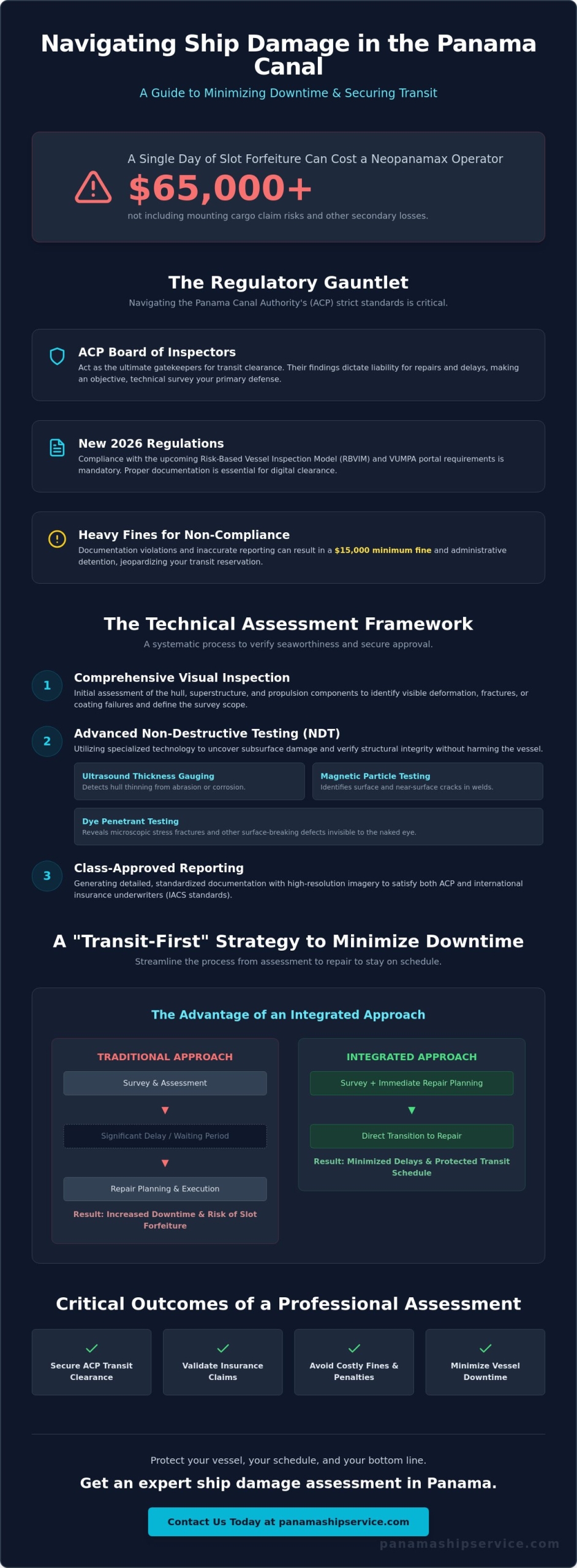
For a Neopanamax operator, a single day of slot forfeiture can cost over $65,000, not including the mounting risk of cargo claims. When your vessel sustains damage near the Isthmus, the clock doesn’t just tick; it accelerates. You need a ship damage assessment panama that satisfies both international underwriters and the Panama Canal Authority’s strict safety standards. We understand the pressure of facing a potential transit denial because of unverified damage or documentation that doesn’t meet the latest 2026 VUMPA requirements.
You’ll learn exactly how to navigate the technical and regulatory hurdles to minimize downtime and secure your insurance claims. This guide provides a clear path from the initial assessment to a class-approved mechanical repair. We’ll preview the impact of the new Risk-Based Vessel Inspection Model (RBVIM) and outline the essential steps to keep your vessel on schedule. By the end of this article, you’ll have a roadmap for managing damage without compromising your transit slot or your bottom line.
Key Takeaways
- Understand the critical role of the Panama Canal Authority (ACP) Board of Inspectors in damage verification and transit clearance.
- Learn how to leverage Non-Destructive Testing (NDT) during a ship damage assessment panama to identify subsurface structural fatigue and hull integrity issues.
- Differentiate between Class-approved surveys and independent assessments to ensure compliance with IACS standards and insurance requirements.
- Implement a “Transit-First” strategy to evaluate if a vessel can safely complete its Canal transit before scheduling permanent mechanical repairs.
- Discover the operational advantages of integrating marine surveys with immediate repair planning to reduce downtime and minimize slot forfeiture risks.
Navigating Ship Damage Assessment in Panama: Critical Factors for Canal Transit
The Panama Canal is a high-pressure maritime corridor where timing determines profitability. In 2026, the Panama Canal Authority (ACP) expects to handle an average of 33 transits daily, leaving no room for operational slack. When a vessel sustains damage, whether through a minor lock wall scraping or a more serious collision, the immediate priority is a ship damage assessment panama. This isn’t just a technical requirement; it’s a critical gatekeeper for transit clearance. The ACP maintains a “zero-delay” policy to keep Panama Canal operations moving at peak efficiency. Any vessel with unverified structural or mechanical issues is a risk to the infrastructure and the schedule of other operators.
Damage in this region often stems from the unique physics of the locks. Canal scrapings, tugboat contact, or sudden mechanical failures in the propulsion system are the most frequent culprits. A professional assessment serves as your primary defense against liability disputes. Without a class-approved report, owners face uncertainty regarding insurance claims and potential fines. The ACP Board of Inspectors has the legal mandate to investigate all marine accidents within Canal waters, and their findings often dictate who pays for repairs and delays. A comprehensive survey protects your interests by providing an objective, technical record of the incident.
The High Cost of Transit Delays
Waiting at the Balboa or Cristobal anchorages is an expensive endeavor. For a Neopanamax operator, missing a transit window can lead to slot forfeiture costs exceeding $65,000 per day. This figure doesn’t account for secondary losses like cargo claims or increased fuel consumption. A prompt survey prevents these costs by providing the data needed to secure a “safe to transit” certificate. By integrating your survey with mechanical ship repairs in Panama, you can transition directly from inspection to restoration. This streamlined approach eliminates the gap between identifying a fault and fixing it, ensuring your vessel returns to its schedule as quickly as possible.
Panama’s Unique Regulatory Landscape
Navigating the ACP’s requirements requires deep local knowledge. As of 2026, all damaged vessels must comply with the Risk-Based Vessel Inspection Model (RBVIM). This data-driven framework determines if a ship needs a physical boarding or a digital clearance based on its history and current condition. Conducting a ship damage assessment panama with a partner who understands the nuances of Panamanian maritime law ensures your documentation is machine-validated through the VUMPA portal without rejection. Accurate reporting avoids the $15,000 minimum fine for documentation violations and keeps your transit reservation intact. Whether your ship is Panama-flagged or under a foreign registry, precise compliance is the only way to avoid administrative detention.
The Technical Framework: Core Steps of a Professional Marine Damage Survey
A professional ship damage assessment panama requires a systematic approach that moves beyond surface-level observations. The process begins with a comprehensive visual inspection of the hull, superstructure, and visible propulsion components. Surveyors look for immediate signs of deformation, fracturing, or coating failure that indicate high-energy impacts. This initial phase establishes the scope of work and determines which specialized testing methods are necessary to verify the vessel’s seaworthiness. Standardized reporting with high-resolution imagery is essential, as these documents form the technical foundation for both Canal clearance and insurance adjustments.
Visual and NDT Inspection Techniques
Precision is paramount when assessing structural integrity. We utilize ultrasound thickness gauging to determine if hull plating has been thinned by abrasion or corrosion beyond allowable limits. For critical load-bearing areas, magnetic particle and dye penetrant testing are deployed to verify weld integrity and identify cracks that are not yet visible. Non-Destructive Testing (NDT) identifies microscopic stress fractures in marine steel that are otherwise invisible to the naked eye but critical to the vessel’s structural safety. These methods allow for an exhaustive evaluation without causing further damage to the ship’s components.
Underwater Damage Evaluation
Impacts often occur below the waterline, necessitating a specialized response. Coordinating with professional underwater hull services is the only way to accurately assess sub-surface damage to the keel, bilge keels, and sea chests. Divers equipped with real-time CCTV systems allow superintendents to review the damage from the surface as the inspection happens. This is particularly vital for inspecting the propeller and rudder for misalignment or cavitation damage, which can lead to catastrophic mechanical failure if left unaddressed before a Canal transit.
Following any impact or grounding, a stability and structural integrity analysis must be performed. This ensures the vessel can handle the dynamic loads encountered during the locking process. Furthermore, an environmental impact assessment is conducted to ensure compliance with local MARPOL standards, specifically checking for leaks or compromised tanks that could lead to pollution fines. Adhering to the Panama Canal Authority (ACP) protocol, specifically Notice N-09-2026 regarding marine accident investigations, ensures that all findings are presented in a format the Board of Inspectors will accept. Securing a professional marine survey ensures that every technical detail is captured for both the ACP and your insurance provider, facilitating a smoother transition to the repair phase.
Regulatory Compliance and Insurance: Comparing Assessment Standards
A ship damage assessment panama isn’t a one-size-fits-all procedure. Operators must distinguish between the technical requirements of Classification Societies and the evidentiary needs of insurance adjusters. While the Panama Canal Authority (ACP) focuses on immediate safety and transit viability, your underwriters are looking for a forensic trail that establishes the cause and extent of the incident. Adhering to the correct Regulatory Compliance and Insurance standards is the only way to ensure that your technical findings translate into financial recovery. In this strategic hub, IACS (International Association of Classification Societies) members like ABS and Lloyd’s Register work alongside independent surveyors to provide a multi-layered view of the vessel’s condition.
Class vs. Commercial Surveys
Class surveyors must be present whenever damage affects the structural integrity or essential machinery covered by the vessel’s certificates. Their role is to confirm that the ship remains “in class” and safe for its intended voyage. However, marine surveys in Panama often go deeper into the commercial implications of the damage. While a Class surveyor might only require a temporary patch to allow for a single transit, an owner’s surveyor will document the full scope of permanent repairs needed for an insurance claim. Understanding these differences is vital:
- Emergency Surveys: Focus strictly on immediate seaworthiness and ACP transit approval.
- Damage Surveys: Provide the detailed technical evidence required for Hull and Machinery (H&M) claims.
- Pre-purchase Surveys: Evaluate the long-term maintenance history and overall asset value, which is a different scope entirely from post-accident assessments.
Documentation for Insurance Recovery
Insurance adjusters and P&I Clubs require specific documentation formats to avoid coverage disputes. A professional ship damage assessment panama must include clear “as-found” evidence, which captures the state of the vessel immediately following the incident. This must be contrasted with “as-left” documentation once temporary or permanent repairs are completed. Reports should explicitly detail the cause of damage, the precise extent of structural deformation, and a verified list of recommended repairs. Presenting this data in a standardized, professional format allows adjusters to process claims without requesting additional inspections, which significantly speeds up the reimbursement cycle. Accurate documentation is your best tool for proving that the damage was the result of a covered peril rather than wear and tear.
Minimizing Downtime: Managing the ACP Protocol and Repair Planning
Managing a damaged vessel in Canal waters requires a “Transit-First” strategy. The primary objective of a ship damage assessment panama is to verify if the ship can safely navigate the locks before committing to permanent, time-consuming repairs. If the hull and propulsion systems meet the safety threshold, temporary reinforcements often suffice for transit approval. This approach prevents the vessel from being sidelined at the anchorage while its original slot expires. However, if the damage involves compromised tanks or leaks, you must immediately coordinate MARPOL disposal in Panama to remain compliant with environmental regulations and avoid heavy fines.
The ACP Board of Inspectors (BI) Process
The Republic of Panama’s Law No. 19 of June 11, 1997, gives the Board of Inspectors the legal mandate to investigate marine accidents. When the BI boards your vessel, they require objective technical evidence to determine the cause and extent of the damage. You must provide a clear report that proves the vessel’s “safe for transit” status. It’s vital to complete this investigation before departing from Canal waters. Vessels that leave before the board finishes its work forfeit any future legal action against the Authority. We manage the communication between the vessel master, the agency, and the BI to ensure all technical data is presented accurately and promptly.
Transitioning from Assessment to Repair
Once the assessment defines the damage, you can use the report to secure mechanical ship repairs at the Panama Canal. A detailed specification allows for the immediate ordering of marine-grade steel and the scheduling of specialized technicians. Many repairs don’t require a dry-dock; afloat repair options at the Balboa and Cristobal anchorages are often sufficient for structural patches or mechanical adjustments. This keeps the vessel operational and avoids the long wait times associated with regional shipyards. Having a comprehensive survey report in hand simplifies the bidding process and ensures that the repair team knows exactly what they’re walking into.
Efficiently managing the gap between incident and resolution is the only way to protect your bottom line. If your vessel has sustained damage, you can delegate the technical complexity to our expert surveyors to ensure your operations remain on schedule.
Panama Ship Service: Integrated Assessment and Repair Solutions
Operational efficiency in the Panama Canal depends on the seamless integration of technical services. Most maritime providers separate the surveying process from the repair phase, which often leads to fragmented communication and extended vessel detention. We resolve this by offering a one-stop-shop model that combines a professional ship damage assessment panama with immediate mechanical capabilities. This approach ensures that the technical data captured during an inspection flows directly to the engineers responsible for the restoration. By eliminating the gap between diagnosis and action, we reduce the total time spent at anchorage and help operators avoid the cascading costs of missed transit slots.
Our proactive response team is available for emergency damage assessments across the Canal’s strategic hubs. Whether your vessel is at the Balboa or Cristobal anchorages, we deploy certified marine surveyors and expert mechanical engineers to evaluate the situation on-site. This comprehensive support extends beyond structural integrity; if an incident results in compromised fluid systems, we manage the entire process, including MARPOL-compliant waste disposal. This ensures that every aspect of the incident is handled according to international standards and local environmental laws, protecting the owner from secondary legal or financial liabilities.
Why Choose Panama Ship Service?
Our team brings deep local knowledge of ACP protocols and the specific maritime infrastructure of the Republic of Panama. We have a proven track record of minimizing vessel downtime by consolidating technical services that would otherwise require multiple contractors. We provide class-approved inspections and immediate mechanical repairs to ensure your vessel meets the strict safety requirements for a successful Canal transit. This systematic approach allows owners to delegate the technical complexity of an accident to a single, reliable partner, simplifying the path to operational recovery.
Contact Our Emergency Response Team
Initiating an immediate damage assessment is straightforward. Our teams are positioned to respond at Balboa, Cristobal, and all major anchorages within the Panama Canal area. When time is the most critical factor in your voyage, having a partner who can provide both the survey documentation and the mechanical solution is an essential asset. Don’t let unverified damage jeopardize your schedule or your insurance standing. You can request a ship repair and assessment quote today to secure the technical support needed to keep your vessel moving.
Protecting Your Operational Schedule in Panama
Managing a vessel incident in the Panama Canal requires a balance of technical precision and regulatory speed. You’ve seen how a detailed ship damage assessment panama serves as the foundation for both ACP clearance and successful insurance recovery. By prioritizing a “Transit-First” strategy and utilizing NDT inspection techniques, you can identify structural issues before they lead to costly slot forfeitures or administrative delays.
Transitioning from survey to repair doesn’t have to be a fragmented process that wastes valuable time. Our team provides 24/7 Emergency Technical Support and adheres to IACS-aligned Survey Standards to ensure your documentation is beyond reproach. With our comprehensive mechanical and underwater repair capabilities, we handle the technical complexity so you can focus on your voyage. We’re committed to providing the reliability and expertise you need in this high-stakes environment.
Secure your vessel’s transit with a professional damage assessment from Panama Ship Service. We’re ready to help you navigate the technical hurdles of the Canal with confidence and efficiency.
Frequently Asked Questions
What are the first steps to take if my ship sustains damage in the Panama Canal?
Notify the Panama Canal Authority (ACP) immediately and contact your local agent to initiate the official reporting process. You’re required to submit an incident report through the VUMPA portal to maintain your transit eligibility. Once the Authority is notified, you should engage a professional surveyor to document the damage for both insurance adjusters and the Board of Inspectors.
Does the Panama Canal Authority (ACP) require a specific type of damage assessment?
Yes, the ACP requires a “safe for transit” verification that aligns with the Risk-Based Vessel Inspection Model (RBVIM) standards. While the Board of Inspectors conducts an official investigation, they rely on technical evidence from class-approved surveyors to confirm structural integrity. Your ship damage assessment panama must provide objective data that proves the vessel won’t risk blocking the channel or damaging lock infrastructure.
How long does a typical ship damage assessment take in Panama?
A standard assessment usually takes between 4 and 8 hours depending on the damage location and vessel accessibility. If the impact occurred below the waterline, the timeline may extend to accommodate underwater dive teams and real-time CCTV reviews. We focus on rapid mobilization to ensure the technical report is completed before your next scheduled transit window to prevent slot forfeiture.
Can I transit the Panama Canal with temporary repairs after an assessment?
You can often transit with temporary repairs provided they’re approved by your Classification Society and the ACP Board of Inspectors. These repairs must ensure the vessel remains seaworthy and maneuverable throughout the locking process. The assessment report will define if an afloat reinforcement or a temporary patch is sufficient to meet the Authority’s safety threshold for a single passage.
What is the difference between an NDT survey and a visual damage inspection?
A visual inspection identifies surface-level issues like deformation and coating failure, while NDT (Non-Destructive Testing) detects subsurface structural fatigue. NDT uses specialized tools like ultrasound thickness gauging to find microscopic cracks that aren’t visible to the naked eye. This level of technical depth is often a requirement for a ship damage assessment panama to satisfy IACS members and insurance underwriters.
How much does a professional ship damage assessment cost in Panama?
Costs for a professional assessment depend on several variables, including the vessel’s size, its location at the anchorage, and the specific testing equipment required. Factors such as launch fees for surveyors and the need for underwater dive support will influence the final quote. We provide tailored estimates based on the vessel’s technical needs and the urgency of the operational schedule.
Are your damage assessment reports accepted by major IACS class societies?
Our reports are meticulously structured to meet the documentation standards of all major IACS members, including ABS, Lloyd’s Register, and DNV. We ensure that every technical finding, from weld integrity to hull thickness, is presented in a forensic format that class surveyors can verify. This professional alignment helps prevent disputes with underwriters and facilitates a faster path to permanent repair certification.
What happens if the damage assessment reveals a MARPOL violation?
If an assessment identifies a leak or compromised tank that violates MARPOL standards, you must immediately initiate containment and cleanup protocols. The ACP won’t allow a vessel to transit or depart if it poses an environmental risk to Canal waters. We provide integrated MARPOL disposal services to handle contaminated waste and help your vessel return to environmental compliance without unnecessary administrative delays.