
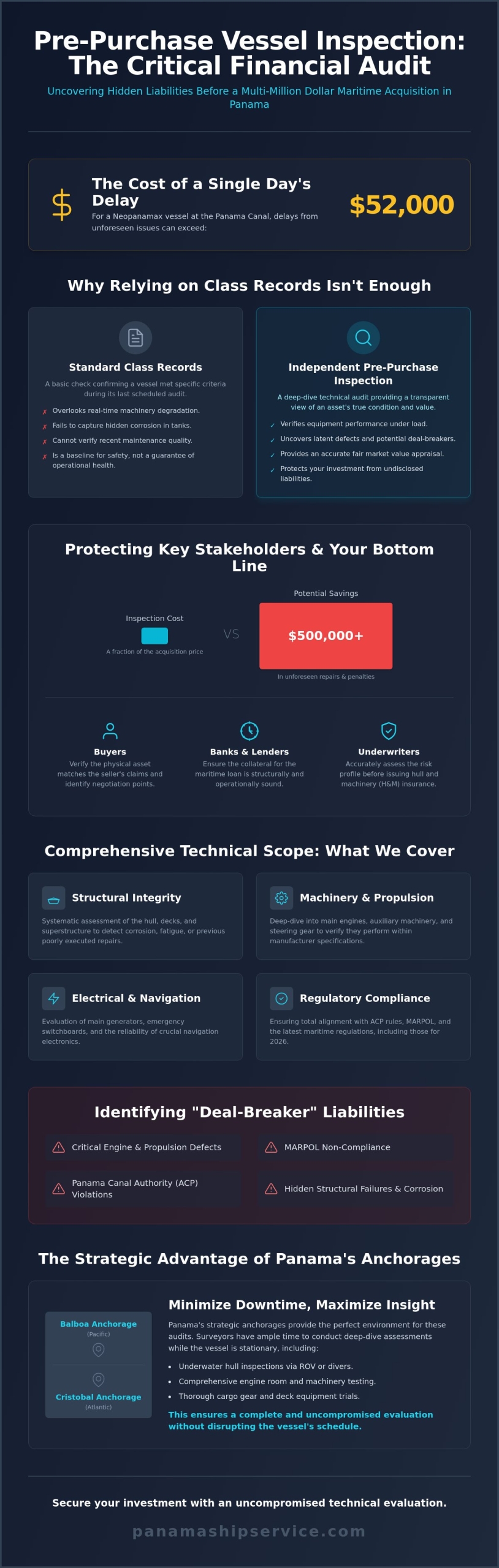
A single day of delay for a Neopanamax vessel at the Panama Canal can cost over $52,000 in lost charter hire and rescheduling fees. When you’re on the verge of a multi-million dollar maritime acquisition, the difference between a profitable asset and a financial sinkhole often comes down to what you can’t see. You likely recognize that the complexity of Panama Canal Authority (ACP) compliance and the risk of hidden structural defects make a standard survey insufficient. A specialized pre-purchase vessel inspection Panama is not just a technical formality; it’s a critical financial audit of the vessel’s operational and regulatory viability.
We understand the pressure to move quickly while maintaining absolute fiscal responsibility. This guide will show you how to secure your investment through a comprehensive technical audit designed to uncover engine wear and ensure total alignment with the latest 2026 maritime regulations. You’ll learn what to expect from a detailed condition report with high-resolution evidence, how to obtain an accurate fair market value appraisal, and how to distinguish between immediate maintenance needs and long-term operational costs.
Key Takeaways
- Learn why relying solely on Class records often overlooks critical defects and how an independent audit provides the necessary transparency for high-stakes maritime acquisitions.
- Understand the technical breadth of a pre-purchase vessel inspection Panama, covering everything from hull structural integrity to main engine performance and steering gear reliability.
- Identify the strategic advantages of conducting surveys at Balboa or Cristobal anchorages to minimize operational downtime while ensuring a deep-dive assessment of the asset.
- Recognize “deal-breaker” liabilities, such as engine defects or MARPOL non-compliance, that could lead to significant financial loss or Panama Canal Authority penalties.
- Discover how integrating technical surveys with professional mechanical ship repairs ensures immediate post-purchase asset protection and regulatory readiness.
The Role of Pre-Purchase Vessel Inspections in Maritime Due Diligence
Acquiring a commercial vessel is a high-stakes transaction where undisclosed technical failures can lead to immediate operational insolvency. A pre-purchase vessel inspection Panama is a thorough, independent assessment of a ship’s structural and technical condition conducted specifically to protect a buyer before a change of ownership. This process serves as the bedrock of maritime due diligence, providing a transparent view of the asset’s true value and operational readiness.
Relying on Class records alone is a common but dangerous shortcut. While these documents confirm that a ship met specific criteria during its last scheduled audit, they fail to capture the real-time degradation of machinery or hidden corrosion in ballast tanks. A clean Class record is a baseline for safety, not a guarantee of a trouble-free vessel. Professional vessel safety surveys performed during the pre-purchase phase fill this gap by identifying issues that Class might overlook, such as poor maintenance habits or aging propulsion components.
The financial impact of skipping this step can be devastating. A comprehensive survey typically costs a fraction of the total acquisition price, yet it can save a buyer hundreds of thousands of dollars. It isn’t uncommon for an inspection to uncover latent defects that would have necessitated $500,000 in unforeseen mechanical ship repairs shortly after the closing. By identifying these liabilities early, buyers can negotiate price reductions or require the seller to rectify the issues before the title transfers. This report serves as a primary risk-management tool for three key stakeholders:
- Buyers: To verify the physical asset matches the seller’s claims.
- Banks: To ensure the collateral for the maritime loan is structurally sound.
- Underwriters: To accurately assess the risk profile before issuing hull and machinery (H&M) insurance.
Distinguishing Pre-Purchase from Standard Condition Surveys
While standard condition surveys are often superficial visual checks, a pre-purchase vessel inspection Panama involves deep-dive operational testing. It moves beyond checking if equipment exists to verifying how it performs under load. A critical component of this report is the “Valuation” element, which aligns the technical findings with current market trends. Panama’s strategic anchorages provide the perfect environment for these audits, allowing surveyors ample time to conduct underwater hull inspections and engine room assessments while the vessel is stationary.
The Surveyor’s Objective Independence
Objective independence is the most valuable asset a surveyor brings to the table. They act as your “eyes and ears” on the ground, operating without the conflicts of interest that might influence a seller’s internal reports. Their goal is to find the “deal-breakers” that could compromise your investment. An independent third-party surveyor provides an uncompromised technical evaluation that ensures the buyer’s financial interests are protected from undisclosed liabilities and structural defects.
Technical Scope: What a Comprehensive Vessel Condition Survey Covers
A standard visual check is insufficient for a high-value maritime asset. A comprehensive pre-purchase vessel inspection Panama must dissect every critical system to identify latent liabilities that could disrupt operations. This technical audit provides a baseline for the vessel’s physical health and ensures that the buyer isn’t inheriting a maintenance nightmare. A professional survey typically includes a rigorous evaluation of the following categories:
- Structural Integrity: A systematic assessment of the hull, decks, and superstructure to detect corrosion, fatigue, or previous poorly executed repairs.
- Machinery and Propulsion: A deep-dive into the main engines, auxiliary machinery, and steering gear to verify they perform within manufacturer specifications.
- Electrical Systems: Evaluation of main generators, emergency switchboards, and the reliability of navigation electronics.
- Cargo Handling Equipment: Testing the operational readiness of cranes, hatch covers, and pumping systems for tankers.
- Maintenance Record Review: A detailed analysis of the Planned Maintenance System (PMS) history to verify the crew has followed mandatory service intervals.
Hull and Deck Inspection Protocols
Technical surveyors utilize Ultrasonic Thickness Measurements (UTM) to verify that the hull steel remains within allowable limits. This data is critical for predicting future dry-docking costs. We look for signs of structural stress, such as hogging or sagging, which indicate that the vessel’s longitudinal strength may be compromised. Ballast tanks receive special attention, as their coating condition is often the first indicator of how well the vessel has been managed by its previous owners.
Engine Room and Operational Testing
Lube oil analysis reports act as a blood test for the main engines, revealing metal wear patterns that suggest internal damage. Beyond the main plant, we test emergency equipment, including fire pumps, CO2 systems, and lifeboats, to ensure the vessel meets safety requirements. Sea trials are the final step, allowing us to monitor temperatures, pressures, and vibration levels under real-world load conditions. If you need a technical partner to verify these systems, our team provides expert marine surveys to safeguard your interests.
Evaluating Underwater Assets
Integrating underwater hull services is vital for a complete picture of the vessel’s bottom. Panama’s warm, nutrient-rich tropical waters accelerate biofouling at a rate much higher than in temperate regions. Even a moderate layer of barnacles or tubeworms can increase fuel consumption by 10% to 15%, significantly impacting your voyage economics. We assess the propeller condition for cavitation damage and measure rudder clearances to ensure the steering system is mechanically sound. Identifying these issues before the sale allows you to account for the cost of hull cleaning or specialized repairs in your final offer.
Navigating the Inspection Process in Panama’s Strategic Ports
Execution of a pre-purchase vessel inspection Panama requires precise logistical coordination between the Pacific and Atlantic terminals. Choosing the right boarding location is the first strategic decision. Balboa, on the Pacific side, offers extensive anchorage areas suitable for deep-dive technical audits, while Cristobal provides similar capabilities on the Atlantic side. The choice usually depends on the vessel’s current voyage pattern and its scheduled arrival at the Canal. Efficiency is the priority; the goal is to complete the assessment without disrupting the vessel’s operational flow.
Coordinating with the Panama Canal Authority (ACP) is mandatory to ensure the survey schedule doesn’t conflict with assigned transit slots. This is particularly critical in 2026, as ongoing drought conditions have led to stricter transit restrictions and reduced daily slots. Missing a window is expensive. A single day of delay for a Neopanamax vessel can cost over $52,000 in lost charter hire and rescheduling fees. Furthermore, non-compliance with ACP operational notices, such as N-11-2026, can result in fines ranging from B/.100.00 to B/.1,000,000.00. A well-timed “Transit Survey” allows the inspector to board before the locks, utilizing the stationary time at anchor or slow-steaming periods for maximum efficiency.
Step-by-Step: From Booking to Report Delivery
The process begins with a rigorous documentation request. We analyze the vessel’s statutory certificates, Class records, and general arrangement drawings before the surveyor even steps on board. The on-site inspection typically lasts between 12 and 24 hours, depending on the vessel’s size and accessibility. Because maritime deals move at a fast pace, a 24-48 hour turnaround for the final report is standard. This rapid reporting ensures that buyers have the data they need to meet closing deadlines or renegotiate terms based on technical findings.
Local Knowledge: The Panama Ship Service Advantage
Operating in a global chokepoint requires more than just technical skill; it requires local proficiency. Navigating port security, arranging launch services, and managing crew changes are complex tasks that can delay an inspection if handled poorly. Our expertise in marine surveys in Panama ensures that all logistical hurdles are cleared before the vessel arrives. We also account for unique environmental factors, such as the transition from the saltwater anchorages to the freshwater environment of Gatun Lake. This change in salinity and temperature can impact cooling systems and machinery performance, making local environmental knowledge an essential component of a reliable pre-purchase report.
Mitigating Risk: Identifying Costly Liabilities Before the Transaction
Risk mitigation is the core of maritime due diligence. A pre-purchase vessel inspection Panama allows you to identify “deal breakers” like structural fatigue or main engine defects before you’re legally committed to the asset. If a vessel requires immediate repairs that exceed your allocated budget, the survey provides the technical data needed to walk away from the deal or renegotiate the purchase price. We don’t just look at the current state; we use these findings to help you build a 2-year CAPEX forecast. This projection accounts for upcoming steel renewals, engine overhauls, and mandatory equipment upgrades, ensuring you understand the true cost of ownership over the next 24 months.
Leveraging a professional report is your strongest tool during price negotiations. When a surveyor documents specific deficiencies with photographic evidence and cost estimates, the conversation shifts from speculation to technical reality. Sellers are more likely to offer credits or rectify issues when presented with an independent audit. This proactive approach prevents the financial loss associated with inaccurate vessel valuations and ensures you don’t inherit the previous owner’s maintenance backlog. If you’re ready to secure your investment with an authoritative audit, our team provides comprehensive Marine Surveys to guide your decision-making process.
Regulatory and Flag State Readiness
Regulatory readiness is a moving target that requires constant monitoring of local and international standards. In 2026, the Panama Maritime Authority (PMA) has established specific fees for technical documents, including USD 100.00 for each statutory certificate and USD 75.00 for endorsements. Our inspection verifies that the vessel’s paperwork is in order to avoid these administrative delays. We also ensure the ship is prepared for disposal services in Panama and meets the latest MARPOL standards. Furthermore, we check for PCSOPEP compliance, where authorized person fees typically range from $600 to $1,200 per year. Failing to meet these Panama Canal Authority (ACP) requirements can result in fines as high as B/.1,000,000.00, making compliance a top priority for any strategic buyer.
Hidden Costs: Beyond the Visual Inspection
Hidden costs often lurk in the spare parts inventory and the vessel’s safety culture. An outdated or depleted inventory of critical spares means higher operational risk and potential downtime during the first few months of ownership. We also look beyond the machinery to evaluate how the crew manages the ship. A professional survey identifies the gap between “paper compliance” and “operational reality.” If the crew isn’t following the Planned Maintenance System (PMS), the ship’s physical condition will eventually reflect that neglect, regardless of what the certificates say. Identifying these cultural and logistical gaps early allows you to plan for necessary crew training or management changes immediately after the closing.
Professional Survey Solutions with Panama Ship Service
Panama Ship Service positions itself as the primary technical partner for international buyers requiring a pre-purchase vessel inspection Panama. Our technical team brings decades of cumulative experience in the strategic ports of Balboa and Cristobal. We understand that maritime acquisitions are high-stakes, time-sensitive transactions. Our systematic approach ensures that every technical audit is conducted with the highest level of proficiency and fiscal responsibility. We provide the clarity you need to move forward with confidence or negotiate from a position of technical strength.
What sets us apart is our ability to bridge the gap between identifying a defect and resolving it. Most surveyors provide a report and then exit the process. We offer a more integrated solution. If an inspection reveals critical engine wear or structural issues, we can immediately coordinate mechanical ship repairs in Panama to address these findings. This seamless transition from audit to action minimizes vessel downtime and ensures your new asset is operationally ready for its first voyage under your management. We handle the technical complexity so you can focus on the business of ship operation.
A One-Stop-Shop for Ship Owners
Our service portfolio is designed to simplify the vessel acquisition process. Beyond technical surveys and repairs, we provide comprehensive logistical support to ensure a smooth change of ownership. This includes providing high-quality ship supplies at the Panama Canal for immediate provisioning once the transaction is finalized. We also offer technical consulting for vessel modifications or upgrades required to meet specific charterer requirements. By consolidating these services, we reduce administrative overhead and improve operational efficiency for our clients.
Contact Us for Reliable Maritime Data
Confidentiality and integrity are the foundations of our reporting process. We understand that the data contained in a pre-purchase report is sensitive and critical to your financial strategy. Every survey scope we design is customized to the specific vessel type, whether you are acquiring a bulk carrier, a tanker, or a Neopanamax container ship. We prioritize quick turnaround times without compromising the depth of our technical analysis. To secure your maritime investment and receive a detailed, confidential quote, contact Panama Ship Service today. Our team is ready to deploy to any anchorage in Panama to protect your interests.
Secure Your Maritime Asset with Technical Precision
A successful maritime acquisition depends on the accuracy of your technical due diligence. Relying solely on Class records or superficial visual checks creates unnecessary financial risk in a high-stakes environment like the Panama Canal. By conducting a rigorous pre-purchase vessel inspection Panama, you gain a transparent view of the ship’s structural health and operational readiness. This data allows you to forecast future CAPEX needs accurately and negotiate from a position of technical authority.
Panama Ship Service provides the localized expertise needed to navigate these complexities with efficiency. We offer 24/7 availability across both Balboa and Cristobal anchorages and deliver comprehensive technical reports within 48 hours. Our team maintains deep expertise in both commercial and offshore vessel types, ensuring your investment is protected against hidden liabilities and regulatory delays. We handle the technical complexity so you can focus on your operational goals.
Schedule Your Pre-Purchase Vessel Inspection in Panama today to move forward with absolute confidence in your fleet’s future.
Frequently Asked Questions
What is included in a standard pre-purchase vessel inspection?
A standard pre-purchase vessel inspection Panama includes a technical audit of the ship’s structural integrity, machinery performance, and electrical systems. Surveyors assess the hull for corrosion, test main engines and auxiliary units, and verify the functionality of cargo handling equipment. The scope also extends to a meticulous review of maintenance records and statutory certificates to ensure the vessel’s operational history aligns with its current physical condition.
How long does a pre-purchase survey take at the Panama Canal?
An on-site pre-purchase survey typically requires 12 to 24 hours to complete. This duration depends on the vessel’s size, complexity, and the level of access provided to critical areas like ballast tanks and engine components. Because maritime transactions are time-sensitive, we prioritize efficiency to ensure the inspection doesn’t disrupt the vessel’s scheduled departure or Panama Canal transit window.
Can an inspection be performed while the vessel is transiting the Canal?
Inspections can be conducted during a Panama Canal transit to maximize operational efficiency. This “Transit Survey” allows the technical team to board the vessel while it is at anchor or moving at slow speeds through the locks. It is an ideal logistical solution that prevents additional downtime while allowing surveyors to observe machinery performance under real-world load conditions during the transit process.
Why is a pre-purchase survey different from a Class survey?
A pre-purchase survey is a financial due diligence tool, whereas a Class survey focuses on meeting minimum safety and regulatory standards. Class records only confirm that a vessel met specific criteria at the time of the last audit. A pre-purchase inspection provides a deeper assessment of the vessel’s actual condition, identifying hidden wear and maintenance backlogs that Class surveyors might overlook during routine compliance checks.
Do you provide underwater hull inspections as part of the pre-purchase report?
We integrate comprehensive underwater hull inspections into the pre-purchase report to identify biofouling, propeller damage, and rudder clearances. These assessments are critical in Panama’s tropical waters, where rapid marine growth can significantly impact fuel efficiency. Utilizing CCTV or diver observations, we provide high-resolution evidence of the vessel’s submerged assets, ensuring the buyer isn’t inheriting costly hull cleaning or repair requirements.
What happens if the surveyor identifies a major defect?
Major defects are documented with detailed photographic evidence and included in the final technical report. If a surveyor identifies structural fatigue or engine failures that exceed repair budgets, the buyer can use this data to renegotiate the purchase price or request that the seller rectify the issues. This transparency ensures that the buyer is fully aware of all “deal-breaker” liabilities before the title transfers.
How much does a pre-purchase vessel inspection in Panama cost?
The cost of a pre-purchase vessel inspection Panama varies based on the vessel’s size, type, and the specific technical scope required. Factors such as the location of the survey, the inclusion of underwater hull services, and the urgency of the reporting timeline influence the final quote. We provide customized proposals tailored to the unique requirements of each maritime acquisition to ensure maximum value and accuracy.
Is the survey report recognized by major banks and insurers?
Professional survey reports are widely recognized and often required by major maritime banks, underwriters, and P&I clubs. These stakeholders rely on independent technical audits to assess the risk profile of the asset before approving financing or issuing hull and machinery insurance. Our reports provide the authoritative data needed to satisfy the rigorous due diligence requirements of international financial and insurance institutions.