
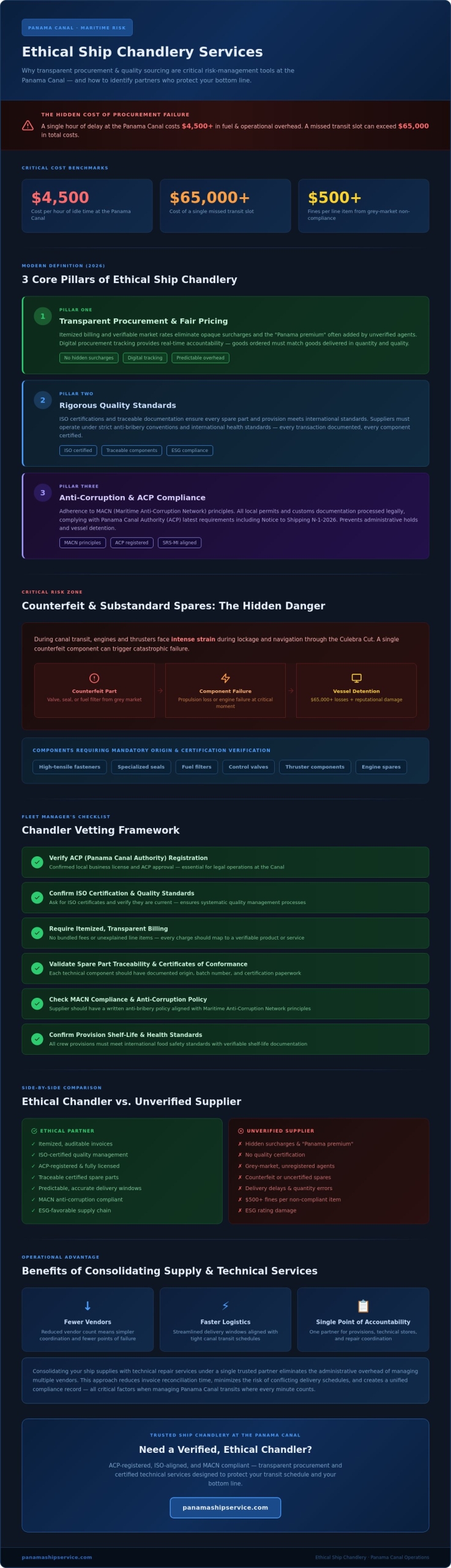
A single hour of delay at the Panama Canal can cost a vessel operator upwards of $4,500 in fuel and operational overhead. While most managers focus on toll structures and booking fees, the hidden risks of procurement often cause the most damage. You’ve likely dealt with the frustration of inflated invoices or substandard engine spares that fail exactly when you can’t afford a breakdown. Choosing ethical ship chandlery services isn’t just a matter of corporate social responsibility; it’s a critical risk-management strategy designed to protect your bottom line.
We understand that your transit schedule leaves no room for logistics errors or technical failures. This article explores how transparent procurement and high-quality provisions ensure your vessel remains compliant and operational. You’ll discover how to identify partners who prioritize technical accuracy over hidden commissions, ensuring every delivery matches the tight windows of the locks. From avoiding customs fines to securing reliable technical spares, we’ll show you how integrity drives efficiency at one of the world’s most demanding maritime hubs.
Key Takeaways
- Understand how ethical ship chandlery services integrate transparent procurement with certified quality standards to protect your operational budget.
- Identify the direct link between substandard engine spares and the risk of costly mechanical failures during critical Panama Canal transit maneuvers.
- Learn the essential requirements for high-quality provisions and technical stores that comply with international maritime safety and shelf-life standards.
- Implement a professional vetting framework to verify vendor credentials, local business licenses, and Panama Canal Authority (ACP) registrations.
- Discover the administrative advantages of consolidating ship supplies with technical repair services to reduce vendor counts and streamline logistics.
What Are Ethical Ship Chandlery Services in 2026?
In 2026, the definition of What is a Ship Chandler? has evolved from a simple local merchant to a vital link in the global supply chain. Modern ethical ship chandlery services are defined by three core pillars: transparent procurement, fair pricing, and rigorous quality standards. This shift reflects a broader transition in the maritime industry where suppliers are no longer just vendors but strategic partners. For fleet managers, an ethical partner acts as a safeguard against the operational risks that frequently occur during high-stakes transits. It’s a move toward professional proficiency that prioritizes the vessel’s long-term health over quick sales.
Ethics in the supply chain directly influence a vessel’s ESG (Environmental, Social, and Governance) rating. As international regulations tighten, the origin and quality of every provision on board become a matter of compliance record. Reliable chandlers now operate under ISO certifications and strict anti-bribery conventions. This ensures that every transaction is documented, every spare part is traceable, and every crew provision meets international health standards. In the high-pressure environment of the Panama Canal, where a single hour of delay costs upwards of $4,500, having a partner who prioritizes technical accuracy over short-term profit is essential for fiscal responsibility.
Transparency and Fair Pricing Models
The era of hidden surcharges and kickback culture is ending. Ethical chandlery prioritizes itemized billing and verifiable market rates for all provisions. By eliminating opaque pricing structures, fleet managers can accurately forecast their overhead without fearing the “Panama premium” often added by unverified agents. Digital procurement tracking provides real-time accountability. This allows shore-based teams to verify that the goods ordered match the goods delivered in both quantity and quality. It’s about creating a predictable procurement cycle that mirrors the operational efficiency required for a successful canal transit.
Anti-Corruption and Compliance Standards
Integrity at the Panama Canal requires strict adherence to the Maritime Anti-Corruption Network (MACN) principles. Ethical suppliers ensure all local permits and customs documentation are processed legally to prevent administrative holds. Using unverified grey market suppliers in Panama carries significant legal risks; it can lead to fines starting at $500 per line item or even vessel detention. A professional partner handles the complexity of local regulations, ensuring that your vessel remains compliant with the Panama Canal Authority’s (ACP) latest requirements, such as those outlined in Notice to Shipping N-1-2026. This proactive compliance prevents the costly delays that arise from documentation errors or substandard sourcing.
Why Ethical Sourcing is Critical for Panama Canal Transits
The Panama Canal is a unique bottleneck where operational efficiency isn’t just a goal; it’s a financial necessity. A missed transit slot can lead to costs exceeding $65,000, while a single hour of idle time drains upwards of $4,500 in overhead. In this high-stakes environment, ethical ship chandlery services act as your first line of defense against logistical paralysis. Ethical sourcing ensures that every item delivered, from fresh provisions to critical engine components, meets the highest industry benchmarks. This commitment to quality aligns with the Social Responsibility Standard for the Maritime Industry (SRS-MI), which provides a framework for sustainable and accountable operations. When procurement is handled with integrity, you eliminate the risk of port-stay extensions caused by supply disputes or incorrect deliveries.
Avoiding Substandard Spares and Counterfeits
Bargain mechanical parts are a liability in high-torque engine environments. During a canal transit, engines and thrusters face intense strain during lockage and navigation through the Culebra Cut. A counterfeit valve or a substandard fuel filter can fail at the most critical moment, leading to vessel detention, propulsion loss, or even collision. We prioritize verifying the origin and certification of all technical components, including high-tensile fasteners and specialized seals. By leveraging deep technical expertise to vet spare parts quality, we ensure that what arrives on your deck is fully fit for purpose. This level of scrutiny prevents the “grey market” issues that often plague high-traffic ports. If you’re concerned about your current technical stock, you can request a technical stores audit to verify your fleet’s readiness.
Operational Readiness and Transit Safety
The Panama Canal Authority (ACP) maintains rigorous safety standards outlined in Notice to Shipping N-1-2026. Non-compliance leads to immediate delays and potential fines starting at $500 per line item for documentation errors. Ethical chandlery ensures that your deck and engine stores are not just present, but fully compliant with ACP regulations. There is a direct link between reliable supplies and successful mechanical ship repairs. When high-quality materials are used during a port stay, the subsequent maintenance is more effective and emergency stops are prevented. Beyond technical spares, the quality of fresh, dry, and frozen stores directly impacts crew morale. A well-fed crew is more alert and productive during the demanding 8 to 12-hour transit process. This alertness is vital for reducing the risk of human error during complex maneuvers. Proactive supply management through ethical ship chandlery services ensures that your vessel enters the locks in peak condition, both mechanically and operationally.
Core Pillars of a Reliable Ship Supply Partnership
A reliable partnership in the maritime sector is built on logistical precision and technical accountability. Ethical ship chandlery services provide a comprehensive range of fresh, dry, and frozen stores, but the true value lies in certified shelf-life and cold-chain integrity. In Panama’s tropical climate, food safety is a critical operational variable that directly impacts crew health. We maintain strict temperature controls from the warehouse to the vessel’s rail, ensuring provisions remain fit for consumption throughout the subsequent voyage. This systematic approach eliminates the risk of receiving spoiled goods that lead to mid-voyage shortages.
Technical stores require the same level of scrutiny. We source deck, engine, and cabin stores exclusively from reputable manufacturers to ensure compatibility and durability. Reliability is significantly enhanced when you integrate supply delivery with technical interventions such as underwater hull services. By coordinating these activities, you reduce the number of launch trips and streamline your vessel’s port stay. It’s a proactive strategy that prioritizes fiscal responsibility by minimizing administrative overhead and logistical complexity.
Quality Assurance for Technical Spares and Provisions
Logistical efficiency depends on rigorous quality control. We implement a strict first-in, first-out (FIFO) system for all perishable goods to guarantee maximum freshness. Technical spares are vetted to ensure they comply with class approval requirements, preventing the installation of non-compliant components. Fleet managers are encouraged to request local warehouse inspections. This transparency allows you to verify that storage conditions meet international standards, such as ISO 22000, before a single crate is loaded onto a delivery barge.
MARPOL and Environmental Ethics in Supply
Environmental stewardship is now a core component of ethical procurement. We actively work to reduce single-use plastics in ship provisions and packaging, helping vessels meet their internal sustainability goals. Our sourcing includes environmentally friendly cleaning chemicals and lubricants that minimize the impact of accidental discharge. These supply choices are not just ethical; they influence the vessel’s overall MARPOL disposal compliance. By providing products with biodegradable packaging and eco-friendly formulations, we simplify the waste management process for your crew, ensuring that your ship remains compliant with the International Convention for the Prevention of Pollution from Ships (MARPOL).
Evaluating Your Chandler: A Vetting Framework for Fleet Managers
Evaluating a supplier at the Panama Canal requires more than a basic price comparison. It’s a process of verifying operational proficiency to ensure your vessel doesn’t become a statistic of delay. Fleet managers must perform due diligence to avoid the hidden costs of poor logistics. Follow this four-step vetting framework to ensure you’re engaging with ethical ship chandlery services that prioritize your transit schedule and vessel integrity.
First, verify all local business licenses and Panama Canal Authority (ACP) registrations. A legitimate partner must have authorized access to both Balboa and Cristobal ports. Second, request a transparent breakdown of their sourcing and quality control processes. You need to know the exact origin of your engine spares and provisions. Third, evaluate their physical infrastructure. A chandler without their own refrigerated trucks or launch boats relies on third-party availability, which introduces unnecessary risk during peak transit periods. Finally, check for integrated service capabilities. A partner who can handle ship supplies alongside mechanical repairs or surveys reduces your vendor count and administrative burden.
Verification of Local Licenses and Certifications
Access to the Panama Canal’s restricted zones is strictly regulated. Ensure your chandler holds the necessary permits for Balboa and Cristobal port access to avoid delivery failures at the rail. Look for ISO 9001 or ISO 22000 certifications. These aren’t just badges; they’re proof of a systematic approach to quality and food safety. Local experience is non-negotiable. A veteran chandler understands the rhythm of the locks and the precise timing required to coordinate with ACP pilots and agents. This localized knowledge prevents the administrative holds that sideline less experienced operators.
Logistics Efficiency and Just-in-Time Delivery
The Panama Canal never sleeps. Your supplier shouldn’t either. Assess their ability to deliver mid-stream or during lockage maneuvers. In an environment where a missed slot carries a heavy financial penalty, 24/7 responsiveness is a baseline requirement, not a premium feature. Efficient ship supplies at the Panama Canal prevent transit slot losses by ensuring all stores are on board before the vessel enters the first set of locks. When logistics are handled with precision, you can focus on navigation instead of procurement disputes. If you need a partner who meets these rigorous standards, you can contact our procurement team for a consultation.
Consolidating Technical and Supply Services with Panama Ship Service
Managing multiple vendors at the Panama Canal locks creates unnecessary administrative friction. In an environment where every minute of port stay is scrutinized for cost, a one-stop-shop model provides a significant competitive advantage. We bridge the gap between technical repairs and chandlery by applying an engineering perspective to every requisition. This consolidation reduces your vendor count and simplifies the procurement cycle, allowing your shore-based team to focus on vessel movements rather than chasing multiple invoices. Our commitment to ethical ship chandlery services ensures that whether you need engine spares or fresh provisions, the process remains transparent and fiscally responsible.
We provide 24/7 support across both the Atlantic and Pacific entrances of the Canal. This geographic coverage ensures that your vessel receives consistent service regardless of its transit direction. By integrating our technical expertise with ship supplies, we provide a level of reliability that traditional, supply-only chandlers cannot match. We don’t just deliver boxes; we deliver operational readiness backed by decades of maritime experience in the region.
One-Stop Operational Efficiency in Balboa and Cristobal
Operational efficiency in Balboa and Cristobal depends on the synchronization of services. Coordinating supply delivery with scheduled marine surveys in Panama allows you to maximize the utility of every hour spent at anchor. You can significantly reduce launch boat costs by consolidating crew changes, ship supplies, and technician transport into fewer trips. This proactive logistics management is overseen by a single point of contact, eliminating the communication gaps that lead to delivery delays. It’s a systematic approach designed to mirror the precision of the Panama Canal Authority’s own schedules.
Integrated Repairs and Ethical Supply Chain
Our background in mechanical repairs makes us uniquely qualified to source technical spares. We understand the tolerances and specifications required for high-stress components because our own technicians are often the ones performing the installations. This technical insight ensures that all materials, from specialized seals to heavy-duty fasteners, meet or exceed international maritime standards. When vessels require specialized pumping or water treatment systems, we facilitate sourcing from trusted experts like Water Services, Inc. to maintain operational integrity. We vet our entire supply chain to prevent the entry of substandard or counterfeit goods that could jeopardize your vessel’s safety. Panama Ship Service maintains a rigorous commitment to ethical ship chandlery services through full ACP authorization and a transparent procurement process that ensures compliance with all local and international regulations.
Secure Your Vessel’s Performance at the Panama Canal
Navigating the complexities of the Panama Canal requires more than just a transit slot; it demands a procurement partner who prioritizes technical integrity and transparent logistics. By choosing ethical ship chandlery services, you protect your vessel from the hidden costs of substandard spares and the administrative friction of multiple unverified vendors. A one-stop-shop model that integrates mechanical expertise with ship supplies ensures your engine and deck stores meet the rigorous standards of the Panama Canal Authority (ACP).
Panama Ship Service provides 24/7 operational support in both Balboa and Cristobal. As an ACP-authorized service provider, we bridge the gap between technical repairs and essential provisions to keep your fleet moving. Don’t leave your transit schedule to chance with unverified grey-market suppliers. Our integrated mechanical repair and supply expertise is designed to minimize your overhead and maximize your efficiency at this critical maritime hub.
Request a Transparent Chandlery Quote for Your Panama Transit and ensure your next transit is handled with professional precision.
Frequently Asked Questions
What exactly defines ethical ship chandlery services?
Ethical ship chandlery services are defined by a commitment to transparent procurement, fair market pricing, and adherence to international quality standards. This framework eliminates hidden commissions and ensures that every item, from provisions to technical spares, is fully traceable. It’s about moving beyond simple supply to a strategic partnership that prioritizes the vessel’s operational health and regulatory compliance.
How do ethical chandlery services impact my vessel transit time at the Panama Canal?
These services reduce transit times by ensuring all necessary stores and spares are delivered accurately before the vessel enters the locks. Given that a single hour of delay at the Panama Canal can cost upwards of $4,500 in fuel and overhead, precision in logistics is vital. Ethical providers coordinate deliveries to match your specific transit window, preventing the administrative holds or technical failures that result from substandard supplies.
Are ethical ship chandlery services more expensive than traditional suppliers?
Ethical services are more cost-effective when you consider the total cost of operation rather than just the initial quote. Traditional, unverified suppliers often hide surcharges or provide low-quality goods that lead to mid-transit mechanical failures. By avoiding customs fines and operational delays, ethical procurement protects your budget from the high costs of logistics errors and equipment downtime.
Can a ship chandler help with MARPOL compliance and waste disposal?
A professional chandler supports compliance by providing environmentally friendly supplies and coordinating MARPOL disposal services. We source cleaning chemicals and lubricants that meet international environmental standards, reducing the risk of non-compliance during inspections. Integrating your supply needs with MARPOL disposal simplifies waste management and ensures your vessel adheres to the latest International Convention for the Prevention of Pollution from Ships regulations.
What should I look for in a ship chandler quality certification?
Look for ISO 9001 for quality management and ISO 22000 for food safety, as these are the industry benchmarks for reliability. Membership in the Maritime Anti-Corruption Network (MACN) is also a key indicator of ethical operations. These certifications prove the supplier has rigorous systems in place for quality control, storage, and transparent business practices, which are essential for high-stakes canal transits.
How does Panama Ship Service ensure the quality of technical spare parts?
We leverage our extensive mechanical repair background to vet every technical component against class approval requirements. Our team understands the specific tolerances needed for high-torque environments at the Canal, so we only source from reputable manufacturers. This technical insight allows us to identify and reject substandard spares before they reach your vessel, ensuring long-term mechanical reliability.
Is it possible to receive supplies while the vessel is in transit through the locks?
Deliveries are typically coordinated at anchorages in Balboa or Cristobal before the transit begins to ensure maximum safety and efficiency. While mid-stream delivery is possible under specific conditions, most operators prefer receiving supplies at the Pacific or Atlantic entrances to avoid interfering with lockage maneuvers. We use our own launch boats and barges to ensure all stores are on board before your vessel enters the first set of locks.
What are the risks of using an unverified ship chandler in Panama?
Using an unverified supplier carries significant risks, including customs fines starting at $500 per line item and potential vessel detention. Substandard engine spares can cause propulsion loss during critical maneuvers, leading to missed transit slots that cost over $65,000. Beyond financial loss, unverified vendors expose your company to legal liabilities and compliance failures that can damage your fleet’s reputation.